What you'll learn
- How to spot legally important facts and turn them into issues.
- How to use statutes and cases through statutory interpretation and precedent.
- How to build AO1, AO2 and AO3 points in a clear legal argument.
- How to argue persuasively where the law is uncertain or authorities conflict.
Legal skills are the method you use across the whole A-Level: legal system, law making, criminal law, tort, and your optional paper. You will use them in public law areas, where the state is involved, and private law areas, where individuals or organisations dispute rights and liabilities.
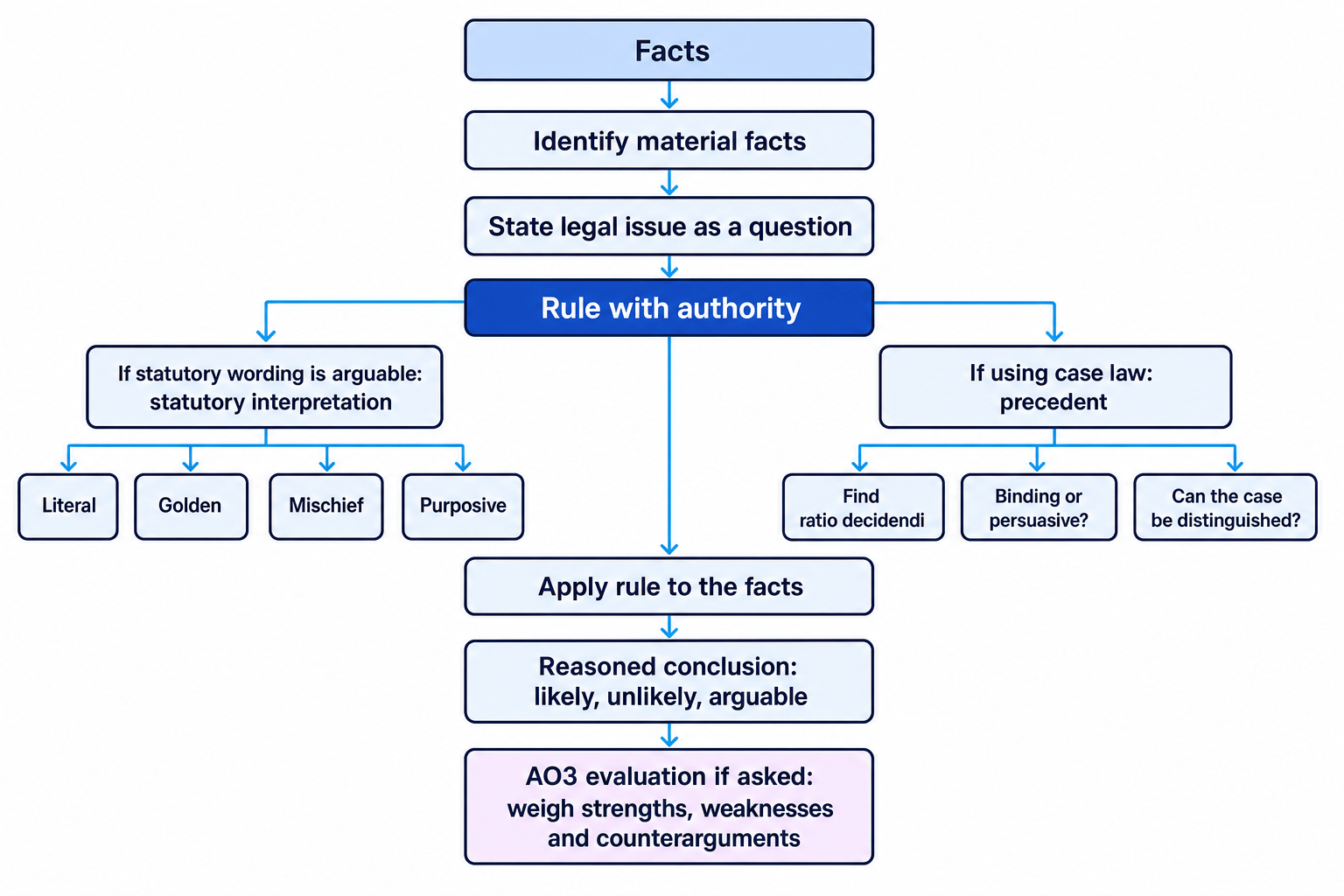
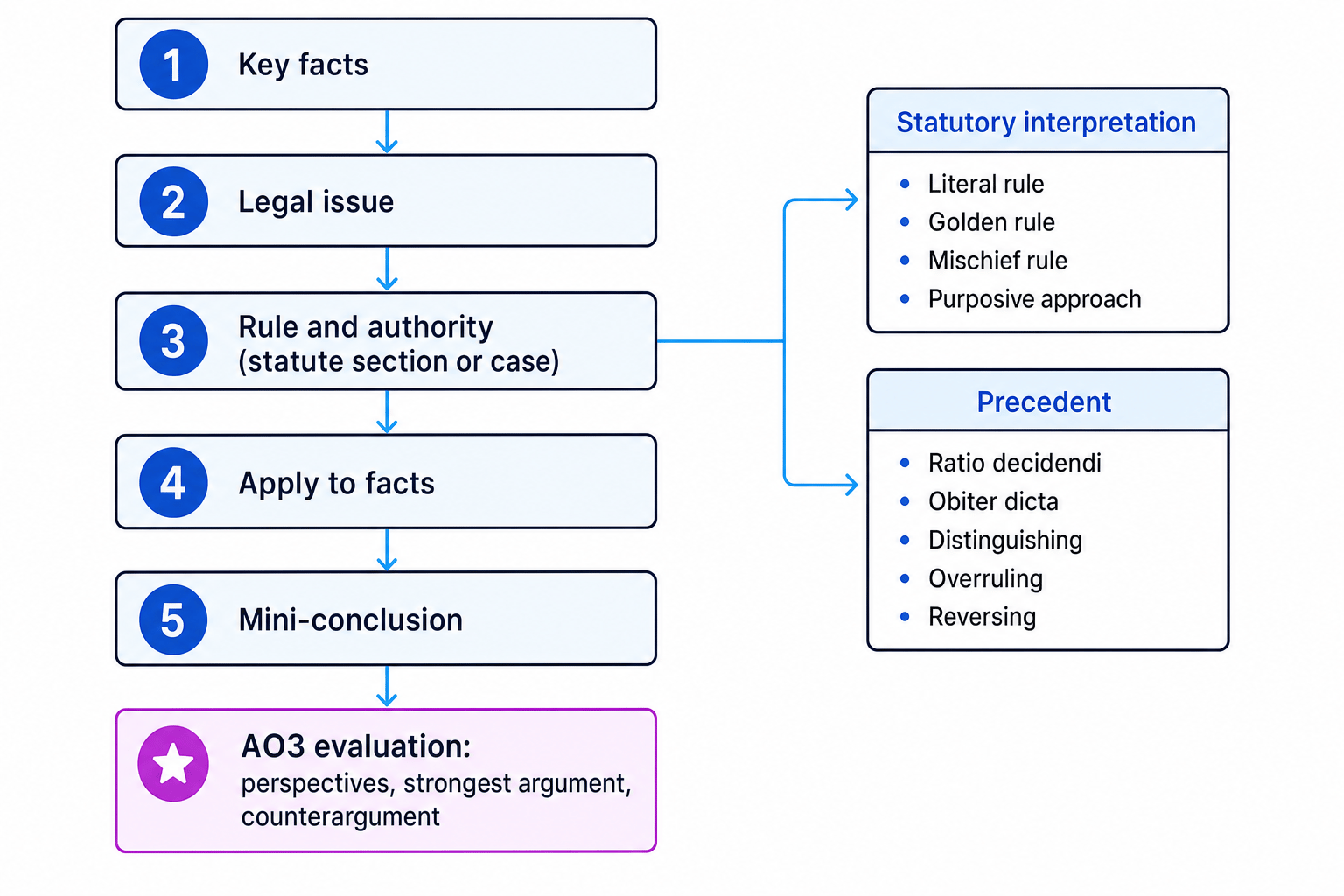
The basic movement is always: facts → issue → rule and authority → application → conclusion, with evaluation where the question asks for AO3.
The three exam jobs: AO1, AO2 and AO3
Core exam objectives
AO1 is accurate knowledge and understanding of legal rules, principles and authority. AO2 is applying those rules to a factual scenario. AO3 is analysis and evaluation: weighing arguments, judging strengths and weaknesses, and supporting a viewpoint with legal reasoning.
Legal authority
Legal authority means the source that proves your legal point, such as a statute section, a case decision, or a Convention right. For example, s1 Theft Act 1968 is authority for the offence of theft.
The golden pattern
A strong legal answer does not just state the law. It states the law accurately, applies it to the facts, and reaches a reasoned conclusion.
Skill 1: Spotting issues from facts
A factual scenario is the story you are given in a problem question. A material fact is a fact that matters legally because it connects to a rule. A legal issue is the legal question raised by those facts.
In criminal law, you often look for the actus reus — the external element of the offence, such as conduct or consequence — and the mens rea — the mental element, such as intention or recklessness.
Spotting issues in a short scenario
Maya angrily shoves Noor outside a club. Noor falls and breaks her wrist. Maya says, “I only meant to push her away, not injure her.”
- Treat the shove as possible actus reus because it is a direct application of force to Noor.
- Treat the broken wrist as legally significant harm, raising possible liability under s47 Offences Against the Person Act 1861, assault occasioning actual bodily harm.
- Use R v Savage; Parmenter (1991): Savage threw beer and the glass injured the victim; Parmenter injured his baby by rough handling. The principle is that s47 requires intention or recklessness as to assault or battery, not intention or recklessness as to the actual bodily harm.
- Frame the issues as questions: did Maya commit a battery, did that battery cause actual bodily harm, and did she at least intend or foresee the unlawful force?
Starting with the conclusion
Do not begin with “Maya is guilty of s47.” First separate the legal issues, then test each element, then conclude.
Skill 2: Breaking legal rules into elements
Many legal rules are made of constituent parts, meaning separate elements that must each be proved. This is especially important in problem questions.
For theft, s1 Theft Act 1968 states that a person is guilty if they “dishonestly appropriate property belonging to another with the intention of permanently depriving the other of it.” That gives you five elements: dishonesty, appropriation, property, belonging to another, and intention permanently to deprive.
Breaking theft into elements
Sam takes Priya’s laptop from her bag, puts it in his own bag, and plans to sell it online.
- Choose the relevant rule: s1 Theft Act 1968 because the facts involve taking another person’s property.
- Test the external elements: Sam assumes the rights of an owner, so there is appropriation under s3 Theft Act 1968; a laptop is property under s4 Theft Act 1968; it belongs to Priya under s5 Theft Act 1968.
- Test dishonesty: Ivey v Genting Casinos (2017), involving a gambler using edge-sorting in a casino, gives the modern approach to dishonesty by considering the defendant’s belief about the facts and then whether ordinary decent people would see the conduct as dishonest.
- Test intention permanently to deprive: Sam plans to sell the laptop, so he is treating it as his own to dispose of permanently.
- Conclude that theft is likely if the prosecution can prove those elements beyond reasonable doubt.
Skill 3: Analysing legislation through statutory interpretation
Legislation is written law made by Parliament, usually in an Act. Statutory interpretation means the process by which courts decide what statutory words mean.
The main approaches are:
- Literal rule: give words their ordinary meaning. In Fisher v Bell (1961), a flick knife in a shop window was not an “offer for sale” under s1 Restriction of Offensive Weapons Act 1959 because a display was only an invitation to treat.
- Golden rule: modify the ordinary meaning to avoid absurdity. In Adler v George (1964), being inside a prohibited place counted as being “in the vicinity of” it.
- Mischief rule: interpret the Act to fix the problem Parliament aimed to remedy. In Smith v Hughes (1960), prostitutes calling from balconies were treated as soliciting “in a street.”
- Purposive approach: interpret words in light of the wider purpose of the Act. In R (Quintavalle) v Secretary of State for Health (2003), a new embryo-creation technique was included within the Act’s purpose.
Interpreting “offer for sale”
A shopkeeper displays a prohibited knife in the window with a price label. The statute makes it an offence to “offer for sale” that type of knife.
- Start with the statutory phrase “offer for sale” because liability depends on that wording.
- Apply the literal rule using contract law meaning: a shop display is an invitation to treat, meaning an invitation for customers to make an offer, not an offer itself.
- Compare the facts with Fisher v Bell (1961), where the same kind of display did not amount to an offer for sale.
- Conclude that, on a literal interpretation, the shopkeeper is unlikely to be liable, even if that outcome seems to weaken public protection.
Use interpretation only when meaning matters
If the statutory wording is clear and directly fits the facts, apply it. If a word or phrase is arguable, explain which interpretation supports each side.
Skill 4: Analysing case law through precedent
Case law is law developed through judicial decisions. The doctrine of precedent means courts follow earlier decisions where appropriate.
Precedent vocabulary
Stare decisis means “stand by decided matters.” The ratio decidendi is the binding legal reason for the decision. Obiter dicta are other comments made by a judge, which may be persuasive but are not binding.
A binding precedent must be followed by a lower court. A persuasive precedent may influence the court but does not have to be followed. Distinguishing means avoiding a precedent because the facts are materially different. Overruling means a higher court declares an earlier legal rule wrong. Reversing means an appeal court changes the decision in the same case.
Donoghue v Stevenson (1932) involved a snail in an opaque ginger beer bottle; the principle was that manufacturers owe a duty of care to ultimate consumers where harm is reasonably foreseeable. Young v Bristol Aeroplane (1944) established that the Court of Appeal is generally bound by its own previous decisions, subject to limited exceptions.
Using the ratio of Donoghue
A sealed bottle of juice contains glass. The consumer drinks it and cuts her mouth.
- Extract the ratio decidendi from Donoghue v Stevenson (1932): a manufacturer can owe a duty of care to a consumer where the product reaches them without reasonable opportunity for inspection.
- Compare the material facts: both cases involve a sealed drink, a hidden defect, and physical injury to the consumer.
- Apply the principle: the manufacturer should reasonably foresee that contaminated bottled juice could injure the ultimate consumer.
- Conclude that a duty of care is likely, unless later facts show the defect was introduced after manufacture.
Quoting the result instead of the ratio
“Mrs Donoghue won” is not the precedent. The useful authority is the legal reason why a duty of care could arise.
Skill 5: Constructing clear legal arguments
A strong problem answer often follows IRAC: Issue, Rule, Application, Conclusion. This keeps your answer logical and concise.
Your rule should be supported by authority. Your application should use the exact facts. Your conclusion should be realistic: “likely,” “unlikely,” or “arguable” is often better than pretending certainty.
Writing an IRAC paragraph
Police officers arrest a suspect in a busy street. During the arrest, they knock into Ollie, who falls and is injured.
- Issue: decide whether the police may owe Ollie a duty of care in negligence for a positive act causing physical injury.
- Rule: use Robinson v Chief Constable of West Yorkshire (2018), where police officers knocked over an elderly passer-by during an arrest; the Supreme Court held that ordinary negligence principles could apply to police positive acts.
- Application: Ollie, like the claimant in Robinson, is a passer-by injured during a physical arrest, so the harm is foreseeable and closely connected to the officers’ conduct.
- Conclusion: a duty of care is likely, though breach and causation would still need separate analysis.
Skill 6: Arguing where authority is unclear or conflicting
Sometimes there is no exact precedent, or cases appear to point in different directions. That is not a problem — it is an opportunity to show legal skill.
Use analogical reasoning, meaning you argue that the new facts are similar to, or different from, decided cases. If cases conflict, consider court hierarchy, dates, whether one case explains another, and whether the facts can be distinguished.
Arguing from uncertain authorities
A police-operated drone malfunctions during an arrest and injures a passer-by. There is no exact drone case.
- Acknowledge the gap: there is no clear precedent specifically on police drones, so the argument must use the nearest principles.
- Compare with Robinson v Chief Constable of West Yorkshire (2018): the injury results from a positive police act during an arrest, so ordinary negligence principles may apply.
- Address Caparo v Dickman (1990), where investors relied on audited accounts and the court used foreseeability, proximity, and whether it was fair, just and reasonable for a novel duty. After Robinson, Caparo is not a universal checklist for every duty question.
- Build the strongest view: because the facts involve direct physical injury from police activity, Robinson is the closer authority and a duty is arguable.
- Counter the alternative: if the claim were about police failing to prevent a third party’s crime, the duty argument would be weaker and distinguishable.
Use uncertainty honestly
If the law is unclear, say so, then explain which argument is stronger and why. That is more persuasive than forcing a definite answer.
Skill 7: Evaluating legal issues
To evaluate is to make a reasoned judgement. AO3 is not just a list of advantages and disadvantages. You need perspectives, support, a strongest viewpoint, and a counterargument.
Different topics have different evaluation focuses, so use the wording of the question and the relevant specification area. For example, criminal law evaluation may focus on fairness or effectiveness, while tort evaluation may focus on balancing competing interests or achieving the aims of tort law.
Evaluating precedent
Proposition: the doctrine of precedent makes the law too rigid.
- Support the proposition: binding precedent promotes consistency, but Young v Bristol Aeroplane (1944) shows that the Court of Appeal is usually bound by its own decisions, which can make correction slow.
- Develop the counterargument: precedent also supports the rule of law, the idea that law should be clear, predictable and applied consistently.
- Add flexibility: courts can distinguish cases, and higher courts can overrule. In R v R (1991), involving a husband charged with raping his wife, the House of Lords recognised that the old marital rape exemption no longer applied, showing common law development.
- Reach a judgement: precedent is not simply too rigid; its strength is stability, but it depends on appeal courts using their powers carefully to keep law fair and modern.
Evaluation without authority
An AO3 point such as “this is unfair” is weak on its own. Link the judgement to a rule, case, statute, or legal principle.
In the exam
- Read the scenario once for the story, then again for material facts: actions, harm, mental state, timing and relationships.
- Turn each issue into IRAC: issue, rule with authority, application to facts, conclusion.
- Break rules into elements and apply every element separately.
- If interpretation or precedent is arguable, explain both sides before choosing the stronger argument.
- For AO3, give a judgement supported by legal authority, then answer the best counterargument.
Check yourself
- Can you explain the difference between ratio decidendi and obiter dicta?
- Can you take one offence or tort and break it into its separate legal elements?
- Can you make an AO3 point that includes a viewpoint, authority and counterargument?