Evaluation of the law of contract
What you'll learn
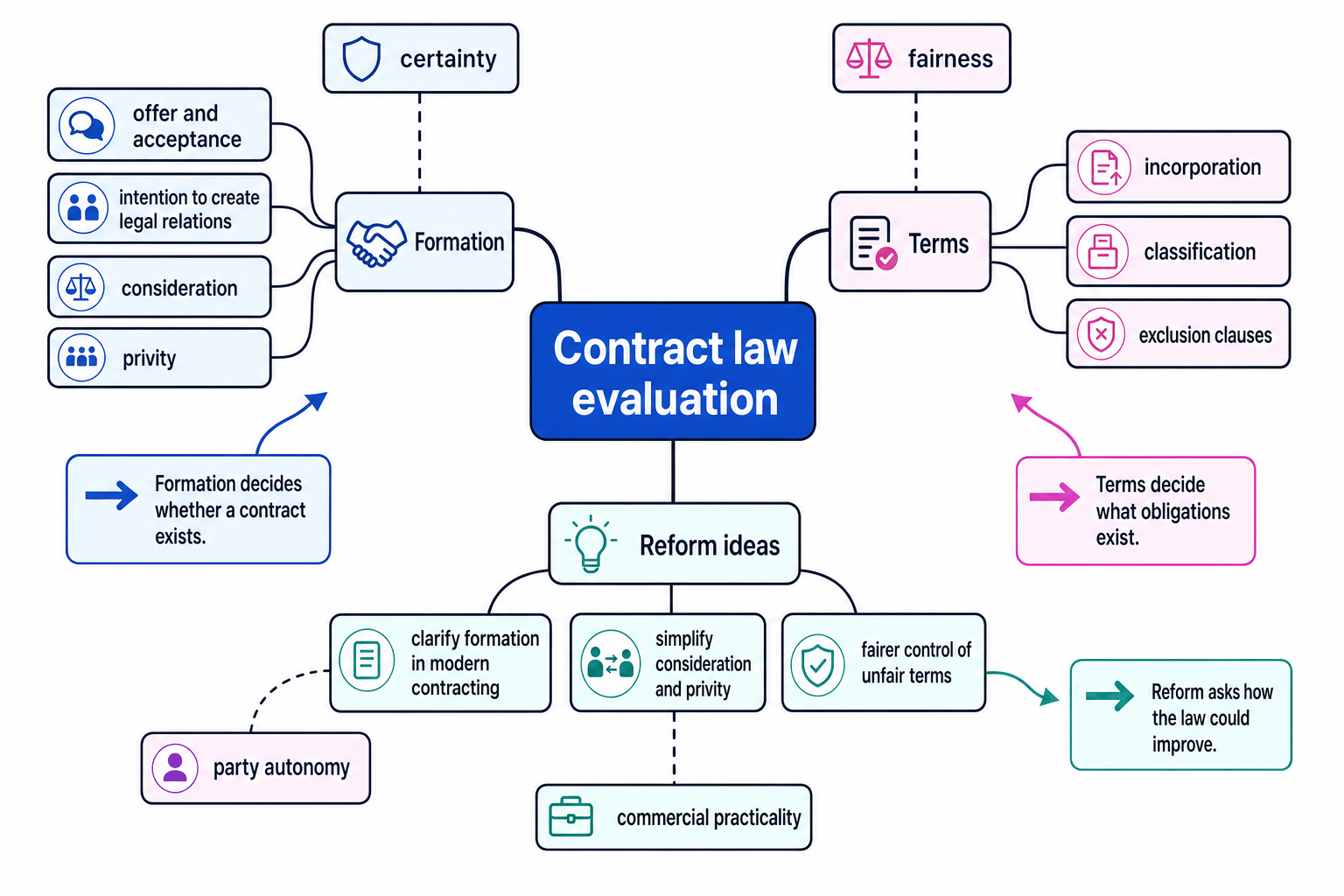
- How to evaluate formation: offer and acceptance, intention, consideration and privity.
- How to evaluate contract terms: incorporation, classification and exclusion clauses.
- How to build AO3 arguments about certainty, fairness, commercial practicality and reform.
- How to use legal authority in concise, persuasive evaluation paragraphs.
The aim of evaluation in contract law
In contract law, evaluation means judging whether the rules work well. You are not just describing the law; you are asking whether it is clear, fair, practical and in need of reform.
Critical evaluation
Critical evaluation is AO3: explaining strengths, weaknesses and possible reforms of the law, supported by cases, statutes and reasoned argument.
A strong evaluation paragraph usually follows this pattern:
- State the area of law you are evaluating.
- Give a short rule and authority.
- Explain why the rule is useful.
- Explain the criticism or limitation.
- Reach a balanced judgement.
The big contract tension
Contract law constantly balances certainty and fairness. Businesses need predictable rules, but individuals may need protection from harsh or technical outcomes.
Formation of contract
Formation
Formation means the legal requirements for creating a binding contract: offer, acceptance, intention to create legal relations and consideration.
Offer and acceptance
An offer is a clear promise to be bound on specific terms. Acceptance is final and unqualified agreement to those terms.
The law uses an objective approach: it asks what a reasonable person would think the parties said or did, not what they secretly intended. In Carlill v Carbolic Smoke Ball Co (1893), an advert promising £100 to users who still caught flu was held to be a unilateral offer accepted by performing the required act. This shows flexibility.
Other rules create certainty. In Hyde v Wrench (1840), a counter-offer destroyed the original offer. In Pharmaceutical Society of Great Britain v Boots (1953), goods on a shop shelf were an invitation to treat, not an offer, so the customer made the offer at the till.
The strength is predictability: parties can know when obligations arise. The weakness is artificiality, especially with modern contracting online, where automated systems, “click acceptance” and instant messages can make old rules feel strained. The postal rule from Adams v Lindsell (1818), where acceptance is effective when posted, is often criticised as outdated.
Evaluating offer and acceptance
A company emails Mia offering to sell laptops for £400 each. Mia replies, “I’ll pay £350.” Later she tries to accept the £400 offer.
- The issue is whether Mia’s later acceptance is valid or whether her first reply ended the offer.
- Under Hyde v Wrench (1840), a counter-offer rejects and destroys the original offer.
- Mia’s £350 reply changes the price, so it is a counter-offer rather than a request for information.
- The rule gives certainty because the seller knows the original £400 offer is no longer open, but it may be harsh if Mia did not understand the legal effect.
- A balanced evaluation is that the rule is commercially useful, but sometimes technical for ordinary consumers.
Intention to create legal relations
Intention to create legal relations
Intention to create legal relations means the parties must intend their agreement to be legally enforceable.
The law uses presumptions. Domestic or social agreements are presumed not to be legally binding, as in Balfour v Balfour (1919), where a husband’s promise to pay his wife money while abroad was not enforceable. But the presumption can be rebutted: in Merritt v Merritt (1970), separated spouses who made a written agreement did intend legal consequences.
Commercial agreements are presumed to be legally binding. In Rose & Frank v Crompton (1925), however, an “honour clause” showed the parties did not intend legal enforceability.
This area is practical because it prevents courts being flooded with family disputes. However, it can be criticised for relying on assumptions about relationships that may feel outdated or unfair.
Do not treat presumptions as automatic
The presumptions for intention are starting points, not fixed rules. Always check the facts: written terms, separation, business context and clear wording can change the result.
Consideration
Consideration
Consideration is the price for a promise: each party must give or promise something of value in exchange.
In Currie v Misa (1875), consideration was described as a benefit to one party or detriment to the other. The law does not require equal value: in Thomas v Thomas (1842), £1 rent was sufficient consideration even though not adequate.
The doctrine is criticised as technical. In Foakes v Beer (1884), part payment of a debt was not good consideration for a promise to give up the rest. This may be commercially harsh. Yet Williams v Roffey Bros (1990) softened the doctrine by recognising “practical benefit” as good consideration where a contractor promised extra payment to ensure work was completed on time.
Promissory estoppel also reduces unfairness. In Central London Property Trust v High Trees House (1947), a landlord could not go back on a promise to accept reduced rent during wartime for that period. However, estoppel is generally a shield, not a sword: it usually defends against a claim rather than creating a new cause of action.
Evaluating consideration
A builder agrees to complete flats for £80,000. The owner later promises an extra £10,000 because delay would trigger penalties under another contract.
- The issue is whether the builder gives fresh consideration for the extra £10,000.
- Under Williams v Roffey Bros (1990), a practical benefit can be good consideration if there is no fraud or duress.
- The owner gains the practical benefit of avoiding delay penalties, so the promise may be enforceable.
- This makes the law more commercially realistic because it recognises real-world benefits beyond money or goods.
- The criticism is uncertainty: it sits awkwardly with Foakes v Beer (1884), which remains strict for part-payment of debts.
Privity of contract
Privity of contract
Privity of contract means only the parties to a contract can sue or be sued on it.
The traditional rule was strict. In Tweddle v Atkinson (1861), a groom could not enforce promises made between the fathers to pay money to the couple because he was not a party. In Dunlop v Selfridge (1915), Dunlop could not sue a retailer because there was no contract between them.
The Contracts (Rights of Third Parties) Act 1999 reformed this. Under s1, a third party may enforce a term if the contract expressly says so or the term purports to confer a benefit on them, unless the contract shows otherwise.
This reform is a major strength because it reduces injustice. But privity still matters: contracting parties can exclude the 1999 Act, and third parties must still fit the statutory requirements.
Privity evaluation
Privity used to prioritise contractual certainty over fairness to intended beneficiaries. The 1999 Act improves fairness while still preserving party autonomy.
Contract terms
Contract term
A contract term is a statement that becomes part of the contract and creates legal obligations.
Evaluation of terms asks whether the law fairly decides what promises are included, how important they are and whether parties can exclude liability.
Incorporation of terms
Incorporation
Incorporation means the process by which a term becomes part of the contract.
Terms may be incorporated by signature, notice or previous dealings. In L’Estrange v Graucob (1934), a person who signed a document was bound by its terms even though she had not read them. This supports certainty but can be harsh.
For notice, the term must be brought to the party’s attention before or at contracting. In Parker v South Eastern Railway (1877), reasonable notice could incorporate ticket terms. In Thornton v Shoe Lane Parking (1971), a car park exclusion clause given after the machine accepted money was too late. In Interfoto v Stiletto (1989), an especially onerous term required particularly clear notice.
The law is strong because it protects reasonable expectations. But it can still be difficult for consumers faced with long standard-form contracts they realistically never read.
Evaluation phrase
For incorporation, a strong phrase is: “The law promotes certainty through signature and notice, but struggles with the reality of unread standard terms.”
Classification of terms
Classification of terms
Classification means deciding the legal importance of a term and what remedy follows if it is breached.
A condition is a major term; breach allows termination and damages. In Poussard v Spiers (1876), missing opening performances was breach of condition.
A warranty is a minor term; breach gives damages only. In Bettini v Gye (1876), missing rehearsals was breach of warranty.
An innominate term is classified by the seriousness of the breach. In Hong Kong Fir Shipping v Kawasaki (1962), the court asked whether the breach deprived the innocent party of substantially the whole benefit of the contract.
The three-way classification is flexible. The criticism is uncertainty: parties may not know in advance whether breach of an innominate term allows termination.
Evaluating classification of terms
A singer misses two rehearsals but is available for all concerts. The organiser wants to terminate the contract.
- The issue is whether the rehearsal obligation is a condition or a warranty.
- Bettini v Gye (1876) suggests missing rehearsals may be a warranty where the main performances can still happen.
- Since the singer can perform all concerts, the organiser has not lost the main benefit of the contract.
- The likely remedy is damages only, not termination.
- This seems fair because it prevents an excessive response to a minor breach, though it may reduce certainty for the organiser.
Exclusion clauses
Exclusion clause
An exclusion clause is a term that tries to limit or remove liability for breach of contract or negligence.
Exclusion clauses must be incorporated and interpreted properly. The courts may use contra proferentem, meaning ambiguous wording is interpreted against the party relying on it. In Curtis v Chemical Cleaning (1951), a cleaner could not rely on a clause where its effect had been misrepresented.
Statutory control is crucial. The Unfair Contract Terms Act 1977 restricts exclusion clauses, especially in business liability. The Consumer Rights Act 2015 protects consumers: terms must be fair and transparent, and unfair terms are not binding.
In Photo Production v Securicor (1980), the House of Lords accepted that clear exclusion clauses can be effective even for serious breach, subject to statutory controls. In George Mitchell v Finney Lock Seeds (1983), a limitation clause failed the reasonableness test under UCTA 1977.
The evaluation is balanced. Exclusion clauses support freedom of contract and allow businesses to price risk. But without controls, they can be oppressive, especially where bargaining power is unequal.
Do not evaluate exclusion clauses using common law only
Modern evaluation must include statute. UCTA 1977 and the Consumer Rights Act 2015 are central to explaining how the law controls unfair exclusion clauses.
Ideas for reform
Reform means changing the law to make it clearer, fairer or more suitable for modern contracting.
Reforming formation
One reform idea is to update communication rules. The postal rule from Adams v Lindsell (1818) could be replaced by a general receipt rule, especially because modern communication is usually instant or trackable. This would improve certainty.
Another idea is clearer statutory guidance for online contracts: when automated acceptance occurs, when terms are incorporated and how notice should work for digital terms.
Reforming consideration and privity
Consideration could be simplified. One option is to enforce serious promises where there is clear intention to create legal relations, rather than requiring technical consideration. This would reduce problems from Foakes v Beer (1884), but it might also make casual promises too easily enforceable.
Privity has already been reformed by the Contracts (Rights of Third Parties) Act 1999. A further reform could make third-party rights easier to identify, but too much expansion may undermine party autonomy.
Reforming terms and exclusion clauses
For terms, reform could involve clearer rules for standard-form contracts. Consumers and small businesses often click or sign without reading. The law could require clearer summaries of unusual or onerous terms, building on Interfoto v Stiletto (1989).
For exclusion clauses, one reform idea is stronger protection for small businesses, which may face standard terms similar to consumers but without the same level of protection under the Consumer Rights Act 2015.
In the exam
- Use AO1 briefly: state the rule and authority accurately before evaluating it.
- Build AO3 balance: give one strength, one criticism and a judgement for each area.
- Link reform to the problem: do not suggest reform vaguely; explain which rule it improves and what risk it creates.
Check yourself
- Why might the postal rule be criticised in modern contract law?
- How does the Contracts (Rights of Third Parties) Act 1999 soften the privity rule?
- Are exclusion clauses more about freedom of contract or protection from unfairness?