Criminal courts and lay people
What you'll learn
- How criminal offences are classified and routed through the Magistrates’ Court and Crown Court.
- The main criminal appeal routes and the reasons someone may appeal.
- The adult sentencing aims in s142 Criminal Justice Act 2003 and the main sentence types.
- How lay magistrates and juries are selected, what they do, and the strengths and weaknesses of jury trial.
The starting point: jurisdiction
Criminal courts deal with offences against the state, such as assault, theft, robbery and murder. The two main criminal trial courts are the Magistrates’ Court and the Crown Court.
Jurisdiction
Jurisdiction means the legal power of a court to hear a case and make decisions about it. In criminal law, jurisdiction depends mainly on the seriousness and classification of the offence.
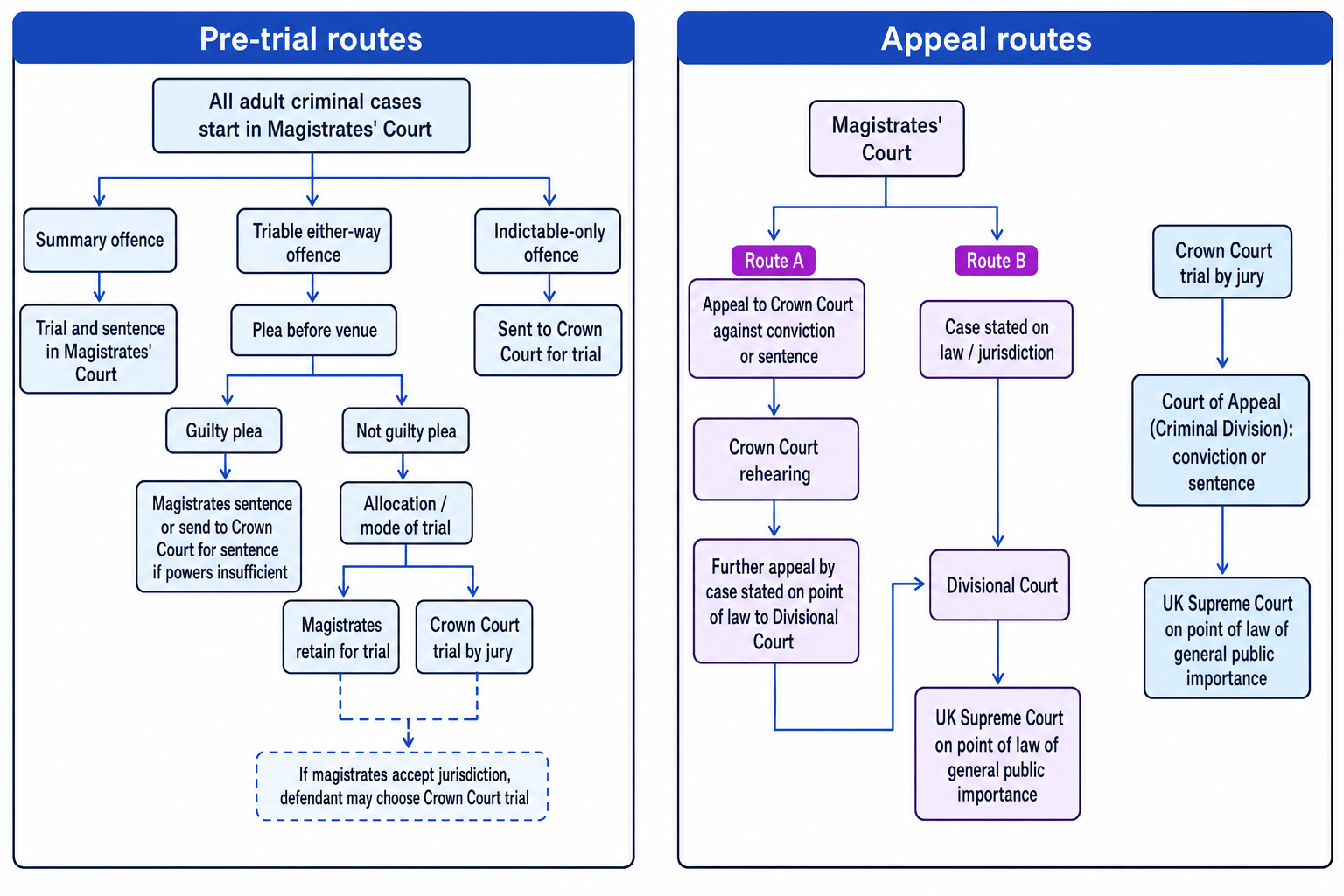
All adult criminal cases begin in the Magistrates’ Court, even the most serious ones. The key question is what happens after that first appearance.
Classification of offences
Criminal offences are grouped into three main categories.
Three offence categories
- Summary offences are the least serious offences and are tried only in the Magistrates’ Court, such as minor motoring offences.
- Triable either-way offences can be tried either in the Magistrates’ Court or the Crown Court, depending on seriousness and procedure. Theft under s1 Theft Act 1968 is a common example.
- Indictable-only offences are the most serious offences and must be tried in the Crown Court, such as murder, rape and robbery.
Pre-trial procedures
A plea is the defendant’s formal answer to the charge: guilty or not guilty. At the first hearing, the Magistrates’ Court may also consider bail, meaning release until the next hearing, or remand, meaning the defendant is kept in custody.
For summary offences, the Magistrates’ Court deals with the trial and sentence.
For triable either-way offences, the court uses plea before venue. If the defendant pleads guilty, magistrates may sentence them or send them to the Crown Court for sentence if their powers are insufficient. If the defendant pleads not guilty, there is allocation or mode of trial, where magistrates decide whether the case is suitable for them. If they accept jurisdiction, the defendant may still choose Crown Court trial.
For indictable-only offences, the Magistrates’ Court sends the case to the Crown Court for trial, commonly under s51 Crime and Disorder Act 1998.
Thinking serious cases start in the Crown Court
Even murder starts with a first appearance in the Magistrates’ Court. The key point is that indictable-only cases are then sent to the Crown Court very quickly.
Routing an either-way case
Maya is charged with theft under s1 Theft Act 1968 after allegedly stealing a laptop. She pleads not guilty.
- Theft is identified as a triable either-way offence, so the case does not automatically stay in the Magistrates’ Court or automatically go to the Crown Court.
- Because Maya pleads not guilty, the court moves to allocation / mode of trial, where magistrates assess seriousness, complexity and their sentencing powers.
- If magistrates decide the case is too serious, they send it to the Crown Court. If they accept jurisdiction, Maya can still elect Crown Court trial by jury.
- The likely route therefore depends on seriousness: a simple low-value theft may stay in the Magistrates’ Court, while a more serious or complex theft may go to the Crown Court.
Appeals and appellate courts
An appeal is a challenge to a court’s decision. An appellate court is a court that hears appeals.
Reasons to appeal
A defendant may appeal because they argue that:
- the conviction is unsafe;
- the court made an error of law;
- the judge misdirected the jury;
- evidence was wrongly admitted or excluded;
- there was a serious procedural irregularity;
- the sentence was wrong in principle or manifestly excessive.
The prosecution has more limited appeal rights, but can sometimes challenge an error of law or ask for review of an unduly lenient sentence in certain serious cases.
Appeals from the Magistrates’ Court
A defendant convicted in the Magistrates’ Court may appeal to the Crown Court against conviction or sentence. This is usually a rehearing by a Crown Court judge and magistrates.
A case stated appeal goes to the King’s Bench Divisional Court — older OCR materials may call this the Queen’s Bench Divisional Court — where the issue is a point of law or whether the magistrates acted outside their jurisdiction.
Case stated
A case stated appeal asks the lower court to state the legal question for a higher court. It is not a full retrial of the facts.
Appeals from the Crown Court
A defendant appealing from a Crown Court trial goes to the Court of Appeal (Criminal Division). The main test for conviction appeals is whether the conviction is unsafe, under the Criminal Appeal Act 1968.
A further appeal to the UK Supreme Court is only possible where there is a point of law of general public importance and permission is granted.
Choosing the correct appeal route
Sam is convicted after a summary trial in the Magistrates’ Court. He says the magistrates misunderstood the meaning of the offence in the statute.
- The original trial court is the Magistrates’ Court, so the first possible routes are Crown Court appeal or case stated.
- Sam is not mainly asking for the evidence to be reheard; he says there was an error of law.
- The correct route is therefore case stated to the Divisional Court, rather than an ordinary rehearing in the Crown Court.
- If the case later raises a point of law of general public importance, a further appeal to the UK Supreme Court may be possible with permission.
Sentencing and court powers
A sentence is the punishment or order imposed after conviction. For adult offenders, the court must consider the purposes of sentencing in s142 Criminal Justice Act 2003.
The five adult sentencing aims
Under s142 Criminal Justice Act 2003, the aims are punishment, reduction of crime including deterrence, reform and rehabilitation, protection of the public, and reparation to victims or the community.
Factors affecting sentence
Courts follow Sentencing Council guidelines. The central idea is seriousness, based on harm and culpability.
Aggravating factors make the offence more serious, such as previous convictions, use of a weapon, targeting a vulnerable victim, offending on bail, or hostility based on race or religion.
Mitigating factors reduce seriousness or blame, such as genuine remorse, cooperation, no previous convictions, mental health difficulties, or an early guilty plea. An early guilty plea can reduce the sentence because it saves court time and spares witnesses from trial.
Types of adult sentences
Custodial sentences involve prison. They include immediate imprisonment and suspended sentences. A suspended sentence is a prison sentence that is not served immediately unless the offender commits another offence or breaches conditions.
Non-custodial sentences include:
- community orders, such as unpaid work, curfew, rehabilitation activity or treatment requirements;
- fines, often linked to seriousness and the offender’s means;
- discharges, where the court either imposes no further penalty or gives a conditional discharge;
- compensation orders, requiring payment to the victim.
The Magistrates’ Court has limited sentencing powers and can send an either-way offender to the Crown Court for sentence if necessary. The Crown Court has wider powers and can sentence up to the statutory maximum for the offence.
Selecting a sentence type
Noah pleads guilty to an either-way assault. He has no previous convictions, but the victim suffered significant injury.
- The court identifies the relevant aims in s142 Criminal Justice Act 2003: punishment and public protection matter because harm was caused, while rehabilitation may matter because Noah has no previous convictions.
- The court assesses seriousness by balancing harm and culpability. Significant injury increases seriousness, but a guilty plea and clean record mitigate it.
- If the custody threshold is crossed, the court may consider imprisonment or a suspended sentence. If it is not crossed, a community order with unpaid work or rehabilitation requirements may better meet the sentencing aims.
- The final sentence should match both the offence seriousness and the statutory powers of the court hearing the case.
Lay people in criminal cases
Lay people
Lay people are ordinary members of the public who participate in the justice system without being professional judges. In criminal cases, the main examples are lay magistrates and jurors.
Lay magistrates
Lay magistrates, also called justices of the peace, are unpaid volunteers. They usually sit in benches of two or three in the Magistrates’ Court. They are advised on law and procedure by a legally qualified legal adviser, but they decide the facts, verdict and sentence.
Qualifications, selection and appointment
Lay magistrates do not need legal qualifications. They are selected for qualities such as good character, understanding and communication, social awareness, maturity, sound judgement, and reliability.
They are appointed by the Lord Chancellor, following a selection process involving application, interviews and local advisory committees. They receive training before sitting and continuing training afterwards. They generally retire at 75.
Role in criminal cases
Magistrates:
- hear summary trials;
- deal with many either-way offences if allocated to them;
- conduct first appearances for all adult offences;
- decide bail and remand;
- issue warrants;
- sentence within their powers;
- send cases to the Crown Court for trial or sentence where needed.
Juries
A jury is a group of 12 ordinary people who decide whether the defendant is guilty or not guilty in Crown Court trials.
Qualifications and selection
Under the Juries Act 1974, jurors are randomly selected from the electoral register. They must usually be aged 18 to 75, registered to vote, and have lived in the UK, Channel Islands or Isle of Man for at least five years since age 13. People may be disqualified for reasons such as serious criminal convictions or being on bail.
Challenges to jurors are limited. A party may challenge for cause, meaning they must show a specific reason why a juror should not serve. Peremptory challenges, where no reason was needed, have been abolished.
Role in criminal cases
The judge directs the jury on the law. The jury decides the facts and returns the verdict. The prosecution must make the jury sure of guilt, often expressed as proof beyond reasonable doubt.
Juries should try to reach a unanimous verdict. If they cannot, the judge may accept a majority verdict, commonly 10–2, after sufficient deliberation time.
Advantages and disadvantages of juries
The jury debate
Juries bring democratic participation and independence into criminal justice, but their secrecy and lack of reasons make it difficult to know whether verdicts are rational and fair.
Advantages
Juries promote public confidence because ordinary citizens take part in serious criminal trials. This makes the system feel less dominated by lawyers and judges.
They provide independence from the state. Bushell’s Case (1670) established that jurors cannot be punished for their verdict, supporting jury independence.
They may also allow community conscience. In R v Ponting (1985), a civil servant was acquitted after leaking documents, despite strong evidence; the case is often used to show jury equity, sometimes called a “perverse” verdict.
Random selection can also make juries more representative than a single professional judge, especially when 12 people deliberate together.
Disadvantages
Juries give no reasons for their verdicts. Section 8 Contempt of Court Act 1981 protects jury deliberation secrecy, but this can make unfair reasoning hard to detect.
In R v Mirza (2004), allegations about racist comments in the jury room could not easily be investigated after verdict because of jury secrecy. This shows the tension between finality and fairness.
Jurors may be influenced by improper material. In R v Young (1995), jurors used a ouija board while deliberating; the conviction was quashed because the verdict was affected by outside material.
There is also a risk of intimidation or tampering. In R v Twomey (2009), trial without jury was ordered because of serious jury-tampering concerns.
Balanced AO3 judgement
A strong jury evaluation does not simply say “juries are good” or “juries are bad”. Weigh democratic legitimacy and independence against secrecy, possible bias and practical cost.
In the exam
- Start criminal process answers by classifying the offence: summary, either-way or indictable-only.
- For appeals, identify the original court first, then ask whether the issue is conviction, sentence, law, jurisdiction or general public importance.
- For sentencing, link the facts to s142 Criminal Justice Act 2003, then discuss aggravating and mitigating factors.
- For lay people essays, use precise AO1 first, then evaluate with examples such as R v Ponting (1985), R v Young (1995), R v Mirza (2004) and R v Twomey (2009).
Check yourself
- What happens to a triable either-way offence if the defendant pleads not guilty?
- When would a case stated appeal be more appropriate than an appeal to the Crown Court?
- What are two strong advantages and two strong disadvantages of using juries in criminal trials?