Enforcement of human rights law
What you'll learn
- How UK courts enforce human rights before and after the Human Rights Act 1998.
- How judicial review can be used to challenge public bodies for rights breaches.
- When a case can go to the European Court of Human Rights.
- How to apply enforcement routes in scenario questions and evaluate their effectiveness.
The starting point: what is being enforced?
Human rights in this topic mainly means the rights protected by the European Convention on Human Rights, usually shortened to the ECHR. Examples include Article 5 ECHR, the right to liberty, Article 6 ECHR, the right to a fair trial, Article 8 ECHR, the right to respect for private and family life, and Article 10 ECHR, freedom of expression.
The key UK statute is the Human Rights Act 1998, often called the HRA. It allows people to rely on most ECHR rights in UK courts, rather than having to go straight to the European Court of Human Rights in Strasbourg.
Enforcement of human rights
Enforcement means the legal methods used to make human rights effective in practice: bringing a claim, defending yourself using a right, asking a court to interpret legislation compatibly with rights, challenging a public authority, or ultimately applying to the European Court of Human Rights.
The diagram gives you the “route map” for this topic: domestic courts first, judicial review where appropriate, and Strasbourg only after domestic remedies have been used.
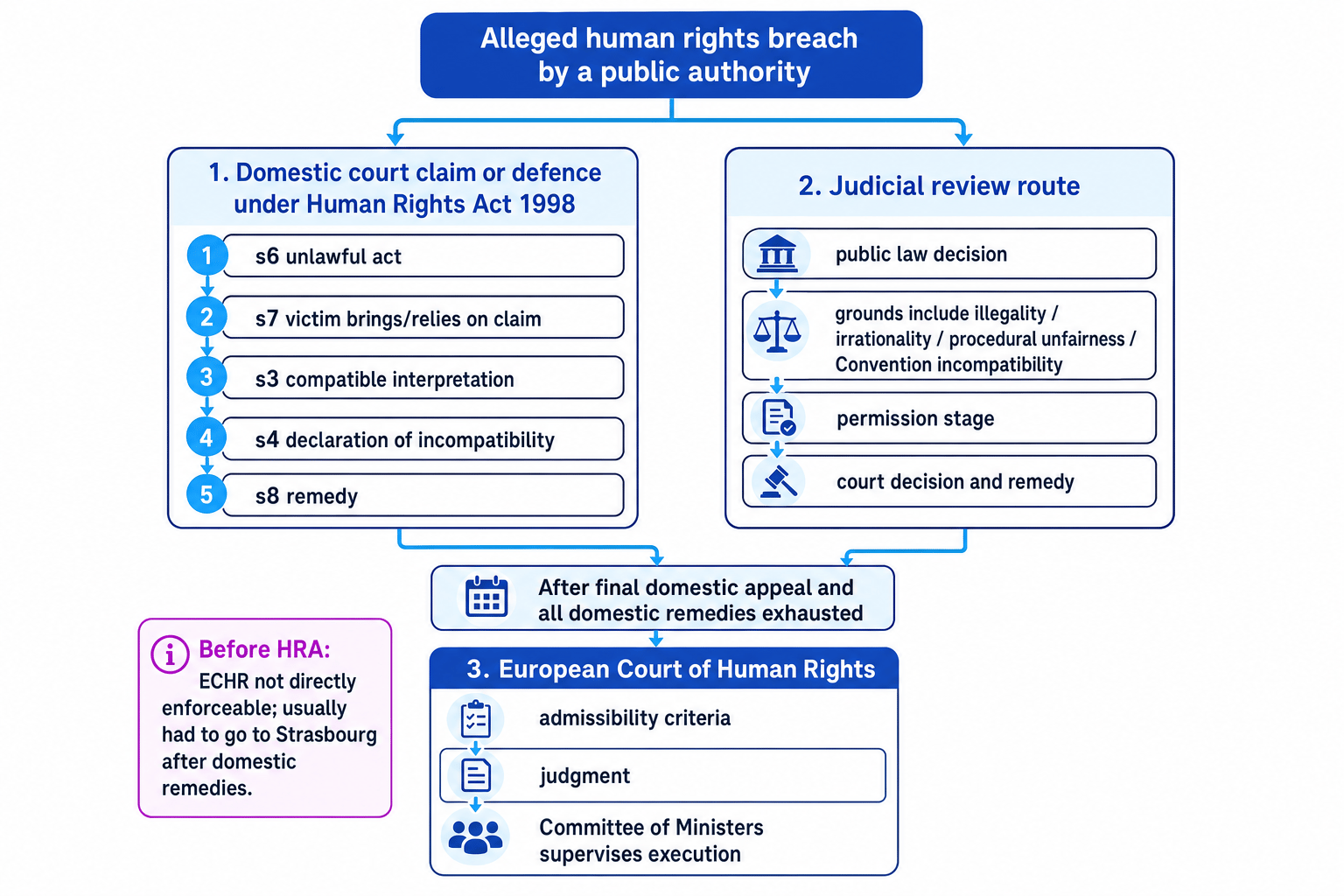
Domestic courts and human rights
Domestic courts means courts within the UK legal system, such as the High Court, Court of Appeal and UK Supreme Court. Since the HRA came into force in October 2000, UK courts have had a central role in interpreting and applying Convention rights.
Before 2000: limited domestic enforcement
Before the HRA came fully into force, the ECHR was not directly enforceable in UK courts. A claimant could argue using common law rights or ordinary statutory interpretation, but they could not simply say, “This breaches Article 8 ECHR, so the UK court must give me a remedy.”
Important pre-HRA authorities include:
- R v Secretary of State for the Home Department, ex parte Brind (1991) — broadcasters challenged restrictions on broadcasting the voices of Sinn Féin members; the House of Lords held that the unincorporated ECHR could not be directly enforced in UK courts.
- Malone v Metropolitan Police Commissioner (1979) — a claimant complained about telephone tapping, but there was no clear domestic remedy; this showed the weakness of relying only on common law protection.
- Malone v UK (1984) — the European Court of Human Rights later held that the UK had breached Article 8 ECHR because phone tapping lacked clear legal regulation.
- R v Secretary of State for the Home Department, ex parte Simms (2000) — prisoners challenged restrictions on oral interviews with journalists; the House of Lords confirmed the principle of legality: fundamental rights cannot be overridden by vague or general statutory words.
The pre-HRA position
Before 2000, UK courts could protect rights indirectly through common law and statutory interpretation, but individuals usually had to go to Strasbourg for a direct ECHR remedy.
After 2000: the Human Rights Act route
The HRA “brought rights home” by giving UK courts specific tools to enforce Convention rights.
| HRA provision | What it does | Key authority |
|---|---|---|
| s2 Human Rights Act 1998 | UK courts must “take into account” European Court of Human Rights case law, but are not strictly bound by it. | R v Horncastle (2009) — hearsay evidence was challenged under Article 6; the UK Supreme Court said it could decline to follow Strasbourg where there were strong reasons. |
| s3 Human Rights Act 1998 | Courts must interpret legislation compatibly with Convention rights “so far as it is possible to do so”. | Ghaidan v Godin-Mendoza (2004) — same-sex partner succession to a tenancy; the House of Lords read legislation compatibly with Article 14 and Article 8. |
| s4 Human Rights Act 1998 | Higher courts may make a declaration of incompatibility where primary legislation cannot be read compatibly. | Bellinger v Bellinger (2003) — a trans woman could not be legally recognised as female for marriage under the statute; the court made a declaration instead of rewriting the law. |
| s6 Human Rights Act 1998 | It is unlawful for a public authority to act incompatibly with Convention rights, unless primary legislation forces it to do so. | Aston Cantlow v Wallbank (2003) — a church council was not a core public authority; the case helps define “public authority”. |
| s7 Human Rights Act 1998 | A “victim” of an unlawful act may bring proceedings or rely on Convention rights in existing proceedings. | This mirrors the victim requirement in Article 34 ECHR. |
| s8 Human Rights Act 1998 | Courts may grant remedies they consider just and appropriate, including damages where necessary. | Greenfield v Secretary of State for the Home Department (2005) — prison disciplinary proceedings breached Article 6, but damages were not automatic. |
Declaration of incompatibility
A declaration of incompatibility is a formal statement by a higher court under s4 HRA that an Act of Parliament is incompatible with Convention rights. It does not invalidate the Act.
Thinking UK courts can strike down Acts of Parliament
Under the HRA, UK courts cannot strike down primary legislation. A s4 declaration leaves the law legally valid, although it puts strong political pressure on Parliament to change it.
Judicial review as a human rights enforcement tool
Judicial review is the process by which the High Court reviews the lawfulness of decisions or actions by public bodies. It is especially important for human rights because many rights breaches are committed by state bodies: police, prisons, schools, local authorities, immigration authorities and government ministers.
Judicial review
Judicial review is a public law claim asking a court to check whether a public authority has acted lawfully. It is not usually about whether the judge would have made a better decision.
The traditional judicial review grounds come from Council of Civil Service Unions v Minister for the Civil Service (GCHQ) (1985), where trade union rights were removed at GCHQ for national security reasons. The case identified key grounds of review:
- Illegality — the public body misunderstood or exceeded its legal powers.
- Irrationality — the decision was so unreasonable that no reasonable authority could have made it.
- Procedural impropriety — the authority used an unfair process.
- Proportionality — especially important in human rights cases, asking whether interference with a right goes further than necessary.
Ultra vires
Ultra vires means “beyond the powers”. A public authority acts ultra vires if it does something it has no legal power to do.
In a human rights judicial review, the claimant may argue that the public body has acted unlawfully under s6 HRA 1998 by breaching a Convention right. The court may then consider the right, any permitted restriction, and whether the restriction is proportionate.
R v Secretary of State for the Home Department, ex parte Daly (2001) is important. Prison policy allowed legally privileged correspondence to be examined when prisoners were absent. The House of Lords held that the policy interfered disproportionately with prisoners’ rights. The case shows proportionality can be a more intense review than ordinary irrationality.
Judicial review of a protest restriction
A local council bans all demonstrations outside the town hall for six months after one noisy protest. A local campaigner wants to challenge the ban using Article 10 ECHR, freedom of expression, and Article 11 ECHR, freedom of assembly.
-
Identify the issue: The council is a public authority, so s6 HRA 1998 applies. The campaigner is directly affected, so they can bring a claim under s7 HRA 1998.
-
State the rule: Article 10 and Article 11 are qualified rights, meaning they can be restricted for legitimate aims such as public safety or preventing disorder. However, the restriction must be proportionate. In Daly (2001), the court closely examined whether the rights interference went further than necessary.
-
Apply the rule: Preventing disorder is a legitimate aim, but a blanket six-month ban on all demonstrations is broad. The council could use less restrictive measures, such as limiting numbers, requiring notice, or imposing conditions on time and place.
-
Conclude: The campaigner has a strong argument that the ban is unlawful under s6 HRA 1998 and should be quashed or declared unlawful. Damages under s8 HRA 1998 are possible but not automatic.
Judicial review in problem questions
Ask: Who made the decision? Is it a public authority? Which Convention right is affected? Is the right absolute, limited or qualified? If qualified, focus on proportionality.
The European Court of Human Rights
The European Court of Human Rights, often called the ECtHR, is the international court in Strasbourg that hears complaints that a state has breached the ECHR. It is part of the Council of Europe system, not the European Union.
European Court of Human Rights
The ECtHR is the Strasbourg court that interprets and applies the ECHR. Individuals, groups and non-governmental organisations can apply against states, but only if the admissibility rules are met.
The ECtHR does not act like another ordinary appeal court. It does not simply re-try the facts or correct every domestic legal error. Its role is to decide whether the state has failed to secure Convention rights.
Admission criteria
The main admissibility rules are found in Article 34 ECHR and Article 35 ECHR.
A case generally must satisfy these requirements:
- The applicant must be a victim of a Convention breach.
- The complaint must be against a state that is party to the ECHR.
- The complaint must concern a Convention right.
- Domestic remedies must be exhausted first.
- The application must be lodged within four months of the final domestic decision.
- The application must not be anonymous, abusive, substantially the same as a matter already examined, or manifestly ill-founded.
- The applicant must usually have suffered a significant disadvantage.
After an application is lodged, it may be rejected as inadmissible, communicated to the government for response, settled, or decided by a committee, chamber, or in exceptional cases the Grand Chamber. Under Article 46 ECHR, final judgments are binding on the state. Under Article 41 ECHR, the Court may award “just satisfaction”, including compensation.
Guiding principles of the ECtHR
The ECtHR uses several important principles.
Subsidiarity means national authorities have the first responsibility for protecting rights. Strasbourg is a back-up, not the starting point.
Margin of appreciation means states have some discretion in how they protect rights, especially in sensitive areas involving morality, religion, social policy or national security. In Handyside v UK (1976), the Court allowed the UK a margin of appreciation over restricting an allegedly obscene schoolbook, while still stressing that freedom of expression is vital.
Living instrument means the Convention is interpreted in light of modern conditions. In Tyrer v UK (1978), judicial corporal punishment in the Isle of Man was held to breach Article 3 ECHR; the Court said the Convention must be interpreted as a living instrument.
Proportionality asks whether the state has struck a fair balance between individual rights and the public interest.
Checking admissibility in Strasbourg
Sam complains that a public hospital disclosed his medical information, breaching Article 8 ECHR. He immediately applies to the ECtHR without bringing any claim in the UK courts.
-
Identify the possible right and respondent: Article 8 is relevant because medical information falls within private life. The complaint is against the UK because the hospital is a public body.
-
Check victim status: Sam is personally affected by the disclosure, so he is likely to be a victim under Article 34 ECHR.
-
Apply the exhaustion rule: Sam has not used domestic remedies, such as an HRA claim in the UK courts. Article 35 ECHR normally requires domestic remedies to be exhausted first.
-
Conclude: Even if the Article 8 argument is strong, the ECtHR is likely to declare the application inadmissible because Strasbourg is not the first port of call.
Confusing the ECtHR with the EU
The ECtHR is not an EU court. Brexit did not remove the UK from the ECHR or the jurisdiction of the Strasbourg court.
AO3: how effective is human rights enforcement?
The post-2000 system has clear strengths. The HRA makes rights more accessible because claimants can rely on Convention rights in UK courts. Judicial review provides a practical route for challenging public authorities. Section 3 HRA can avoid conflict by allowing courts to interpret legislation compatibly where possible.
However, there are limits. A declaration of incompatibility under s4 HRA does not itself change the law or give the claimant a complete remedy. Judicial review can be expensive, technical and time-sensitive. Strasbourg is important as an external safeguard, but its admissibility rules are strict and the process can be slow.
The overall balance is deliberate: UK courts protect rights domestically, but Parliament remains sovereign, and the ECtHR supervises from an international level.
In the exam
- Start with the enforcement route: domestic HRA claim, judicial review, or ECtHR after domestic remedies.
- Anchor your answer in sections: s2, s3, s4, s6, s7 and s8 HRA 1998; Article 34, Article 35, Article 41 and Article 46 ECHR where relevant.
- In scenario questions, use IRAC: identify the public authority and right, state the legal test, apply proportionality or admissibility rules, then give a clear conclusion.
Check yourself
- Why could claimants not directly enforce ECHR rights in UK courts before the HRA came into force?
- What is the difference between a s3 interpretation and a s4 declaration of incompatibility?
- Why might the ECtHR reject an application even if the applicant seems to have a strong human rights argument?