The interaction of labour markets
What you'll learn
- How wages and employment are determined in a competitive labour market.
- Why wage differentials exist between occupations, regions and groups of workers.
- How monopsony power, trade unions and bilateral monopoly change labour-market outcomes.
- How to evaluate labour market flexibility, mobility and bargaining power in essays.
1. The big picture: labour markets interact
A labour market is where employers demand labour and workers supply labour. There is not just one labour market: there are many linked markets for nurses, software engineers, retail workers, teachers, delivery drivers, construction workers and so on.
Labour market
A labour market is the market in which labour services are bought by employers and sold by workers, with the wage rate acting as the price of labour.
Labour markets interact because workers can move between jobs, regions and sectors. If wages rise in engineering, some students may train as engineers rather than enter another occupation. If rents are too high in London, workers may be less able to move there even if wages are higher.
2. Prerequisites: labour demand and labour supply
Demand for labour
Firms demand labour because workers help produce goods and services. This means labour demand is a derived demand: it depends on demand for the final product.
A firm will usually employ more workers if the extra revenue generated by the next worker is high enough.
Marginal revenue product of labour
The marginal revenue product of labour, written as MRPLMRP_LMRPL, is the extra revenue a firm gains from employing one more worker. A common expression is MRPL=MPPL×MRMRP_L = MPP_L \times MRMRPL=MPPL×MR, where MPPLMPP_LMPPL is the extra output from one more worker and MRMRMR is extra revenue from selling that output.
Demand for labour shifts right when, for example:
- workers become more productive through training or technology;
- demand for the final product rises;
- the price of the final product rises;
- labour becomes more useful alongside capital, such as skilled technicians using new machinery.
Supply of labour
Labour supply means the quantity of workers willing and able to work at each wage rate.
Supply of labour may increase when:
- wages rise in that occupation;
- immigration increases the available workforce;
- training improves occupational mobility;
- childcare becomes cheaper, increasing labour-market participation;
- working conditions improve.
Demand and supply logic
In competitive labour markets, wages are pulled up by stronger labour demand and pushed down by stronger labour supply, all else equal.
3. Wage determination in a highly competitive labour market
A highly competitive labour market has many employers and many workers. No single firm or worker has enough power to set the wage. They are wage takers, meaning they accept the market wage.
The wage is determined where labour demand equals labour supply.
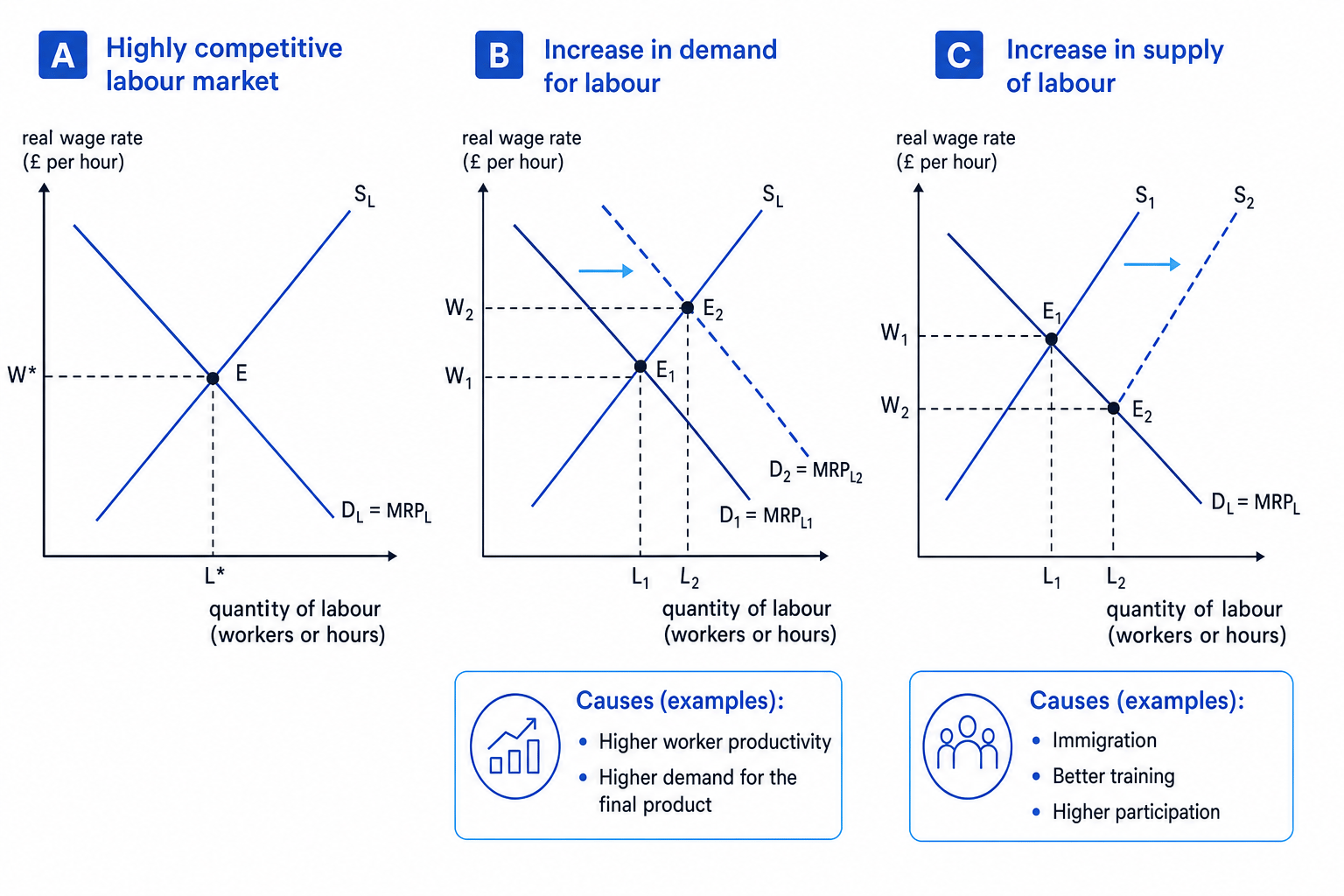
In the first panel, equilibrium occurs at wage W∗W^*W∗ and employment L∗L^*L∗, where DL=SLD_L = S_LDL=SL. If demand for labour rises, both wages and employment rise. If supply of labour rises, employment rises but the wage falls, assuming demand is unchanged.
Tracing a rise in labour demand
- Suppose demand for electric vehicles rises, so car manufacturers need more battery engineers. This increases demand for labour because the final product is now more profitable.
- The labour demand curve shifts right from D1D_1D1 to D2D_2D2, while labour supply is unchanged in the short run.
- At the old wage, firms want to hire more engineers than are available, creating upward pressure on wages.
- The new equilibrium has a higher wage and higher employment because firms compete to attract scarce engineering labour.
Shift versus movement
A higher wage does not itself shift the supply curve. It causes a movement along the existing labour supply curve. The supply curve shifts only when a non-wage factor changes, such as migration, training or participation.
4. Wage differentials
Wage differential
A wage differential is a difference in wage rates between workers, occupations, firms, regions or demographic groups.
Wage differentials exist because labour markets are not identical. Some jobs require more scarce skills. Some workers have higher productivity. Some jobs are unpleasant or risky, so employers may need to pay a compensating wage differential to attract workers.
Common causes include:
- differences in human capital: education, training, experience and skills;
- differences in productivity and therefore MRPLMRP_LMRPL;
- occupational immobility: workers cannot easily switch jobs because they lack skills or qualifications;
- geographical immobility: workers cannot easily move location, often due to housing costs or family ties;
- trade union power: collective bargaining may raise wages;
- monopsony power: a dominant employer may hold wages below competitive levels;
- discrimination: workers may be paid differently for reasons unrelated to productivity;
- public sector pay rules or minimum wages.
Explaining a wage gap
- A care worker earns £12 per hour and a software developer earns £30 per hour, so the absolute wage differential is £18 per hour.
- Using the care worker’s wage as the base, the percentage differential is 30−1212×100=150%\frac{30 - 12}{12} \times 100 = 150\%1230−12×100=150%.
- Part of the gap may be explained by labour demand: software developers may have high MRPLMRP_LMRPL because their work can generate large revenues for firms.
- Part of the gap may be explained by labour supply: fewer workers have advanced coding skills than basic care skills, so supply is more limited.
- However, a strong answer would also evaluate: care work may be socially valuable but underpaid due to weak bargaining power, public funding constraints and monopsony-like employers.
Assuming all wage gaps are fair
A wage differential may reflect productivity and scarcity, but it may also reflect discrimination, immobility or unequal bargaining power. Always ask whether the gap is economically justified.
5. Labour market flexibility and mobility
Labour market flexibility
Labour market flexibility is the ability of wages, working hours, contracts and employment patterns to adjust to changing economic conditions.
Mobility of labour
Mobility of labour is the ease with which workers can move between jobs, occupations, industries or regions.
There are two important types of mobility:
- Occupational mobility: moving between types of work, such as retail to nursing.
- Geographical mobility: moving between places, such as Newcastle to Bristol.
Greater flexibility can help the economy adjust after shocks. For example, after Brexit trade frictions, the pandemic and post-pandemic labour shortages, firms needed workers to move into expanding sectors such as logistics, health, digital services and green technology.
But flexibility can also mean insecurity. Zero-hours contracts and gig work may reduce costs for firms, but workers may face unstable income, weaker training and lower bargaining power.
Balanced evaluation
More flexibility is not automatically good. It improves adjustment and efficiency if workers are protected and retrained, but it may worsen insecurity and inequality if bargaining power is very unequal.
6. Monopsony power in labour markets
Monopsony
A monopsony exists when there is one dominant buyer of labour, giving the employer wage-setting power in a labour market.
In a monopsony, workers have limited alternative employers. This can happen in a remote town with one major factory, or in specialised labour markets where a large organisation dominates employment. The NHS, for example, is a very large employer for many healthcare workers, although it is not the only possible employer.
A monopsonist can often pay a lower wage than would exist in a competitive labour market. Because it faces an upward-sloping labour supply curve, attracting extra workers may require raising wages, but doing so can increase costs across existing workers too. This means the marginal cost of labour can be above the wage.
The likely effects are:
- lower wages than in a competitive market;
- lower employment than in a competitive market;
- reduced worker welfare;
- possible under-allocation of labour to that sector;
- higher profits or lower costs for the employer.
However, evaluation matters. A large employer may also provide stable jobs, formal training, pensions and career progression. In some cases, government intervention, minimum wages or trade unions can reduce the negative effects of monopsony power.
Monopsony essay shortcut
For monopsony, your core chain is: fewer alternative employers → weaker worker bargaining power → wage below competitive level → possible exploitation and lower employment.
7. Trade unions
Trade union
A trade union is an organisation of workers that uses collective bargaining to improve pay, working conditions and employment rights.
Trade unions can affect labour markets by:
- negotiating higher wages;
- improving non-wage conditions, such as holidays, safety and pensions;
- reducing wage inequality;
- protecting workers from unfair dismissal;
- organising industrial action, such as strikes.
In a competitive labour market, if a union pushes the wage above equilibrium, firms may demand fewer workers. This can create unemployment or reduce hours.
But in a monopsony labour market, a union may act as a countervailing power against the employer. If the employer was previously holding wages and employment below competitive levels, a union wage rise can potentially increase both wages and employment, at least up to a point.
Union power in different labour markets
- In a competitive labour market, a union-negotiated wage above equilibrium raises firms’ labour costs.
- Firms move along their labour demand curve and reduce the quantity of labour demanded, so employment may fall.
- In a monopsony labour market, the employer may initially pay below the competitive wage and employ fewer workers than the competitive level.
- A moderate union wage can force the employer to pay more while also making it easier to attract workers, so employment may rise rather than fall.
- The judgement depends on how high the negotiated wage is and how elastic demand for labour is.
Trade unions always reduce employment
This is too simplistic. In a competitive market, a high union wage may reduce employment. In a monopsony, union power can move wages and employment closer to the competitive outcome.
8. Bilateral monopoly
Bilateral monopoly
A bilateral monopoly occurs when a powerful buyer of labour, such as a monopsonist employer, faces a powerful seller of labour, such as a strong trade union.
Here, both sides have bargaining power. The employer wants to keep wages low. The union wants higher wages and better conditions. The final wage is therefore not determined purely by demand and supply; it depends on negotiation, strike threats, legal rules, public opinion and the financial position of the employer.
The outcome is often indeterminate in theory, meaning economics cannot predict one exact wage without knowing bargaining strength.
Possible effects include:
- wages may rise above the monopsony wage;
- worker welfare may improve;
- employment may rise if the union corrects monopsony underpayment;
- employment may fall if the negotiated wage is pushed too far above productivity;
- strikes may disrupt output and reduce consumer welfare;
- long-term agreements may improve stability and productivity.
A UK example could be public-sector pay bargaining, where large public employers negotiate with unions representing nurses, teachers or rail workers. Recent disputes during the cost-of-living squeeze show how inflation, fiscal pressure and labour shortages can all affect bargaining.
Bilateral monopoly judgement
Bilateral monopoly is not automatically bad. It can correct employer power, but if bargaining becomes adversarial or wages exceed productivity growth, it may reduce employment, raise costs or cause disruption.
9. How to evaluate impacts well
For OCR evaluation, avoid one-sided claims. The impact depends on:
- Elasticity of labour demand: if labour demand is wage-inelastic, wage rises cause smaller employment falls.
- Elasticity of labour supply: if workers have few alternatives, employers have more power.
- Time period: in the long run, firms may automate, relocate or train new workers.
- Productivity effects: higher wages may improve motivation, retention and training.
- Macroeconomic context: during labour shortages, wage rises may be less damaging to employment.
- Stakeholders: workers, firms, consumers, taxpayers and government may be affected differently.
In the exam
- Start with a clear diagram or definition, then explain the mechanism: demand, supply, wage, employment and bargaining power.
- Evaluate with “it depends on…” factors such as elasticity, time period, productivity, union strength and the degree of monopsony power.
- Use applied context: UK public-sector pay disputes, post-pandemic labour shortages, Brexit-related migration changes, regional housing costs or the cost-of-living squeeze.
Check yourself
- Why might a wage rise caused by a trade union reduce employment in one labour market but increase it in another?
- What are three reasons why software engineers might earn more than care workers?
- How does geographical immobility affect wage differentials between UK regions?