x

Supply of labour

What you'll learn

  • What economists mean by the supply of labour to an industry.
  • Why labour supply can shift, and why some industries struggle to attract workers quickly.
  • How wage elasticity of supply of labour depends on skills, mobility and time.
  • How to explain economic rent and transfer earnings using a diagram.

Labour supply: the basic idea

In the labour market, labour is a factor of production: human effort, skills and time used to produce goods and services. The supply of labour to an industry is the amount of labour that workers are willing and able to offer at different wage rates.

A wage rate is the payment for labour, usually shown as £ per hour, per week, or per year. The quantity of labour can be measured as the number of workers, or as total hours worked.

Definition

Supply of labour

The supply of labour to an industry is the quantity of labour workers are willing and able to provide to that industry at different wage rates, over a given period of time.

For most industries, a higher wage makes work in that industry more attractive, so the quantity of labour supplied tends to rise. This gives an upward-sloping labour supply curve.

However, remember the distinction between:

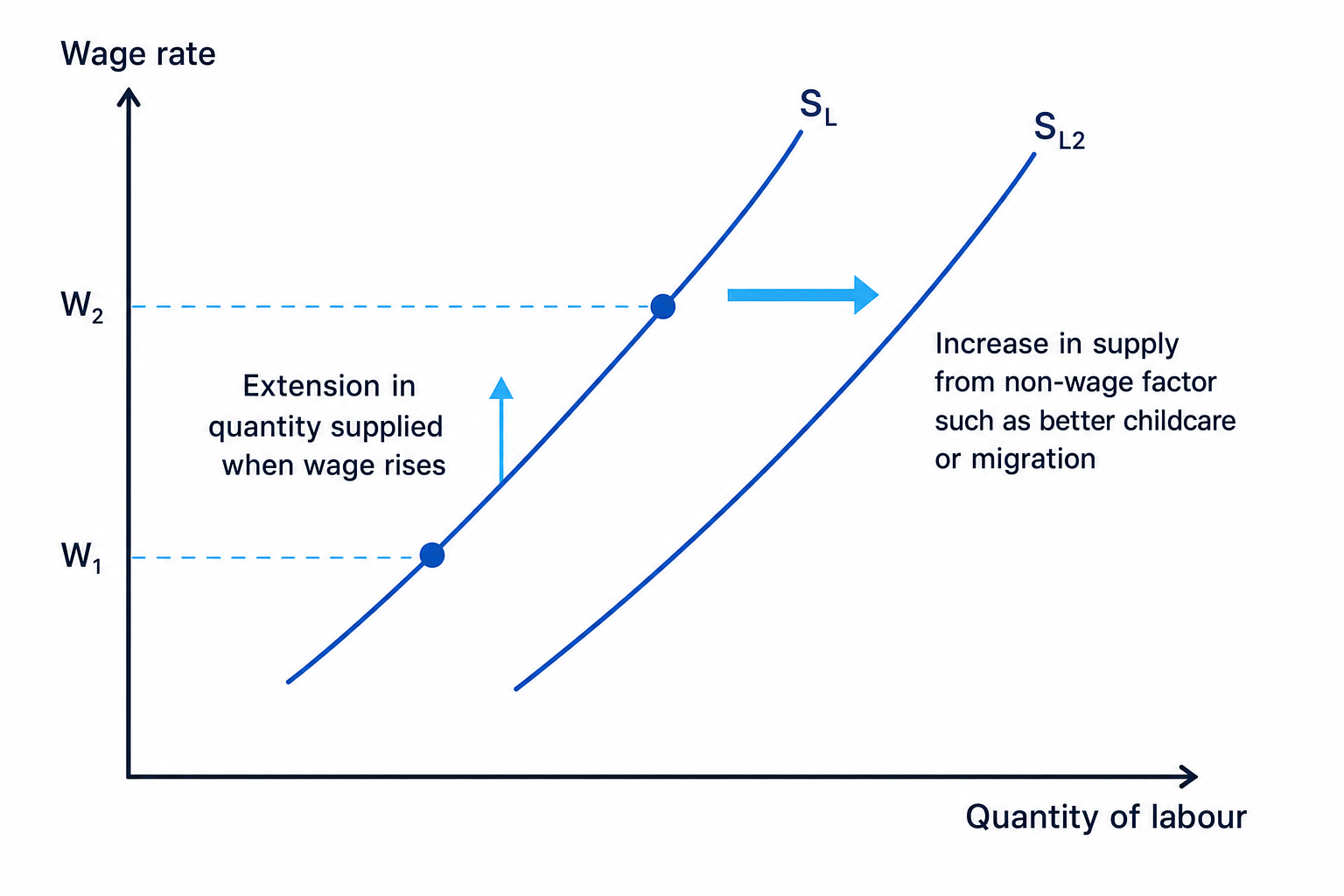
  • a movement along the labour supply curve, caused by a change in the wage rate in that industry;
  • a shift of the labour supply curve, caused by a non-wage factor, such as migration, training, working conditions or changes in tax.
Common Mistake

Movement versus shift

Do not say “supply increases” just because the wage rate rises. A higher wage normally causes an extension in quantity supplied along the existing labour supply curve. A shift requires a non-wage factor.

Why people supply labour: work versus leisure

Workers face a choice between work and leisure. In economics, leisure means any non-paid-work time, including rest, childcare, study, commuting-free time and hobbies.

A higher wage affects this choice in two ways:

  • The substitution effect: a higher wage raises the opportunity cost of leisure, so workers may substitute away from leisure towards more work.
  • The income effect: a higher wage raises income, so workers may be able to afford more leisure and work fewer hours.
Definition

Opportunity cost of leisure

The opportunity cost of leisure is the income a worker gives up by not working during that time.

For many workers at ordinary wage levels, the substitution effect is stronger: higher wages encourage more labour supply. But for some high earners, the income effect may dominate, so they choose shorter hours despite higher pay.

Key Idea

Industry supply is usually upward sloping

Even if some individuals work fewer hours when wages rise, an industry’s labour supply curve is usually upward sloping because higher wages attract workers from other occupations, regions or inactivity.

Factors affecting the supply of labour to an industry

The supply of labour to an industry depends on both the rewards of the job and workers’ ability to enter that occupation.

1. The wage rate relative to other industries

If wages in an industry rise relative to similar occupations, more workers may move into that industry. For example, if care homes raise pay relative to retail, some workers may switch into social care.

But the size of the response depends on how easily workers can move. A qualified nurse cannot instantly become a software engineer, and a software engineer cannot instantly become a surgeon.

2. Non-wage benefits and working conditions

Workers care about more than pay. Labour supply may increase if an industry offers:

  • safer working conditions;
  • flexible hours or remote work;
  • better pensions or holiday entitlement;
  • job security;
  • training and promotion opportunities;
  • higher social status or job satisfaction.

Poor working conditions can reduce labour supply even if wages are higher. This is important in sectors such as social care, hospitality, agriculture and logistics, where long or unsocial hours may discourage workers.

3. Skills, qualifications and training requirements

If an industry requires long training or formal qualifications, labour supply is harder to increase quickly. Medicine, dentistry, engineering and teaching all have entry requirements that limit short-run supply.

Industries with lower training barriers, such as some seasonal hospitality jobs, may be able to attract workers more quickly.

4. Occupational and geographical mobility

Occupational mobility is the ability of workers to move between different types of jobs. Geographical mobility is the ability of workers to move between regions.

Labour supply is higher where workers can realistically move into the industry. Barriers include housing costs, family commitments, transport links, licensing rules and differences in required skills.

5. Demographics and migration

The size and structure of the working-age population affect labour supply. An ageing population may reduce labour supply in physically demanding sectors, while a rising school-leaving age or higher university participation can delay entry into full-time work.

Migration can also matter. In the UK, sectors such as agriculture, hospitality, social care and construction have historically relied on migrant labour. Post-Brexit migration rules changed the availability of EU workers in some industries, contributing to labour shortages in certain occupations.

6. Tax, benefits and government policy

Workers respond to the net wage, meaning pay after income tax, National Insurance and benefit withdrawals. If marginal tax rates or benefit withdrawal rates are high, extra work may bring only a small rise in disposable income, reducing the incentive to supply labour.

Government policies can increase labour supply through:

  • apprenticeships and education subsidies;
  • childcare support, especially for parents;
  • raising the retirement age;
  • occupational licensing reform;
  • immigration policy;
  • transport and housing investment.
Example

Analysing a labour supply shift

A UK region introduces subsidised childcare for parents working in the hospitality sector. Explain the likely effect on labour supply to hospitality.

  1. Identify the affected incentive: subsidised childcare reduces the cost of working for parents, so the net reward from employment rises even if the hourly wage is unchanged.
  2. Decide whether this is a wage or non-wage factor: the wage rate itself has not changed, so this causes a shift of the labour supply curve rather than a movement along it.
  3. Apply it to the industry: more parents may be willing and able to work evenings, weekends or part-time shifts, increasing labour supply to hospitality.
  4. Add a limitation: the effect may be smaller if hospitality jobs still involve unsocial hours, low job security or poor transport links.

Wage elasticity of supply of labour

Wage elasticity of supply of labour measures how responsive the quantity of labour supplied is to a change in the wage rate.

Definition

Wage elasticity of supply of labour

Wage elasticity of supply of labour is the responsiveness of the quantity of labour supplied to a change in the wage rate.

Wage elasticity of supply=%ΔQs of labour%ΔW\text{Wage elasticity of supply} = \frac{\% \Delta Q_s \text{ of labour}}{\% \Delta W}Wage elasticity of supply=%ΔW%ΔQs​ of labour​

If labour supply is wage elastic, a small increase in wages causes a proportionately larger increase in quantity supplied. The supply curve is relatively flat.

If labour supply is wage inelastic, even a large wage rise causes only a small increase in quantity supplied. The supply curve is relatively steep.

Factors affecting wage elasticity of labour supply

Labour supply is likely to be more wage elastic when:

  • workers can enter the industry quickly;
  • training requirements are low;
  • skills are transferable from other jobs;
  • workers are geographically mobile;
  • there is unemployment or spare labour available;
  • the time period is long enough for workers to retrain or relocate.

Labour supply is likely to be more wage inelastic when:

  • training takes years;
  • professional qualifications or licences are required;
  • workers are tied to a region by housing or family commitments;
  • jobs are highly specialised;
  • employment contracts limit quick movement;
  • workers value non-wage features strongly, such as vocation or lifestyle.
Example

Calculating wage elasticity of labour supply

An industry raises its average wage from £10 per hour to £12 per hour. The number of workers willing to work in the industry rises from 50,000 to 55,000. Calculate the wage elasticity of supply of labour.

  1. Calculate the percentage change in the wage using the original wage as the base: the wage rises by £2 from £10, so the percentage change is 20%.
  2. Calculate the percentage change in labour supplied using the original number of workers as the base: workers rise by 5,000 from 50,000, so the percentage change is 10%.
  3. Substitute into the elasticity formula: wage elasticity of supply is 10% divided by 20%, which equals 0.5.
  4. Interpret the result: labour supply is wage inelastic because the value is less than 1; the percentage rise in workers is smaller than the percentage rise in wages.
Tip

Elasticity interpretation

For labour supply, the elasticity is usually positive: higher wages tend to increase quantity supplied. A value below 1 means inelastic; above 1 means elastic.

Short run and long run supply of labour

The short run is a period in which some factors affecting labour supply cannot easily change. In labour markets, this often means workers cannot instantly gain qualifications, relocate or switch careers.

The long run is a period long enough for workers, firms and governments to adjust more fully.

Definition

Short run and long run labour supply

In the short run, labour supply is limited by existing workers, skills, qualifications and location. In the long run, labour supply can change more as workers retrain, migrate, enter education or alter participation decisions.

Short-run labour supply

In the short run, labour supply to an industry is usually relatively inelastic. A wage rise may encourage:

  • existing workers to do overtime;
  • part-time workers to increase hours;
  • inactive workers to re-enter employment;
  • workers in similar jobs to switch industry.

But the response may still be limited if the industry requires training, professional registration, security checks or relocation.

Long-run labour supply

In the long run, labour supply is usually more elastic. Higher wages can encourage:

  • school leavers to choose relevant courses;
  • workers to retrain;
  • migrants to move to the country or region;
  • firms to offer apprenticeships;
  • governments to expand training places;
  • people outside the labour force to participate.

For example, if wages for electricians rise sharply because of green-transition investment and housebuilding demand, more workers may eventually train as electricians. But this cannot happen overnight.

Example

Short-run versus long-run response

Suppose wages for HGV drivers rise after a shortage of drivers.

  1. In the short run, some qualified drivers may work overtime or return to the occupation, so quantity supplied rises slightly.
  2. The response is limited because new drivers need training, tests and licences, so the short-run labour supply is relatively inelastic.
  3. In the long run, higher wages make the occupation more attractive to new entrants, and firms may fund training, so more drivers qualify.
  4. Therefore, the long-run supply response is likely to be larger and more elastic than the short-run response.

Economic rent and transfer earnings

When workers are paid a wage, their total earnings can be divided into transfer earnings and economic rent.

Definition

Transfer earnings and economic rent

Transfer earnings are the minimum payment needed to keep a factor of production in its current use rather than its next best alternative. Economic rent is any payment above transfer earnings.

For labour, transfer earnings are linked to opportunity cost. If a worker would need at least £30,000 per year to stay in teaching rather than switch to another job, then £30,000 is their transfer earnings. If they are paid £35,000, the extra £5,000 is economic rent.

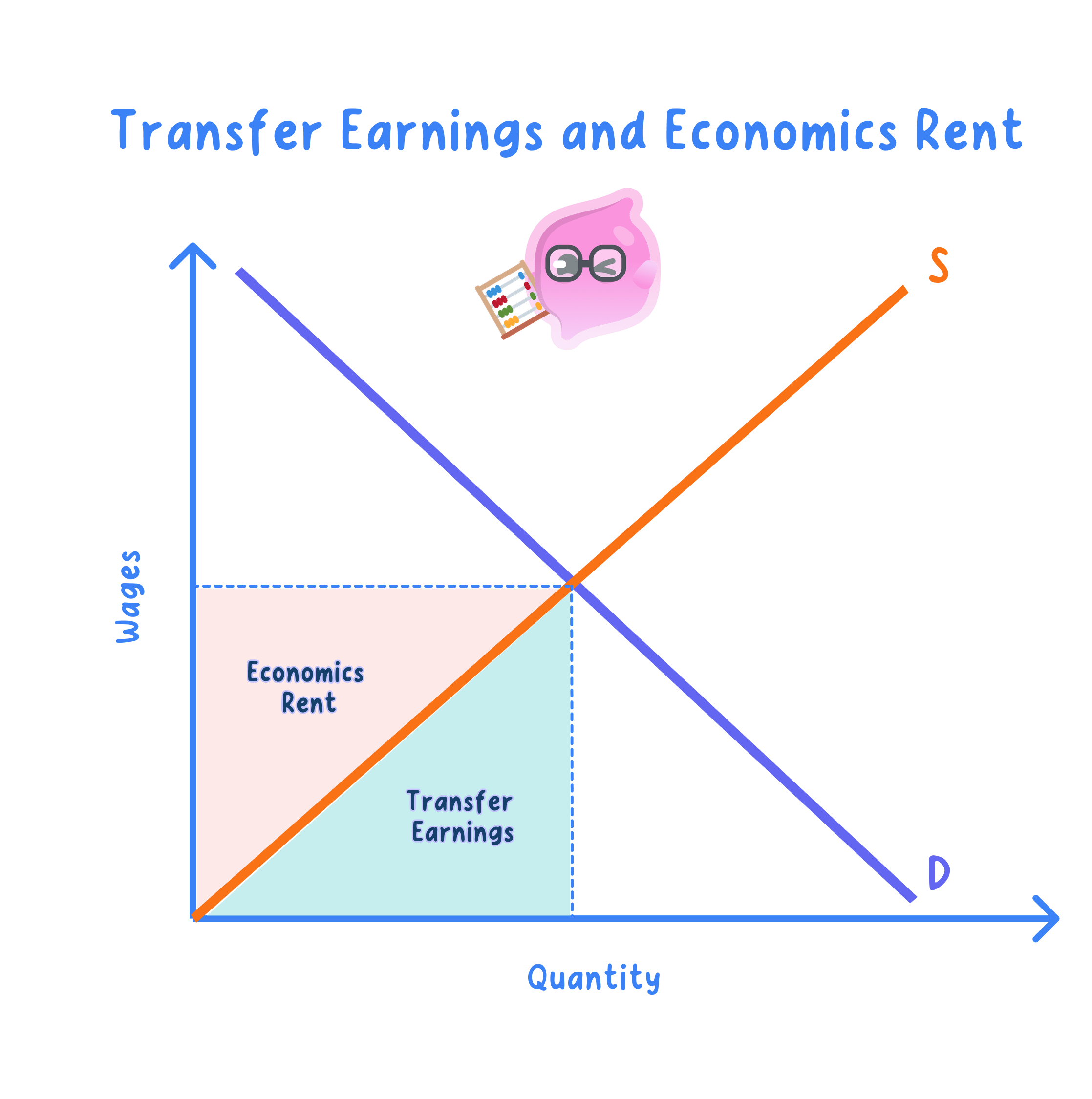
The diagram shows an industry labour supply curve. At wage W1 and employment L1, total earnings are the rectangle W1 × L1. The area under the supply curve is transfer earnings. The area above the supply curve but below the wage line is economic rent.

Labour supply diagram showing economic rent above the supply curve and transfer earnings below the supply curve

How to interpret the diagram

The labour supply curve shows the minimum wage needed to attract each additional unit of labour into the industry. Workers lower down the supply curve would have been willing to work for less than W1, but they still receive W1. The difference is economic rent.

If labour supply is very elastic, workers have close alternatives and most earnings are transfer earnings. If labour supply is very inelastic, workers have few alternatives or a scarce talent, so a large share of earnings may be economic rent.

Example

Calculating economic rent and transfer earnings

Suppose 100 workers are employed at £20 per hour. The labour supply curve is a straight line from the origin to the wage of £20 at 100 workers.

  1. Calculate total earnings: 100 workers each receive £20 per hour, so total earnings are £2,000 per hour.
  2. Find transfer earnings: because the supply curve is a straight line from the origin, the area under it is a triangle. Its area is half of the total earnings rectangle, so transfer earnings are £1,000 per hour.
  3. Calculate economic rent: economic rent equals total earnings minus transfer earnings, so it is £2,000 minus £1,000 = £1,000 per hour.
  4. Interpret the result: half the total payment is needed to keep workers in this industry, while the other half is surplus above their minimum required payment.
Common Mistake

Confusing economic rent with rent on property

In labour markets, economic rent does not mean payment for housing or land. It means surplus earnings above the worker’s transfer earnings.

Bringing it together

A strong answer on labour supply should link the theory to the industry. For example, a wage rise may solve shortages in retail faster than in medicine because retail workers need less formal training. Similarly, immigration policy may matter more in agriculture or social care than in highly regulated professions.

The key evaluation point is time. In the short run, wage increases may mainly reward existing workers if supply is inelastic. In the long run, higher wages can attract new entrants, but only if workers can train, move and afford to enter the occupation.

Exam technique

In the exam

  1. Start by defining labour supply clearly: workers willing and able to work in an industry at different wage rates.
  2. Separate wage changes from non-wage factors: wage changes cause movements along the curve; non-wage factors shift the curve.
  3. When discussing elasticity, always explain why the response is large or small: training time, mobility, alternative jobs and time period are usually the key factors.
  4. For economic rent and transfer earnings, label the wage, quantity of labour, supply curve and the two areas clearly.
  5. Add judgement by comparing short run with long run, and by applying your answer to the specific industry in the question.
Self review

Check yourself

  • Why might a wage rise fail to increase labour supply much in the short run?
  • What is the difference between transfer earnings and economic rent?
  • In which type of industry would you expect labour supply to be more wage elastic: hospitality or medicine? Why?

Recap questions

Test yourself with 5 quick questions on this guide. Answer them all correctly to complete it.

PreviousNext

How was this guide?

Supply of labour Revision Guide

  1. A Level
  2. /Economics
  3. /Supply of labour