Circular flow of income
What you'll learn
- How households, firms, government, banks and overseas trade fit into the circular flow of income.
- Why injections add spending to the economy and leakages remove spending.
- How national income can be measured using the income, output and expenditure methods.
- Why all three measures should, in theory, give the same value for GDP.
The starting point: households and firms
A simple economy begins with two key groups:
- Households: people who own resources and buy goods and services.
- Firms: businesses that produce goods and services using resources.
Households provide factors of production to firms. These are the resources used to produce output:
- Land: natural resources.
- Labour: human effort and skills.
- Capital: man-made resources such as machinery.
- Enterprise: risk-taking and organisation by entrepreneurs.
In return, firms pay households factor incomes: wages, rent, interest and profit.
Circular flow of income
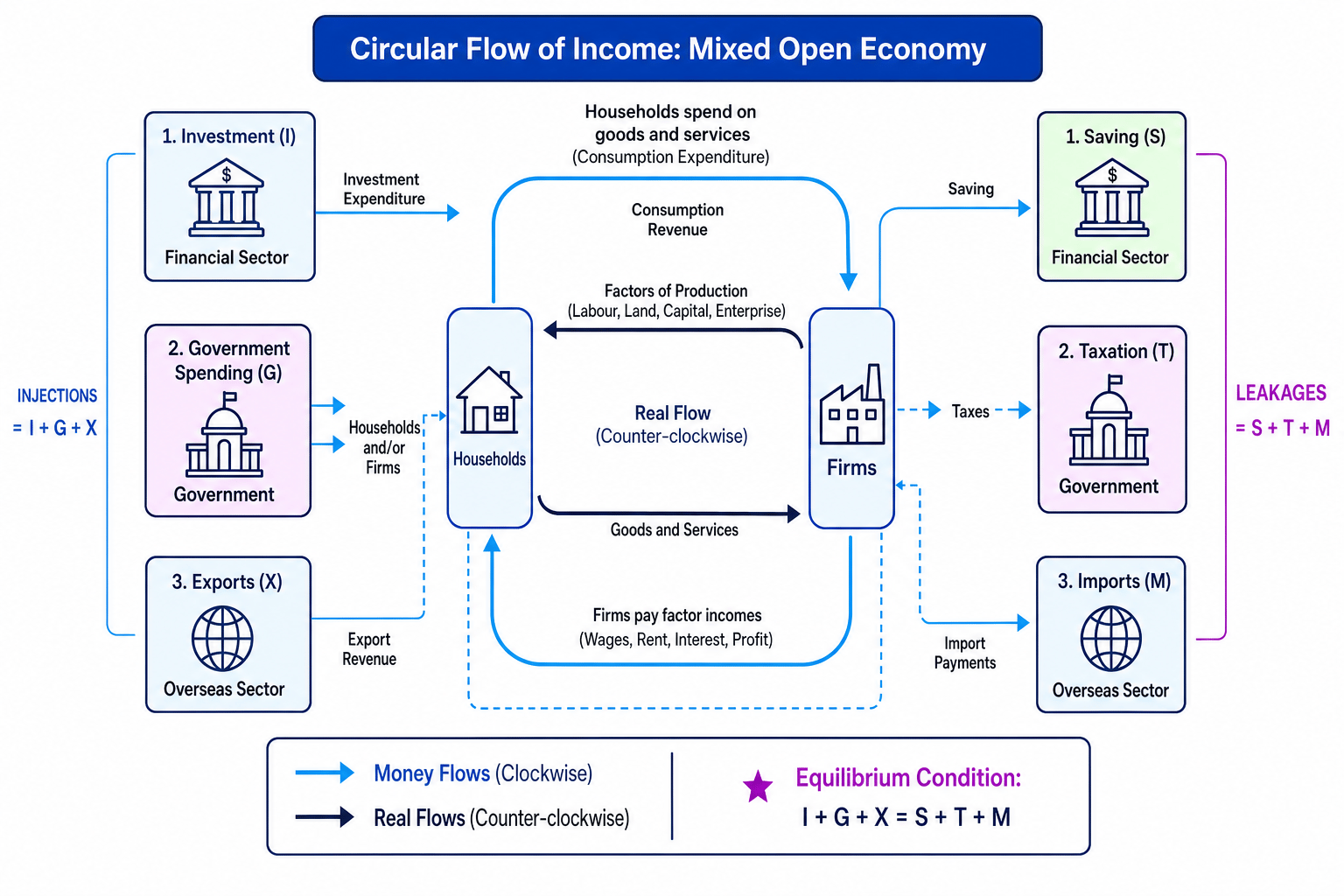
The circular flow of income is a model showing how money, goods and services, and resources move between different sectors of the economy.
In the simplest version, households supply factors of production to firms, firms produce output, households buy that output, and firms use the revenue to pay incomes back to households.
Real flows and money flows
There are two flows happening at the same time.
Real flows
Real flows are the movement of actual resources, goods and services.
For example:
- Households supply labour to firms.
- Firms supply goods and services to households.
Money flows
Money flows are the payments moving in the opposite direction.
For example:
- Firms pay wages to workers.
- Households spend income on goods and services.
The core link
One person’s spending becomes another person’s income. This is the basic logic behind the circular flow and the measurement of national income.
Adding injections and leakages
A real economy is not just households and firms. It also includes:
- Financial sector: banks and other institutions dealing with saving and borrowing.
- Government sector: collects taxes and spends on public services.
- Overseas sector: trade with other countries.
This means some money enters the circular flow, while some leaves it.
Leakages: money leaving the flow
Leakages
Leakages, also called withdrawals, are flows of money out of the circular flow of income. The main leakages are saving, taxation and imports.
The three leakages are:
Saving, S
Saving is income not spent on current consumption. If households save more, less money immediately flows to firms as consumer spending.
Taxation, T
Taxation is money paid to the government. Taxes reduce the disposable income available for households to spend, or reduce firms’ retained profits.
Imports, M
Imports are goods and services bought from overseas. Spending on imports leaves the domestic circular flow because it becomes income for foreign firms, not UK firms.
Imports are not part of UK output
Imports are included in UK consumers’ spending, but they are not produced in the UK. That is why imports are subtracted in the expenditure measure of GDP.
Injections: money entering the flow
Injections
Injections are flows of spending into the circular flow of income. The main injections are investment, government spending and exports.
The three injections are:
Investment, I
Investment is spending by firms on capital goods, such as machinery, technology, buildings and equipment. It adds demand now and can increase productive capacity in the long run.
Government spending, G
Government spending is spending by the state on goods and services, such as NHS services, education, defence and infrastructure.
Exports, X
Exports are goods and services sold to other countries. For the UK, examples include financial services, pharmaceuticals, cars, creative industries and higher education.
Circular flow equilibrium
The circular flow is in macroeconomic equilibrium when planned injections equal planned leakages:
I+G+X=S+T+MI + G + X = S + T + MI+G+X=S+T+MThis does not mean the economy is performing well. It only means there is no immediate pressure for total income to rise or fall because injections and leakages are balanced.
If injections exceed leakages, spending in the economy tends to rise. Firms may respond by increasing output and employment.
If leakages exceed injections, spending tends to fall. Firms may cut output, reduce hiring or allow inventories to build up.
Tracking a change in injections and leakages
Suppose the UK economy starts in circular flow equilibrium. Household saving rises by £10 billion, while government spending rises by £6 billion. Taxes, imports, investment and exports are unchanged.
-
Identify the change in leakages. Saving is a leakage, so total leakages rise by £10 billion.
-
Identify the change in injections. Government spending is an injection, so total injections rise by £6 billion.
-
Compare the two changes. Leakages have risen £4 billion more than injections because £10 billion minus £6 billion equals £4 billion.
-
Draw the implication. There is net withdrawal from the circular flow, so planned spending is likely to fall, putting downward pressure on output, income and employment.
Quick memory check
Leakages are S, T, M: Saving, Taxation, Imports. Injections are I, G, X: Investment, Government spending, Exports.
Connecting circular flow to aggregate demand
In macroeconomics, total planned spending on an economy’s output is called aggregate demand.
The expenditure equation is:
AD=C+I+G+(X−M)AD = C + I + G + (X - M)AD=C+I+G+(X−M)Where:
- C is consumption by households.
- I is investment by firms.
- G is government spending.
- X - M is net exports, meaning exports minus imports.
This is why the circular flow sits inside the wider topic of aggregate demand and aggregate supply. Changes in injections and leakages affect aggregate demand, which can then affect real GDP, unemployment and inflation.
Measuring national income
Gross Domestic Product
Gross Domestic Product, or GDP, is the total value of final goods and services produced within an economy over a period of time, usually a quarter or a year.
GDP is a key measure of national income. In theory, national income, national output and national expenditure are three ways of measuring the same circular flow.
That is because:
- Output creates income for factors of production.
- Income allows expenditure on goods and services.
- Expenditure gives firms revenue, which encourages further output.
The output method
The output method measures the value of goods and services produced in the economy.
To avoid counting the same production more than once, economists use value added.
Value added
Value added is the increase in value created by a firm at a stage of production. It is calculated as the value of output minus the value of intermediate inputs.
For example, if a bakery buys flour and turns it into bread, GDP should count the value added by the bakery, not count the flour again as if it were new output.
Avoiding double counting with value added
A farmer sells wheat to a miller for £2 million. The miller sells flour to a bakery for £5 million. The bakery sells bread to consumers for £9 million.
-
Calculate the farmer’s value added. The farmer produces wheat worth £2 million, so value added is £2 million.
-
Calculate the miller’s value added. The miller sells flour for £5 million but bought wheat for £2 million, so value added is £3 million.
-
Calculate the bakery’s value added. The bakery sells bread for £9 million but bought flour for £5 million, so value added is £4 million.
-
Add the value added at each stage. Total value added is £2 million plus £3 million plus £4 million, which equals £9 million.
-
Check against the final good. The final bread sold to consumers is worth £9 million, matching total value added.
The income method
The income method measures the incomes earned from producing output.
It adds up factor incomes such as:
- Wages and salaries paid to labour.
- Rent paid for land or property.
- Interest paid to capital owners.
- Profits earned by enterprise.
Transfer payments, such as some welfare benefits, are not counted as income from current production because they are transfers of money rather than payments for producing output.
The expenditure method
The expenditure method measures total spending on final goods and services produced in the economy.
The key formula is:
Y≡C+I+G+(X−M)Y \equiv C + I + G + (X - M)Y≡C+I+G+(X−M)Here, Y represents national income or GDP.
Using the expenditure method
Suppose an economy has consumption of £1,500 billion, investment of £350 billion, government spending of £600 billion, exports of £700 billion and imports of £800 billion.
-
Substitute the values into the expenditure equation. GDP is consumption plus investment plus government spending plus exports minus imports.
-
Add domestic spending and exports. £1,500 billion plus £350 billion plus £600 billion plus £700 billion equals £3,150 billion.
-
Subtract imports. £3,150 billion minus £800 billion equals £2,350 billion.
-
State the result with units. GDP using the expenditure method is £2,350 billion.
Why the three methods should match
In theory:
National output≡National income≡National expenditure\text{National output} \equiv \text{National income} \equiv \text{National expenditure}National output≡National income≡National expenditureThis is because each transaction has two sides. If a UK firm sells a good, that sale is:
- Output produced by the firm.
- Expenditure by the buyer.
- Income for workers, owners and other factor providers.
In practice, official data may not match perfectly because of timing differences, missing information, informal economic activity and measurement error. Statistical agencies such as the UK Office for National Statistics often include adjustments to reconcile the three approaches.
Three angles, one economy
The output, income and expenditure methods look different, but they are measuring the same underlying circular flow of production, income and spending.
A short note on real-world context
In the UK, the circular flow helps explain recent macroeconomic pressures. During a cost-of-living squeeze, households may cut discretionary consumption, weakening firms’ revenues. Higher Bank of England interest rates can encourage saving and discourage investment. At the same time, government spending on health, energy support or infrastructure can act as an injection into aggregate demand.
The impact depends on the size of the change, the multiplier effect, confidence, import leakages and whether the economy has spare capacity.
In the exam
-
Define the key term first: circular flow, injection, leakage, GDP or value added, depending on the question.
-
Use the correct symbols: injections are I, G and X; leakages are S, T and M.
-
If asked about measurement, clearly separate the output, income and expenditure methods rather than mixing them together.
-
Link circular flow changes to aggregate demand where relevant: more injections tend to increase AD, while more leakages tend to reduce it.
Check yourself
- Why are imports treated as a leakage from the UK circular flow of income?
- How can the same economic activity be measured as output, income and expenditure?
- What happens if planned injections are greater than planned leakages?