The diagrams below illustrate the interaction between two related labour markets: Market A (Cybersecurity Analysts) and Market B (Systems Administrators). These two occupations require overlapping technical skills, allowing workers to transition between them with some retraining.
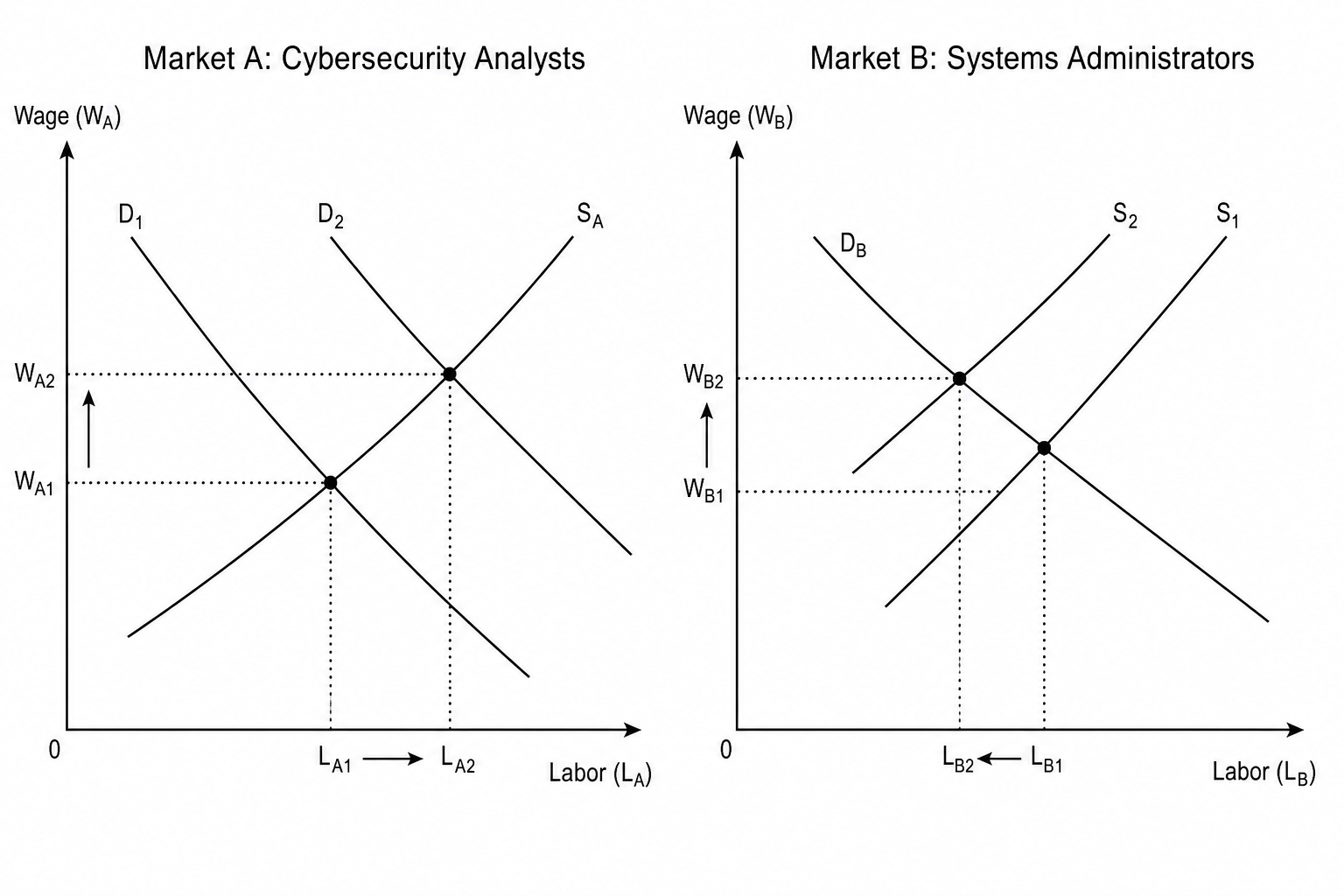
Suppose there is a significant and sustained increase in global cybersecurity threats, which shifts the demand for Cybersecurity Analysts from D1 D_1\,D1 to D2D_2D2.
Which of the following describes the most likely sequence of adjustments and the final long-run equilibrium outcome in both labour markets?
The higher equilibrium wage in Market A (WA2W_{A2}WA2) incentivises some Systems Administrators to retrain and transition to cybersecurity. This reduces the supply of labour in Market B, shifting the supply curve leftwards from S1S_1S1 to S2S_2S2, which increases the equilibrium wage in Market B to WB2W_{B2}WB2 and reduces employment to LB2L_{B2}LB2.
The higher equilibrium wage in Market A (WA2W_{A2}WA2) increases the demand for complementary IT infrastructure. This shifts the demand curve in Market B rightwards, resulting in a higher equilibrium wage (WB2W_{B2}WB2) and an increased level of employment (LB2L_{B2}LB2) in Market B.
The expansion of employment in Market A (LA2L_{A2}LA2) creates a demonstration effect, attracting new school-leavers into the IT sector. This shifts the supply curve in Market B rightwards from S2S_2S2 to S1S_1S1, resulting in a lower equilibrium wage (WB1W_{B1}WB1) and a higher level of employment (LB1L_{B1}LB1) in Market B.
The shift in demand in Market A causes a wage-price spiral that reduces firms' profitability. To cut costs, firms in Market B reduce wages from WB2W_{B2}WB2 to WB1W_{B1}WB1 and increase employment from LB2L_{B2}LB2 to LB1L_{B1}LB1, shifting the supply curve rightwards.

