The financial sector
What you'll learn
- What the financial sector does in an economy.
- Why savings and investment can support economic development.
- How the Harrod-Domar model links savings, capital and growth.
- Why microfinance can help development, but is not a magic solution.
The big picture: growth versus development
Before looking at finance, be clear about the end goal.
Economic development
Economic development means an improvement in living standards and quality of life, including higher incomes, better health, education, opportunity, reduced poverty and greater economic security. It is broader than economic growth, which means an increase in real GDP.
A country can grow without fully developing if the gains go to a small group, if pollution rises, or if public services remain poor. So when you evaluate the financial sector, always ask: does it improve people’s lives, or only increase money flows?
What is the financial sector?
The financial sector
The financial sector is the part of the economy made up of institutions, markets and regulators that help households, firms and governments save, borrow, lend, invest, make payments and manage risk.
It includes banks, building societies, insurance companies, pension funds, stock markets, bond markets, and institutions such as the Bank of England, the UK’s central bank.
A financial intermediary is an institution, such as a bank, that connects savers with borrowers. A capital market provides longer-term finance, for example by selling shares or bonds. A payment system allows money to move safely between people and firms.
The financial sector supports development through several channels:
- Mobilising savings: collecting small savings from many households.
- Allocating credit: directing funds towards firms and projects expected to generate returns.
- Maturity transformation: using short-term deposits to fund longer-term loans.
- Risk management: using insurance and diversified lending to reduce the impact of shocks.
- Payments and liquidity: enabling quick transactions; liquidity means how easily an asset can be turned into cash without losing value.
- Monetary policy transmission: interest-rate changes by the Bank of England affect borrowing, saving and investment.
The diagram below shows the main chain: savings are channelled through financial intermediaries into investment, which can raise productivity and living standards.
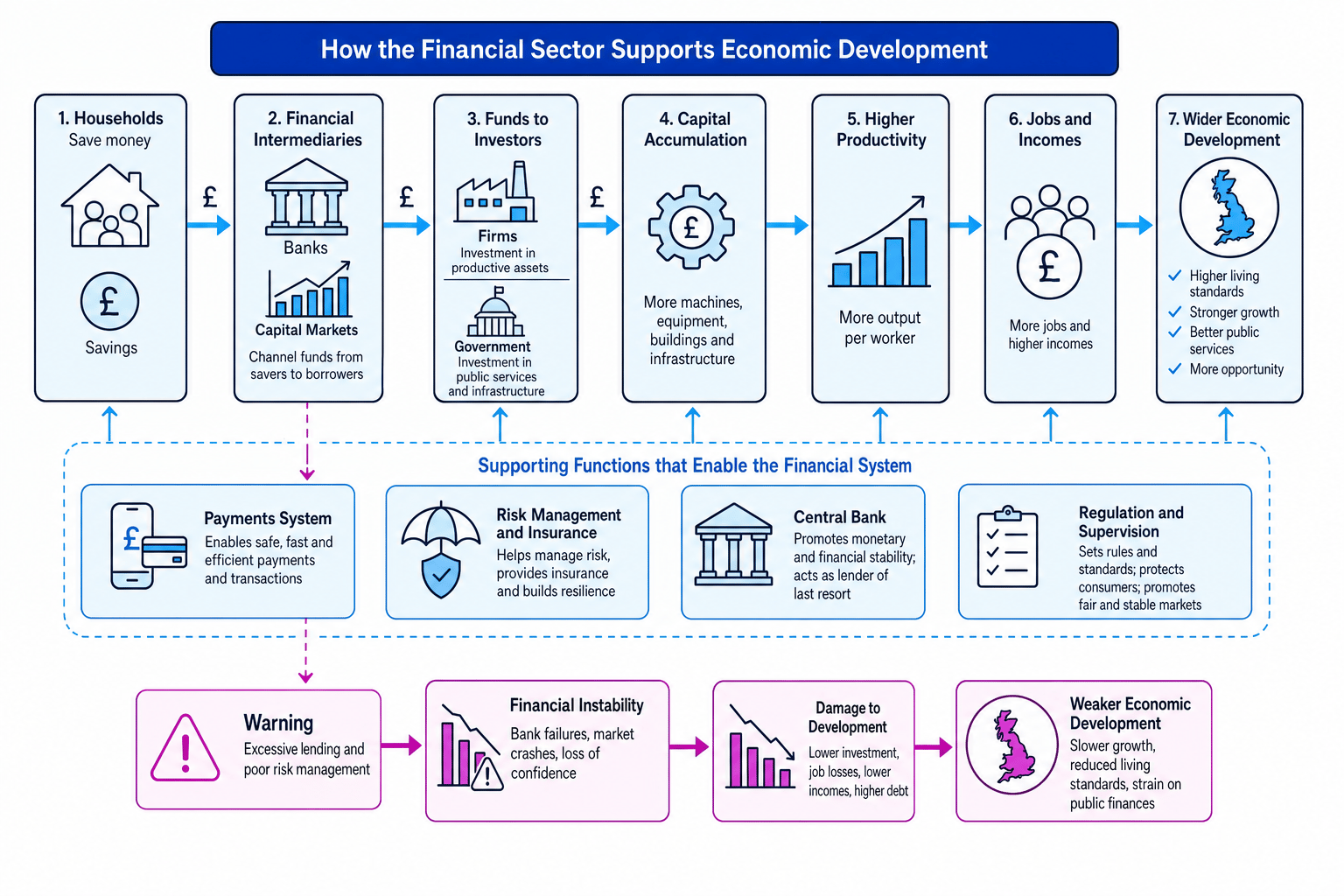
Tracing financial intermediation into development
- Households deposit £10 million in banks or pension funds, increasing the pool of funds available for lending or investment.
- Financial intermediaries assess risk and lend part of this money to firms, for example to buy machinery or build infrastructure.
- If the investment raises output per worker, firms can produce more at lower average cost, increasing productivity and potentially wages.
- Development improves only if the gains spread through jobs, incomes, tax revenue, public services and poverty reduction.
Finance is an enabler
The financial sector does not create development by itself. It enables development when it channels funds into productive, inclusive and sustainable investment.
Savings and investment
Savings and investment
Saving is income not spent on current consumption. Investment is spending on capital goods, such as machinery, technology, buildings and infrastructure, that increase the economy’s productive capacity.
This distinction matters. If a household “invests” by buying existing shares, that is a financial investment for the household, but it is not necessarily new real investment for the economy unless it helps firms raise new funds.
Confusing financial investment with economic investment
In A-Level Economics, investment usually means spending on new capital goods. Buying an existing asset, such as a second-hand share or house, may transfer ownership without increasing the economy’s productive capacity.
Savings can promote development because they provide funds for investment. Investment can then increase the capital stock, meaning the total amount of capital goods in an economy. More and better capital can raise labour productivity, meaning output per worker.
The development chain is:
higher savings → more loanable funds → more investment → capital accumulation → higher productivity → higher incomes and tax revenue → improved living standards
However, the chain is not automatic.
Assessing a higher savings rate
- If households save a larger share of income, consumption may fall in the short run, reducing aggregate demand and firm revenues.
- If banks and capital markets channel those savings into productive investment, long-run productive capacity may rise.
- If firms are pessimistic, or banks prefer low-risk assets, higher saving may not become higher investment. This is close to Keynes’ idea of the paradox of thrift, where extra saving can weaken demand if not matched by investment.
The Harrod-Domar model
The Harrod-Domar model, associated with Roy Harrod and Evsey Domar, explains growth as depending on the savings rate and the productivity of capital.
Harrod-Domar model
The Harrod-Domar model states that the growth rate of an economy depends positively on the savings rate and negatively on the capital-output ratio.
The basic formula is:
g=svg = \frac{s}{v}g=vswhere:
- ggg is the growth rate of real GDP.
- sss is the savings rate, written as a decimal share of national income.
- vvv is the capital-output ratio, often called the incremental capital-output ratio or ICOR.
The ICOR shows how much extra capital is needed to produce one extra unit of output:
v=ΔKΔYv = \frac{\Delta K}{\Delta Y}v=ΔYΔKA lower ICOR means investment is more efficient: less extra capital is needed to generate extra output.
The model is easiest to understand as a flow from savings to investment to capital accumulation to output growth.
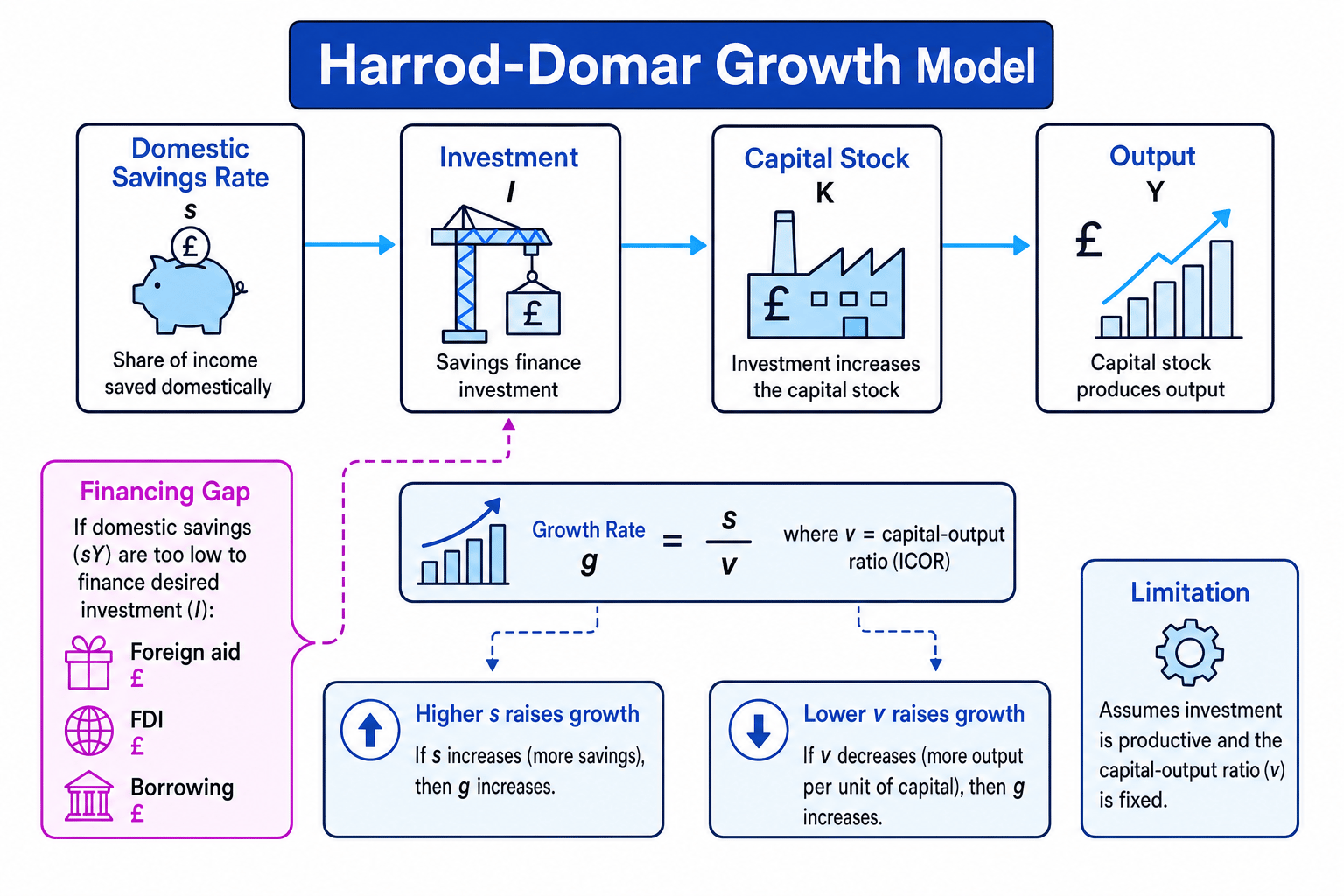
Estimating a financing gap
A country has GDP of £80 billion. It wants real GDP growth of 6% per year. Its ICOR is 4, and its domestic savings rate is 15%.
- Calculate the required savings rate using the Harrod-Domar relationship: s∗=g∗×v=0.06×4=0.24s^* = g^* \times v = 0.06 \times 4 = 0.24s∗=g∗×v=0.06×4=0.24. The country needs saving and investment equal to 24% of GDP.
- Convert that into required investment: 24% of £80 billion is £19.2 billion.
- Calculate domestic saving: 15% of £80 billion is £12.0 billion.
- Find the financing gap: £19.2 billion minus £12.0 billion equals £7.2 billion. This gap could be filled by foreign aid, foreign direct investment or borrowing, but only if the funds are used productively.
Harrod-Domar is a simplification
The model assumes saving becomes investment and that investment is productive. In reality, corruption, weak infrastructure, poor education, political instability or financial crises can stop investment from raising output.
Microfinance
Microfinance
Microfinance means small-scale financial services, such as tiny loans, savings accounts and insurance, provided to people or small firms who cannot access traditional banking.
The best-known part is microcredit, meaning very small loans. Microfinance is often aimed at low-income households, informal workers and small entrepreneurs who lack collateral, which is an asset a borrower offers as security for a loan.
Microfinance can promote development by:
- helping people start or expand small businesses;
- smoothing consumption during shocks, such as illness or crop failure;
- increasing financial inclusion, especially for women;
- building a savings record, which can improve future access to credit.
Examples often used in development economics include the Grameen Bank in Bangladesh and mobile-money systems such as M-Pesa in Kenya.
Analysing a microfinance loan
A self-employed tailor borrows £200 to buy a sewing machine. The machine increases monthly revenue by £70, while extra materials cost £30 and loan repayments are £20 per month.
- Calculate the extra operating surplus before loan repayment: £70 minus £30 equals £40 per month.
- Subtract the repayment: £40 minus £20 equals £20 extra income per month.
- The loan supports development if the extra income improves living standards and the borrower is not pushed into unsustainable debt.
- The outcome depends on demand for tailoring, the interest rate, repayment flexibility and whether the borrower has access to markets.
Overstating microfinance
Microfinance can help individuals, but it rarely replaces the need for roads, schools, healthcare, reliable electricity, stable institutions and larger-scale investment.
Evaluating the role of the financial sector in development
The financial sector can be extremely important because development usually requires investment before benefits arrive. Roads, factories, broadband, hospitals and renewable energy all need upfront finance.
A strong financial sector can:
- raise the quantity of investment by mobilising savings;
- improve the quality of investment by screening borrowers;
- support entrepreneurship and small firms;
- reduce vulnerability through insurance and savings products;
- help governments borrow for infrastructure;
- support green transition spending through bonds and ESG finance.
But the financial sector can also harm development.
One risk is financial instability. Excessive lending, weak regulation and asset bubbles can create crises. The 2008 global financial crisis showed how bank failures can reduce lending, increase unemployment and force governments into costly bailouts.
Another risk is misallocation of credit. If banks mainly fund property speculation or consumer credit, the economy may see rising asset prices rather than productive capacity. This can worsen inequality.
A third issue is exclusion. Poor households and small firms may face high interest rates or no access to banking. In low-income economies, weak legal systems and lack of collateral can limit lending even when savings exist.
Necessary but not sufficient
A well-functioning financial sector is often necessary for development, but it is not sufficient. Its impact depends on regulation, institutions, education, infrastructure, macroeconomic stability and whether finance reaches productive uses.
A balanced judgement is that finance is most powerful when it is stable, inclusive and linked to real investment. In the UK, higher Bank of England interest rates after the inflation shock made borrowing more expensive, showing how financial conditions can quickly affect investment. In developing economies, the key issue is often not just the amount of finance, but whether it reaches productive firms and poorer households on fair terms.
In the exam
- Start by defining development broadly: income, health, education, poverty reduction and living standards.
- Use the chain: savings → financial sector → investment → capital accumulation → productivity → incomes → development.
- For Harrod-Domar, state g=svg = \frac{s}{v}g=vs, then evaluate the assumptions behind the formula.
- Always balance the benefits of finance against risks: instability, exclusion, debt, speculation and weak regulation.
Check yourself
- Why might higher savings fail to increase economic development?
- In the Harrod-Domar model, what happens to growth if the capital-output ratio rises?
- Give one benefit and one limitation of microfinance.