What you'll learn
- Why financial institutions are regulated, and what can go wrong without regulation.
- The main methods regulators use: capital rules, liquidity rules, conduct rules, deposit insurance and macroprudential policy.
- The role and functions of a central bank such as the Bank of England.
- How to evaluate central bank policies, the IMF and the World Bank in supporting financial stability.
Why financial regulation matters
A financial institution is an organisation such as a bank, building society, insurer, pension fund or investment firm that channels funds between savers and borrowers, provides payment services, or manages financial risk.
Finance is unusually important because the whole economy relies on trust. If households stop trusting banks, they may withdraw deposits. If banks stop trusting each other, lending can freeze. If credit dries up, firms may cut investment and employment, reducing aggregate demand and real GDP.
Financial regulation
Financial regulation means the rules, supervision and enforcement used to influence how financial institutions behave, so that consumers are protected and the financial system remains stable.
The main purpose is not to eliminate every possible failure. Some financial firms should be allowed to fail if they are badly run. The aim is to prevent failures from causing wider damage to households, firms, taxpayers and the macroeconomy.
Finance creates systemic risk
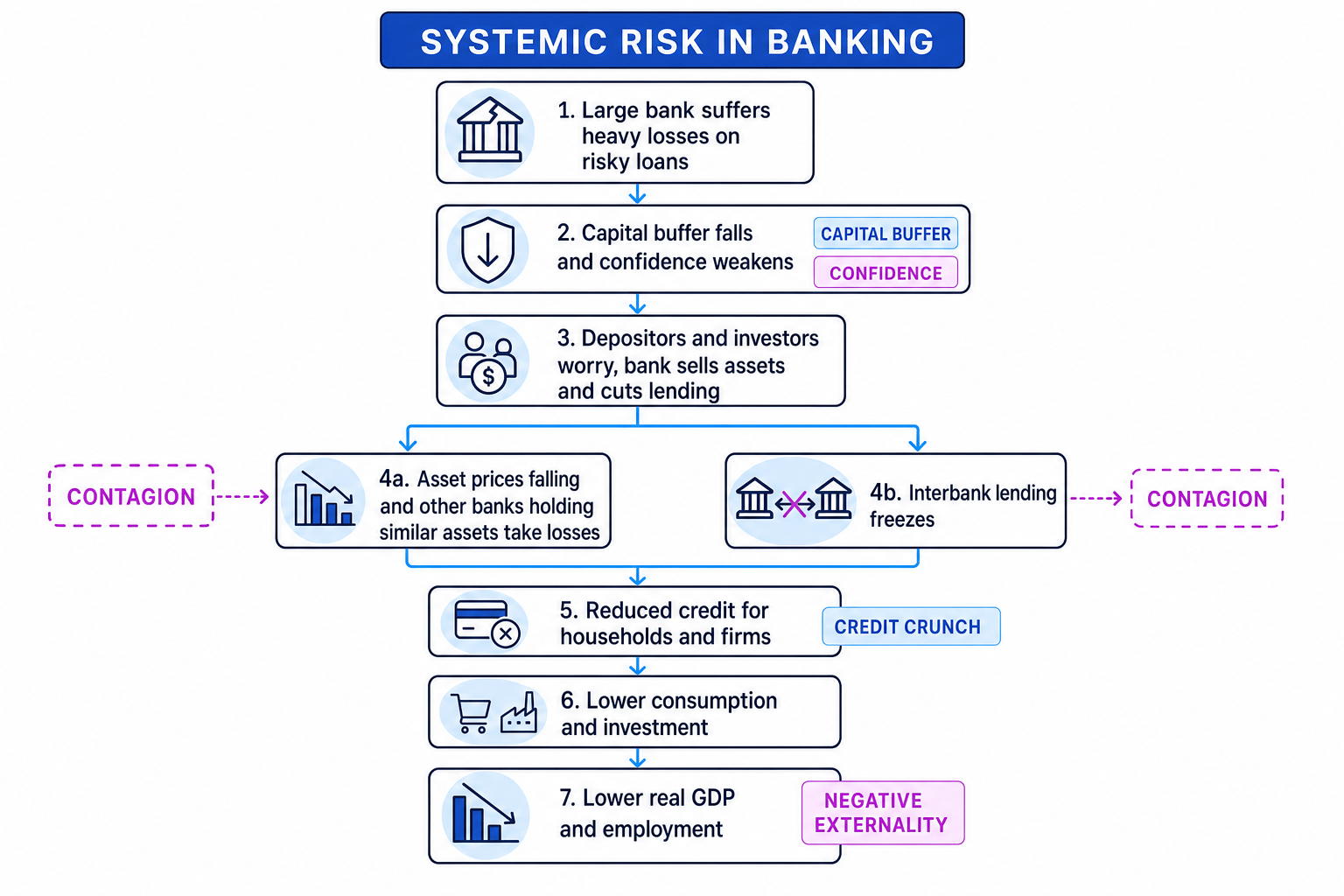
A problem inside one large financial institution can spread through the whole financial system because banks lend to each other, hold similar assets, rely on confidence, and provide essential payment and credit services.
Tracing systemic risk
-
Suppose a large bank makes heavy losses on risky loans. Its capital buffer falls, so depositors and investors begin to worry about whether the bank is safe.
-
To raise cash, the bank sells assets quickly and cuts new lending. This can push asset prices down and reduce credit available to households and firms.
-
Other banks holding similar assets may now face losses too. They may also reduce lending, even if they were not directly involved in the original bad loans.
-
Lower lending reduces consumption and investment, shifting aggregate demand left. Output and employment may fall, so a private banking failure creates a negative externality for the wider economy.
Purposes of financial regulation
Regulation has several linked aims:
Protecting consumers and savers
Consumers often face asymmetric information, meaning one side of a transaction knows more than the other. A bank or investment firm usually understands financial products better than the customer. Regulation tries to prevent mis-selling, hidden charges, fraud and excessive risk-taking with customers’ money.
Maintaining financial stability
Financial stability means the financial system can keep providing payments, credit and risk-management services even during shocks. After the 2008 global financial crisis, UK regulation became much more focused on preventing systemic collapse.
Reducing moral hazard
Moral hazard occurs when an individual or firm takes more risk because they expect someone else to bear the cost if things go wrong. If banks expect government bailouts, they may take excessive risks. Regulation tries to make shareholders and managers bear more of the consequences.
Supporting macroeconomic performance
A stable financial sector supports investment, consumption, trade and confidence. Instability can worsen recessions through the financial accelerator, where falling asset prices reduce collateral values, causing banks to lend less, which further weakens the economy.
Methods of financial regulation
Prudential regulation
Prudential regulation focuses on the safety and soundness of financial institutions. In the UK, the Prudential Regulation Authority, part of the Bank of England, supervises banks, building societies, insurers and major investment firms.
A key tool is a capital requirement. Bank capital includes shareholders’ funds and retained profits that can absorb losses. If a bank has more capital, it is less likely to become insolvent after bad loans or falling asset prices.
A related idea is risk-weighted assets: assets adjusted for how risky they are. A government bond may receive a lower risk weight than a risky business loan.
Capital ratio=Tier 1 capitalrisk-weighted assets×100\text{Capital ratio} = \frac{\text{Tier 1 capital}}{\text{risk-weighted assets}} \times 100Capital ratio=risk-weighted assetsTier 1 capital×100Checking a bank’s capital ratio
-
A bank has £12bn of Tier 1 capital and £120bn of risk-weighted assets. Its capital ratio is:
£12bn£120bn×100=10%\frac{\text{£12bn}}{\text{£120bn}} \times 100 = 10\%£120bn£12bn×100=10% -
If the required minimum is 8%, the bank initially has a buffer of 2 percentage points above the minimum.
-
Now suppose bad loans reduce capital by £4bn, leaving £8bn of capital while risk-weighted assets remain £120bn. The new ratio is:
£8bn£120bn×100≈6.7%\frac{\text{£8bn}}{\text{£120bn}} \times 100 \approx 6.7\%£120bn£8bn×100≈6.7% -
The bank is now below the 8% requirement, so it may need to raise new capital, cut dividends, retain profits, or reduce risky lending.
Liquidity rules and stress tests
Liquidity means the ability to meet short-term cash demands. A bank can be solvent in the long run but still collapse if it cannot access cash quickly enough. Regulators therefore require banks to hold high-quality liquid assets, such as central bank reserves or government bonds.
A stress test is a simulation of severe economic conditions, such as a recession, house price fall or jump in unemployment, to see whether banks could survive.
Conduct regulation
Conduct regulation focuses on how financial firms treat customers and behave in markets. In the UK, the Financial Conduct Authority regulates conduct. It aims to prevent mis-selling, insider dealing, market manipulation and unfair treatment of consumers.
A useful UK example is the payment protection insurance scandal, where banks had to compensate customers for mis-sold products. This shows why consumer protection matters as well as bank solvency.
Deposit insurance and resolution
Deposit insurance protects savers if a bank fails. In the UK, the Financial Services Compensation Scheme protects eligible deposits up to £85,000 per person, per authorised bank. This reduces the risk of bank runs because depositors know some savings are protected.
Resolution means managing the failure of a financial institution in an orderly way. The aim is to keep essential services running without automatically using taxpayer-funded bailouts.
Assuming regulation means banks cannot fail
Good regulation does not guarantee zero failures. It tries to make failure less likely, less contagious and less costly for the wider economy.
Macroprudential regulation
Macroprudential regulation looks at risk across the whole financial system, not just one bank at a time. In the UK, the Bank of England’s Financial Policy Committee can use tools such as countercyclical capital buffers and mortgage lending restrictions.
For example, if house prices and mortgage lending rise too quickly, regulators may tighten loan-to-income or loan-to-value limits to reduce the risk of a housing bubble.
Evaluating the importance of regulation
Regulation is important because financial markets are prone to market failure. Banks create credit, provide payments and connect many parts of the economy. Without regulation, excessive risk-taking can create severe negative externalities, as seen in the 2008 financial crisis.
However, regulation also has costs. Compliance can raise banks’ costs, which may be passed on through higher fees or more expensive loans. Very strict rules may reduce credit availability, especially for small firms. There is also a risk of regulatory arbitrage, where financial activity moves into less regulated areas such as shadow banking.
The strongest judgement is that regulation is essential, but it must be proportionate. Too little regulation risks crisis; too much can reduce competition, innovation and lending. The best systems combine clear rules, credible enforcement, strong capital and liquidity buffers, and a realistic plan for bank failure.
The role and functions of a central bank
A central bank is the institution responsible for monetary stability and financial stability. In the UK, this is the Bank of England.
Its main functions include:
- Setting monetary policy, mainly through the Bank Rate and asset purchases or sales.
- Acting as banker to commercial banks and the government.
- Issuing banknotes and supporting payment systems.
- Acting as lender of last resort to solvent but illiquid banks.
- Supervising financial stability through the PRA and Financial Policy Committee.
- Managing official reserves and supporting confidence in the financial system.
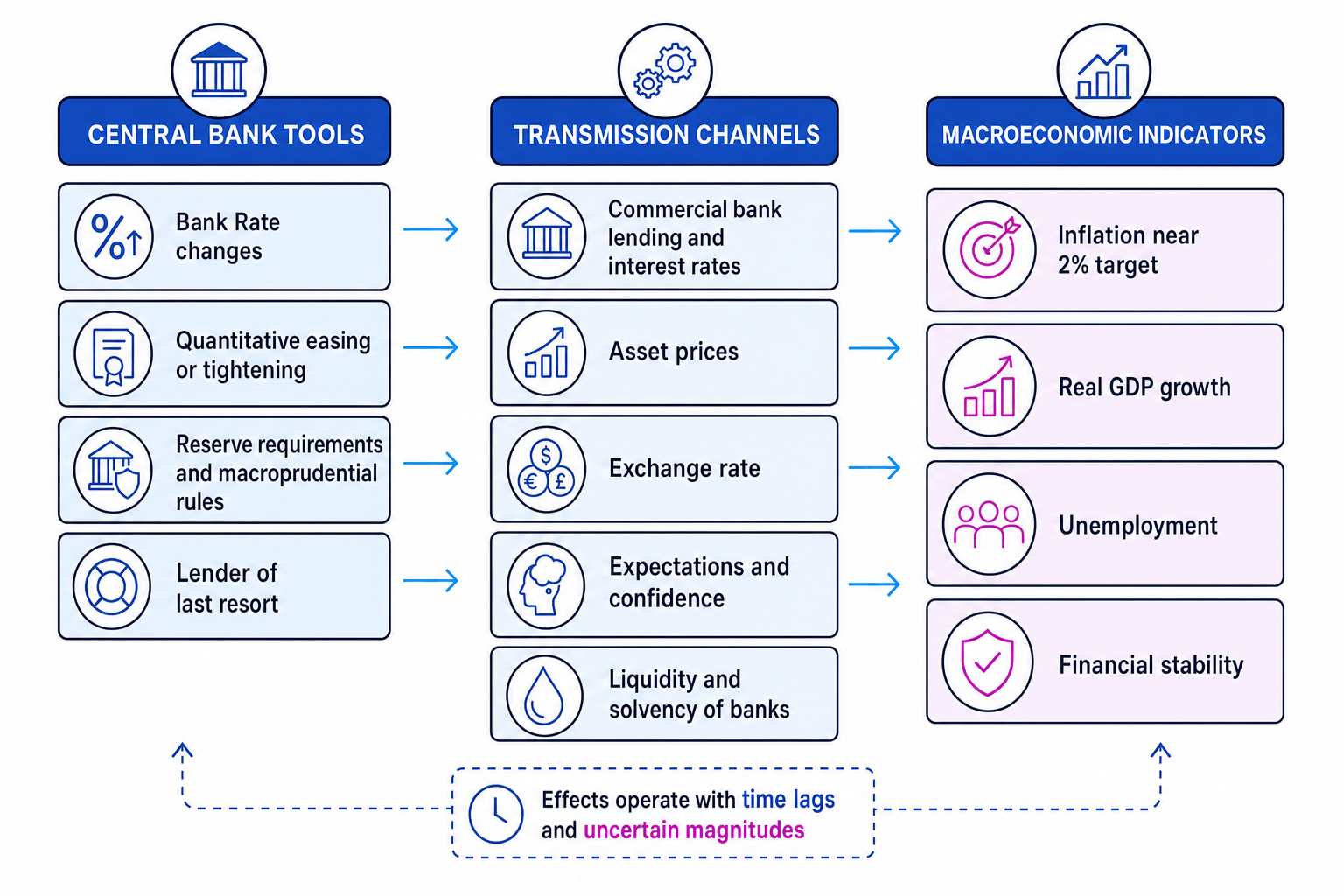
The diagram shows how central bank tools affect the wider economy through transmission channels.
Central bank policy measures and their effectiveness
Bank Rate changes
The Bank Rate is the interest rate set by the Bank of England’s Monetary Policy Committee. Raising Bank Rate usually increases borrowing costs and saving returns. This tends to reduce consumption and investment, lowering aggregate demand and easing inflationary pressure.
It may also cause the pound to appreciate if foreign investors are attracted by higher UK returns. A stronger pound can reduce import prices but may hurt export competitiveness.
Quantitative easing and tightening
Quantitative easing is when a central bank creates reserves to buy financial assets, usually government bonds, aiming to lower long-term interest rates and increase liquidity. Quantitative tightening reverses this by selling assets or allowing them to mature.
QE can be useful when interest rates are close to zero, as after the 2008 crisis and during the pandemic. But it may be less effective if banks do not lend, firms do not invest, or households are trying to repay debt. It can also raise asset prices, benefiting wealthier households more.
Forward guidance
Forward guidance is central bank communication about the likely future path of policy. If credible, it can shape expectations and influence spending decisions now. But if economic conditions change, guidance may be revised, which can weaken trust.
Lender of last resort
As lender of last resort, a central bank can provide emergency liquidity to banks facing temporary cash shortages. This can prevent panic and contagion. The risk is moral hazard: banks may take greater risks if they expect support.
Choosing a central bank policy mix
-
Suppose CPI inflation is 6%, above the 2% target, and unemployment is low. This suggests demand may be too strong relative to productive capacity.
-
The central bank could raise Bank Rate. Higher mortgage and loan rates reduce household disposable income and discourage investment, so aggregate demand grows more slowly.
-
If inflation is mainly caused by global energy prices, higher interest rates may be less effective because the original cause is on the supply side, not domestic demand.
-
A balanced judgement would be that Bank Rate rises can help prevent a wage-price spiral and anchor expectations, but they work with time lags and may reduce growth in the short run.
Evaluation shortcut
When evaluating central bank policy, ask: is the problem demand-side, supply-side or financial-sector instability? Interest rates are strongest against demand-pull inflation, but weaker against imported cost-push inflation.
Evaluating central bank effectiveness
Central banks can be powerful because they influence interest rates, credit conditions, exchange rates and expectations. Independence can improve credibility because markets believe policy is focused on inflation and stability rather than short-term political goals.
But central banks face limits. Policy works with uncertain time lags, often around 12–24 months. They cannot easily solve supply-chain shocks, low productivity or structural unemployment. There may also be conflicts between objectives: raising rates to reduce inflation can increase unemployment and create pressure on indebted households and firms.
A strong judgement is that central banks are most effective when the shock is financial or demand-side, and when policy is credible. They are less effective when inflation is driven by external supply shocks, or when fiscal policy is working in the opposite direction.
The IMF and the World Bank
The International Monetary Fund is an international organisation that promotes global monetary cooperation and financial stability. Its main roles include surveillance, emergency lending, technical advice and support for countries with balance of payments problems.
The World Bank focuses more on long-term development. It provides loans, grants and advice for projects such as infrastructure, education, health systems and institutional reform.
Neither institution is a world government. They cannot directly regulate every financial institution. Instead, they influence the global financial system through funding, advice, monitoring, conditionality and coordination with bodies such as the Financial Stability Board and Basel committees.
Evaluating their role
The IMF can reduce contagion by lending to countries facing currency crises or sudden capital outflows. Its surveillance reports can warn about risks, and its technical support can improve financial regulation in lower-income economies.
However, IMF loans often come with conditionality, meaning policy changes required as part of the support package. Conditions may include spending cuts, tax rises, higher interest rates or structural reforms. These may restore confidence, but they can also deepen recessions and create social costs.
The World Bank can support financial stability indirectly by improving long-run development, infrastructure, governance and resilience. But projects may increase debt burdens if returns are weak, and critics argue that governance gives too much influence to richer countries.
Evaluating IMF support in a currency crisis
-
If a country faces rapid capital flight, its foreign currency reserves may fall as it tries to defend its exchange rate and pay for imports.
-
IMF lending can provide foreign currency and reassure investors that the country can meet short-term obligations, reducing the risk of default and contagion.
-
Conditionality may improve confidence if it tackles the root causes, such as large fiscal deficits or weak banking supervision.
-
The evaluation depends on design: if conditions are too severe, they may reduce growth and living standards, making debt harder to repay.
In the exam
-
Separate purpose, method and evaluation: say what the regulation is trying to achieve, how it works, then whether it is likely to succeed.
-
Use synoptic links: connect financial regulation to market failure, negative externalities, aggregate demand, inflation, unemployment and government failure.
-
Make your judgement conditional: effectiveness depends on the type of shock, time period, strength of enforcement, and whether regulation is coordinated internationally.
Check yourself
- Why can the failure of one large bank create negative externalities for the whole economy?
- How do capital requirements and liquidity requirements reduce different types of risk?
- Why might IMF support stabilise a crisis in one country but still be controversial?