Money and interest rates
What you'll learn
- What economists mean by money, and the functions and characteristics that make something “money”.
- How money is created by the Bank of England and commercial banks.
- The difference between narrow money and broad money, using liquidity.
- How the money supply can affect the price level using the Fisher equation of exchange, and how interest rates are determined.
1. What is money?
In everyday language, “money” often means cash. In economics, it is broader: most money in the UK is not notes and coins, but bank deposits that can be spent using debit cards, transfers and direct debits.
Money
Money is anything that is generally accepted as a means of payment for goods, services and debts.
The four functions of money
Money performs four key functions:
- Medium of exchange — money is accepted in payment, so people do not need barter.
- Unit of account — prices, wages, profits and debts can be measured in a common unit, such as pounds sterling.
- Store of value — money allows purchasing power to be saved and used later.
- Standard of deferred payment — money allows borrowing and lending because future payments can be stated in monetary terms.
Without money, exchange would rely on a double coincidence of wants: you would need to find someone who both has what you want and wants what you have. Money removes that problem.
Characteristics of good money
For something to work well as money, it should be:
- Acceptable — people trust it and are willing to receive it.
- Durable — it does not easily wear out or decay.
- Portable — it is easy to carry or transfer.
- Divisible — it can be split into smaller units for different-sized transactions.
- Scarce — its supply is limited enough to maintain value.
- Recognisable — users can identify it and detect counterfeits.
- Stable in value — low inflation helps money remain a good store of value.
Legal tender is not the same as money
In economics, money is about general acceptability. Bank deposits are money even though they are not physical cash, because they are widely accepted for payment.
2. The creation and supply of money
The money supply is the total stock of money circulating in an economy at a point in time.
In the UK, money is supplied mainly in two ways:
Central bank money
The central bank is the institution responsible for monetary stability; in the UK this is the Bank of England. Central bank money includes:
- notes and coins in circulation
- reserves held by commercial banks at the Bank of England
Reserves are balances that commercial banks use to settle payments between themselves.
Commercial bank money
A commercial bank is a bank that takes deposits and makes loans to households and firms. Most money is created when commercial banks lend.
When a bank makes a loan, it does not simply hand over existing cash. It usually creates a matching deposit in the borrower’s account. That deposit is spendable, so it counts as money.
Tracing deposit creation
-
A bank approves a £5,000 loan to a small business. The bank records a £5,000 asset, because the business now owes the bank money, and a £5,000 liability, because the business’s deposit account has increased.
-
The business spends the £5,000 on equipment. The deposit may move to another bank, but the banking system as a whole still has £5,000 more deposits than before, so broad money has increased.
-
If the business later repays £1,000 of the loan principal, the bank reduces the loan asset and the deposit money used for repayment disappears. Loan repayment therefore destroys money.
Commercial bank money creation is limited by:
- demand for loans from creditworthy borrowers
- the interest rate set by the Bank of England
- banks’ expectations of default risk
- capital and liquidity regulation
- the need to settle payments using reserves
The money multiplier is a simplification
A textbook money multiplier can be useful, but do not write as if banks can lend without limit. In the modern UK system, lending is constrained by profitability, regulation, risk and the Bank of England’s policy rate, not just by a fixed reserve ratio.
3. Narrow and broad money
To compare types of money, economists use the idea of liquidity.
Liquidity
Liquidity means how quickly and easily an asset can be used as money, or converted into money, without losing value.
Narrow money
Narrow money includes the most liquid forms of money. This usually means cash and instantly accessible deposits, such as money in current accounts.
It is “narrow” because it only counts assets that can be used almost immediately for spending.
Broad money
Broad money includes narrow money plus less liquid money-like assets, such as some savings deposits and short-term deposits. In the UK, broad money is often discussed using measures such as M4, which includes sterling notes and coin plus a wide range of private sector bank and building society deposits.
| Measure | Typical contents | Liquidity |
|---|---|---|
| Narrow money | Cash and instant-access deposits | Very high |
| Broad money | Narrow money plus savings and other deposits | Lower, but still money-like |
Narrow versus broad money
The key difference is liquidity: narrow money is immediately spendable, while broad money includes assets that may need to be transferred or converted before spending.
4. Money supply and the price level
The price level is the average level of prices in an economy, often measured using an index such as the CPI, where the base year equals 100.
A key theory linking money and prices is the quantity theory of money, associated with monetarist economists such as Milton Friedman. Friedman argued that “inflation is always and everywhere a monetary phenomenon”, meaning sustained inflation is usually linked to excessive growth in the money supply.
The formal relationship is the Fisher equation of exchange:
MV=PQMV = PQMV=PQwhere:
- M is the money supply
- V is the velocity of circulation, meaning how often each unit of money is used in a period
- P is the price level
- Q is real national output
The right-hand side, P times Q, represents nominal spending or nominal GDP.
If V and Q are fairly stable, then an increase in M is likely to cause an increase in P. In simple terms: more money chasing the same amount of goods and services pushes up prices.
Using the Fisher equation to estimate inflation
-
Suppose the money supply rises by 8% from the base period, velocity falls by 2%, and real output rises by 1%. Since P=MVQP = \frac{MV}{Q}P=QMV, compare the new price level with the old one.
-
Substitute the percentage changes as multipliers:
P1P0=1.08×0.981.01≈1.048\frac{P_1}{P_0} = \frac{1.08 \times 0.98}{1.01} \approx 1.048P0P1=1.011.08×0.98≈1.048 -
The price level rises by about 4.8%. If the starting price index was 100, the new index would be about 104.8.
How strong is this relationship?
The Fisher equation is always true as an identity, but the causal link from money supply to prices depends on assumptions.
If the economy is close to full capacity, extra money may mainly increase prices. This helps explain why rapid monetary expansion can be inflationary.
However, if there is spare capacity, firms may respond to higher demand by increasing output rather than prices. Also, velocity can change. During periods of uncertainty, households and firms may hold onto money, reducing V.
UK context is useful here. During the pandemic and energy-price shock period, the UK experienced both monetary expansion and major supply-side pressures. CPI inflation rose sharply, reaching over 11% in October 2022, but this was not caused by money growth alone: global energy prices, supply-chain disruption and labour-market tightness also mattered.
Evaluation shortcut
When evaluating the money supply and inflation, ask: Is output fixed? Is velocity stable? Is the economy near full capacity? If not, the link between money growth and inflation is weaker.
5. Interest rates
Interest rate
An interest rate is the price of borrowing money and the reward for saving, usually expressed as an annual percentage of the amount borrowed or saved.
A nominal interest rate is the stated rate, before adjusting for inflation. A real interest rate adjusts for inflation, showing the change in purchasing power.
A simple approximation is:
r≈i−πr \approx i - \pir≈i−πwhere r is the real interest rate, i is the nominal interest rate and pi is the inflation rate.
Calculating a real interest rate
-
Suppose a savings account pays a nominal interest rate of 5.25% and inflation over the year is 4.00%. Use r≈i−πr \approx i - \pir≈i−π.
-
Substitute the values:
r≈5.25%−4.00%=1.25%r \approx 5.25\% - 4.00\% = 1.25\%r≈5.25%−4.00%=1.25% -
The saver’s purchasing power rises by about 1.25%. If inflation were higher than the nominal rate, the real interest rate would be negative.
6. The determination of interest rates
In a simple money market diagram, the rate of interest is determined by the interaction of the demand for money and the supply of money.
The demand for money is also called liquidity preference: the desire to hold wealth in liquid money form rather than in interest-bearing assets. People demand money for transactions, precautionary reasons and speculative reasons.
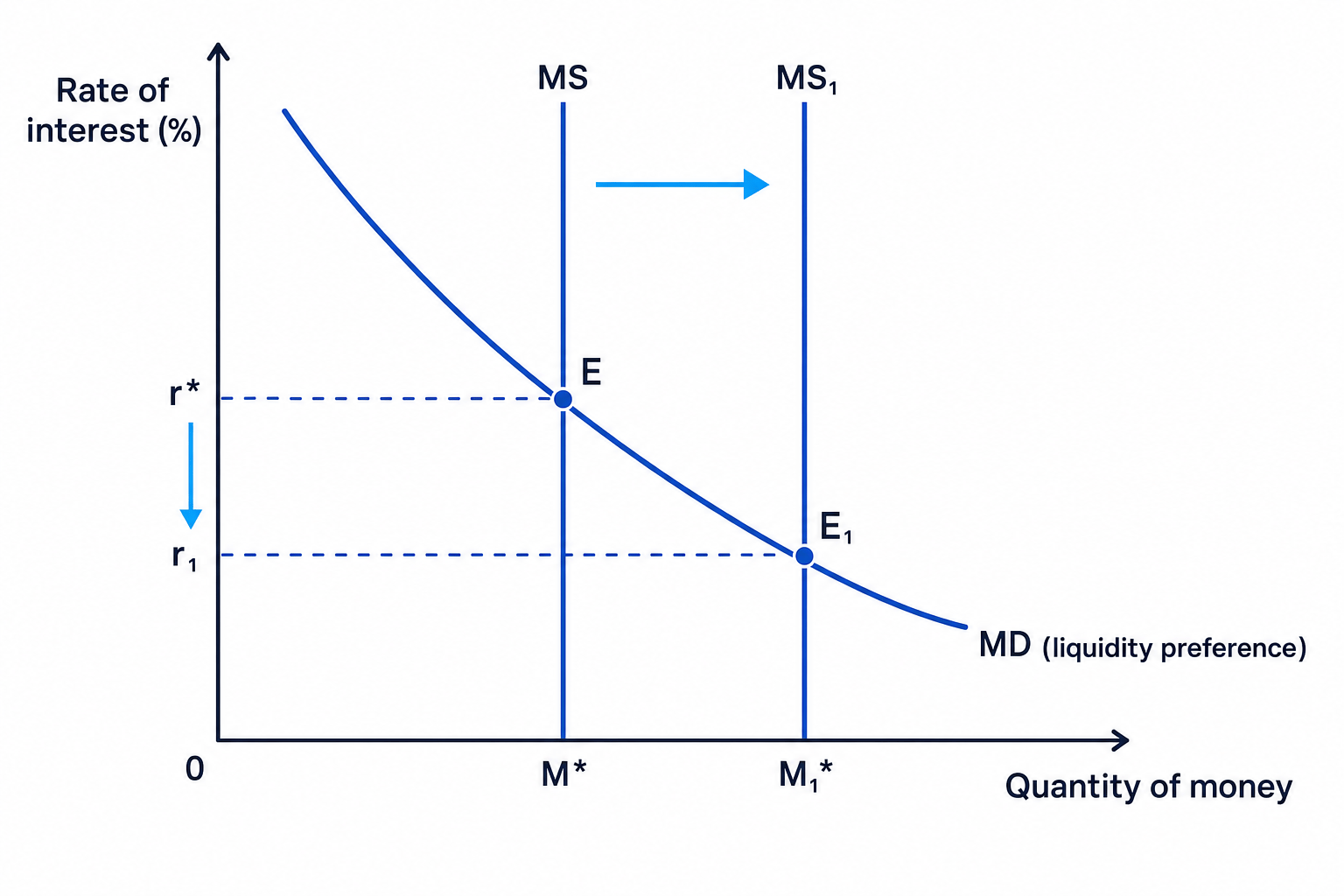
The diagram below shows the money market. The money supply curve is vertical because, in this simplified model, the central bank controls the supply of money independently of the current interest rate.
Reading the diagram
The vertical axis shows the rate of interest. The horizontal axis shows the quantity of money.
The money demand curve slopes downwards because a higher interest rate increases the opportunity cost of holding money. If you hold cash or current-account deposits, you give up the interest you could earn elsewhere. So, at higher interest rates, people tend to hold less money.
Equilibrium is where money demand equals money supply. In the diagram, this is at E, with interest rate r* and money quantity M*.
If the money supply increases from MS to MS1, there is an excess supply of money at the original interest rate. People try to use surplus money to buy financial assets such as bonds. Higher demand for bonds pushes bond prices up and bond yields down, so the market interest rate falls to r1.
Interest rates in the money market
The interest rate is the “price” that equilibrates money demand and money supply. An increase in money supply, other things equal, lowers the equilibrium interest rate.
The Bank of England in practice
In the UK, the Bank of England’s Monetary Policy Committee (MPC) sets Bank Rate, the main policy interest rate. Bank Rate influences the interest paid on reserves, which then affects savings rates, mortgage rates, business loan rates, bond yields and exchange rates.
From December 2021 to August 2023, Bank Rate rose from 0.1% to 5.25% as the Bank of England tried to reduce inflation after the cost-of-living shock. This shows how interest rates are used as a macroeconomic policy tool, not just as a theoretical money-market price.
7. Synoptic links and evaluation
Higher interest rates can reduce aggregate demand by discouraging borrowing and investment, increasing mortgage payments, encouraging saving, and strengthening the pound. A stronger pound can reduce import prices but may make exports less competitive.
However, the effect depends on context. If consumer confidence is very weak, lower interest rates may not stimulate much borrowing. If households have fixed-rate mortgages, higher Bank Rate may take time to affect spending. If inflation is caused mainly by energy prices or supply shocks, higher interest rates can reduce demand but may not directly solve the original cause of inflation.
Do not confuse two Fisher ideas
The Fisher equation of exchange is MV=PQMV = PQMV=PQ. This is different from the Fisher relationship between nominal rates, real rates and inflation expectations.
In the exam
-
Define money through its functions, not just as cash: include deposits and general acceptability.
-
For the interest-rate diagram, label both axes, the money demand curve, the money supply curve and the equilibrium interest rate.
-
When using MV=PQMV = PQMV=PQ, explain the assumptions: stable velocity and limited spare capacity make money growth more inflationary.
-
Add evaluation by considering time lags, confidence, credit conditions, spare capacity and whether inflation is demand-pull or cost-push.
Check yourself
- Why are bank deposits counted as money even though they are not notes and coins?
- What happens to the price level in MV=PQMV = PQMV=PQ if money supply rises but real output rises too?
- Why does the money demand curve slope downwards in the money market diagram?