What you'll learn
- What supply-side policies are and how they affect SRAS and LRAS.
- How to explain privatisation, deregulation, subsidies, competition policy, investment, tax/benefit reform, labour flexibility and immigration control.
- How to use AD-AS and labour-market diagrams in your answers.
- How to evaluate whether supply-side policies actually achieve macroeconomic objectives.
1. The starting point: the “supply side”
The supply side of the economy is its ability to produce goods and services. It depends on factors such as labour, capital, technology, skills, infrastructure, enterprise and competition.
Supply-side policy
A supply-side policy is a government policy designed to increase an economy’s productive potential, usually by improving productivity, incentives, competition or labour-market performance.
Supply-side policies can be:
- Market-based: policies that try to make markets work with fewer barriers, such as deregulation, privatisation, lower taxes and labour-market flexibility.
- Interventionist: policies where the government actively spends, invests or supports markets, such as education, training, infrastructure, research and development, and subsidies.
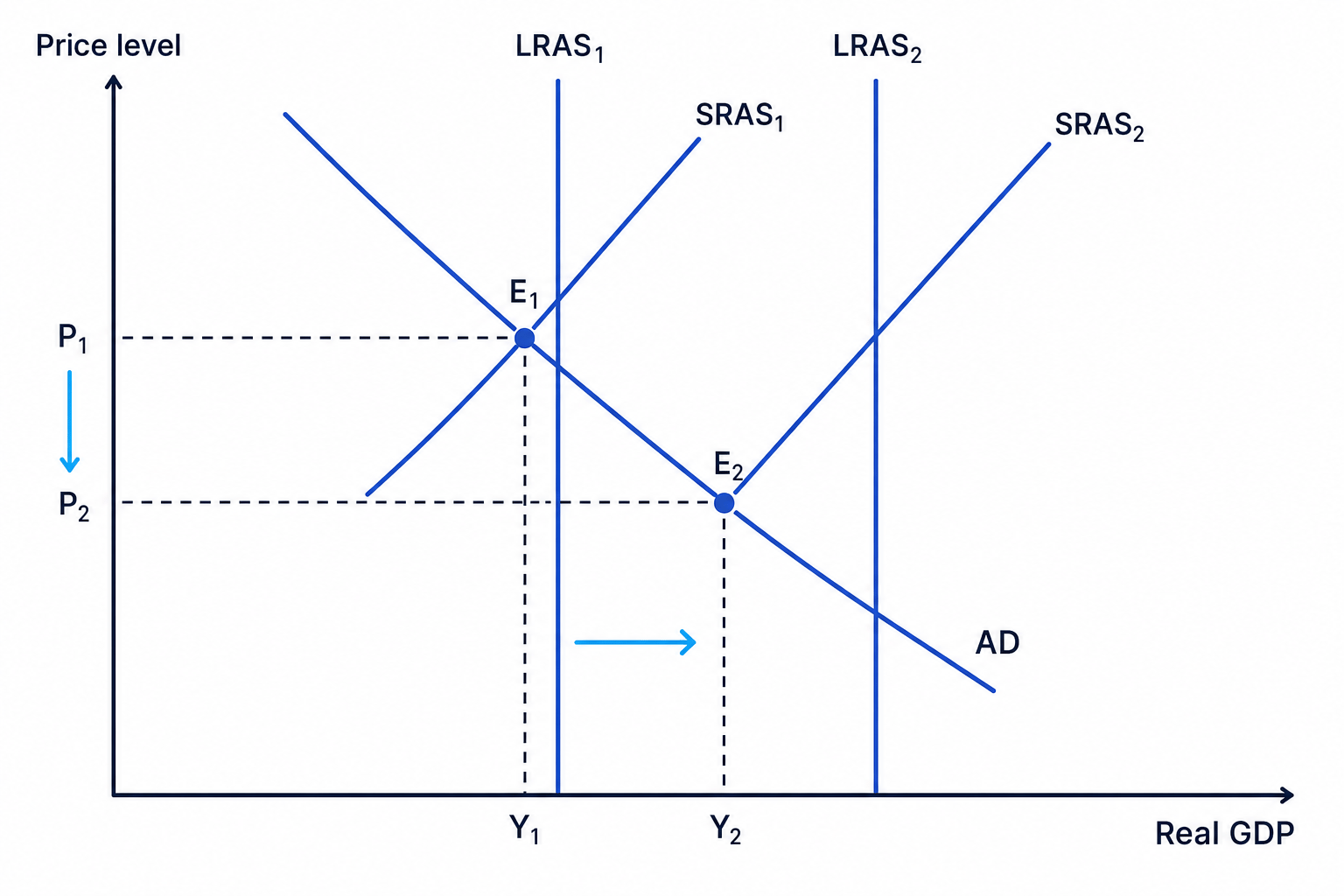
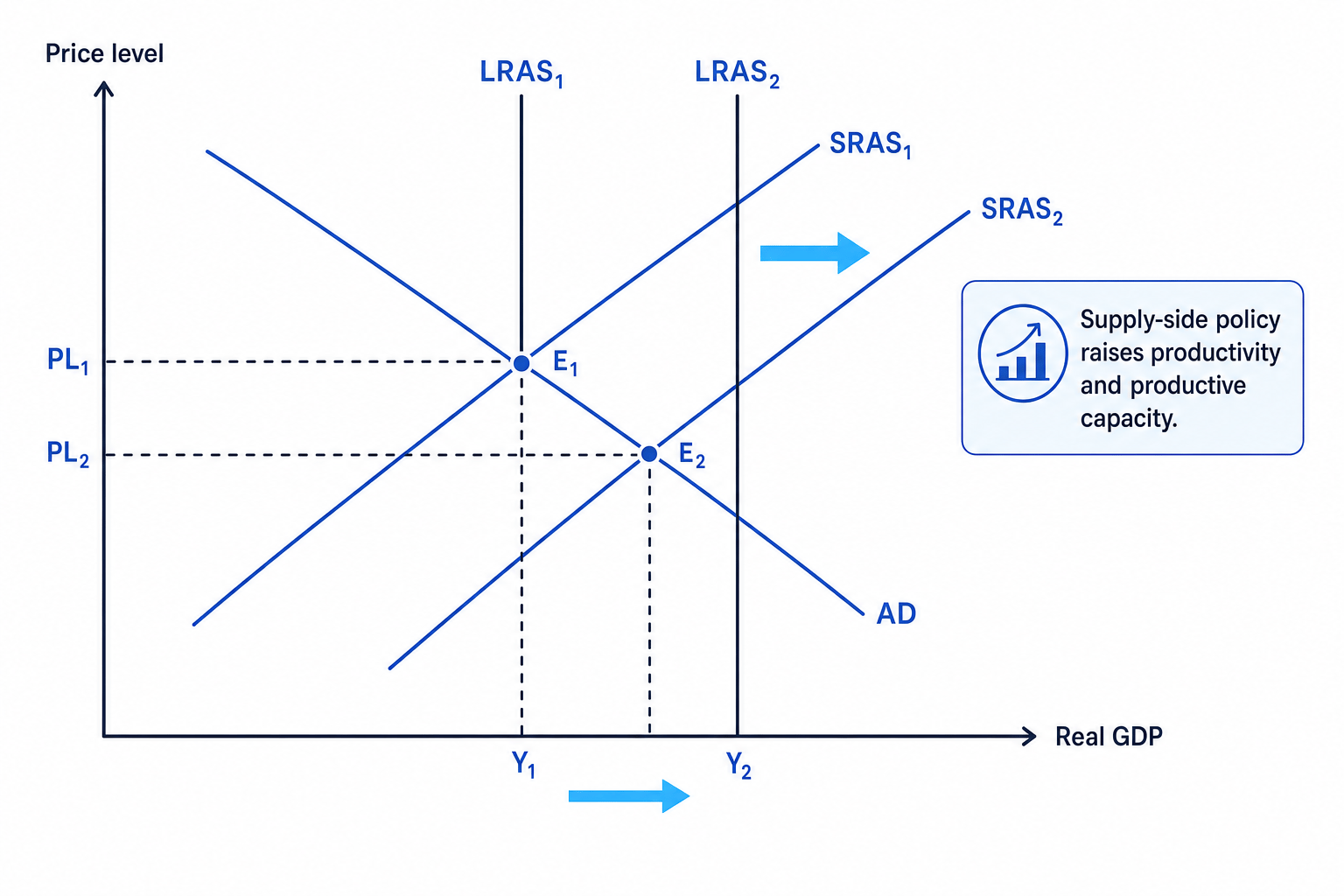
In an AD-AS diagram, supply-side policy is usually shown by a rightward shift of short-run aggregate supply (SRAS), long-run aggregate supply (LRAS), or both. SRAS is the total output firms are willing to produce at different price levels in the short run. LRAS is the economy’s maximum sustainable output when all resources are efficiently used.
The core diagram
If supply-side policy reduces firms’ costs, SRAS shifts right. If it raises the economy’s productive capacity, LRAS shifts right. This can increase real GDP and reduce inflationary pressure at the same time.
Using AD-AS for apprenticeships
- A government-funded apprenticeship programme raises human capital, meaning workers’ skills, knowledge and productivity improve.
- More productive workers reduce unit labour costs, the labour cost of producing one unit of output, so SRAS shifts right. If skills improve permanently, LRAS also shifts right.
- The diagram predicts higher real GDP and a lower price level, helping economic growth, employment and price stability.
Shifting AD instead of AS
Public spending on infrastructure may increase AD in the short run, but the supply-side point is the longer-term increase in productive capacity. In a supply-side answer, make the SRAS/LRAS shift explicit.
2. Privatisation, deregulation and subsidies
Privatisation
Privatisation is the transfer of assets or businesses from the public sector — government-owned organisations — to the private sector, made up of firms and individuals.
The argument is that private firms face a stronger profit motive, meaning they have an incentive to cut costs, innovate and respond to consumers. If this reduces waste, productivity improves and LRAS may shift right.
However, privatisation works best when there is real competition. If a public monopoly becomes a private monopoly, consumers may face higher prices without much efficiency gain.
Deregulation
Deregulation means removing or simplifying government rules in a market. This can reduce business costs, lower barriers to entry and encourage new firms to compete.
For example, reducing planning delays for housing, energy projects or broadband infrastructure could increase investment and productive capacity. But deregulation can create problems if rules were protecting workers, consumers or the environment.
Subsidies
A subsidy is a payment from the government that lowers the cost of production or consumption. A producer subsidy shifts supply to the right in a market because firms can supply more at each price.
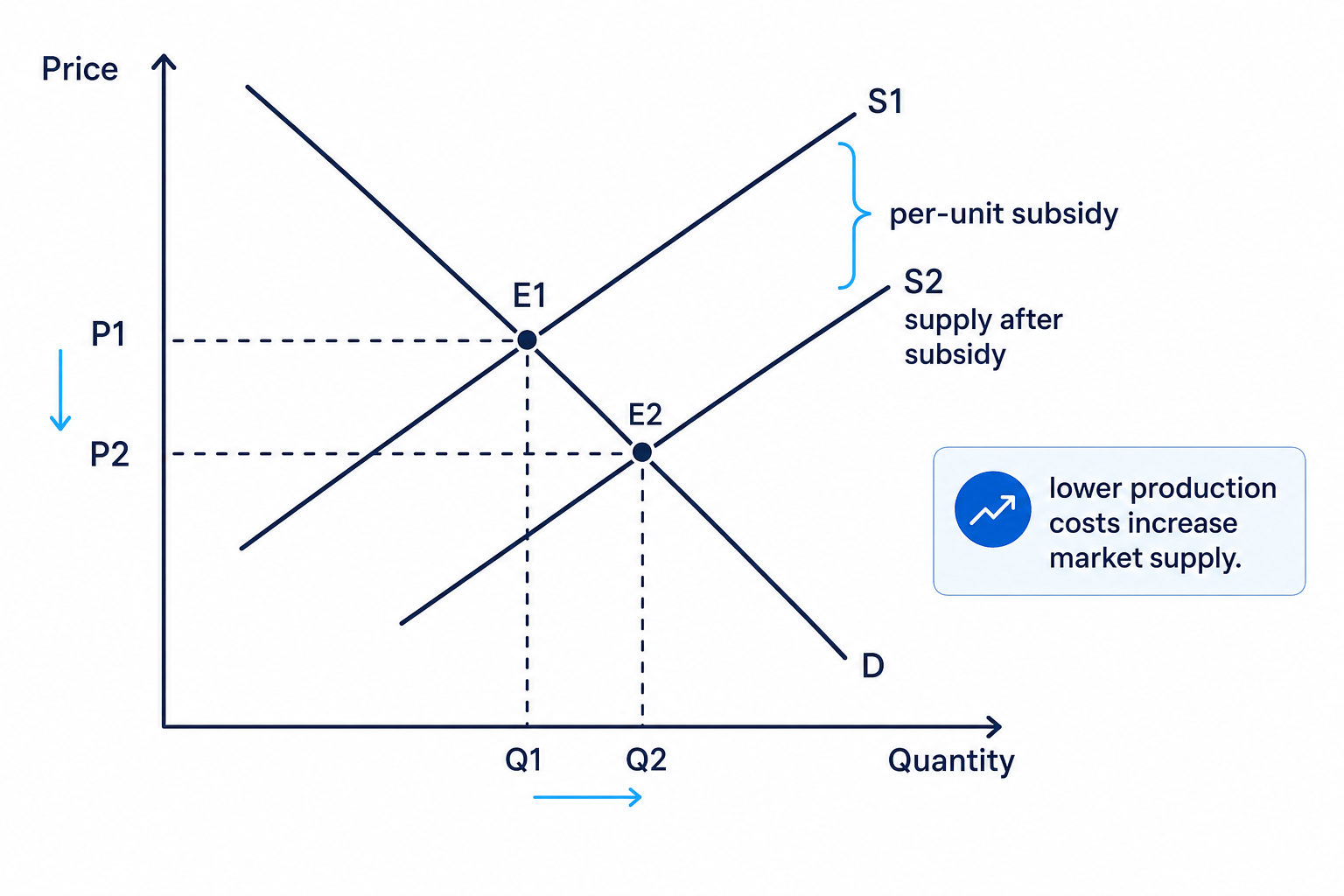
Subsidies can be supply-side policies when they support investment in areas such as green technology, childcare, transport, energy security or research and development.
Tracing a producer subsidy
- Suppose the government subsidises UK battery production. Firms’ production costs fall, so market supply shifts from S1 to S2.
- The equilibrium price falls from P1 to P2 and output rises from Q1 to Q2, making the product more affordable and increasing production.
- If batteries are an important input for electric vehicles, lower costs may spread through the economy, shifting SRAS right; if the industry expands permanently, LRAS may rise too.
3. Competition policy
Competition policy is government action to promote competition and prevent anti-competitive behaviour. In the UK, the Competition and Markets Authority (CMA) investigates issues such as cartels, abusive monopoly power and mergers that may reduce competition.
Competition can improve the supply side because firms under pressure are more likely to cut costs, improve quality and innovate. Productive efficiency means producing at the lowest possible average cost. Dynamic efficiency means improving products and production methods over time.
Analysing a blocked merger
- If two large firms propose a merger, the CMA asks whether the new firm would gain enough market power to raise prices or reduce choice.
- Blocking the merger may preserve competitive pressure, reducing waste and encouraging firms to improve efficiency.
- But if the merger would create economies of scale — lower average costs from larger output — blocking it could prevent cost savings, so the final judgement depends on the market evidence.
Competition policy links microeconomics and macroeconomics neatly: a policy aimed at individual markets can reduce costs across the economy, shifting SRAS and potentially LRAS right.
4. Investment in infrastructure, education, training and R&D
Infrastructure means the basic systems that allow an economy to function, such as roads, rail, ports, energy networks, broadband and water systems. Better infrastructure reduces transport, communication and energy costs for firms.
Education and training improve human capital. This can reduce structural unemployment, which is unemployment caused by a mismatch between workers’ skills or location and the jobs available.
Research and development (R&D) means activity that creates new knowledge, products or production processes. R&D can raise productivity through innovation, especially in sectors such as pharmaceuticals, artificial intelligence, clean energy and advanced manufacturing.
UK examples include R&D tax credits, investment in broadband, green-transition spending, further education reforms, and transport projects such as Crossrail or HS2. These policies are often slow, but they can have large long-run effects.
Best use of the AD-AS diagram
For infrastructure, education, training and R&D, draw LRAS shifting right. If you want to add short-run analysis, also show SRAS shifting right where costs fall, but do not forget the long-run capacity effect.
5. Tax and benefit system reforms
The tax and benefit system affects incentives to work, save, invest and take risks. A marginal tax rate is the percentage of an extra £1 of income paid in tax. A benefit taper is the rate at which welfare payments are withdrawn as someone earns more.
Lower marginal tax rates, lower National Insurance contributions, or smoother benefit tapers can increase the reward from working. This may increase labour supply and reduce unemployment.
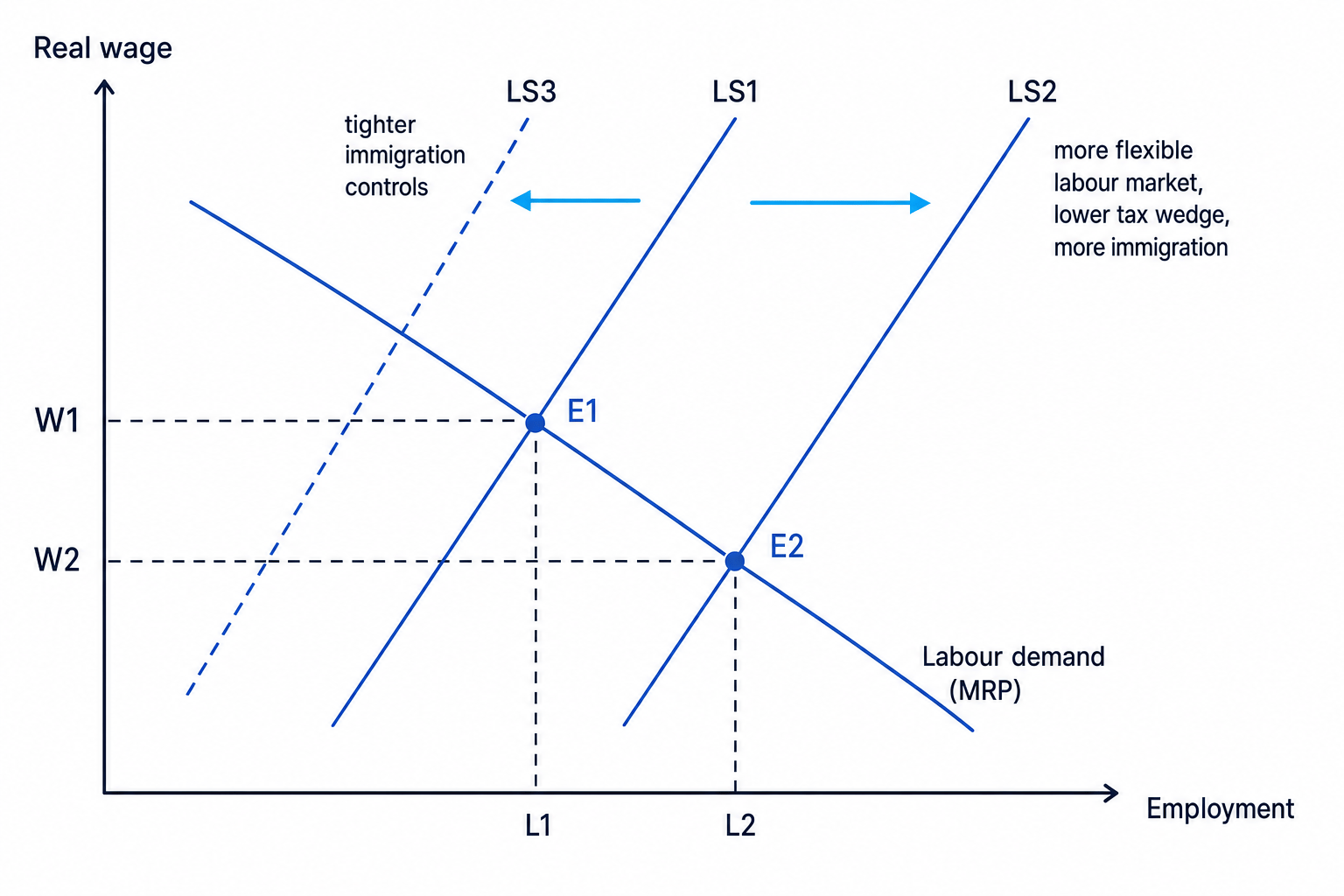
The labour-market diagram below shows labour supply shifting right, increasing employment from L1 to L2. It also shows that tighter immigration controls can shift labour supply left.
Reading the labour market diagram
- A lower benefit taper means workers keep more of each extra £1 earned, so more people are willing to work at each pre-tax wage.
- Labour supply shifts right from LS1 to LS2, increasing employment from L1 to L2. The market wage may fall, but the after-tax reward to work may still rise.
- Higher employment increases potential output, so LRAS can shift right and structural unemployment may fall.
Evaluation matters here. Lower taxes can improve incentives, but they may reduce government revenue used for education, healthcare and infrastructure. Benefit cuts may increase labour supply for some people, but worsen poverty or reduce health, which can damage productivity.
6. Improved labour market flexibility
Labour market flexibility means how easily wages, working hours, job roles and workers can adjust to changes in the economy.
It includes:
- Occupational mobility: how easily workers can move between types of job.
- Geographical mobility: how easily workers can move between regions.
- Wage flexibility: how easily wages adjust to shortages or surpluses.
- Flexible contracts, childcare support, retraining, housing policy and reduced hiring costs.
More flexibility can reduce unemployment and help firms respond to shocks, such as post-pandemic labour shortages or supply-chain disruption. If workers move quickly into expanding sectors, output rises and LRAS shifts right.
But flexibility can have costs. Too much job insecurity may reduce morale, training and productivity. Zero-hours contracts may help some workers but create unstable incomes for others.
7. Immigration control
Immigration control means rules affecting who can enter a country to live and work. This is not automatically “less immigration”; it may mean a points-based system targeting specific skills.
Easing immigration for skilled workers can shift labour supply right, reduce shortages and increase productive capacity. This has been important in UK sectors such as the NHS, social care, agriculture, hospitality and construction.
Tighter immigration controls shift labour supply left, as shown by LS3 in the labour-market diagram. This may raise wages for some workers, but it can also worsen labour shortages, increase firms’ costs and shift SRAS left.
Assuming immigration control always raises LRAS
A selective policy that attracts scarce skills may raise LRAS. A restriction that reduces the available workforce may lower LRAS. Always explain the direction of the labour supply effect.
8. Evaluating supply-side policies
Supply-side policies can be powerful because they target the economy’s capacity, not just spending. They can support several macroeconomic objectives at once: higher growth, lower unemployment, lower inflationary pressure, better international competitiveness and an improved balance of payments, which records transactions with the rest of the world.
However, effectiveness depends on the policy and context.
Why they may work well
Supply-side policies are especially useful when the economy faces capacity problems. For example, if the UK has labour shortages, weak productivity growth or high energy costs, policies improving skills, infrastructure and competition can raise output without simply creating more inflation.
They are also important after shocks. Following Brexit trade frictions, global supply-chain problems and the cost-of-living squeeze, policies that reduce costs and improve resilience can help firms compete.
Why they may disappoint
Many supply-side policies have long time lags. Education, infrastructure and R&D may take years to affect productivity. There is also an opportunity cost: money spent on subsidies or transport cannot be spent elsewhere.
There is a risk of government failure, meaning intervention creates inefficiency because of poor information, weak incentives or political pressure. For example, subsidies may support firms that would have invested anyway.
Overall judgement
The strongest judgement is that supply-side policy is usually most effective for long-run growth and structural unemployment, but less reliable for short-run demand problems. If unemployment is caused by weak AD, training alone will not create jobs quickly. A strong answer compares supply-side policy with fiscal or monetary policy and explains why the best mix depends on the cause of the problem.
In the exam
- Start with a clear definition, then identify the transmission mechanism: policy → incentives/costs/productivity/labour supply → SRAS or LRAS shift → macro objective.
- Use the correct diagram: AD-AS for productive capacity, a market supply diagram for subsidies, and a labour-market diagram for tax, flexibility or immigration policies.
- Evaluate with context: consider time lags, cost, opportunity cost, government failure, distributional effects and whether the problem is short-run demand or long-run supply.
Check yourself
- Why might education and training shift LRAS rather than just SRAS?
- How could deregulation improve efficiency but also create market failure?
- In what circumstances would tighter immigration controls reduce productive capacity?