Policy conflicts
What you'll learn
- What a policy conflict is, and how it differs from a simple policy choice.
- Why major objectives like growth, low inflation, low unemployment and environmental protection can clash.
- How to use the short-run Phillips curve to explain an inflation–unemployment trade-off.
- How to evaluate conflicts by considering time period, context, magnitude and stakeholder effects.
The starting point: governments have multiple objectives
Governments and central banks do not usually pursue just one goal. In UK macroeconomics, common objectives include:
- Sustainable economic growth — increasing real GDP over time without creating major instability.
- Low and stable inflation — keeping the general price level rising slowly and predictably. In the UK, the Bank of England has a 2% CPI inflation target.
- Low unemployment — ensuring people who are willing and able to work can find jobs.
- Balance of payments stability — avoiding persistent external imbalances, especially large current account deficits.
- Sound public finances — keeping government borrowing and national debt manageable.
- Equitable income distribution — reducing excessive inequality and poverty.
- Environmental sustainability — protecting natural resources and limiting pollution.
Policy objective
A policy objective is a target or goal that policymakers try to achieve, such as low inflation, economic growth or lower unemployment.
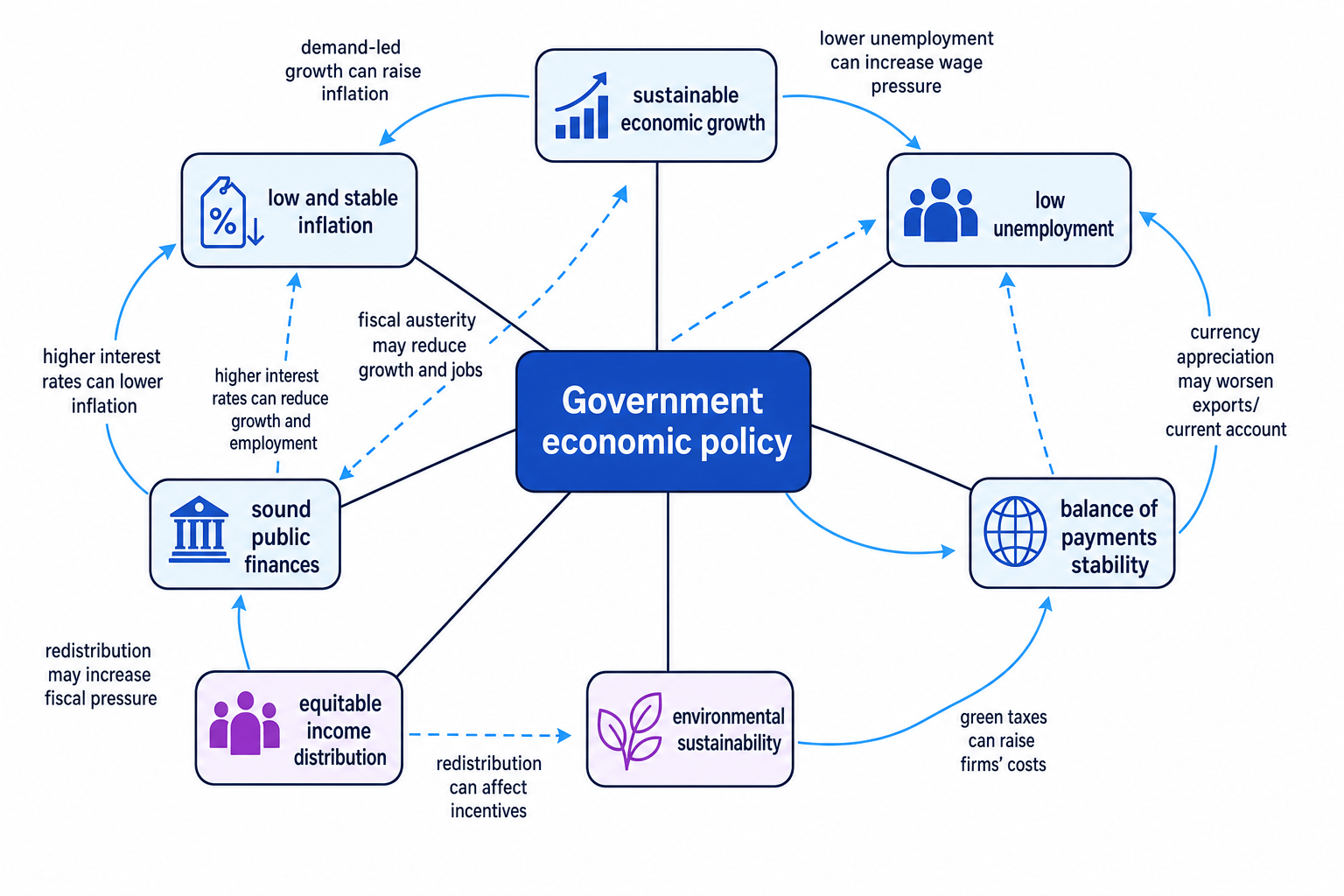
The difficulty is that the same policy can help one objective while harming another. This is why policy decisions are often about judgement, not just “choosing the correct policy”.
A conflict map helps you see that policy objectives are connected, not separate boxes to memorise.
What is a policy conflict?
Policy conflict
A policy conflict occurs when achieving progress towards one policy objective makes it harder to achieve another objective.
A closely related term is trade-off.
Trade-off
A trade-off is a situation where gaining more of one desirable outcome means accepting less of another desirable outcome.
For example, an expansionary fiscal policy, such as higher government spending or lower taxes, may increase aggregate demand. This can raise real GDP and reduce unemployment, but it may also increase inflationary pressure and worsen the budget deficit.
The big idea
Policy conflicts exist because resources are scarce, economies have capacity limits, and policies affect different groups in different ways.
Why conflicts happen
1. Demand-side pressure
Aggregate demand is total planned spending in the economy. It includes consumption, investment, government spending and net exports.
When the economy has spare capacity, higher aggregate demand can raise output and employment with limited inflation. But when the economy is close to full capacity, higher demand may mainly push up prices.
So a demand-side policy can create a conflict:
- More growth and employment
- But higher inflation and possibly more imports
Expansionary fiscal policy and conflicting objectives
Suppose the UK government increases infrastructure spending during a period of low unemployment and high inflation.
- Higher government spending directly increases aggregate demand because government spending is one component of AD.
- Firms receive more orders and may hire more workers, so real GDP and employment rise in the short run.
- If firms are already near full capacity, they may respond by raising prices and wages, creating demand-pull inflation.
- The policy therefore supports growth and employment but conflicts with low inflation and may also increase government borrowing.
2. Supply-side limits
Aggregate supply is the total output firms are willing and able to produce at different price levels.
If the productive capacity of the economy grows slowly, policymakers face tougher trade-offs. Trying to expand demand faster than supply can cause inflation. This was relevant during the post-pandemic period, when global supply-chain shocks, energy price rises and labour-market tightness limited how quickly output could expand.
3. Distributional effects
A policy may improve the average performance of the economy but hurt particular groups.
For example, higher interest rates may reduce inflation, helping savers and those on fixed incomes. But they raise mortgage costs for many households and can reduce investment by firms.
Ignoring who gains and loses
Do not evaluate a policy conflict only at the national level. Strong answers consider stakeholders: households, firms, workers, taxpayers, exporters, importers, future generations and the government.
The inflation–unemployment conflict
One of the classic macroeconomic policy conflicts is between low inflation and low unemployment.
In the short run, higher aggregate demand can reduce unemployment because firms need more labour to produce more output. However, this can also raise inflation as wages and prices increase.
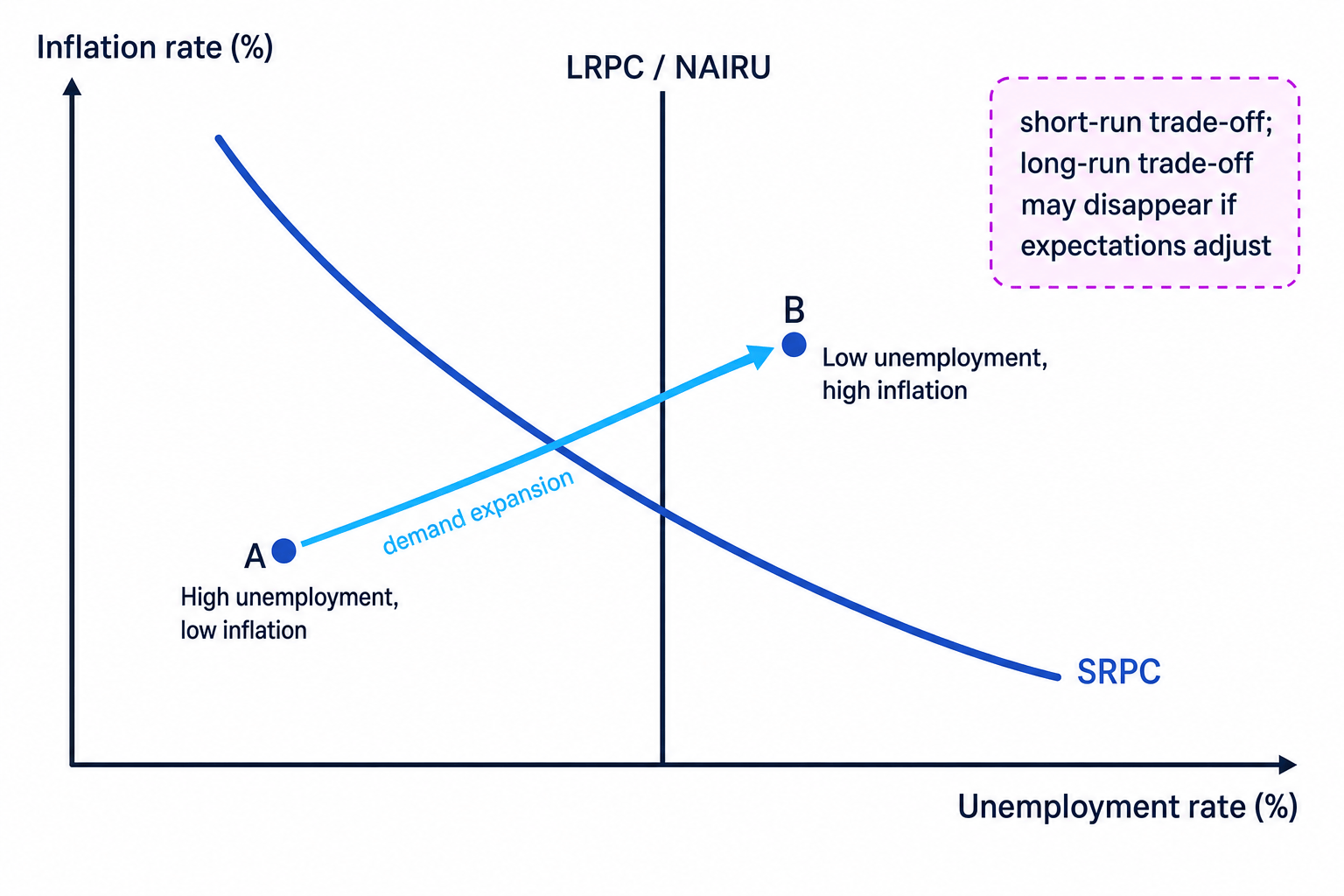
This relationship is often shown using the short-run Phillips curve.
Short-run Phillips curve
The short-run Phillips curve shows an inverse relationship between inflation and unemployment in the short run: lower unemployment is associated with higher inflation, and higher unemployment is associated with lower inflation.
The diagram below shows a movement from point A to point B. A demand expansion reduces unemployment but increases inflation.
Why the trade-off may not last
In the long run, workers and firms may adjust their inflation expectations. If people expect higher inflation, workers demand higher wages and firms raise prices in advance. This can shift the short-run Phillips curve upwards.
The long-run Phillips curve is often drawn as vertical at the NAIRU.
NAIRU
The NAIRU is the non-accelerating inflation rate of unemployment: the unemployment rate at which inflation is stable, rather than rising or falling.
This means policymakers may not be able to permanently lower unemployment below the NAIRU using demand-side stimulus. They may only create accelerating inflation.
Short run versus long run
A useful evaluation phrase is: “There may be a short-run trade-off, but the long-run conflict depends on whether the policy improves productive capacity.”
Common policy conflicts you should know
Growth versus inflation
Expansionary fiscal or monetary policy can increase growth by raising aggregate demand. But if the economy is near full capacity, this may cause demand-pull inflation.
UK context: during the cost-of-living squeeze, policymakers faced a difficult choice. Supporting household incomes could protect living standards and consumption, but too much demand support risked worsening inflationary pressure.
Inflation versus unemployment
Contractionary monetary policy, such as higher Bank of England interest rates, can reduce inflation by lowering consumption and investment. But lower spending can reduce firms’ revenues, causing slower growth and higher unemployment.
Growth versus the balance of payments
Higher domestic growth can increase imports because households and firms buy more foreign goods and services. If exports do not rise equally, the current account deficit may widen.
This matters for the UK because the UK has often run current account deficits. Strong domestic demand can therefore conflict with external balance.
Inflation versus the balance of payments
Higher interest rates may reduce inflation and attract financial inflows, causing the pound to appreciate. A stronger pound makes imports cheaper, which can also reduce inflation. However, it makes UK exports more expensive to overseas buyers, potentially worsening export competitiveness.
Using the exchange-rate convention: if the rate moves from £1 = 1.25to£1=1.25 to £1 = 1.25to£1=1.35, the pound has appreciated.
Environmental sustainability versus growth
Policies such as carbon taxes, stricter regulation or investment in cleaner production can reduce pollution. But in the short run they may raise firms’ costs, reduce competitiveness and increase prices.
However, this conflict is not automatic. Green investment can also create jobs, stimulate innovation and reduce long-run energy dependence.
Equity versus incentives
Redistribution through progressive taxation and welfare spending can reduce inequality and poverty. But if marginal tax rates become very high, some economists argue that incentives to work, invest or take risks may weaken.
This is debated. The actual effect depends on the tax rate, labour-market conditions, public service quality and how the revenue is used.
Evaluating a carbon tax
A government introduces a carbon tax on firms that produce high emissions.
- The tax raises the private cost of production for polluting firms, giving them an incentive to reduce emissions or switch to cleaner methods.
- This supports environmental sustainability and can correct a negative externality, improving allocative efficiency.
- However, firms may pass higher costs on to consumers, increasing prices and reducing real household incomes.
- The judgement depends on design: if tax revenue is used to support low-income households or fund green technology, the conflict with equity and growth may be reduced.
Policies can also complement each other
A complementarity occurs when progress on one objective helps another objective.
Complementarity
A complementarity is when achieving one policy objective supports progress towards another objective.
For example, supply-side policies such as education, training, infrastructure and research spending can increase productive capacity. This may allow higher growth with less inflationary pressure.
Well-designed green investment may also support environmental goals, employment and long-run growth at the same time.
Not every relationship is a conflict
The best evaluation often says: “This policy creates a conflict in the short run, but may reduce conflicts in the long run if it improves aggregate supply.”
How to evaluate policy conflicts
For OCR evaluation, you need to weigh up both sides and reach a supported judgement. The strongest answers usually consider four things.
1. The state of the economy
A stimulus policy is less inflationary when there is spare capacity and high unemployment. It is more inflationary when the economy is near full employment.
2. The time period
Short-run conflicts may disappear in the long run if the policy improves productivity. But some policies, such as badly targeted subsidies, may create long-run inefficiency.
3. The size of the effect
A small interest rate rise may have limited impact. A sharp increase in rates may strongly reduce inflation but also cause a large fall in investment and housing-market activity.
4. Policy design and coordination
Conflicts can be reduced if policies are combined carefully. For example, the Bank of England may use monetary policy to reduce inflation while the government uses targeted fiscal support for low-income households.
Conflicts are context-dependent
Avoid claiming that one objective always conflicts with another. Whether a conflict occurs depends on spare capacity, expectations, global conditions, policy size and how the policy is financed.
Building a judgement
A strong judgement does not simply say, “It depends.” It explains what it depends on and which factor matters most.
A good structure is:
- Identify the main objective being targeted.
- Explain the transmission mechanism.
- Analyse the conflicting objective.
- Evaluate using short run versus long run, context and policy design.
- Reach a reasoned judgement.
Judging an interest rate rise
The Bank of England raises interest rates to reduce inflation.
- Higher interest rates increase the reward for saving and the cost of borrowing, reducing consumption and investment.
- Lower aggregate demand reduces demand-pull inflationary pressure, helping the inflation objective.
- However, weaker spending may reduce real GDP growth and increase unemployment, especially in interest-sensitive sectors such as housing and construction.
- The policy may be justified if inflation is far above target and expectations are becoming embedded, but the conflict is more serious if inflation is mainly caused by external supply shocks such as energy prices.
In the exam
- Name the conflicting objectives clearly — for example, “low inflation conflicts with low unemployment” rather than vaguely saying “there are problems”.
- Use a chain of analysis — policy change → effect on AD/AS/incentives → effect on target objective → effect on conflicting objective.
- Evaluate with context — judge whether the conflict is short-run or long-run, large or small, and whether policy design could reduce it.
Check yourself
- Why might expansionary fiscal policy create a conflict between growth and inflation?
- How can supply-side policies reduce some policy conflicts in the long run?
- Why might a carbon tax create both environmental benefits and distributional concerns?