Monetary policy
What you'll learn
- How the Bank of England uses interest rates, the money supply and quantitative easing to influence the economy.
- How inflation targeting helps shape expectations and decision-making.
- How monetary policy affects aggregate demand, exchange rates, output and inflation.
- How to evaluate whether monetary policy can achieve the government’s macroeconomic objectives.
1. The basic idea: what is monetary policy?
Monetary policy
Monetary policy is the use of interest rates, money supply measures and other central bank tools to influence aggregate demand, inflation, output and employment.
In the UK, monetary policy is mainly carried out by the Bank of England, the UK’s central bank. Its Monetary Policy Committee (MPC) sets Bank Rate, which is the interest rate the Bank of England pays on reserves held by commercial banks. A commercial bank is a bank that accepts deposits and makes loans to households and firms.
The Bank of England’s main target is price stability, currently defined as 2% CPI inflation. CPI inflation means the annual percentage change in the Consumer Prices Index, a measure of the average price level of a basket of consumer goods and services.
2. Prerequisite: aggregate demand
Aggregate demand
Aggregate demand (AD) is total planned spending in the economy at a given price level:
AD=C+I+G+(X−M)AD = C + I + G + (X - M)AD=C+I+G+(X−M)
where C is consumption, I is investment, G is government spending, X is exports and M is imports.
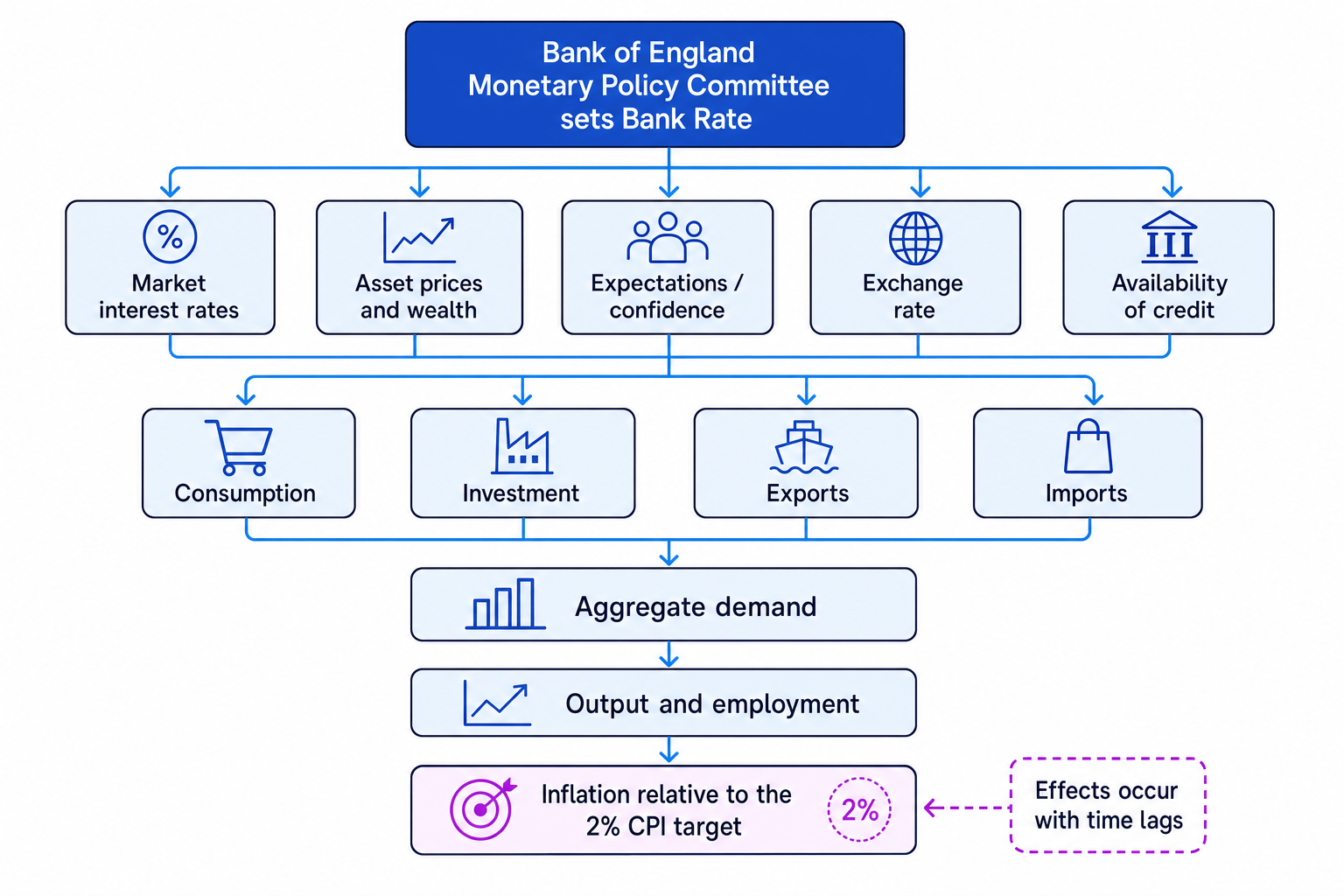
Monetary policy mainly affects C, I, X and M. For example, lower interest rates can encourage households to borrow and spend, firms to invest, and may cause a depreciation of the pound, making exports more competitive.
If the economy has spare capacity, higher AD can raise real GDP and reduce unemployment. If the economy is already close to full capacity, higher AD is more likely to create inflationary pressure.
Transmission mechanism
The monetary transmission mechanism is the chain of effects from a central bank decision, such as changing Bank Rate, through financial markets and spending decisions, to output, employment and inflation.
3. Changes in interest rates
Interest rate
An interest rate is the cost of borrowing money or the reward for saving money, usually expressed as a percentage per year.
When the MPC cuts Bank Rate, market interest rates usually fall. This can:
- make borrowing cheaper for households and firms
- reduce the reward from saving
- lower mortgage payments for some households, especially those on variable-rate mortgages
- increase consumption and investment
- increase aggregate demand
When the MPC raises Bank Rate, the opposite usually happens. Borrowing becomes more expensive, saving becomes more attractive, and AD is likely to fall.
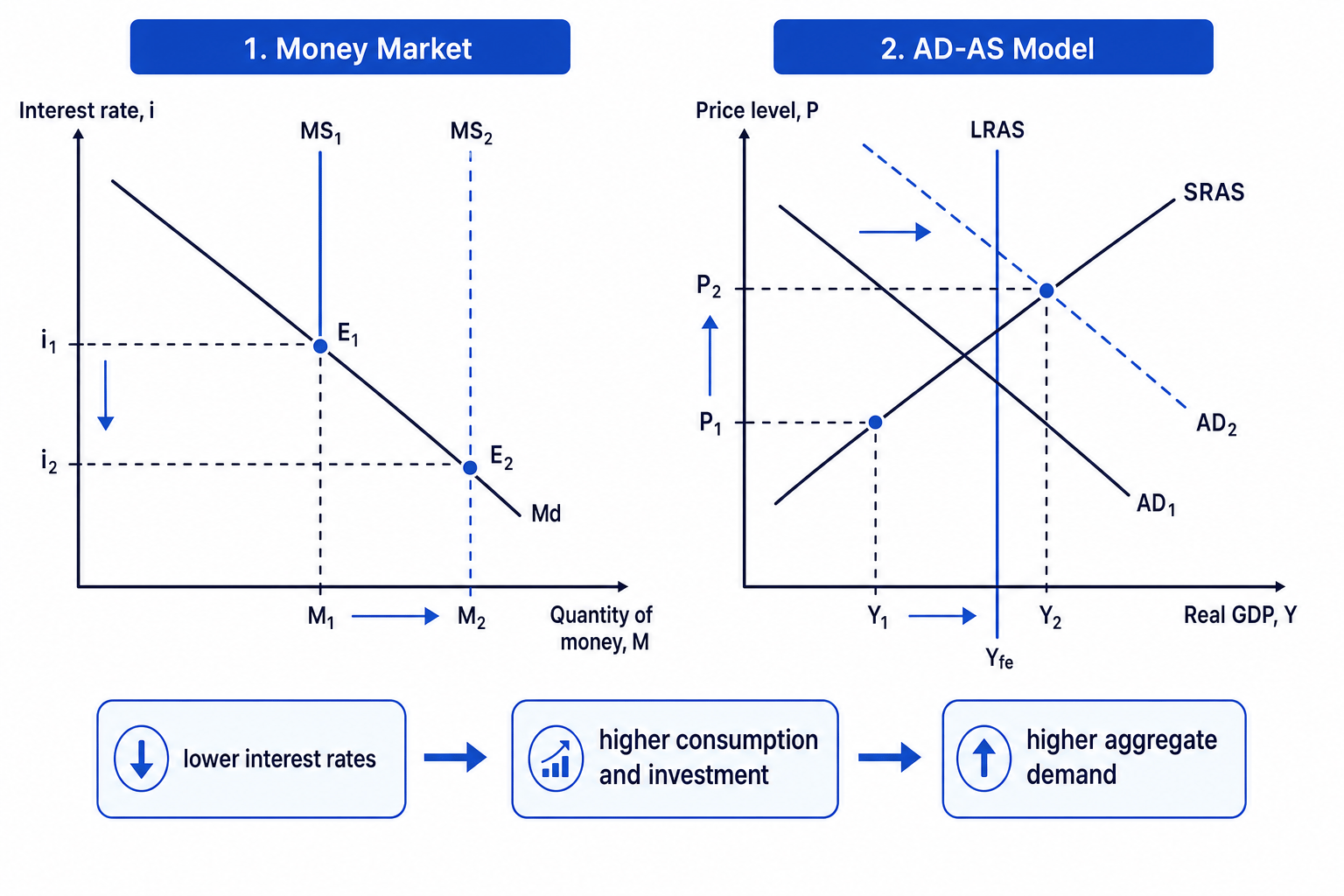
The AD-AS part of the diagram shows expansionary monetary policy shifting AD to the right. The money-market part shows how an increase in the money supply can lower the equilibrium interest rate.
Tracing a Bank Rate cut through aggregate demand
- The MPC cuts Bank Rate, so commercial banks can usually borrow and lend at lower rates.
- Lower loan and mortgage rates reduce the cost of borrowing, so some households increase consumption and some firms approve more investment projects.
- Consumption and investment are components of AD, so AD rises from AD1 to AD2.
- If the economy has spare capacity, real GDP and employment rise; if it is near full employment, the main effect is likely to be a higher price level.
Nominal and real interest rates
Real interest rate
The real interest rate is the nominal interest rate adjusted for inflation. A simple approximation is:
r≈i−πr \approx i - \pir≈i−π
where rrr is the real interest rate, iii is the nominal interest rate and π\piπ is the inflation rate.
This matters because households and firms respond to the real cost of borrowing. If inflation is high, even a high nominal interest rate may not feel very restrictive.
Calculating the real interest rate
- Suppose the nominal interest rate is 5.25% and inflation is 6.70%.
- Substitute into the approximation: r≈i−πr \approx i - \pir≈i−π.
- So the real interest rate is approximately 5.25% minus 6.70% = -1.45 percentage points.
- A negative real interest rate means the value of money borrowed is being eroded by inflation faster than the nominal interest being charged.
4. Changes in the money supply
Money supply
The money supply is the amount of money circulating in the economy, including cash and bank deposits. A broader measure includes easily accessible savings and other liquid financial assets.
In a simple money-market diagram, the money supply is shown as a vertical line. If the central bank increases the money supply, the supply curve shifts right. Given downward-sloping money demand, the equilibrium interest rate falls.
Lower interest rates then increase consumption and investment, shifting AD to the right. This is why money supply changes are linked to output and inflation.
A monetarist view, associated with Milton Friedman, argues that sustained excessive money growth is a major cause of inflation. A simplified version uses the Fisher equation of exchange:
MV=PQMV = PQMV=PQ
where MMM is money supply, VVV is the velocity of circulation, PPP is the price level and QQQ is real output.
Money supply is not a perfect tap
Do not write as if the Bank of England can perfectly control every pound in circulation. In modern banking systems, commercial bank lending also creates deposits, so broad money can be partly endogenous, meaning influenced by behaviour inside the economy.
5. Inflation rate targets
Inflation target
An inflation target is a publicly announced rate of inflation that the central bank aims to achieve over the medium term. In the UK, the target is 2% CPI inflation.
Inflation targeting helps because it shapes expectations. If workers, firms and financial markets believe inflation will return to 2%, wage demands and price-setting may become more stable.
If forecast inflation is above target, the MPC may raise Bank Rate to reduce AD. If forecast inflation is below target, it may cut Bank Rate to support spending.
The target is symmetric: inflation persistently below 2% is also a problem, because weak price growth may signal weak demand and can make debt burdens harder to manage.
Use the target in your chain of analysis
A strong answer does not just say “interest rates rise”. Link it to the target: higher Bank Rate → lower AD → reduced demand-pull inflationary pressure → CPI inflation moves back towards 2%.
6. Quantitative easing
Quantitative easing
Quantitative easing (QE) is when the central bank creates electronic money to buy financial assets, usually government bonds, from financial institutions.
QE is usually used when Bank Rate is very low and the central bank wants to provide extra stimulus. By buying bonds, the Bank of England increases demand for bonds, pushing bond prices up and bond yields down.
A bond yield is the return an investor receives from holding a bond, expressed as a percentage of the bond’s price. Lower yields can reduce long-term borrowing costs for firms and the government.
QE may also raise asset prices, increase wealth, improve confidence and encourage lending. These channels can increase AD.
Bond prices and yields under QE
- Suppose a government bond pays a fixed annual coupon of £40 and initially has a price of £1,000.
- The initial yield is £40÷£1,000×100=4%£40 \div £1{,}000 \times 100 = 4\%£40÷£1,000×100=4%.
- If QE raises demand for the bond and its price rises to £1,250, the yield becomes £40÷£1,250×100=3.2%£40 \div £1{,}250 \times 100 = 3.2\%£40÷£1,250×100=3.2%.
- The bond has become more expensive, so the return as a percentage of its price has fallen. This is how QE can reduce long-term borrowing costs.
QE is not handing cash to households
QE is not the same as the government sending money directly to consumers. It is a central bank asset-purchase programme operating mainly through financial markets, bond yields, asset prices and confidence.
7. Influence of exchange rates
Exchange rate
An exchange rate is the price of one currency in terms of another. For example, £1 = $1.25 means one pound buys 1.25 US dollars.
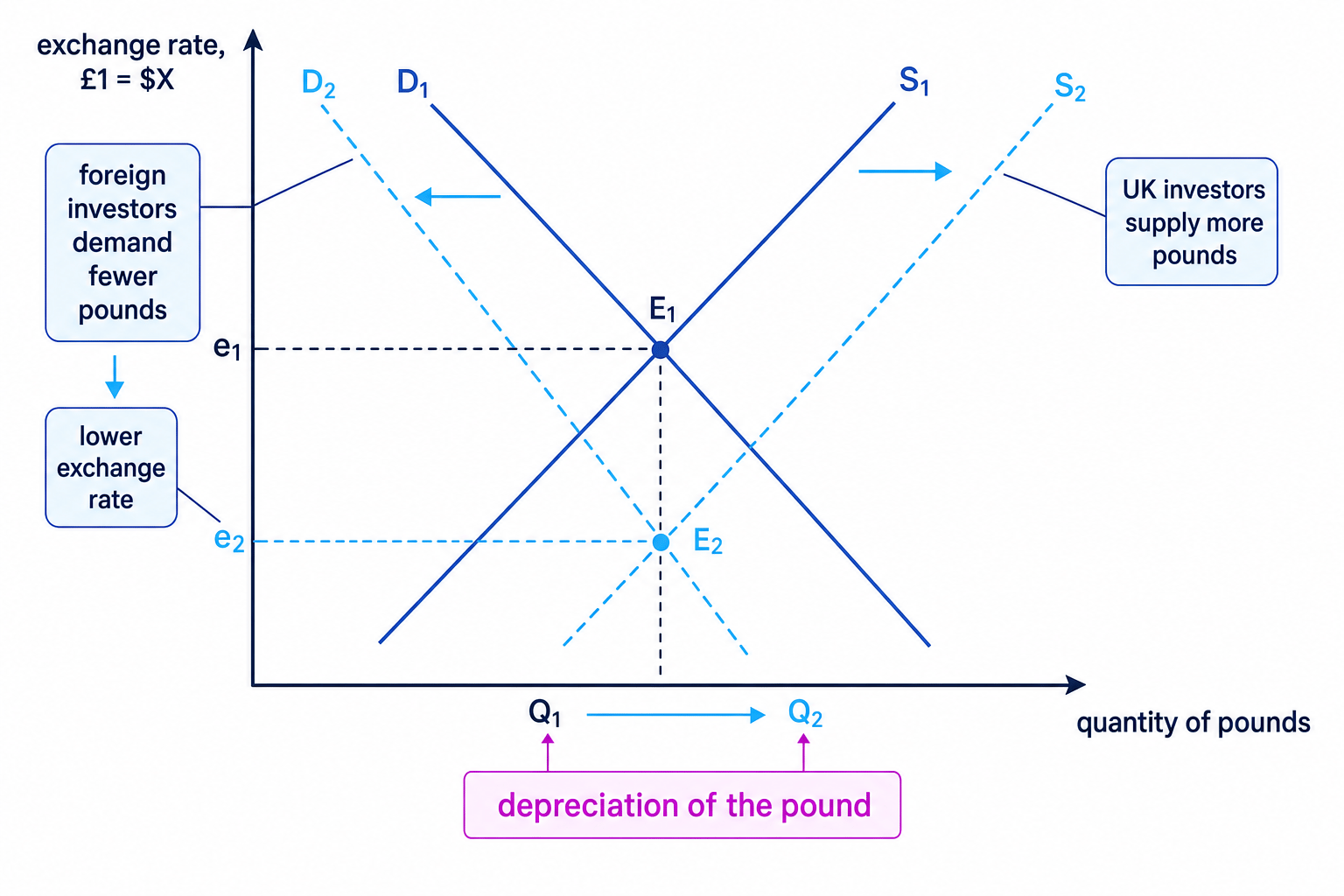
Monetary policy affects exchange rates because interest rates influence international capital flows. If UK interest rates fall relative to other countries, foreign investors may demand fewer pounds, while UK investors may supply more pounds to buy foreign assets. This can cause a depreciation of the pound, meaning the pound falls in value.
A depreciation can:
- make UK exports cheaper for overseas buyers
- make imports more expensive for UK consumers and firms
- increase net exports, raising AD
- increase import-price inflation, especially for energy, food and raw materials
A rise in UK interest rates can cause an appreciation, making the pound stronger. This may reduce imported inflation but can weaken export competitiveness.
Calculating the import-price effect of depreciation
- Suppose a US product costs 100andtheexchangerateisinitially£1=100 and the exchange rate is initially £1 = 100andtheexchangerateisinitially£1=1.25.
- The UK price is $100 divided by 1.25 = £80.
- If the pound depreciates to £1 = 1.10,theUKpricebecomes1.10, the UK price becomes 1.10,theUKpricebecomes100 divided by 1.10 = £90.91.
- The depreciation has made the imported product more expensive in pounds, adding to UK inflationary pressure.
Reading the exchange-rate axis backwards
On a diagram labelled £1 = X,alowervaluemeansthepoundhasdepreciated.Forexample,£1=X, a lower value means the pound has depreciated. For example, £1 = X,alowervaluemeansthepoundhasdepreciated.Forexample,£1=1.10 is weaker than £1 = $1.25.
8. Evaluating monetary policy
Monetary policy can be powerful, but its effectiveness depends on the cause of the problem, the state of the economy and how households, firms and financial markets respond.
Why it can be effective
Monetary policy is flexible. The MPC meets regularly, so Bank Rate can be changed faster than many tax or spending policies. Because the Bank of England is operationally independent, its decisions may be more credible and less politically motivated.
It is also economy-wide. Interest rates affect mortgages, loans, saving, investment, asset prices and exchange rates. This gives monetary policy several channels through which it can influence AD.
Inflation targeting can anchor expectations. If people trust the Bank of England to return inflation to 2%, the economy may avoid a wage-price spiral, where higher wages push up firms’ costs and prices, leading workers to demand even higher wages.
Why it may be less effective
There are time lags. A Bank Rate change may take 12–24 months to have its full effect on inflation. This makes policy difficult when the economy is changing quickly.
Monetary policy is weaker against supply-side inflation. For example, during the cost-of-living squeeze, much UK inflation came from energy prices, global supply-chain disruption and food costs. Higher interest rates can reduce demand, but they cannot directly produce more gas, wheat or microchips.
The effects are uneven. Higher interest rates strongly affect households with variable-rate mortgages or firms needing credit, but savers may benefit. QE may support growth but can also raise asset prices, benefiting wealthier households who already own property and financial assets.
There is also a possible trade-off between objectives. Raising interest rates may reduce inflation, but it can also weaken growth and increase unemployment. Cutting interest rates may support employment, but it can increase demand-pull inflation or weaken the pound.
Overall judgement
Monetary policy is usually most effective for managing demand-side fluctuations and inflation expectations. It is less effective on its own when inflation is caused by supply shocks or when structural problems, such as weak productivity, are holding back growth.
For evaluation, a strong judgement compares alternatives. Fiscal policy may be better targeted at specific groups, such as energy bill support for low-income households, while supply-side policy may be needed to improve productivity, labour-market participation and energy security. Monetary policy is important, but it is rarely the whole solution.
In the exam
- Build a full chain: policy instrument → transmission channel → AD or AS effect → macro objective.
- Use diagrams actively: explain the shift, the new equilibrium, and what happens to real GDP, employment, inflation or the exchange rate.
- Evaluate with conditions: say whether policy is more effective in the short run or long run, with spare capacity or near full employment, and for demand-pull inflation or supply-side inflation.
Check yourself
- How does a cut in Bank Rate affect consumption, investment and aggregate demand?
- Why might QE reduce bond yields and support spending?
- Why is monetary policy less effective when inflation is mainly caused by global energy prices?