x

Demand for labour

What you'll learn

  • Why firms’ demand for workers depends on demand for the goods and services those workers help produce.
  • How marginal revenue product explains employment and wage decisions.
  • What makes demand for labour more or less wage elastic.
  • How productivity affects unit labour costs and competitiveness.

The starting point: why firms demand labour

Firms do not usually hire workers “for their own sake”. They hire workers because labour helps produce output, and output can be sold to earn revenue.

So the demand for labour is part of the factor market: the market for factors of production such as labour, land, capital and enterprise. Workers supply labour; firms demand labour.

Definition

Demand for labour

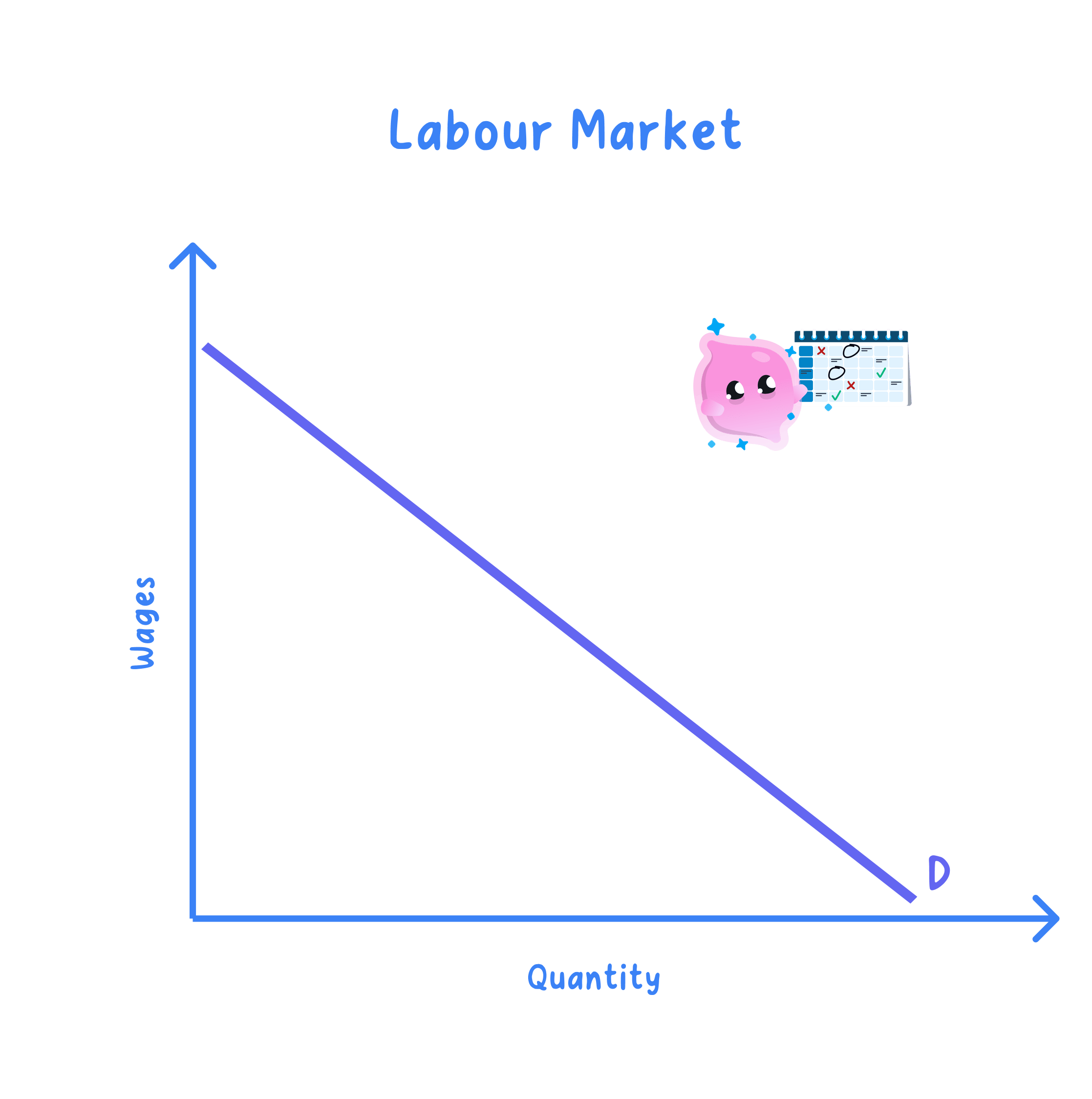
Demand for labour is the quantity of workers, or hours of work, that employers are willing and able to hire at different wage rates over a period of time.

The wage rate is the “price” of labour. For example, if a warehouse pays £12 per hour, that is the hourly wage rate faced by the employer.

Derived demand for labour

Definition

Derived demand

Derived demand means demand for a factor of production comes from demand for the final good or service it helps produce.

This is central to labour markets. If consumers want more restaurant meals, restaurants may demand more chefs, waiters and cleaners. If demand for printed newspapers falls, demand for printing workers may fall too.

Key Idea

Labour demand comes from product demand

A firm’s demand for labour is derived from the value of the output workers can help produce and sell.

Example

Tracing derived demand in an industry

  1. Suppose demand for UK electric vehicles rises as consumers respond to lower running costs and green-transition policies.
  2. Car producers expect to sell more vehicles, so the expected revenue from extra output increases.
  3. They may demand more battery engineers, software specialists and assembly workers because those workers help produce the extra vehicles.
  4. If the extra workers add more to revenue than they add to costs, employment in that part of the industry is likely to rise.

Marginal revenue product theory

To understand how many workers a profit-maximising firm hires, you need three linked ideas.

Definition

Marginal product, marginal revenue and MRP

Marginal product of labour is the extra output produced by employing one more worker, holding other factors constant.
Marginal revenue is the extra revenue gained from selling one more unit of output.
Marginal revenue product of labour is the extra revenue generated by employing one more worker:

MRPL=MPL×MRMRP_L = MP_L \times MRMRPL​=MPL​×MR

A firm will usually hire labour up to the point where the extra revenue from the last worker equals the extra cost of hiring that worker.

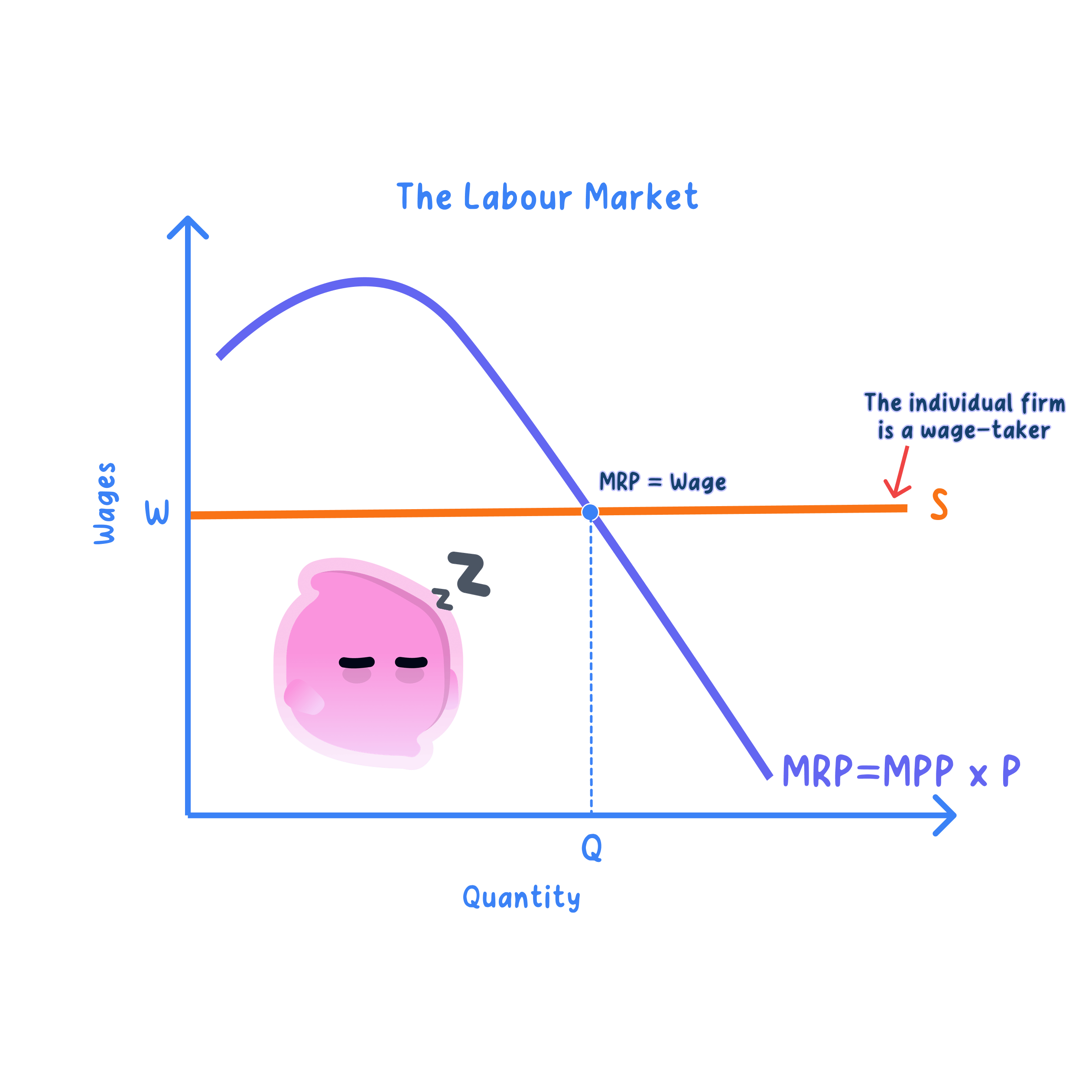
In a competitive labour market, the firm is a wage taker: it accepts the market wage. The marginal cost of labour is therefore equal to the wage rate. The hiring rule is:

MRPL=MCLMRP_L = MCLMRPL​=MCL

If the labour market is competitive, this becomes:

MRPL=WMRP_L = WMRPL​=W

where WWW is the wage rate.

The diagram shows how the industry wage is determined by labour demand and supply, then how an individual competitive firm hires workers up to the point where the wage equals marginal revenue product.

Two-panel diagram showing industry labour market equilibrium wage and a competitive firm hiring labour where MRP equals the wage

The firm’s MRP curve slopes downwards mainly because of diminishing marginal returns: in the short run, as more workers are added to fixed capital, each extra worker may add less extra output than the previous worker.

Example

Using MRP to decide employment

A firm sells each unit of output for £10. The daily wage is £120. Extra workers add the following output: worker 1 adds 20 units, worker 2 adds 18 units, worker 3 adds 14 units, worker 4 adds 10 units.

  1. Calculate each worker’s MRP using MRPL=MPL×MRMRP_L = MP_L \times MRMRPL​=MPL​×MR: worker 1 adds £200, worker 2 adds £180, worker 3 adds £140, and worker 4 adds £100.
  2. Compare each worker’s MRP with the daily wage of £120. The first three workers each add more revenue than they cost.
  3. The fourth worker adds only £100 of revenue but costs £120, so employing the fourth worker would reduce profit.
  4. The firm hires 3 workers, because the third worker’s MRP is above the wage but the fourth worker’s MRP is below it.
Common Mistake

Forgetting the marginal idea

Do not compare total revenue with the wage of one worker. MRP theory is about the extra revenue from the next worker compared with the extra cost of hiring that worker.

Factors affecting demand for labour in an industry

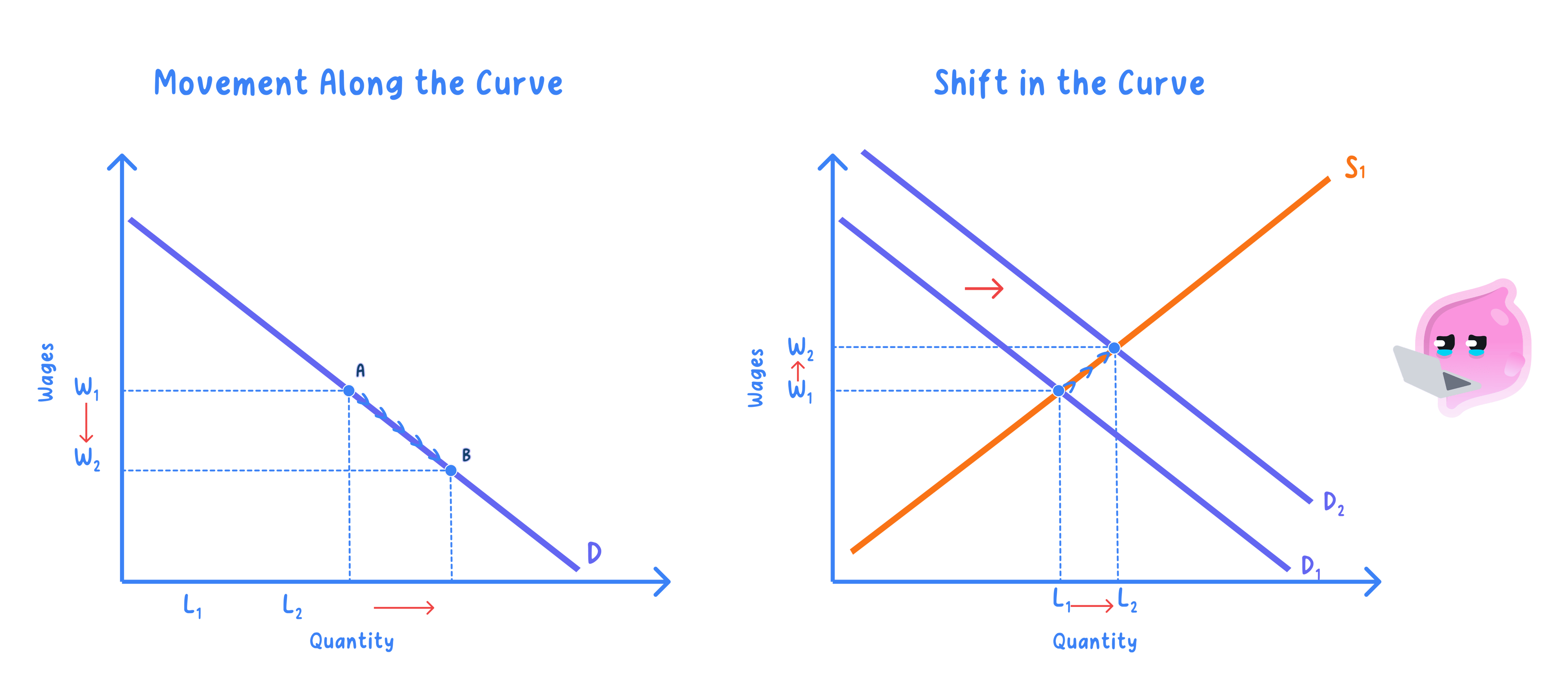
A change in the wage rate causes a movement along the labour demand curve. Other factors can shift the whole demand curve.

Demand for the final product

If demand for the product rises, firms may expand output and demand more labour. For example, post-pandemic demand for logistics and delivery services increased demand for drivers and warehouse staff in some areas.

Productivity of labour

If workers become more productive, their marginal product may rise. This increases MRP and shifts demand for labour to the right, assuming the output can be sold.

Price of the final product

If the selling price of output rises, marginal revenue may rise. This increases MRP. For example, if a firm can sell specialist software at a higher price, it may demand more programmers.

Availability and price of capital

Capital means human-made resources such as machinery, software and equipment. If machines become cheaper and can replace workers, demand for some types of labour may fall. But if capital complements labour, demand for skilled workers may rise. For example, AI tools may reduce demand for some routine tasks while increasing demand for workers who can manage, audit or apply the technology.

Non-wage labour costs

Employers also face costs such as employer National Insurance contributions, pension contributions, training costs and health and safety requirements. Higher non-wage costs can reduce demand for labour, especially in low-margin industries.

Skills and human capital

Human capital means the skills, education, training and health that make workers productive. Industries needing highly skilled labour may demand workers with specific qualifications, such as engineers, nurses or data analysts.

Tip

Shift or movement?

A higher wage normally means a movement up along the demand curve for labour. Higher product demand, higher productivity or higher output prices shift the labour demand curve to the right.

Wage elasticity of demand for labour

Definition

Wage elasticity of demand for labour

Wage elasticity of demand for labour measures how responsive the quantity demanded of labour is to a change in the wage rate:

WED=%ΔQdL%ΔWWED = \frac{\%\Delta Q_{dL}}{\%\Delta W}WED=%ΔW%ΔQdL​​

Because a higher wage usually reduces quantity demanded, the value is normally negative. In essays, you can often discuss elasticity using the absolute size: a value closer to zero is more inelastic; a larger absolute value is more elastic.

Example

Calculating wage elasticity of demand for labour

A firm raises wages by 10%. Employment falls from 1,000 workers to 940 workers.

  1. Calculate the percentage change in employment: employment falls by 60 workers from a base of 1,000, so the change is -6%.
  2. Substitute into the formula: WED=−6%10%WED = \frac{-6\%}{10\%}WED=10%−6%​.
  3. The wage elasticity of demand for labour is -0.6, so demand is wage inelastic because the absolute value is less than 1.

What makes labour demand more wage elastic?

Demand for labour is likely to be more wage elastic when:

  • Labour costs are a high proportion of total costs, so wage rises strongly affect profitability.
  • Workers can be easily replaced by capital, such as self-service checkouts or automated warehouse systems.
  • The final product has elastic demand, so firms cannot easily pass higher wage costs on to consumers through higher prices.
  • Firms have more time to adjust, because in the long run they can change technology, relocate production or redesign roles.
  • The labour is relatively low-skilled or tasks are routine, making substitution easier.

Demand for labour is likely to be more wage inelastic when workers are essential, highly skilled, hard to replace, or when labour costs are a small share of total costs.

Common Mistake

Inelastic does not mean unimportant

Wage inelastic demand means employment is not very responsive to wage changes. It does not mean demand for labour is low.

Productivity and unit labour costs

Definition

Productivity

Labour productivity measures output per worker or output per hour worked. A common formula is:

Labour productivity=outputlabour input\text{Labour productivity} = \frac{\text{output}}{\text{labour input}}Labour productivity=labour inputoutput​

Productivity matters because it affects how much revenue a worker can generate. Higher productivity can increase MRP, support higher wages and improve competitiveness.

Definition

Unit labour cost

Unit labour cost is the labour cost of producing one unit of output:

Unit labour cost=total labour costoutput\text{Unit labour cost} = \frac{\text{total labour cost}}{\text{output}}Unit labour cost=outputtotal labour cost​

If wages rise but productivity rises faster, unit labour costs can fall. This is important for UK firms facing cost-of-living pressures, higher wage demands and international competition.

Example

Calculating productivity and unit labour cost

A firm employs 50 workers for 8 hours each day at £15 per hour. It produces 2,000 units per day.

  1. Calculate total labour hours: 50×8=40050 \times 8 = 40050×8=400 labour hours.
  2. Calculate labour productivity: 2,000400=5\frac{2{,}000}{400} = 54002,000​=5 units per labour hour.
  3. Calculate total labour cost: 50×8×£15=£6,00050 \times 8 \times \text{£}15 = \text{£}6{,}00050×8×£15=£6,000.
  4. Calculate unit labour cost: £6,0002,000=£3\frac{\text{£}6{,}000}{2{,}000} = \text{£}32,000£6,000​=£3 per unit.
  5. If training raises output to 2,400 units with the same labour cost, unit labour cost falls to £6,0002,400=£2.50\frac{\text{£}6{,}000}{2{,}400} = \text{£}2.502,400£6,000​=£2.50 per unit.
Common Mistake

Productivity gains can affect workers differently

Higher productivity may increase demand for workers if it raises MRP and output expands. But labour-saving technology can reduce demand for some workers while increasing demand for others with complementary skills.

Pulling the topic together

For OCR H460, the big chain of analysis is:

  1. Demand for labour is derived from product demand.
  2. A worker’s value to the firm depends on marginal revenue product.
  3. Firms hire up to the point where MRPL=WMRP_L = WMRPL​=W in a competitive labour market.
  4. Anything that changes marginal product or marginal revenue can shift labour demand.
  5. Productivity affects MRP and unit labour costs, influencing wages, profits and competitiveness.
Exam technique

In the exam

  1. Start with a precise definition: derived demand, MRP, productivity or unit labour cost, depending on the question.
  2. If asked for a diagram, label axes carefully: wage or MRP on the vertical axis, employment or quantity of labour on the horizontal axis.
  3. Explain the chain of causation: product demand or productivity changes → MRP changes → labour demand shifts → employment and/or wages change.
  4. Avoid treating all workers as identical: apply your answer to the industry, skill level and time period in the question.
Self review

Check yourself

  • Why is the demand for nurses, software developers or construction workers described as derived demand?
  • How does a firm use MRP to decide whether to hire one more worker?
  • What might make demand for labour more wage elastic in one industry than another?

Recap questions

Test yourself with 5 quick questions on this guide. Answer them all correctly to complete it.

PreviousNext

How was this guide?

Demand for labour Revision Guide

  1. A Level
  2. /Economics
  3. /Demand for labour