What you'll learn
- What economists mean by international trade, exports and imports.
- How trade patterns have changed over time, including global value chains and the rise of emerging economies.
- Why trade can raise living standards, but also create winners and losers.
- How to evaluate trade differently for developed, emerging and developing countries.
1. What is international trade?
International trade means buying and selling goods and services across national borders. It connects households, firms and governments in different economies.
International trade
International trade is the exchange of goods and services between countries. Goods are physical products, such as cars or food. Services are non-physical outputs, such as banking, tourism, insurance, software and education.
Two key terms come up constantly:
- Exports are goods and services sold to other countries.
- Imports are goods and services bought from other countries.
A country with lots of international trade is called an open economy. The UK is a very open economy because it imports many goods, such as manufactured products, food and energy, while exporting services such as finance, higher education, consultancy and creative industries.
Net exports and the balance of trade
Net exports
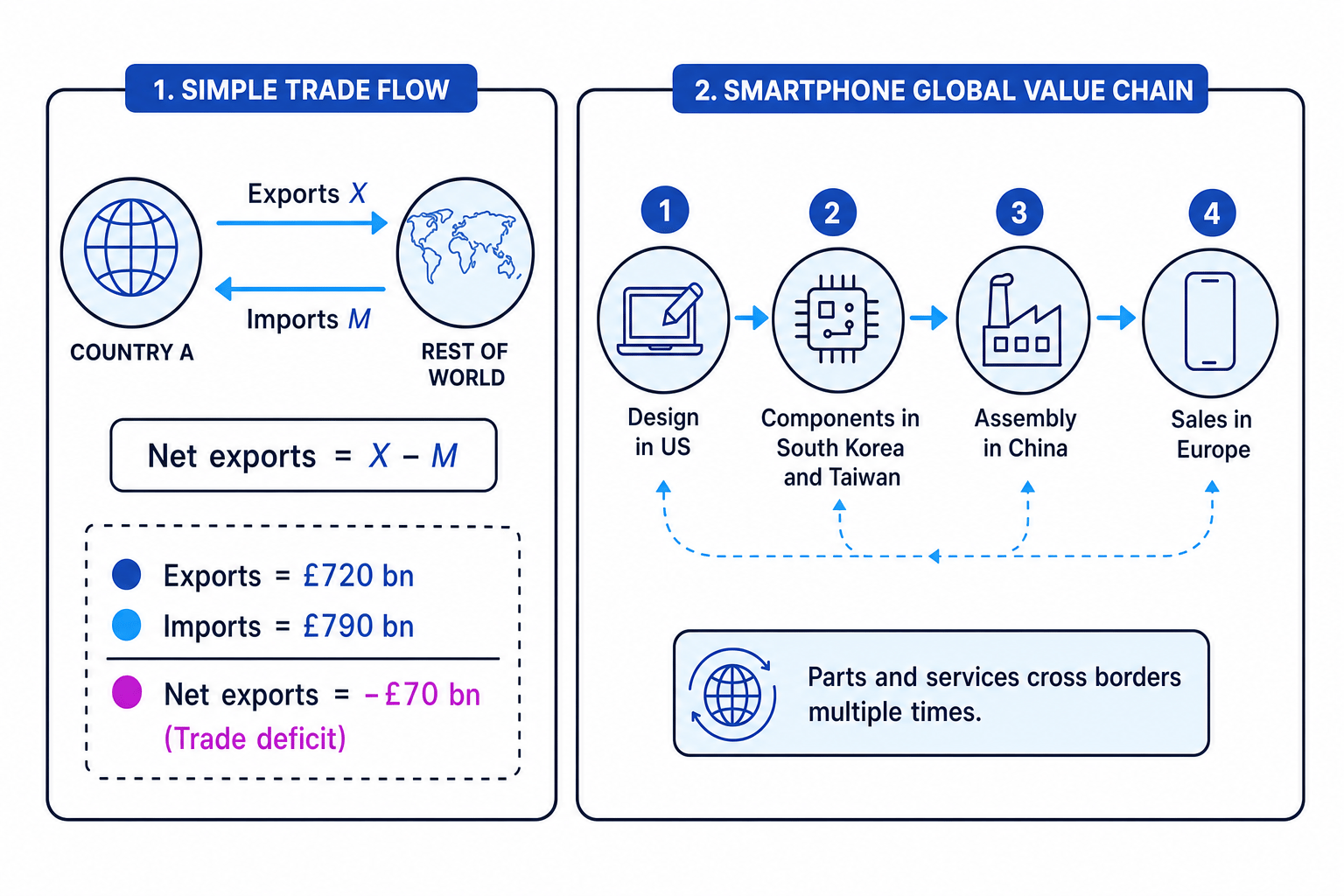
Net exports are the value of exports minus the value of imports. If exports are greater than imports, net exports are positive. If imports are greater than exports, net exports are negative.
The formula is:
Net exports=X−M\text{Net exports} = X - MNet exports=X−Mwhere XXX means exports and MMM means imports.
Calculating net exports
A country exports £720 billion of goods and services and imports £790 billion.
- Substitute the values into the formula: net exports = £720 billion − £790 billion.
- Calculate the difference: £720 billion − £790 billion = −£70 billion.
- Interpret the sign: net exports are negative, so the country has a trade deficit of £70 billion in goods and services.
Thinking exports are always good and imports are always bad
Exports create demand for domestic output, but imports also improve living standards by giving consumers and firms access to cheaper, better or unavailable products. The issue is not “exports good, imports bad”; it is whether trade improves welfare and whether the gains are fairly shared.
2. Why do countries trade?
Countries trade because they differ in:
- natural resources, such as oil, gas, minerals, land or climate;
- labour skills and education levels;
- technology and productivity;
- capital equipment and infrastructure;
- consumer tastes and income levels;
- government policy, regulation and trade agreements.
A country may produce some goods more efficiently than others. This allows specialisation, where countries focus resources on producing goods or services in which they are relatively efficient.
Specialisation
Specialisation means concentrating production on a narrower range of goods or services, often where a firm, region or country has a cost or quality advantage.
The classic argument for trade comes from David Ricardo’s theory of comparative advantage: even if one country is more efficient at producing everything, trade can still benefit both countries if each specialises in the product it can produce at the lowest opportunity cost.
Core logic of trade
International trade can increase total world output because countries specialise according to their strengths, then exchange what they produce.
3. Patterns of international trade over time
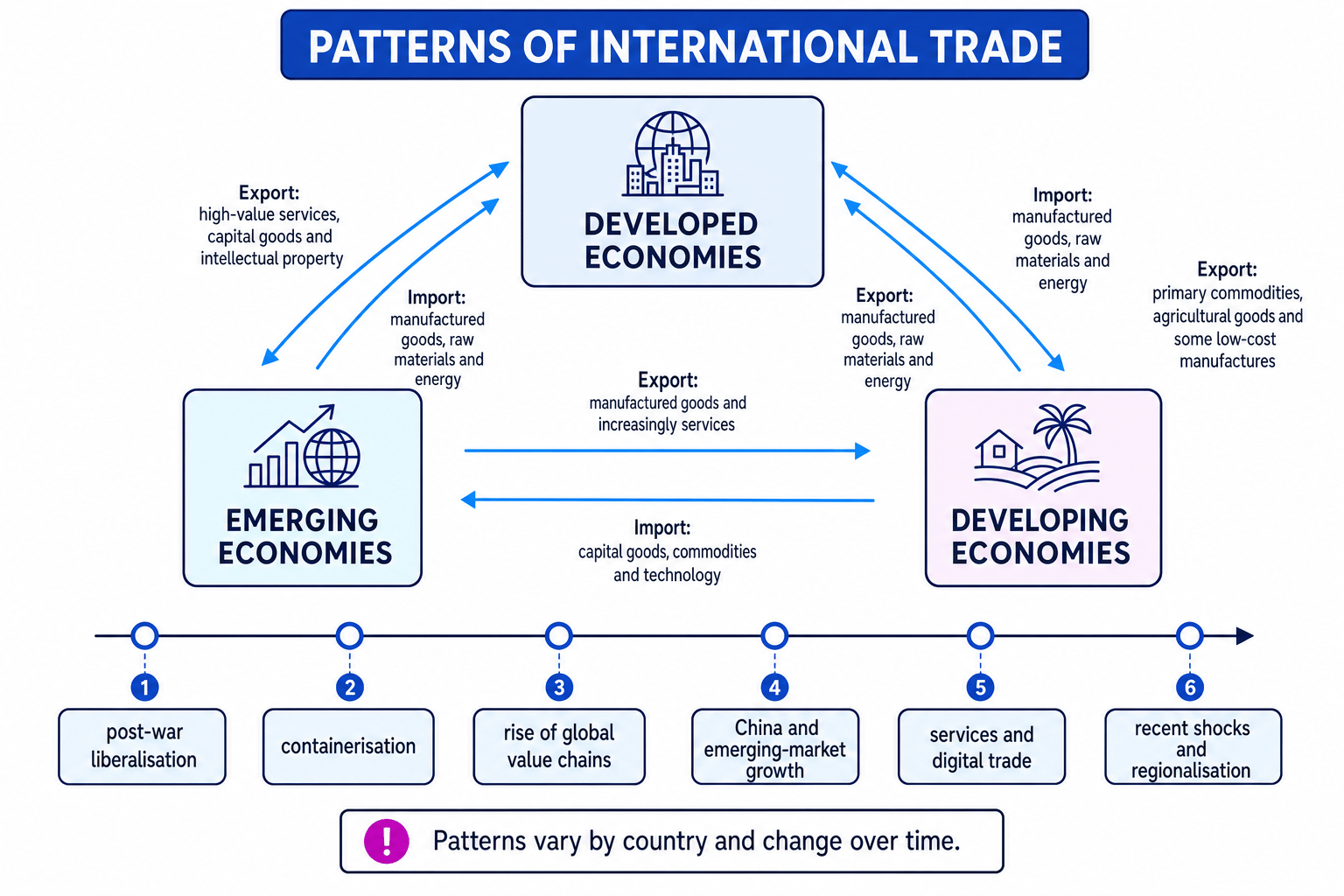
Patterns of trade describe who trades with whom, what is traded, and how those flows change over time.
Post-war trade liberalisation
After the Second World War, many countries reduced tariffs and other barriers to trade through agreements such as the General Agreement on Tariffs and Trade, later replaced by the World Trade Organization.
Trade liberalisation
Trade liberalisation means reducing barriers to international trade, such as tariffs, quotas and restrictive regulations.
This helped global trade grow faster than global output for much of the late twentieth century.
Containerisation and lower transport costs
From the 1960s onwards, containerisation made shipping cheaper, faster and more reliable. Standardised containers made it easier to move goods between ships, trains and lorries.
This supported long-distance trade in manufactured goods and helped firms split production across countries.
Global value chains
Global value chain
A global value chain is a production process where different stages of making a good or service take place in different countries.
For example, a smartphone might be designed in the US, use components from South Korea and Taiwan, be assembled in China, and then be sold across Europe. This means trade is not just “finished goods moving from one country to another”; it often involves repeated movements of components, services and intellectual property.
The rise of emerging economies
Emerging economy
An emerging economy is a country moving towards higher income levels, industrialisation and deeper integration into global markets, such as China, India, Brazil, Vietnam or Indonesia.
China’s entry into the WTO in 2001 accelerated its role as a major exporter of manufactured goods. More recently, some production has shifted to countries such as Vietnam, Bangladesh and Mexico as firms seek lower costs or reduce reliance on one supply chain.
Growth in services and digital trade
Trade is increasingly about services, data and intellectual property, not just physical goods. The UK is a good example: it is highly competitive in financial services, insurance, legal services, higher education, culture and digital products.
Recent shocks and regionalisation
Since the 2008 financial crisis, world trade growth has been less rapid. More recently, COVID-19, Brexit trade frictions, Russia’s invasion of Ukraine, energy shocks, and US-China tensions have made firms and governments think more about supply-chain resilience.
Supply-chain resilience
Supply-chain resilience is the ability of production networks to keep operating despite shocks such as pandemics, wars, transport disruption or sudden price rises.
Some firms now use near-shoring, which means moving production closer to final consumers, or friend-shoring, which means sourcing from politically allied countries.
4. Trade and country groups
Economists often distinguish between developed, emerging and developing economies. These are broad categories, so use them carefully.
Developed, emerging and developing economies
A developed economy usually has high income per head, advanced infrastructure and a large service sector. An emerging economy is industrialising and becoming more integrated into global markets. A developing economy usually has lower income per head, weaker infrastructure and often greater dependence on primary products.
Country categories are not fixed boxes
These labels are useful for broad analysis, but countries differ hugely within each group. For example, Singapore and Germany are both developed, but their trade patterns are not identical. India and Vietnam are both emerging, but they specialise in different sectors.
5. Advantages of international trade
Lower prices and greater choice
Imports increase consumer choice and can reduce prices. This is especially important during a cost-of-living squeeze because cheaper imported food, clothing or manufactured goods may support real incomes.
Higher output and efficiency
Trade increases the size of the market available to firms. This can help firms achieve economies of scale, where average costs fall as output rises.
Economies of scale
Economies of scale occur when a firm’s long-run average cost falls as output increases.
For example, a car manufacturer selling into many countries may spread research, design and factory costs over millions of vehicles.
Increased competition and innovation
Foreign competition can force domestic firms to cut costs, improve quality and innovate. This can raise productivity over time.
Export-led growth
For some countries, exports are a major driver of growth. Export revenue creates demand for domestic output, employment and investment. This has been important for economies such as China, South Korea and Vietnam.
Access to technology, capital goods and inputs
Developing and emerging economies may import machinery, medicines, software or renewable-energy technology that they cannot yet produce efficiently themselves. This can support long-run development.
Assessing trade for an emerging economy
Suppose an emerging economy attracts multinational firms to produce electronics for export.
- Analyse the short-run gain: export demand raises output, employment and tax revenue, so GDP and living standards may rise.
- Add the long-run channel: workers and domestic suppliers may learn new skills and technologies, increasing productivity.
- Consider the constraint: if the economy only performs low-value assembly, wages may remain low and profits may be repatriated abroad, limiting development.
- Reach a judgement: trade is most beneficial if the country moves up the value chain into design, branding, management and higher-skilled production.
6. Disadvantages of international trade
Structural unemployment
Trade can cause structural unemployment, where workers lose jobs because the structure of the economy changes and their skills no longer match available jobs.
Structural unemployment
Structural unemployment occurs when workers are unemployed because their skills, location or industry experience do not fit the jobs available in the economy.
For developed economies, cheaper imports may reduce demand for domestic manufacturing. This can damage particular regions, even if the economy as a whole gains.
Overdependence and vulnerability to shocks
Countries may become dependent on a narrow range of exports or on imports of essential goods. COVID-19 exposed reliance on global supply chains for medical equipment, while the energy price shock after Russia’s invasion of Ukraine showed the risks of dependence on imported energy.
Unequal gains from trade
The benefits of trade may go mainly to consumers, highly skilled workers, owners of capital or multinational corporations, while low-skilled workers face wage pressure or job losses.
Environmental costs
Long-distance transport, resource extraction and industrial production can increase carbon emissions and environmental degradation. If production moves to countries with weaker environmental regulation, global pollution may increase.
Commodity dependence
Many developing countries rely heavily on primary commodities such as coffee, copper, oil or cocoa. These prices can be volatile, making export revenues unstable.
Commodity dependence
Commodity dependence occurs when a country relies heavily on exports of primary products, making its income vulnerable to changes in global commodity prices.
7. Evaluation by type of country
Developed economies
Developed economies often gain from cheaper imports, access to global markets and strong exports of high-value goods and services. The UK, for instance, benefits from services exports in finance, education, insurance and business services.
However, developed economies may suffer from deindustrialisation, regional inequality and supply-chain vulnerability. Brexit has also increased some trade frictions for UK firms trading with the EU, especially smaller exporters facing extra paperwork or regulatory checks.
Judgement: trade is usually beneficial for developed economies overall, but the gains are uneven. The outcome depends on whether governments support retraining, infrastructure, regional policy and innovation.
Emerging economies
Emerging economies can use trade to industrialise quickly. Export markets allow firms to scale up, attract foreign direct investment and create jobs. China’s rapid growth after WTO accession is a major example.
But emerging economies may face pollution, weak labour standards, dependence on multinational firms and exposure to global downturns. They may also get stuck in the middle-income trap, where growth slows before the country becomes high income.
Middle-income trap
The middle-income trap is a situation where a country grows out of low income but struggles to progress to high income because it cannot compete with either low-wage producers or high-skill innovators.
Judgement: trade is most powerful for emerging economies when it supports productivity growth, education, infrastructure and movement into higher-value industries.
Developing economies
Developing economies may gain from export revenue, job creation, access to imported capital goods and integration into global markets. Trade can help reduce poverty if it creates stable employment and raises government revenue.
However, many developing countries face disadvantages: weak bargaining power, poor infrastructure, reliance on primary commodities, volatile export prices and exposure to exploitation by powerful multinational firms.
Trade is not a development strategy by itself
For developing economies, trade works best when combined with investment in education, transport, health, governance and industrial diversification.
Judgement: international trade can support development, but it does not automatically guarantee it. The quality of institutions, infrastructure and trade agreements strongly affects whether the gains reach households.
8. Overall judgement
International trade can increase efficiency, output and consumer welfare. In theory, it allows countries to specialise, exploit economies of scale and access goods, services and technologies that would otherwise be unavailable or expensive.
But the benefits are not automatic. Trade creates winners and losers within countries. It can worsen regional inequality, damage infant industries, expose economies to external shocks and reinforce dependence on low-value exports.
Best evaluation phrase
A strong judgement is: trade increases potential welfare, but the final impact depends on what a country exports, how diversified it is, how mobile its workers are, and whether government policy helps spread the gains.
In the exam
- Define international trade clearly, then use exports and imports accurately throughout your answer.
- When evaluating, separate short-run and long-run effects, and identify different stakeholders: consumers, workers, firms and governments.
- Avoid saying trade is simply good or bad. Make a supported judgement based on the country’s level of development, export structure and ability to adapt.
Check yourself
- Why might imports improve living standards even if they reduce demand for some domestic firms?
- How have global value chains changed the nature of international trade?
- Why might international trade affect developed, emerging and developing economies differently?