Trade policies and negotiations
What you'll learn
- Why governments use protectionism and how it affects consumers, producers and efficiency.
- How free trade areas, customs unions, monetary unions and economic unions differ.
- How to use diagrams to explain tariffs, quotas, trade creation and trade diversion.
- How to evaluate free trade, protectionism and the role of the World Trade Organisation (WTO).
Starting point: why trade policy matters
Countries trade because resources, technology, labour skills and climate differ across economies. If countries specialise in goods and services where they have a comparative advantage — a lower opportunity cost than another country — total world output can rise.
Free trade
Free trade is international trade with minimal government barriers, such as tariffs, quotas or unnecessary regulations.
In theory, free trade should lower prices, increase consumer choice and encourage firms to become more efficient. In practice, governments often intervene because trade creates winners and losers.
Protectionism
Protectionism
Protectionism is the use of government policies to restrict imports and protect domestic firms from foreign competition.
Common protectionist policies include:
- Tariffs: taxes on imports.
- Quotas: legal limits on the quantity or value of imports.
- Subsidies: financial support to domestic producers.
- Regulations and standards: rules that may make it harder for foreign firms to sell in the market.
- Embargoes: bans on trade with particular countries, often for political reasons.
Governments may use protectionism to protect jobs, support infant industries, preserve national security, prevent dumping, or reduce a current account deficit. However, protectionism usually raises prices and reduces allocative efficiency.
Dumping
Dumping occurs when a foreign firm sells goods in another country at below cost or below the price charged in its home market, potentially damaging domestic producers.
Tariffs and quotas: the basic diagram
A world price is the price of a good on international markets. If the world price is below the domestic no-trade price, the country imports the good.
A tariff raises the domestic price from the world price to the world price plus the tariff. Domestic producers supply more, consumers buy less, and imports fall. The government gains tariff revenue, but society suffers deadweight welfare losses: lost gains from trade that are not received by anyone.
A quota restricts import quantity directly. It also raises the domestic price, but the “quota rent” may go to foreign exporters, import licence holders or the government if licences are auctioned.
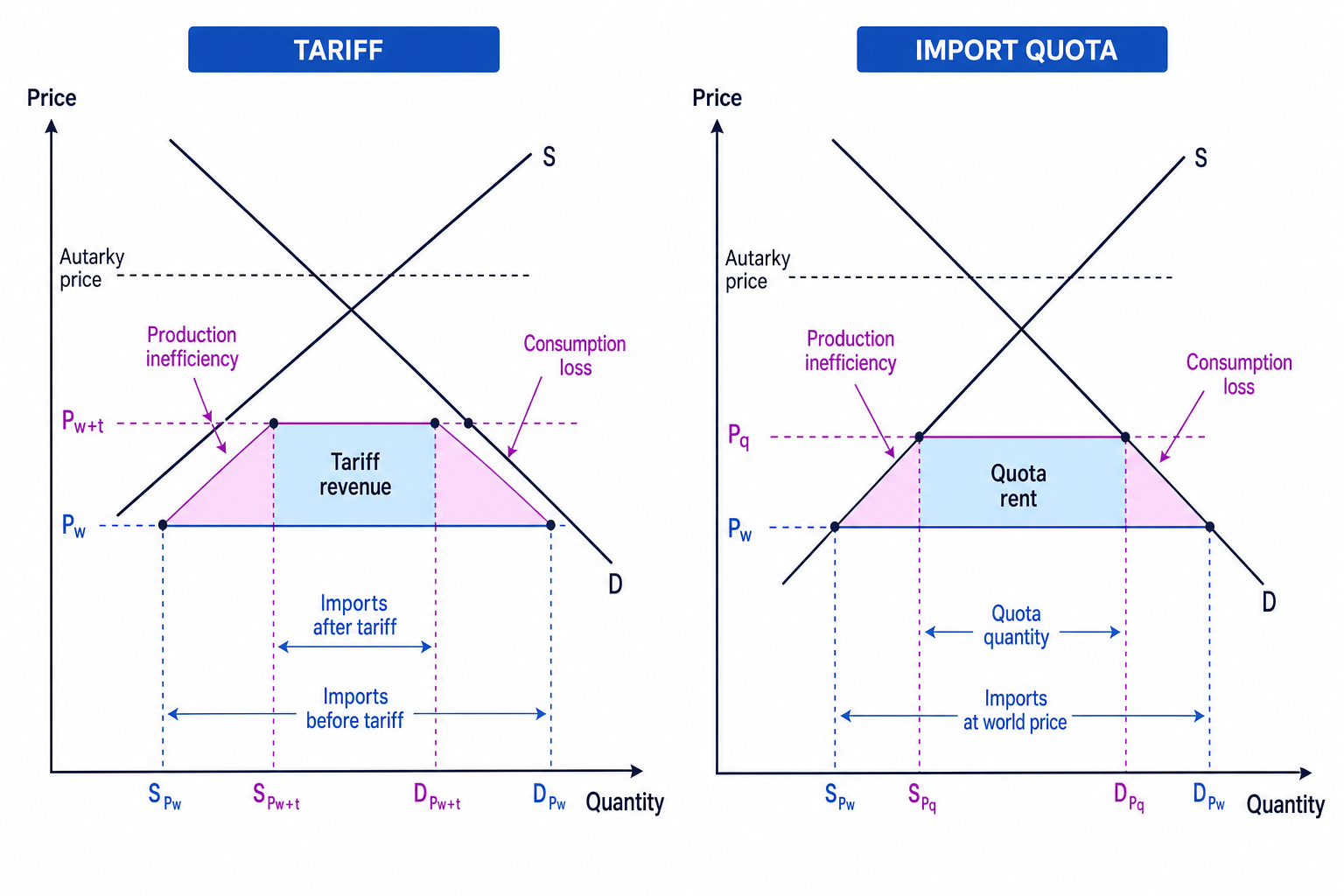
Tariffs and quotas reduce trade
Both tariffs and quotas reduce imports and raise the domestic price. The main difference is that tariffs usually raise government revenue, while quotas create quota rents whose ownership depends on how import licences are allocated.
Calculating tariff revenue and welfare loss
Suppose the world price of a product is 10.Thegovernmentaddsatariffof10. The government adds a tariff of 10.Thegovernmentaddsatariffof4 per unit. Before the tariff, domestic supply is 1.0 million units and domestic demand is 4.0 million units. After the tariff, domestic supply rises to 1.6 million units and domestic demand falls to 3.2 million units.
-
Calculate imports before the tariff: imports are domestic demand minus domestic supply, so 4.0 million minus 1.0 million = 3.0 million units.
-
Calculate imports after the tariff: 3.2 million minus 1.6 million = 1.6 million units. The tariff has reduced imports by 1.4 million units.
-
Calculate tariff revenue using tariff revenue=t×Mafter\text{tariff revenue} = t \times M_{\text{after}}tariff revenue=t×Mafter. This gives 4×1.64 \times 1.64×1.6 million = $6.4 million.
-
Calculate the production inefficiency triangle: 12×4×0.6\frac{1}{2} \times 4 \times 0.621×4×0.6 million = $1.2 million.
-
Calculate the consumption loss triangle: 12×4×0.8\frac{1}{2} \times 4 \times 0.821×4×0.8 million = $1.6 million.
-
Total deadweight loss is 1.2millionplus1.2 million plus 1.2millionplus1.6 million = $2.8 million.
Assuming a tariff eliminates imports
A tariff reduces imports only if it raises the domestic price enough to change supply and demand. Imports may still continue if foreign producers remain cheaper than domestic firms.
Economic integration
Economic integration
Economic integration is the process by which countries reduce trade barriers and coordinate economic policies more closely.
There are different levels of integration.
Free trade area
A free trade area is a group of countries that remove tariffs and quotas between members, while each member keeps its own trade policy towards non-members.
Examples include USMCA and the UK’s membership of CPTPP. Free trade areas often need rules of origin, which prove where a product was made, to stop firms importing through the lowest-tariff member.
Customs union
A customs union removes internal trade barriers between members and sets a common external tariff on non-members.
The EU is a major example, although the UK left the EU customs union after Brexit. A customs union makes trade inside the bloc easier, but members lose the freedom to set their own external tariff policy.
Monetary union
A monetary union is when countries share a currency and usually a common central bank. The eurozone is the key example.
This removes exchange-rate uncertainty and transaction costs between members. However, countries lose independent monetary policy. For example, a country in recession cannot cut its own interest rate or devalue its own currency if the central bank sets policy for the whole union.
Economic union
An economic union involves deeper integration, including free movement of goods, services, capital and often labour, plus some harmonisation of regulations, competition policy and fiscal rules.
The EU is the closest real-world example, though even the EU is not a complete fiscal union because national governments still control much taxation and spending.
Integration ladder
Think of integration as a ladder: free trade area → customs union → monetary union → economic union. Each step usually means more trade access, but less national policy independence.
Trade creation and trade diversion
Trade creation
Trade creation occurs when economic integration causes production to switch from a high-cost domestic producer to a lower-cost producer in a partner country.
Trade creation improves efficiency because resources are used where production costs are lower.
Trade diversion
Trade diversion occurs when trade switches from a lower-cost non-member country to a higher-cost member country because the non-member faces a tariff or quota.
Trade diversion can reduce world efficiency, even if members of the trade bloc trade more with each other.
Tariffs and quotas are central here. Removing internal tariffs can create trade, but keeping external tariffs or quotas can divert trade away from the most efficient global producer.
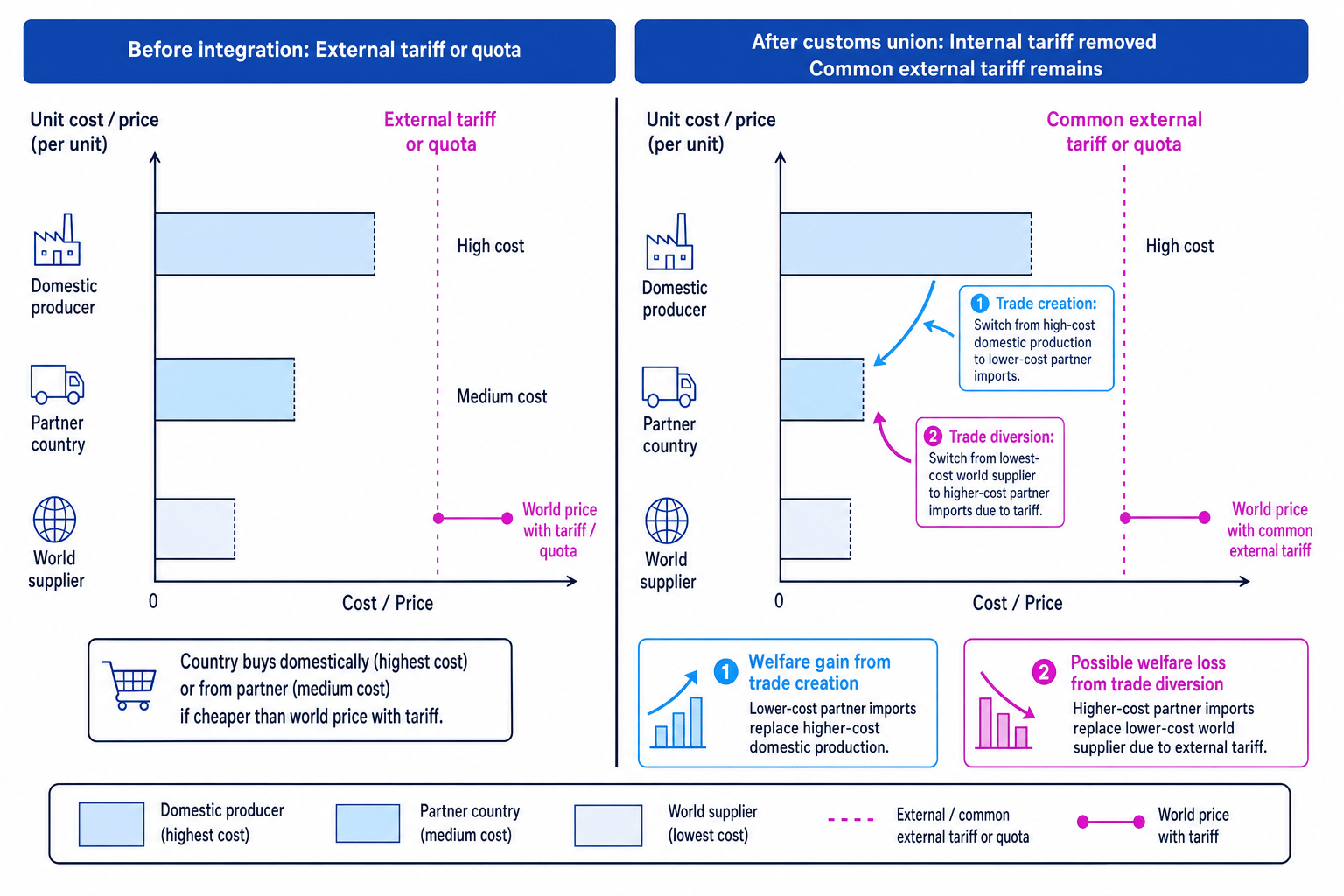
Identifying trade creation and trade diversion
A country can produce a good domestically for £120. A partner country can produce it for £95. A world supplier can produce it for £80, but faces a tariff that raises its landed price to £100.
-
If integration removes the barrier on the partner country and domestic production is replaced by partner imports, the price falls from £120 to £95. This is trade creation because high-cost domestic output is replaced by lower-cost partner output.
-
If the country previously imported from the world supplier at £100 including tariff, but now switches to the partner at £95, consumers pay less. However, the true world resource cost has risen from £80 to £95.
-
This second switch is trade diversion because the tariff means the country buys from a higher-cost partner instead of the lowest-cost world supplier.
Evaluating protectionism and free trade
Advantages of protectionism
Protectionism can protect domestic jobs in the short run. This may matter in regions dependent on one industry, such as steel, cars or shipbuilding, where sudden import competition could create structural unemployment.
It may also support infant industries. These are new industries that may become efficient once they grow, learn and achieve economies of scale. Some East Asian economies used selective industrial policies during development, although not all protectionist policies succeed.
Protectionism can also be justified for national security, food security, environmental standards or anti-dumping action. For example, governments may not want to rely entirely on foreign suppliers for medical equipment, defence technology or energy.
Disadvantages of protectionism
The main disadvantage is higher prices for consumers. During a cost-of-living squeeze, tariffs on food, energy or clothing would be regressive because low-income households spend a larger share of income on essentials.
Protectionism can also reduce competition, allowing domestic firms to become inefficient. It may provoke retaliation, damaging exporters. In a world of global supply chains, tariffs on imported components can raise costs for domestic manufacturers too.
Treating protectionism as costless for workers
Protectionism may protect some jobs, but it can destroy others if firms using imported inputs face higher costs or if trading partners retaliate against exports.
Advantages of free trade
Free trade allows countries to specialise according to comparative advantage. This can raise global output, reduce prices and increase consumer choice.
It also increases competition. Domestic firms may need to cut costs, innovate and improve quality. Exporting firms may benefit from larger markets and economies of scale.
Free trade can support growth in developing economies by creating export revenue, attracting foreign direct investment and spreading technology.
Disadvantages of free trade
Free trade can cause structural change. Workers in uncompetitive industries may lose jobs, and the benefits may be unevenly distributed across regions and skill groups.
There may also be environmental costs if trade increases transport emissions or encourages production in countries with weaker environmental standards. Free trade can increase dependence on global supply chains, which became clear during the pandemic and later supply-chain shocks.
Best judgement on trade policy
Free trade usually improves efficiency overall, but the case for temporary, targeted protectionism is stronger where there is clear market failure, a realistic exit plan, and support for workers to retrain and move into expanding sectors.
The World Trade Organisation
World Trade Organisation
The World Trade Organisation (WTO) is an international organisation that promotes rules-based trade between countries and provides a forum for trade negotiations and disputes.
The WTO promotes free trade by:
- Encouraging countries to reduce tariffs and quotas through negotiations.
- Enforcing principles such as most-favoured-nation treatment, where a trade advantage given to one WTO member should generally be offered to all members.
- Providing a dispute settlement system when countries believe others have broken trade rules.
- Monitoring trade policies and improving transparency.
- Supporting developing countries with technical assistance.
The WTO can make global trade more predictable. This matters because firms are more likely to invest and export when they trust that rules will not change suddenly.
However, the WTO has limitations. Negotiations are slow because agreements require broad consensus. The Doha Development Round stalled, partly because rich and developing countries disagreed over agriculture, subsidies and market access.
The dispute system has also faced pressure, especially since the WTO Appellate Body became unable to function fully after the United States blocked appointments. Meanwhile, major economies increasingly use subsidies, security exceptions and bilateral trade deals, which can weaken multilateral cooperation.
In the exam
-
Define the trade policy precisely before analysing it: tariff, quota, free trade area, customs union, monetary union or economic union.
-
For tariff and quota diagrams, label axes, world price, protected price, import quantities, revenue or quota rent, and deadweight welfare losses.
-
For evaluation, compare short-run protection for firms and workers with long-run costs such as higher prices, inefficiency and retaliation.
-
For economic integration, always distinguish trade creation from trade diversion; more trade within a bloc is not automatically more efficient.
-
When evaluating the WTO, balance its role in creating predictable rules against its weaknesses in enforcement, slow negotiations and geopolitical conflict.
Check yourself
- Why might a tariff create government revenue but still reduce overall welfare?
- How is a customs union different from a free trade area?
- When does economic integration lead to trade diversion rather than trade creation?