Market failure and externalities
What you'll learn
- What market failure means and why free markets may not maximise welfare.
- How to use private, external and social costs and benefits.
- How to explain positive and negative externalities in production and consumption.
- How to read externality diagrams showing QmQ_mQm, Q∗Q^*Q∗ and welfare loss.
The starting point: markets usually follow private signals
In a free market, buyers and sellers respond mainly to private costs and benefits.
A consumer asks: “Is this worth the price to me?”
A producer asks: “Will selling this cover my costs and make profit?”
That works well when all costs and benefits are included in the market price. But sometimes a decision affects people who are not directly involved in the transaction. These people are called third parties.
For example, if a factory produces cheap goods but also creates air pollution, local residents may suffer health costs even though they did not buy or sell the product.
Market failure
Market failure occurs when the price mechanism leads to an inefficient allocation of resources, so total social welfare is not maximised.
Social welfare means the overall wellbeing or benefit to society. In externality analysis, the efficient outcome is the social optimum, where:
MSB=MSCMSB = MSCMSB=MSCThat means the extra benefit to society from the last unit equals the extra cost to society of producing or consuming it.
Spotting market failure
A factory sells an extra unit for a benefit of £24 to the buyer. Producing it costs the firm £20, but it also creates £8 of pollution damage for nearby households.
- Compare the private signals: the buyer’s marginal private benefit is £24 and the firm’s marginal private cost is £20, so the market sees a net private gain of £4.
- Add the external pollution cost: social cost is £20 + £8 = £28.
- Compare social benefit with social cost: £24 is less than £28, so this unit reduces social welfare. The free market would produce too much.
Marginal private, external and social values
The word marginal means “additional” or “extra”. In this topic, we care about the cost or benefit of one more unit.
Key marginal terms
- Marginal private cost (MPC): the extra cost to the producer or consumer directly involved in producing or consuming one more unit.
- Marginal external cost (MEC): the extra cost imposed on third parties from one more unit.
- Marginal social cost (MSC): the total extra cost to society from one more unit.
- Marginal private benefit (MPB): the extra benefit enjoyed by the consumer or firm directly involved.
- Marginal external benefit (MEB): the extra benefit gained by third parties.
- Marginal social benefit (MSB): the total extra benefit to society from one more unit.
The key relationships are:
MSC=MPC+MECMSB=MPB+MEB\begin{aligned} MSC &= MPC + MEC \\ MSB &= MPB + MEB \end{aligned}MSCMSB=MPC+MEC=MPB+MEBIn standard A-Level diagrams, the demand curve usually represents MPB, and the supply curve usually represents MPC.
Private versus social
Markets choose output where private benefit equals private cost: MPB=MPCMPB = MPCMPB=MPC. Society wants output where social benefit equals social cost: MSB=MSCMSB = MSCMSB=MSC.
Thinking every cost is an external cost
A high wage bill, expensive raw materials or higher rent are usually private costs to the firm. They become external costs only if they fall on third parties outside the market transaction.
Externalities
Externality
An externality is a cost or benefit of production or consumption that affects a third party and is not reflected fully in the market price.
There are two broad types:
- A negative externality creates an external cost, so the market outcome is usually too high.
- A positive externality creates an external benefit, so the market outcome is usually too low.
Externalities can come from either:
- Production: the act of making the good creates the third-party effect.
- Consumption: the act of using the good creates the third-party effect.
Negative externalities: external costs
A negative externality happens when production or consumption imposes costs on third parties.
Examples include:
- factory pollution affecting local residents
- road congestion delaying other road users
- passive smoking harming non-smokers
- carbon emissions contributing to climate change
The diagrams below show the two main cases.
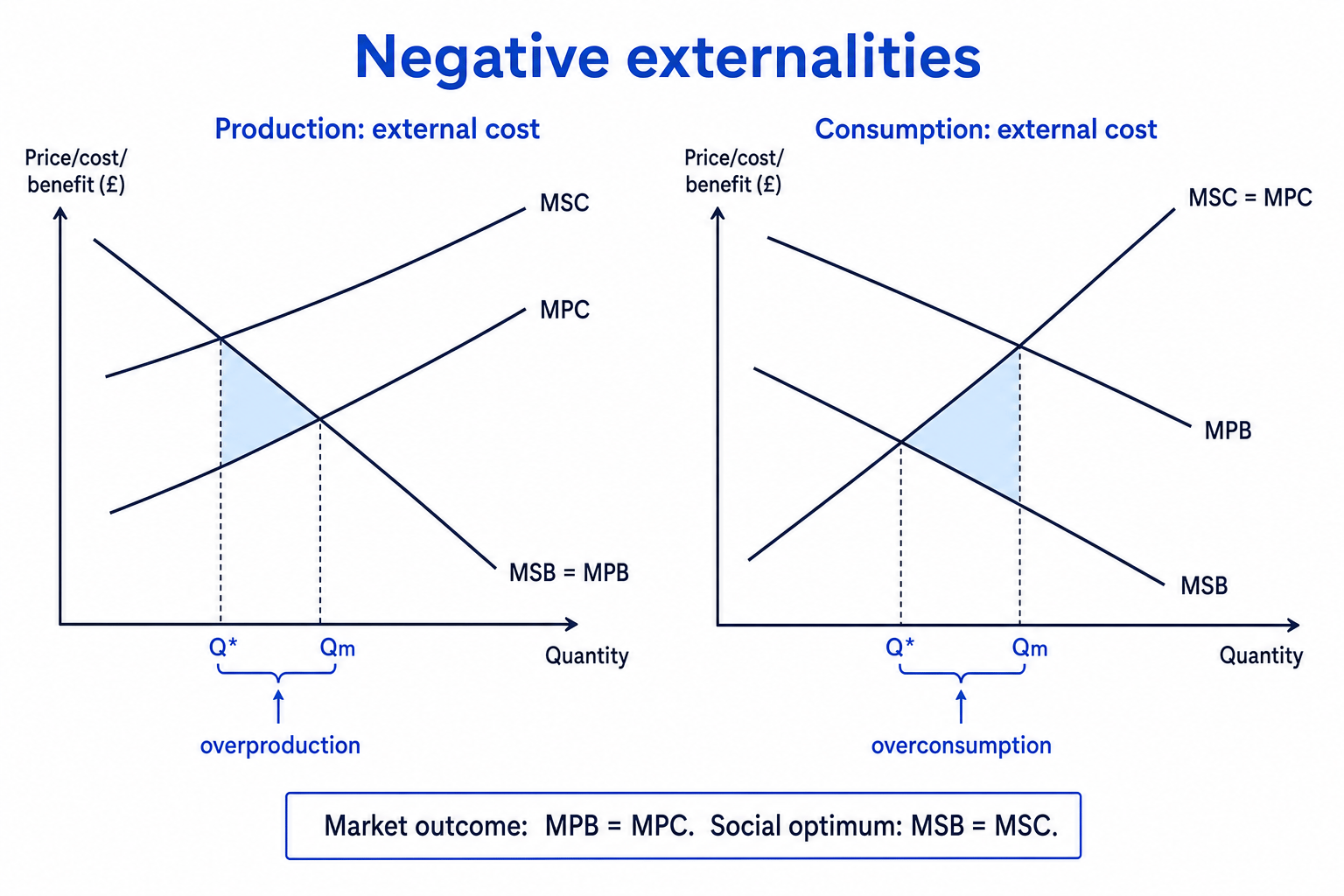
Negative production externality
A negative production externality occurs when producing a good imposes external costs. For example, a chemical plant may create waste that damages a river.
Here, the firm only considers MPC, but society faces MSC. Because external costs exist, MSC is above MPC.
The market produces at QmQ_mQm, where:
MPB=MPCMPB = MPCMPB=MPCBut the socially efficient output is Q∗Q^*Q∗, where:
MSB=MSCMSB = MSCMSB=MSCSince QmQ_mQm is greater than Q∗Q^*Q∗, there is overproduction. The shaded triangle represents deadweight welfare loss, meaning the net loss of social welfare from producing units where social cost exceeds social benefit.
Negative consumption externality
A negative consumption externality occurs when consuming a good harms third parties. For example, smoking may create health costs for others through passive smoking, while excessive alcohol consumption may increase pressure on policing and the NHS.
In this case, the consumer’s MPB is higher than the true MSB. The market overvalues the good because it ignores third-party harm.
So the market quantity QmQ_mQm is again above the socially efficient quantity Q∗Q^*Q∗, causing overconsumption.
Choosing the curve to shift
If the externality comes mainly from production, look at the cost curves. If it comes mainly from consumption, look at the benefit curves.
Interpreting a negative consumption externality
Suppose vaping in public spaces creates discomfort and health concerns for nearby non-users.
- Identify where the third-party effect occurs: the harm comes from consumption, so use a consumption externality diagram.
- Decide the direction of the effect: the effect is harmful, so MSB lies below MPB.
- Compare the quantities: the market chooses QmQ_mQm using MPB and MPC, but society prefers Q∗Q^*Q∗ using MSB and MSC. Since Qm>Q∗Q_m > Q^*Qm>Q∗, there is overconsumption and welfare loss.
Positive externalities: external benefits
A positive externality happens when production or consumption creates benefits for third parties.
Examples include:
- education improving civic participation and productivity
- vaccinations reducing disease spread through herd immunity
- research and development creating knowledge spillovers
- worker training raising skills that future employers may benefit from
The diagrams below show positive externalities in production and consumption.
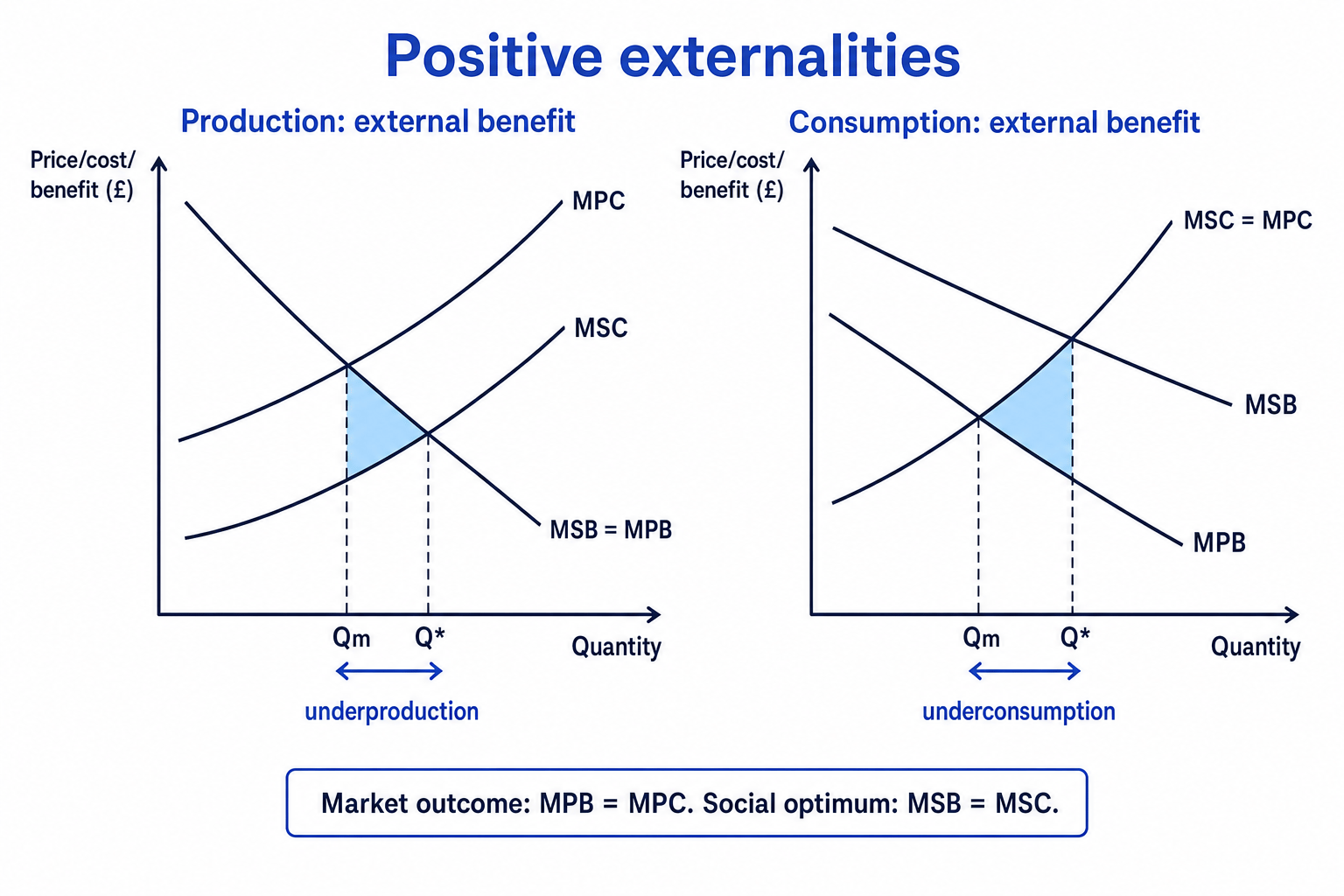
Positive production externality
A positive production externality occurs when producing a good benefits third parties. A classic example is research and development: one firm’s innovation may create knowledge that other firms can use.
The firm faces MPC, but society’s net cost is lower because of the external benefit. Therefore MSC is below MPC.
The market produces at QmQ_mQm, but the social optimum is Q∗Q^*Q∗, where MSB=MSCMSB = MSCMSB=MSC. Since QmQ_mQm is less than Q∗Q^*Q∗, there is underproduction.
Positive consumption externality
A positive consumption externality occurs when consuming a good benefits third parties. Education is a strong example: the student gains private benefits such as higher earnings, but society may also gain from higher productivity, lower crime and better civic participation.
Here, MSB is above MPB because society gains more than the individual consumer captures privately.
The market quantity QmQ_mQm is below the socially efficient quantity Q∗Q^*Q∗, so there is underconsumption.
Calculating marginal social benefit
A training course gives a worker private benefits worth £300. It also creates external benefits worth £120 because other workers learn from them. The private cost of the course is £360.
- Calculate social benefit using MSB=MPB+MEBMSB = MPB + MEBMSB=MPB+MEB: £300 + £120 = £420.
- Compare the private decision: the worker compares £300 of private benefit with £360 of private cost, so they may not buy the course.
- Compare the social decision: society compares £420 of social benefit with £360 of cost, giving a net social gain of £60. The market is likely to underconsume the course.
Welfare loss and why it matters
A deadweight welfare loss is the loss of potential welfare because output is not at the social optimum.
For negative externalities, the market produces or consumes too much. The extra units between Q∗Q^*Q∗ and QmQ_mQm have:
MSC>MSBMSC > MSBMSC>MSBFor positive externalities, the market produces or consumes too little. The missing units between QmQ_mQm and Q∗Q^*Q∗ would have:
MSB>MSCMSB > MSCMSB>MSCThe big picture
Externalities cause market failure because decision-makers respond to private costs and benefits, but society experiences social costs and benefits.
Evaluation points for stronger answers
Even when you have drawn the correct diagram, good evaluation asks how serious the externality is and whether intervention would improve welfare.
The impact depends on the size of the external cost or benefit. Carbon emissions create large long-term global costs, so the welfare loss may be substantial. By contrast, a small local noise externality may be easier to manage.
It also depends on information. Governments may struggle to place an accurate monetary value on pollution, health effects or knowledge spillovers. If the estimate of MEC or MEB is wrong, a tax or subsidy could be too high or too low.
Time matters too. In the short run, consumers may find it hard to change behaviour, especially during a cost-of-living squeeze. In the long run, firms may invest in cleaner technology, and consumers may switch habits.
In the exam
- Start by defining market failure or externality, then state whether the case is positive or negative and production or consumption.
- Draw the correct diagram with labelled axes, MPB, MPC, MSB, MSC, QmQ_mQm, Q∗Q^*Q∗ and the welfare loss triangle.
- Explain the chain clearly: private decision-making leads to MPB=MPCMPB = MPCMPB=MPC, but social efficiency requires MSB=MSCMSB = MSCMSB=MSC; then add a brief judgement about size, time period or measurement problems.
Check yourself
- Why does a negative production externality lead to Qm>Q∗Q_m > Q^*Qm>Q∗?
- In an education market, why might MSB be greater than MPB?
- What is the difference between a private cost and an external cost?