Information failure
What you'll learn
- What information failure means and why it causes market failure.
- How asymmetric information and moral hazard affect markets.
- Why merit goods tend to be under-consumed or under-produced.
- Why demerit goods tend to be over-consumed or over-produced, and how to evaluate this.
The starting point: markets need good information
A market works through the price mechanism: prices send signals to consumers and producers about scarcity, value and profitability.
For a market to allocate resources efficiently, decision-makers need reasonably accurate information about:
- the quality of the good or service
- the future benefits and costs
- risks and side effects
- prices of alternatives
- effects on other people
Allocative efficiency occurs when society’s welfare is maximised because resources are used where they create the greatest net benefit. In marginal terms, this is where marginal social benefit equals marginal social cost: MSB=MSCMSB = MSCMSB=MSC.
A marginal benefit or cost means the extra benefit or cost from one more unit.
- Marginal private benefit (MPB): extra benefit to the individual consumer.
- Marginal private cost (MPC): extra cost to the producer or consumer making the decision.
- Marginal social benefit (MSB): extra benefit to society as a whole.
- Marginal social cost (MSC): extra cost to society as a whole.
The core idea
If people make decisions using inaccurate or incomplete information, the market quantity will not reflect the true costs and benefits. That is why information failure can create market failure.
What is information failure?
Information failure
Information failure occurs when consumers, producers or governments have incomplete, inaccurate, misleading or misunderstood information, so their decisions do not reflect the true costs and benefits of an economic activity.
Information failure is a cause of market failure, which means the free market leads to a net welfare loss or an inefficient allocation of resources.
It can happen because:
- consumers do not know long-term health effects, such as the risks of vaping or high-sugar diets
- producers do not know future demand or environmental impacts
- firms deliberately make information hard to compare, such as complex mobile phone contracts
- the benefits of a good arrive much later, such as education or pension saving
- consumers are affected by behavioural biases, such as overconfidence or short-termism
Information failure does not always mean there is no information. Often, there is too much complicated information, or information is technically available but difficult to understand.
Market failure caused by information failure
The standard diagram shows that consumers or producers act on perceived benefits and costs, not the full or true benefits and costs. This can cause under-consumption of merit goods or over-consumption of demerit goods.
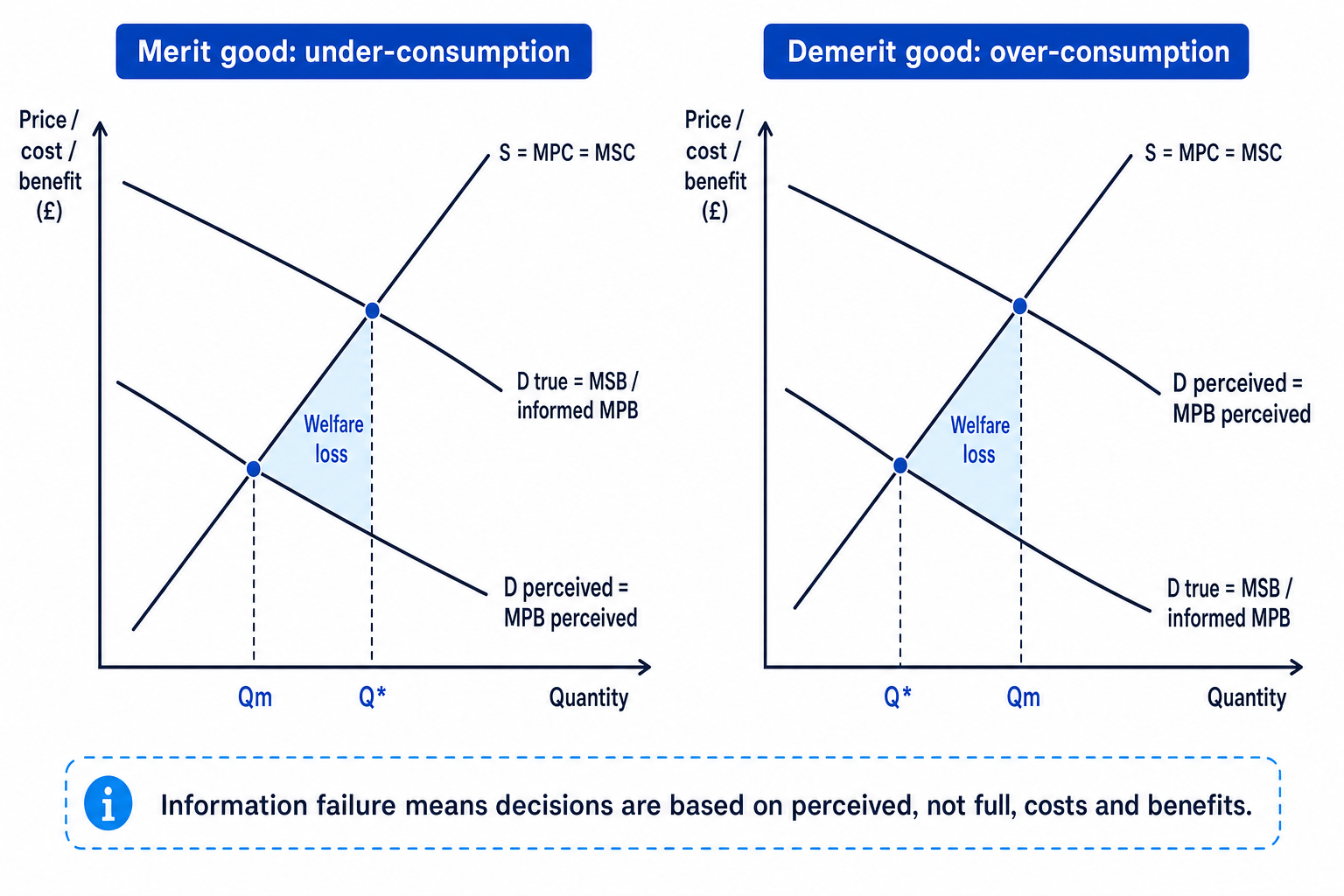
In the merit good diagram, consumers underestimate the true benefit. The perceived demand curve lies below the true benefit curve, so the market produces and consumes only QmQ_mQm, below the efficient quantity Q∗Q^*Q∗. The triangle shows a deadweight welfare loss, meaning potential welfare that society misses out on.
In the demerit good diagram, consumers overestimate the benefit or underestimate the harm. The perceived demand curve lies above the true benefit curve, so the market produces and consumes QmQ_mQm, above the efficient quantity Q∗Q^*Q∗. The welfare loss comes from units where the marginal cost to society exceeds the true marginal benefit.
Estimating welfare loss from under-consumption
A vaccination market has QmQ_mQm of 10 million doses and Q∗Q^*Q∗ of 12 million doses. At QmQ_mQm, the true marginal benefit is £45 per dose, but the perceived marginal benefit and marginal cost are £20 per dose.
-
The market stops at 10 million doses because consumers act on perceived benefit: MPBperceived=MPCMPB_{\text{perceived}} = MPCMPBperceived=MPC at £20.
-
At that quantity, the true marginal benefit exceeds marginal cost by £25 per dose, so extra consumption would raise total welfare.
-
The efficient output is 12 million doses, where the true benefit curve meets the cost curve. If the gap falls linearly to zero, use DWL=12×base×heightDWL = \frac{1}{2} \times \text{base} \times \text{height}DWL=21×base×height.
-
The welfare loss is 0.5 times 2 million doses times £25, which equals £25 million.
Do not confuse information failure with every externality diagram
Information failure focuses on decisions based on wrong or incomplete information. Externalities focus on costs or benefits affecting third parties. In real examples, such as smoking or vaccination, both may exist together, but you should identify which market failure your diagram is showing.
Asymmetric information and moral hazard
Asymmetric information and moral hazard
Asymmetric information exists when one party in a transaction has more or better information than the other. Moral hazard occurs when someone takes more risk because they are protected from some of the consequences of that risk.
Asymmetric information is common in markets where quality or risk is hard to observe.
Examples include:
- a used car seller knowing more about the car’s faults than the buyer
- a borrower knowing more about their repayment risk than a lender
- a patient relying on a doctor’s expert advice
- an insurance customer knowing more about their own behaviour than the insurer
A related idea is adverse selection, where one side cannot observe risk before the transaction. For example, people most likely to need expensive healthcare may be most likely to buy health insurance, pushing up premiums.
Moral hazard happens after the transaction. For example, if a phone is fully insured, the owner may be less careful with it because the insurer bears much of the cost of damage.
Analysing insurance information problems
A car insurer offers fully comprehensive insurance with a very low excess.
-
Before the contract, the driver knows more than the insurer about their driving habits. This is asymmetric information and may lead to adverse selection if riskier drivers are more likely to buy the policy.
-
After the contract, the driver faces a smaller personal cost from an accident because the insurer pays most repair costs. This changes incentives.
-
If the driver now parks less carefully or drives more aggressively, this is moral hazard because the protection from consequences has caused riskier behaviour.
-
The insurer may respond with a higher excess, no-claims discounts, telematics “black box” monitoring, or exclusions in the contract to reduce the information problem.
Timing helps you separate the concepts
Adverse selection is mainly a before the deal problem about hidden characteristics. Moral hazard is mainly an after the deal problem about hidden actions.
Merit goods
Merit goods
A merit good is a good or service that society judges to be more beneficial than consumers realise, so it is likely to be under-consumed or under-produced in a free market.
Merit goods often have long-term private benefits and positive effects on others. Examples include:
- education and training
- vaccinations
- dental check-ups
- public libraries and museums
- pension saving
- home insulation and energy efficiency improvements
The word “judges” matters. Merit goods involve a normative judgement, meaning a value-based view about what people ought to consume more of.
Consumption of merit goods
Consumers may under-consume merit goods because they underestimate future benefits. For example, a young person might undervalue the future earnings and wellbeing benefits of education because the costs are immediate, while the benefits arrive years later.
There may also be affordability issues. If low-income households cannot afford dental treatment or insulation, the market outcome may be below the socially desirable level even if they understand the benefits.
Production of merit goods
Merit goods can also be under-produced. Firms may not produce enough training, research and development, green technology or preventative healthcare because the private profit is lower than the wider social value.
For example, a firm may underinvest in worker training if trained workers can leave for another employer. Society benefits from a more skilled labour force, but the firm cannot capture all those benefits.
Evaluating merit goods
The case for encouraging merit goods is strongest when information failure is large, benefits are long term, and there are wider social gains. Education can raise productivity, reduce unemployment and increase tax revenues. Vaccination can reduce pressure on the NHS and protect vulnerable groups.
Governments can respond through information campaigns, subsidies, direct provision, regulation or “nudges”. UK examples include state-funded education, NHS vaccination programmes and subsidies for some green energy improvements.
However, intervention has limits. It may be paternalistic, meaning the government overrides individual choices “for their own good”. It also has an opportunity cost: money spent subsidising one merit good cannot be spent elsewhere. Government failure is possible if schemes are poorly targeted, captured by producers, or based on weak evidence.
A balanced judgement is that merit goods justify intervention when the evidence of under-consumption is strong and the wider benefits are substantial. Direct provision may work best for essentials such as schooling, while information and subsidies may be better for choices like energy efficiency.
Demerit goods
Demerit goods
A demerit good is a good or service that society judges to be more harmful than consumers realise, so it is likely to be over-consumed or over-produced in a free market.
Examples include:
- tobacco and some vaping products
- alcohol misuse
- gambling
- high-sugar drinks
- illegal drugs
- high-carbon goods where consumers ignore environmental harm
Again, this involves a normative judgement. Some people argue adults should be free to make informed choices, even if those choices are risky.
Consumption of demerit goods
Consumers may over-consume demerit goods because they underestimate health risks, addiction risks or financial harm. For example, gambling adverts may emphasise potential winnings while consumers underestimate the probability and long-term cost of losses.
Demerit goods often create wider costs too. Smoking can increase NHS costs and reduce workforce productivity. Alcohol misuse may create policing, healthcare and family-related costs.
Production of demerit goods
Demerit goods may be over-produced when firms respond to excessive demand or when producers do not face the full social cost of production. For example, fossil fuel production may be privately profitable while contributing to carbon emissions and climate change.
Firms may also have incentives to hide or minimise harmful information. This can worsen information failure if consumers rely on advertising rather than independent evidence.
Evaluating demerit goods
The case for reducing demerit goods is strongest when harms are severe, addictive, imposed on others, or difficult for consumers to understand. Policies include taxes, age restrictions, advertising bans, minimum pricing, plain packaging and public health information.
UK examples include tobacco duties, restrictions on cigarette packaging, the Soft Drinks Industry Levy, and minimum unit pricing for alcohol in Scotland.
But intervention is not automatically successful. Taxes on demerit goods can be regressive, taking a larger share of income from low-income households. If demand is price inelastic because of addiction, a tax may raise revenue but reduce consumption only slightly. Bans can create black markets. Regulation may also harm workers and firms in affected industries.
A strong evaluation should ask whether the policy changes behaviour, whether it targets the true information failure, and whether the benefits exceed the costs. For addictive goods with large external costs, tougher regulation may be justified. For goods where adults are well informed and harms are mainly private, lighter intervention may be more appropriate.
Quick comparison
| Issue | Merit goods | Demerit goods |
|---|---|---|
| Market tendency | Under-consumed or under-produced | Over-consumed or over-produced |
| Information problem | Benefits are underestimated | Costs or harms are underestimated |
| Typical policy aim | Increase output or consumption | Reduce output or consumption |
| Examples | Education, vaccines, training | Tobacco, gambling, high-sugar drinks |
| Main evaluation issue | Paternalism and opportunity cost | Regressivity, freedom and black markets |
In the exam
-
Define the market failure precisely: state what information is missing, inaccurate or unevenly held.
-
For diagrams, label axes, perceived demand, true benefit, QmQ_mQm, Q∗Q^*Q∗ and the welfare loss triangle.
-
Apply to a specific good, not just “a merit good” or “a demerit good”. Use real examples such as vaccines, education, tobacco, gambling or sugary drinks.
-
Evaluate using “it depends on”: size of the information gap, seriousness of harm or benefit, elasticity, time period, equity effects and risk of government failure.
Check yourself
- Why does underestimating the benefits of education lead to under-consumption?
- How is moral hazard different from asymmetric information in general?
- Why might a tax on a demerit good reduce welfare if it is poorly designed?