4.1.8a Exchange rate systems and currency changes
Exchange Rate Systems
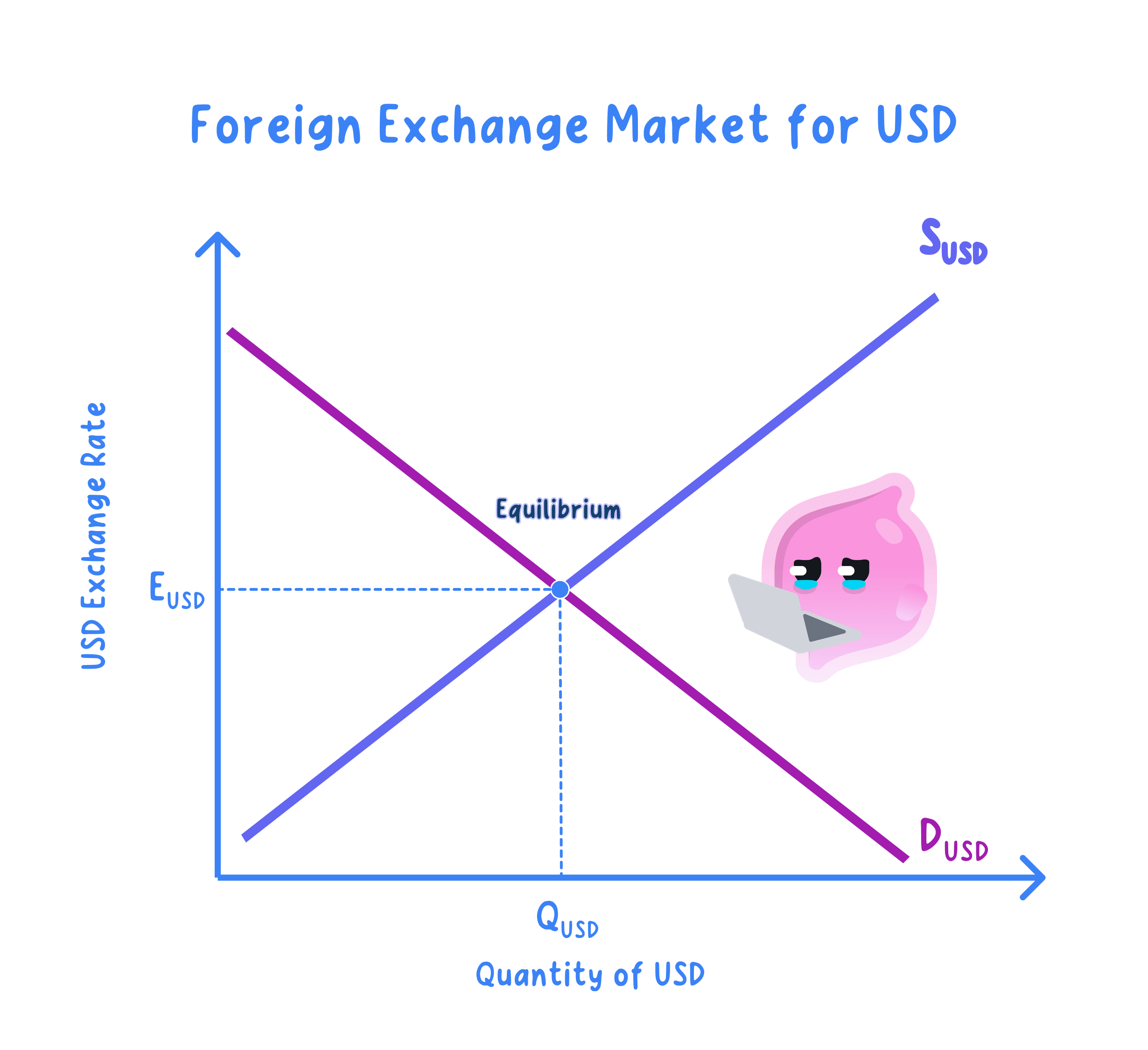
Floating exchange rate: an exchange rate whose value is determined entirely by market demand for and supply of the currency.
Fixed exchange rate: an exchange rate pegged by the authorities to another currency or basket of currencies at a set value.
Managed exchange rate (dirty float): a mostly market-determined rate that the central bank steers within a range through occasional intervention.
- In a floating system there is no official target, so the rate moves freely as the buying and selling of the currency change.
- Sterling, the US dollar and the euro all float, so their values are set by foreign exchange markets rather than by their central banks.
- In a fixed system the central bank maintains the peg by buying and selling foreign currency reserves to hold the rate at its target.
- If selling pressure pushes the currency down, the central bank buys its own currency using reserves to keep the rate at the fixed level, as Hong Kong does with its dollar and as Gulf states such as Saudi Arabia do by pegging to the US dollar.
- The most extreme fix is a monetary union such as the eurozone, where members abandon their own currencies for the euro and so permanently fix their exchange rates with one another.
- In a managed system the rate is largely set by demand and supply, but the authorities step in when they judge a movement to be too large or too rapid.
- China has long managed the renminbi in this way, letting it float within a band the authorities are willing to defend.
- The choice of system trades off exchange-rate stability against control of domestic monetary policy.
Appreciation and Revaluation
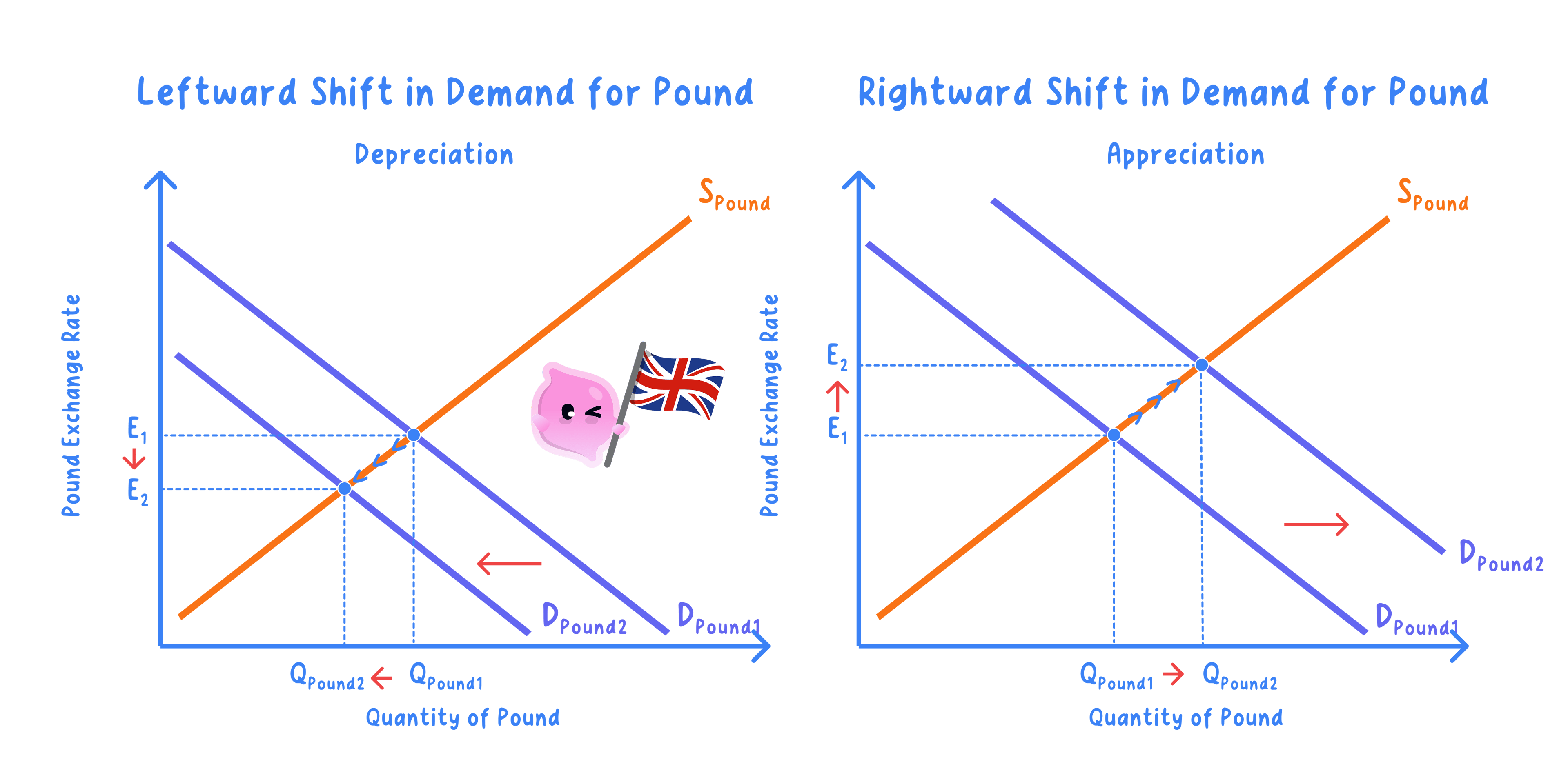
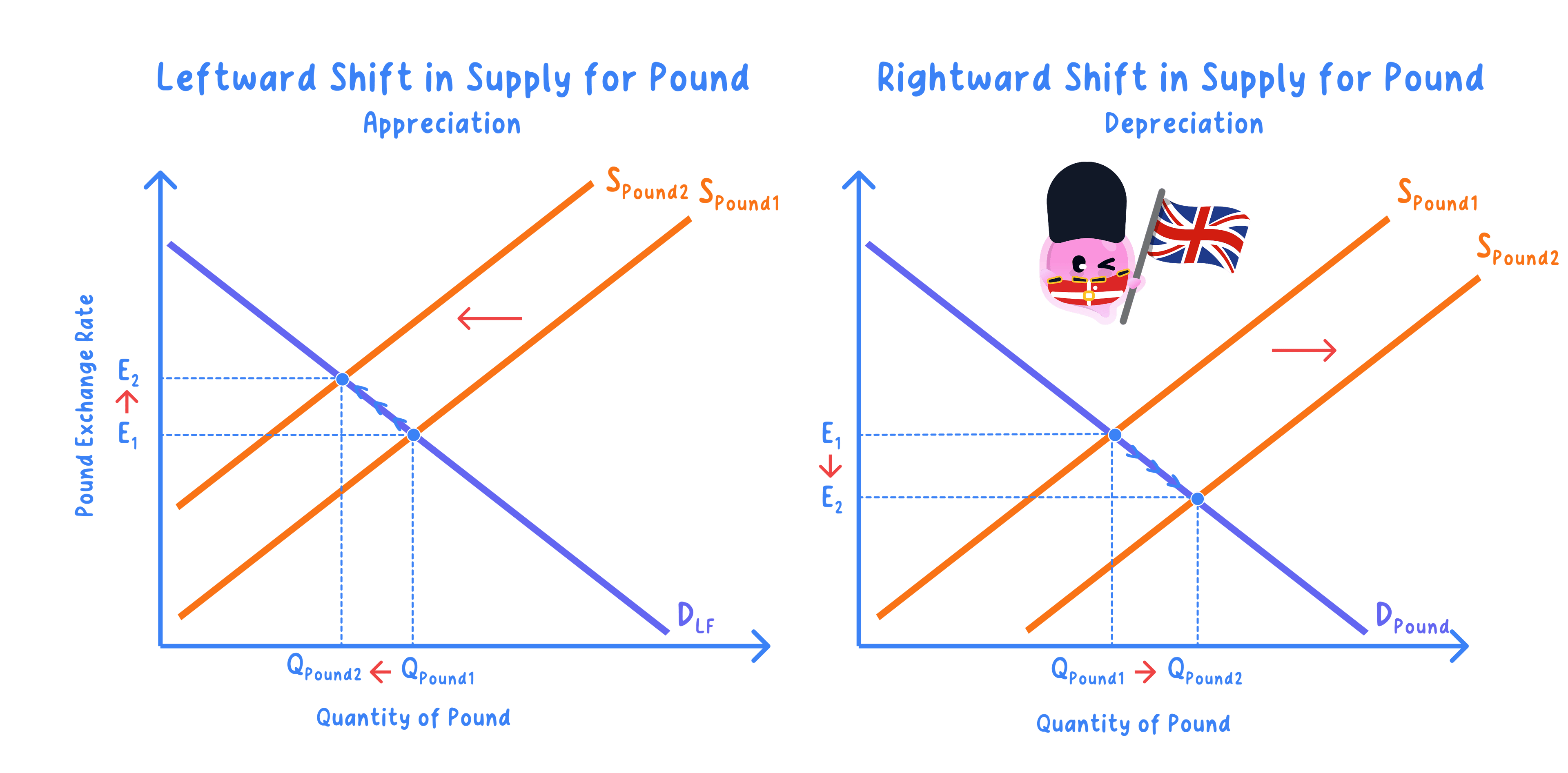
Appreciation: a rise in the value of a floating currency caused by market forces.
Revaluation: a deliberate official increase in the value of a currency in a fixed or managed system.
- An appreciation happens when demand for the currency rises or its supply falls, with no deliberate action by the authorities.
- A revaluation occurs when the authorities reset the peg at a higher value, so the change is a policy decision rather than a market outcome.
- Both raise the currency's value, but the distinction is the cause: market forces for an appreciation, an official policy act for a revaluation.
Depreciation and Devaluation
Depreciation: a fall in the value of a floating currency caused by market forces.
Devaluation: a deliberate official reduction in the value of a currency in a fixed or managed system.
- A depreciation happens when demand for the currency falls or its supply rises, again without any official action.
- A devaluation occurs when the authorities reset the peg at a lower value, making it a policy choice rather than a market movement.
- The mirror of the pair above: both lower the currency's value, but only a devaluation is a deliberate act by the authorities.
Is a floating or a fixed exchange rate better?
- A floating rate is attractive because it can partly self-correct external imbalances and frees the central bank to set interest rates for domestic goals such as controlling inflation.
- But a float can be volatile, and sharp swings create uncertainty that deters trade and long-term investment.
- A fixed rate gives exporters and importers stability and can import credibility for a country with high inflation, but it demands large reserves to defend and surrenders control of interest rates to holding the peg.
- On balance, the better system depends on a country's priorities: economies with deep financial markets often float, while those seeking stability or credibility may peg or manage.
- Use appreciation and depreciation only when a floating currency moves on its own.
- Use revaluation and devaluation only when the authorities deliberately change a fixed or managed peg.
- Identify the system first, then pick the matching term to show precise use of vocabulary.
- Do not treat depreciation and devaluation as the same thing, because they describe different systems.
- Remember that a revaluation or devaluation is a deliberate policy act, not a market movement.
- A rise or fall in a floating currency is never called a revaluation or devaluation.
- What determines a currency's value in a floating system?
- How does a central bank maintain a fixed exchange rate?
- How does an appreciation differ from a revaluation?
- How does a depreciation differ from a devaluation?
- What is a managed or dirty float?
4.1.8b Determinants and impact of exchange rate changes
Exchange Rate Changes
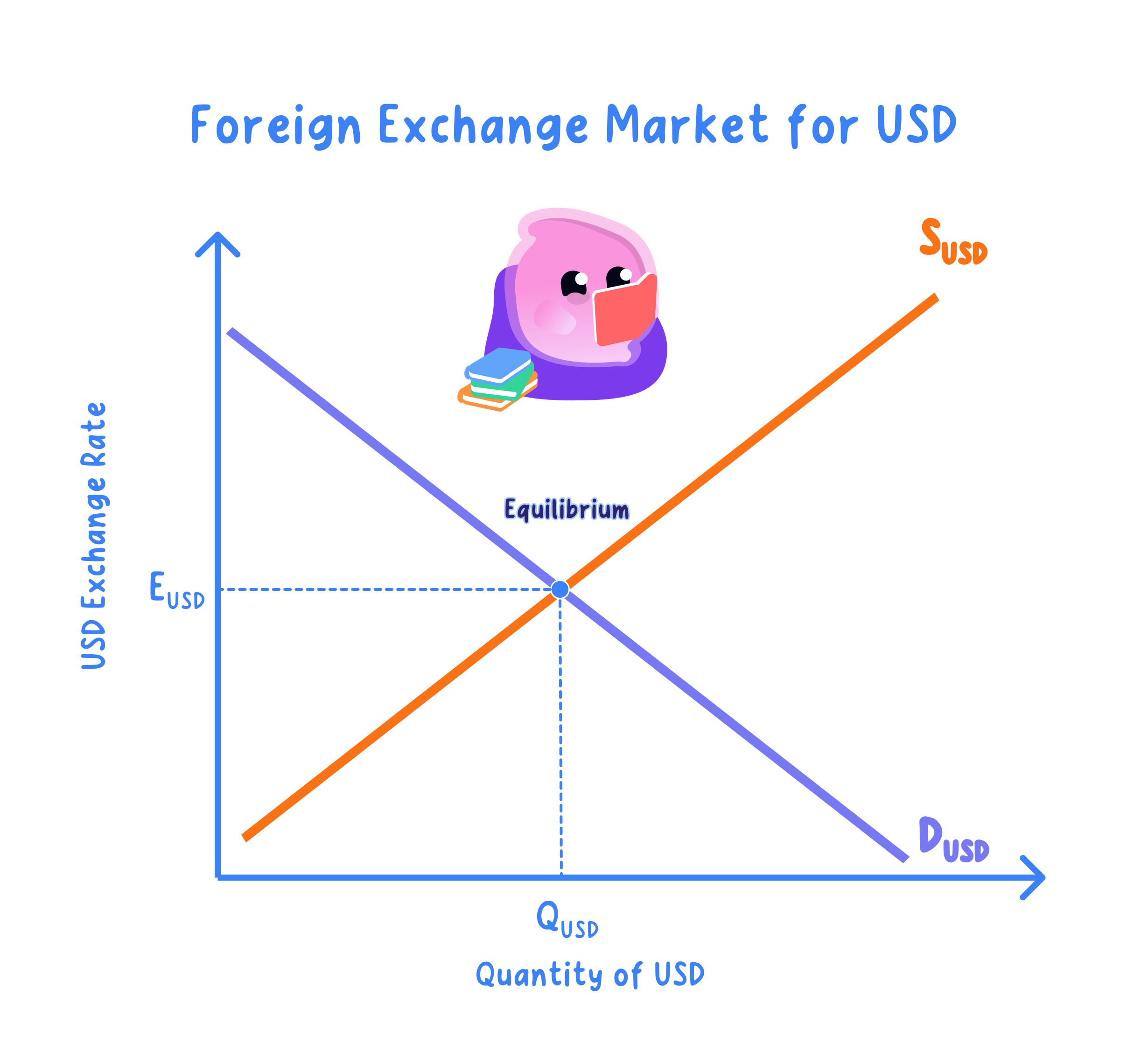
Floating exchange rate: an exchange rate set by the demand for and supply of the currency on the foreign exchange market.
Hot money: short-term capital that moves between countries chasing the highest interest rate or expected return.
- Demand for the currency comes from exports and investment inflows, while its supply comes from imports and investment outflows.
- Relative interest rates drive hot money flows, the major short-run determinant.
- Higher domestic interest rates than abroad attract hot money seeking higher returns, raising demand for the currency and causing it to appreciate, as the US dollar tends to strengthen when the Federal Reserve raises rates.
- Relative inflation changes competitiveness and trade flows.
- Higher domestic inflation than abroad makes exports less competitive, lowering demand for the currency and tending to cause depreciation.
- The current account and trade position influence currency demand and supply.
- A large current account surplus raises demand for the currency, while a persistent deficit tends to weaken it.
- FDI and portfolio investment flows move the rate: inflows raise demand for the currency, while outflows raise its supply.
- Speculation can move the rate sharply and be self-fulfilling.
- If traders expect the currency to rise they buy now, and herding behaviour can amplify the move.
- Quantitative easing tends to weaken a currency.
- It increases the money supply and lowers yields on domestic assets, reducing demand for the currency and putting downward pressure on the rate.
- Faster relative economic growth raises import demand and the supply of the currency, though strong growth may also attract investment inflows that support it.
Government Intervention in Currency Markets
- Governments and central banks can intervene in currency markets even under a broadly floating system.
- One tool is foreign currency transactions using the central bank's reserves.
- To support the currency the central bank buys its own currency using foreign reserves, raising demand; to weaken it, it sells its own currency and buys foreign currency, raising supply.
- A second tool is the use of interest rates.
- Raising interest rates attracts hot money inflows and strengthens the currency, while cutting rates tends to weaken it.
- The Bank of England's policy rate therefore influences sterling through the expected return on UK assets.
- To strengthen a currency, a central bank buys it using foreign currency reserves.
- To weaken a currency, it sells its own currency in exchange for foreign currency.
- Higher Bank of England rates tend to strengthen sterling by attracting capital inflows.
Competitive Devaluation
Competitive devaluation: deliberately lowering the exchange rate to gain a trade advantage; the equivalent under a floating rate is a competitive depreciation.
Beggar-thy-neighbour policy: a policy that benefits one country at its trading partners' expense.
- The aim is to make exports cheaper and imports dearer, boosting net exports and output.
- Because one country's gain comes at its trading partners' expense, it can trigger retaliation and currency wars as others devalue in response.
- If many countries devalue together, as in the 1930s, the competitive gains cancel out and world trade can be disrupted.
- A weaker currency also raises import prices and can cause imported inflation, as dearer imported goods and inputs feed into higher domestic costs and prices.
Impact on the Current Account
Marshall-Lerner condition: a depreciation improves the current account only if the combined price elasticity of demand for exports and imports exceeds one.
J-curve effect: the tendency for the current account to worsen before it improves after a depreciation, because trade volumes take time to adjust.
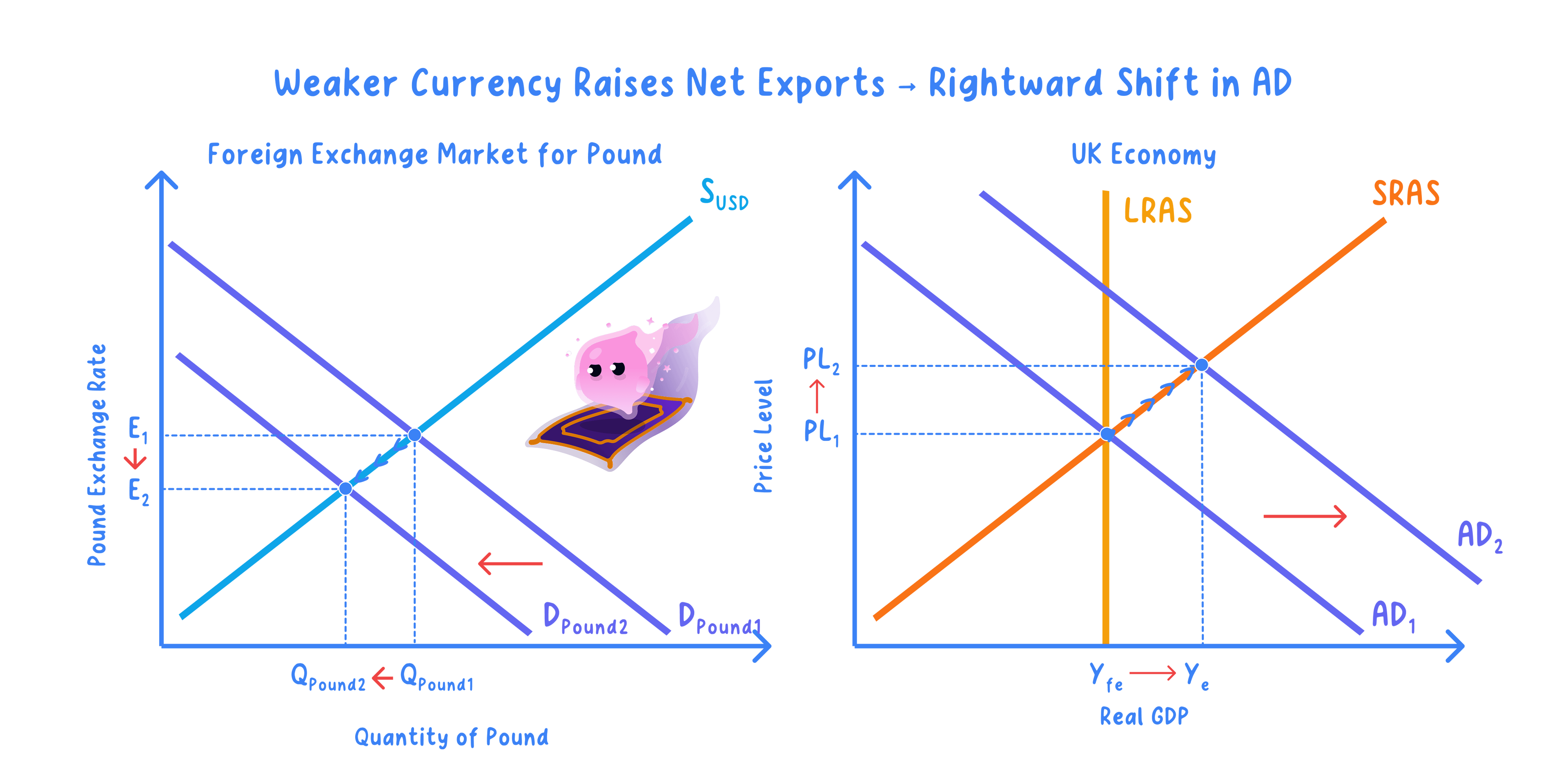
- A depreciation lowers export prices abroad and raises import prices at home, tending to raise export volumes and lower import volumes.
- Whether the balance actually improves depends on the price elasticities of demand for exports and imports.
- The Marshall-Lerner condition requires ∣PEDx∣+∣PEDm∣>1|PED_x| + |PED_m| > 1∣PEDx∣+∣PEDm∣>1; only then does the rise in export volumes and fall in import volumes outweigh the worse terms of trade.
- The adjustment also takes time, which the J-curve captures.
- In the short run demand is price-inelastic, so the dearer import bill worsens the balance first; as volumes respond over the long run the balance improves, tracing a J shape.
- Suppose the price elasticity of demand for exports is 0.5 and for imports is 0.7.
- Their sum is 0.5+0.7=1.20.5 + 0.7 = 1.20.5+0.7=1.2, which exceeds 1, so the Marshall-Lerner condition holds and a depreciation improves the current account over time.
- The J-curve shows the balance dipping first, as volumes take time to adjust, before recovering.
Impact on Growth and Employment
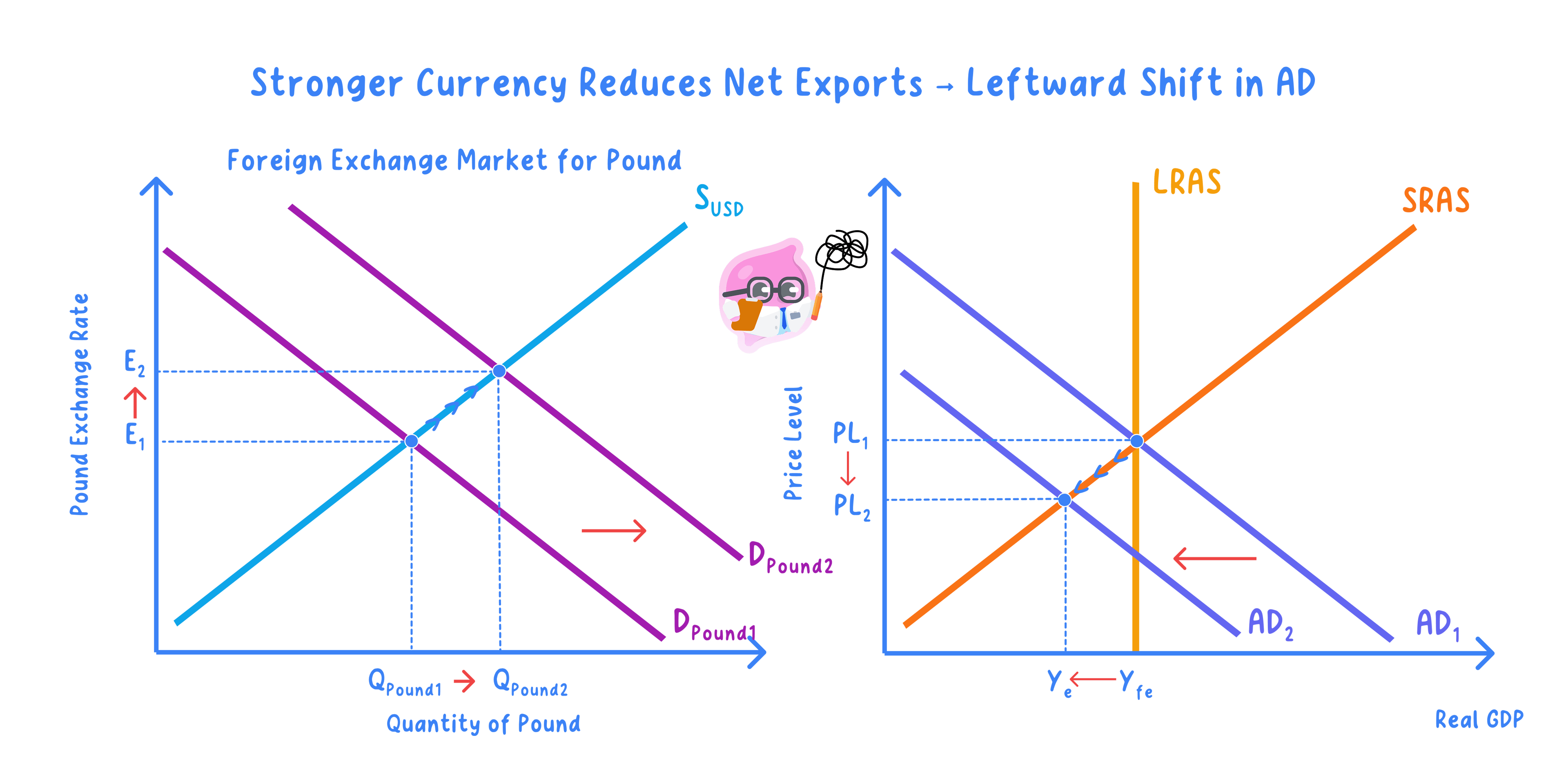
- A depreciation can raise economic growth through higher net exports, as cheaper exports and dearer imports raise aggregate demand and output.
- Export and import-competing industries may create jobs, lowering unemployment.
- The size of the effect depends on the Marshall-Lerner condition and on spare capacity in the economy.
- An appreciation works in reverse, lowering net exports, growth and employment.
Impact on Inflation
- A depreciation raises the price of imported goods and inputs, so dearer imported raw materials and components raise firms' costs and can cause cost-push inflation.
- Higher net exports also raise aggregate demand, adding demand-pull inflationary pressure.
- An appreciation has the opposite effect, easing inflation by lowering import prices.
- After the 2016 EU referendum sterling depreciated sharply against the dollar and euro.
- Import prices rose and UK CPI inflation picked up over the following year.
- This illustrates imported cost-push inflation caused by a depreciation.
Impact on FDI Flows
- A depreciation lowers the cost of a country's assets to foreign investors, which can attract inward FDI.
- A weaker currency can also make a country a cheaper export base for multinationals.
- However, exchange rate volatility and uncertainty can deter FDI by raising risk.
Does a depreciation always improve the current account?
- It should improve because cheaper exports and dearer imports raise export volumes and cut import volumes, boosting net exports and the trade balance.
- But it holds only if the Marshall-Lerner condition is met; if demand is price-inelastic, so that ∣PEDx∣+∣PEDm∣<1|PED_x| + |PED_m| < 1∣PEDx∣+∣PEDm∣<1, dearer imports worsen the balance instead.
- Even when the condition holds, the J-curve means the balance deteriorates first and improves only after a time lag as volumes adjust.
- On balance, it depends on elasticities, the time horizon and whether the depreciation feeds imported inflation that erodes the competitiveness gain.
- State the Marshall-Lerner condition precisely: the sum of the price elasticities of demand for exports and imports must exceed one.
- Explain the J-curve in words, distinguishing the short-run deficit from the long-run improvement.
- Use SPICED to recall that a Strong Pound makes Imports Cheaper and Exports Dearer.
- Always evaluate: the impact of a depreciation depends on elasticities, time and spare capacity.
- Do not assume a depreciation always improves the current account; it improves only if the Marshall-Lerner condition holds and only after a time lag.
- Use depreciation for a floating rate and devaluation for a fixed rate; the terms are not interchangeable.
- Do not confuse a shift in currency demand or supply with a movement along the curve.
- Name four determinants of a floating exchange rate.
- How can a central bank use reserves and interest rates to influence the currency?
- State the Marshall-Lerner condition.
- Why does the J-curve show the current account worsening before it improves?
- How can a depreciation cause cost-push inflation?
