Government intervention
What you'll learn
- Why governments intervene when markets do not produce socially desirable outcomes.
- How taxes, subsidies, price controls, buffer stocks, permits, regulation and competition policy work.
- How to evaluate whether intervention improves welfare or creates government failure.
- How to build balanced OCR H460 essay arguments using diagrams, examples and judgement.
1. The starting point: markets and welfare
A market equilibrium is where demand equals supply, giving an equilibrium price and quantity. In a simple competitive market, this can allocate resources efficiently because consumers and producers respond to price signals.
But markets do not always maximise social welfare, meaning the overall wellbeing of society. For example, pollution creates costs for people not involved in the transaction, and firms with monopoly power may restrict output and raise prices.
Market failure
Market failure occurs when the free market leads to an inefficient allocation of resources, so social welfare is not maximised.
Government intervention
Government intervention is action by the state to influence market outcomes, usually by changing prices, incentives, information, rules, ownership or the amount of competition.
The core mechanism
Most intervention works by changing either prices, costs, information, legal constraints, or market power. Always explain the route from policy to behaviour to outcome.
2. Taxation and subsidies
Taxation
Taxation is money collected by the government from households or firms. In market diagrams, the most common type is an indirect tax, which is placed on spending or production. A specific tax is a fixed amount per unit, while an ad valorem tax is a percentage of price, such as VAT.
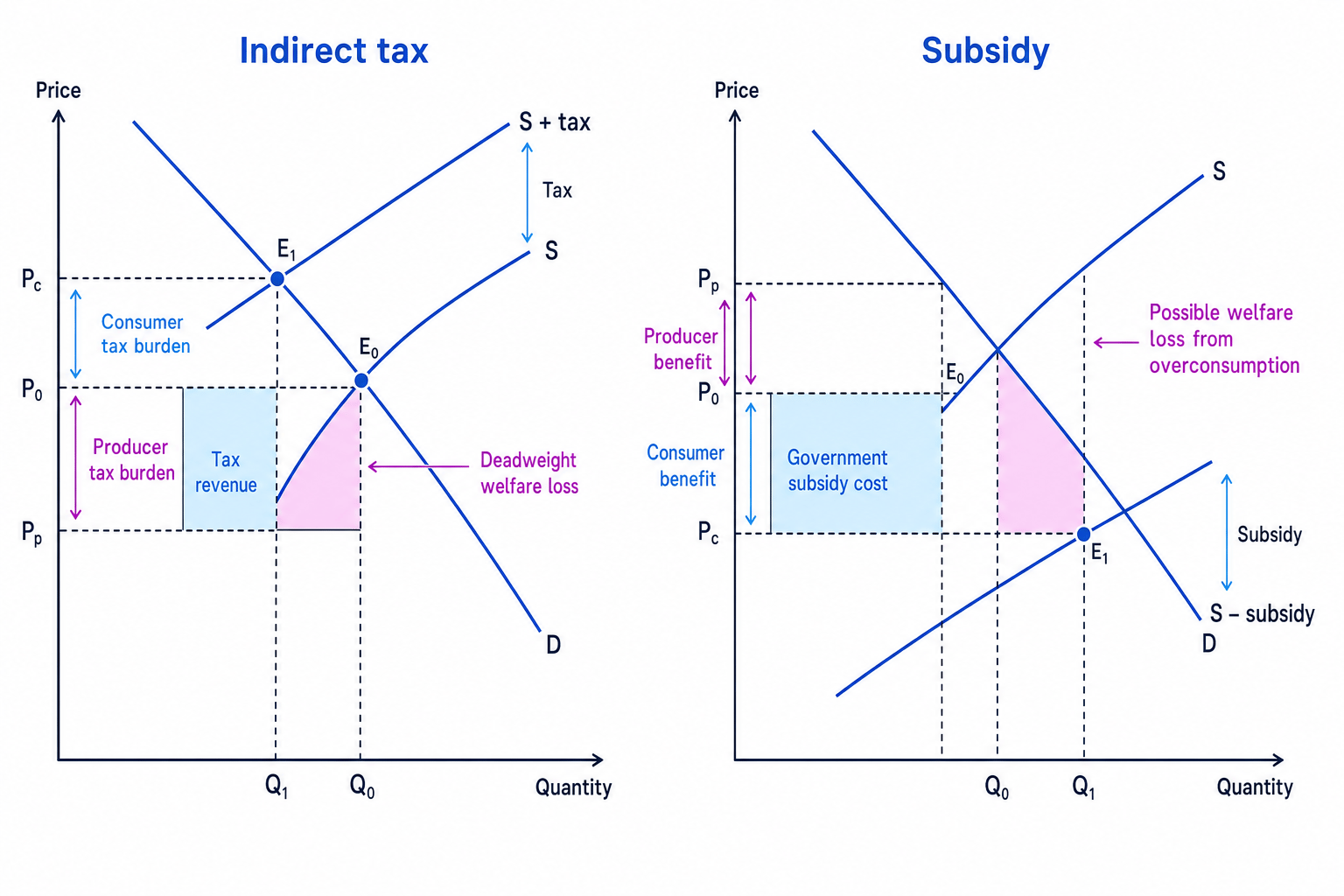
An indirect tax increases firms’ costs, so the supply curve shifts upwards. The market price paid by consumers rises, the price received by producers falls, and quantity traded decreases. This can reduce consumption of demerit goods, such as cigarettes, alcohol or high-sugar products.
If a tax is designed to correct a negative externality, it is often called a Pigouvian tax, after economist Arthur Pigou. The idea is to make consumers or producers “internalise” the external cost.
Subsidies
A subsidy is a payment from the government to producers or consumers to encourage production or consumption. A producer subsidy lowers firms’ costs, shifting supply downwards. This usually lowers the consumer price, raises the producer price received, and increases quantity.
Subsidies may support merit goods, such as education, public transport or green technologies, where the free market may under-consume because private decision-makers ignore wider social benefits.
The tax and subsidy diagrams show how intervention changes prices, output and welfare areas. A deadweight welfare loss is welfare lost to society that is not gained by another group.
Tax incidence
The side of the market that is less price elastic usually bears more of the tax burden. If demand is price inelastic, consumers cannot easily cut consumption, so more of the tax is passed on through higher prices.
Calculating tax incidence
-
Start from the market data: before the tax, price is £10 and quantity is 100,000 units. After the tax, consumers pay £11.20, producers receive £9.70, and quantity falls to 82,000 units.
-
Calculate the tax wedge: £11.20 minus £9.70 gives a tax of £1.50 per unit.
-
Split the burden relative to the original price: consumers pay £1.20 more than before, while producers receive £0.30 less than before.
-
Calculate government revenue: £1.50 per unit on 82,000 units gives £123,000 of tax revenue.
-
Interpret the result: consumers bear most of the burden, suggesting demand is relatively price inelastic compared with supply.
3. Price controls and buffer stock systems
Price controls
Price controls are legal limits on prices.
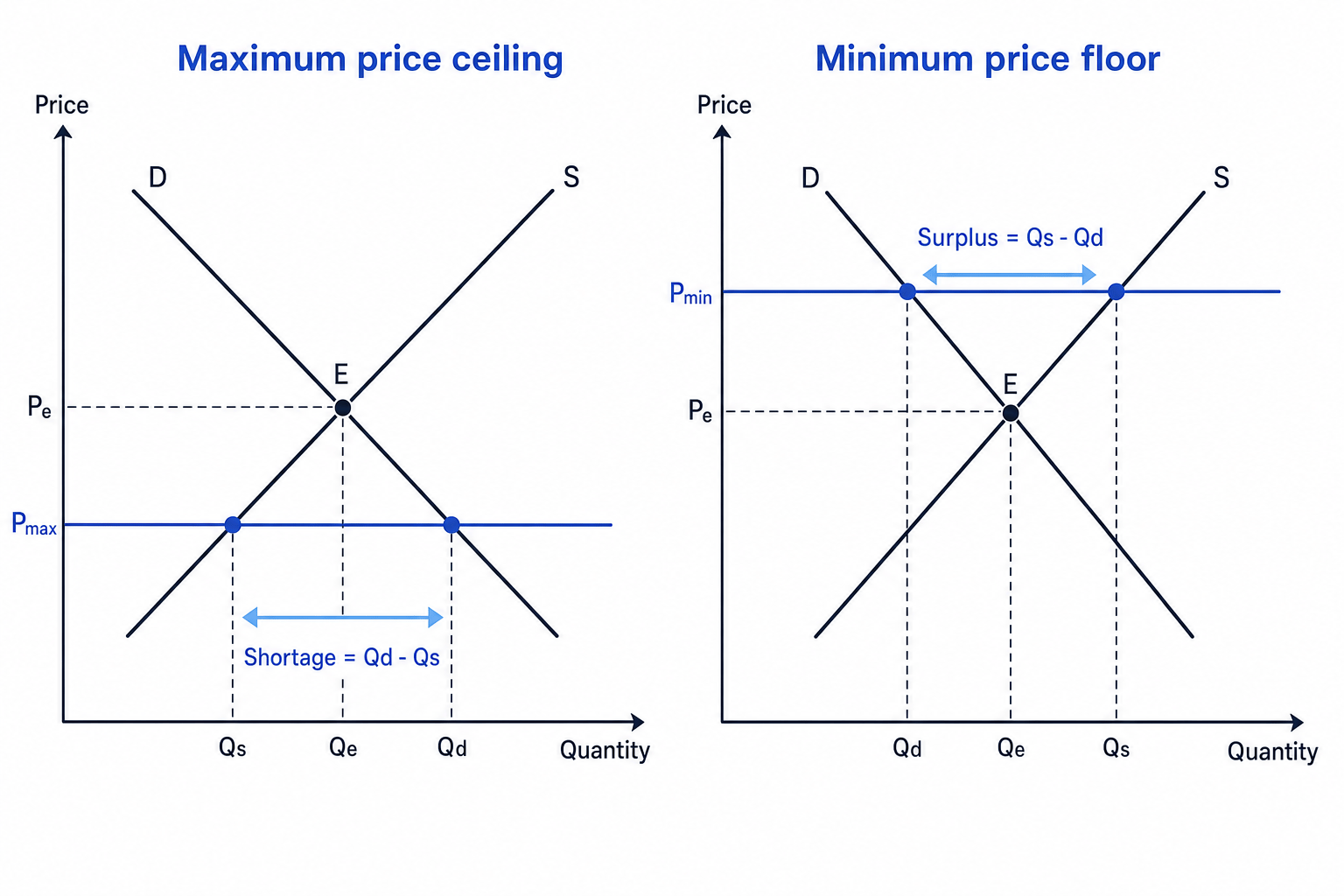
A maximum price, or price ceiling, is a legal price set below the market equilibrium. It is intended to make a good more affordable, such as rent controls on housing. However, if it is binding, quantity demanded exceeds quantity supplied, causing a shortage.
A minimum price, or price floor, is a legal price set above the market equilibrium. It is intended to protect incomes or standards, such as minimum wages in labour markets. However, if it is binding, quantity supplied exceeds quantity demanded, causing a surplus.
Non-binding price controls
A maximum price only affects the market if it is set below the equilibrium price. A minimum price only affects the market if it is set above the equilibrium price.
Analysing a rent cap
-
Classify the intervention: if the market rent is £1,200 per month and the government sets a rent cap at £900, this is a binding maximum price because it is below equilibrium.
-
Compare demand and supply at the controlled price: suppose tenants demand 75,000 flats but landlords supply only 50,000 flats.
-
Calculate the shortage: 75,000 minus 50,000 gives a shortage of 25,000 flats.
-
Analyse the likely effects: some tenants gain cheaper rent, but others cannot find housing; landlords may reduce maintenance or leave the market.
-
Evaluate over time: in the short run, tenants in existing contracts may benefit, but in the long run housing supply may fall further if investment becomes less profitable.
Buffer stock systems
A buffer stock system is a scheme where the government buys and sells stocks of a commodity to stabilise its price. It is most relevant for agricultural goods, where supply can fluctuate due to weather and harvest conditions.
When price falls below a lower intervention price, the government buys surplus output, increasing demand and supporting the price. When price rises above an upper intervention price, the government releases stored stock, increasing supply and reducing the price.
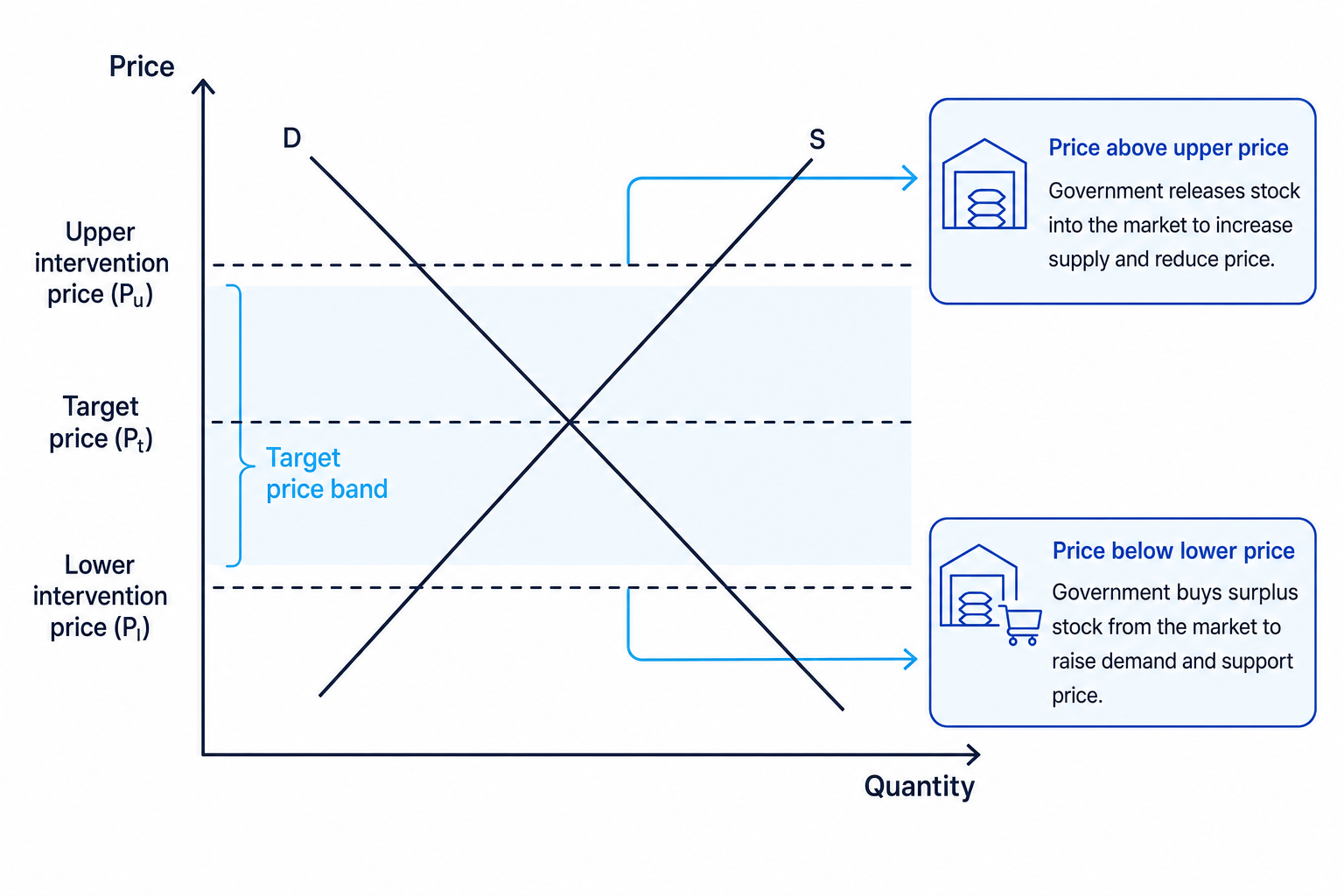
Buffer stocks can stabilise farmer incomes and protect consumers from sharp price rises. But they can be expensive, require storage, and may fail if the target price is set unrealistically high. They work best for goods that are storable and have predictable demand.
4. Spending, partnerships, laws and regulation
Government expenditure
Government expenditure is public-sector spending on goods, services and investment. It may involve direct provision of public goods such as street lighting, flood defences and national defence. A public good is non-rival and non-excludable, meaning one person’s use does not reduce another’s, and non-payers cannot easily be excluded.
Spending can also support merit goods like healthcare and education. In macroeconomics, government spending can increase aggregate demand, while infrastructure investment can improve long-run productive capacity.
The downside is opportunity cost: money spent on one policy cannot be spent elsewhere. Higher spending may also require taxation or borrowing.
Public/private partnerships
A public/private partnership, often called a PPP, is cooperation between government and private firms to finance, build or operate a service or project. For example, private firms might build a hospital or road under a long-term contract.
PPPs can bring private-sector expertise and reduce short-term pressure on public finances. However, contracts can be complex, profit motives may conflict with service quality, and taxpayers may face long-term liabilities.
Legislation and regulation
Legislation means laws passed by government. Examples include bans, age restrictions, safety standards and environmental laws.
Regulation means rules and monitoring, often enforced by bodies such as the Competition and Markets Authority, Ofgem or the Financial Conduct Authority. Regulation can set quality standards, limit emissions, control prices, or require firms to provide accurate information.
Rules can be powerful because they directly restrict behaviour. However, they may raise firms’ compliance costs and can create government failure if regulators lack information or are captured by the industry.
Information provision
Information provision means the government supplies information to help consumers and firms make better decisions. Examples include food labelling, public health campaigns, energy-efficiency ratings and comparison websites.
This can correct information failure, where buyers or sellers lack accurate knowledge. It is relatively low-cost and preserves consumer choice, but it may be weak if consumers ignore advice, face addiction, or lack time to process information.
Competition policy
Competition policy is government action to promote competition and prevent firms from abusing market power. In the UK, the Competition and Markets Authority can investigate mergers, cartels, collusion and abuse of dominance.
The aim is to lower prices, improve quality and increase innovation. However, competition investigations can be slow and difficult, especially in digital markets where firms operate globally and data creates strong barriers to entry.
5. Tradable pollution permits
Tradable pollution permits are a market-based environmental policy. The government sets a cap on total pollution, issues permits, and allows firms to buy and sell them. This is sometimes called cap and trade.
Firms that can cut emissions cheaply will do so and sell spare permits. Firms that find it expensive to reduce emissions may buy permits. This means the emissions reduction should happen where it is cheapest, improving cost efficiency.
A UK example is the UK Emissions Trading Scheme, which applies to energy-intensive industries and power generation. The policy gives firms a financial incentive to reduce carbon emissions, especially when permit prices are high.
Possible weaknesses include inaccurate caps, volatile permit prices, monitoring problems, and carbon leakage, where production shifts to countries with weaker environmental rules.
6. Government failure
Government failure
Government failure occurs when government intervention leads to a net welfare loss, either because it worsens the original problem or because its costs exceed its benefits.
Common causes include:
- Imperfect information: governments may not know the true external cost, demand conditions or likely behavioural response.
- Administrative costs: designing, enforcing and monitoring a policy can be expensive.
- Unintended consequences: rent controls may reduce housing supply; subsidies may support inefficient firms.
- Regulatory capture: regulators may act in the interests of the firms they regulate rather than consumers.
- Political incentives: governments may choose popular short-term policies before elections, even if long-term effects are poor.
- Time lags: by the time intervention works, market conditions may have changed.
- Moral hazard: if firms expect rescue, they may take excessive risks.
Consequences can include deadweight welfare loss, shortages, surpluses, black markets, wasted tax revenue, reduced investment, lower innovation and unfair distributional effects.
Assuming intervention always fixes market failure
A market failure is a reason to consider intervention, not proof that intervention will improve welfare. You must compare the policy with realistic alternatives and with the risk of government failure.
7. Evaluating the effectiveness of intervention
To evaluate effectiveness, ask: did the policy achieve its objective, and were the benefits greater than the costs?
A strong judgement considers:
- The cause of the problem: taxation may suit negative externalities; competition policy suits monopoly power; information provision suits information failure.
- Elasticities: price-based policies work better at changing quantity when demand or supply is responsive.
- Time period: short-run results may differ from long-run incentives.
- Stakeholders: consumers, producers, workers, taxpayers and future generations may be affected differently.
- Administrative feasibility: policies requiring detailed monitoring may be costly.
- Equity: taxes on necessities may be regressive, hitting lower-income households harder.
- Opportunity cost: subsidies and spending require funding.
- Government-failure risk: poor targeting or political pressure can reduce welfare.
Choosing an intervention for sugary drinks
-
Identify the market failure: sugary drinks may create external costs for the NHS and involve information failure if consumers underestimate long-term health risks.
-
Compare policies: an indirect tax raises the price and creates revenue, while information campaigns preserve choice but may be weaker if habits are strong.
-
Use elasticity: if demand is price inelastic, the tax raises revenue but causes only a small fall in consumption; if demand is more elastic among young consumers, the quantity effect may be larger.
-
Add evaluation: the tax may be regressive, so the government could use revenue to fund school sport or healthy food schemes.
-
Reach a judgement: a combined policy is likely to be more effective than one tool alone because it changes both price incentives and consumer information.
Best overall judgement
Intervention is most effective when it is targeted at the exact market failure, based on good information, enforceable at reasonable cost, and regularly reviewed against clear objectives.
In the exam
-
Identify the market failure or policy objective before describing the intervention.
-
Explain the mechanism clearly: show how the policy changes costs, prices, incentives, information or competition.
-
Use a diagram where relevant, especially for taxes, subsidies, price controls and buffer stocks.
-
Evaluate with at least two criteria, such as elasticity, time period, administrative cost, equity and risk of government failure.
-
Finish with a supported judgement comparing the chosen policy with at least one realistic alternative.
Check yourself
-
Why does an indirect tax create a gap between the consumer price and producer price?
-
When does a maximum price cause a shortage, and why might a government still use one?
-
What are two causes of government failure, and what consequence could each create?