Employment
What you'll learn
- How economists distinguish employment, unemployment, the labour force, and economic inactivity.
- How the Labour Force Survey and Claimant Count measure unemployment differently.
- Why governments aim for full employment, but not zero unemployment.
- How to evaluate the causes and consequences of unemployment and the effects of full employment.
Employment, unemployment and the labour force
In economics, employment is not just “having a job” in a casual sense. It is part of how we measure how well an economy is using its labour resources.
Labour market status
- Employment means people aged 16 and over who are in work, including employees and the self-employed.
- Unemployment means people without work who are available for work and actively seeking it.
- The labour force is everyone who is either employed or unemployed.
- Economically inactive people are neither employed nor unemployed, for example many full-time students, retirees, carers, or people too ill to work.
A key point is that unemployment is about being out of work but still in the labour force. Someone who has stopped looking for work is usually counted as economically inactive, not unemployed.
Unemployment rate
The unemployment rate is the percentage of the labour force that is unemployed:
u=number unemployedlabour force×100u=\frac{\text{number unemployed}}{\text{labour force}}\times 100u=labour forcenumber unemployed×100Calculating the unemployment rate
Suppose an economy has 32.8 million people employed, 1.5 million unemployed, and 9.2 million economically inactive.
- Identify the labour force by adding only those who are employed and unemployed: 32.8 million + 1.5 million = 34.3 million.
- Substitute into the unemployment rate formula:
- Interpret the result: the unemployment rate is about 4.4%, meaning roughly 4.4% of the labour force is unemployed.
Using the wrong denominator
Do not divide unemployment by the whole population. The unemployment rate uses the labour force, so economically inactive people are excluded.
Measuring unemployment: LFS and Claimant Count
The UK has two main unemployment measures. They often move together, but they are not identical because they count different things.
| Measure | What it counts | Strengths | Limitations |
|---|---|---|---|
| Labour Force Survey | A household survey using the international definition: without work, actively seeking work, and available to start soon. | Broad, internationally comparable, includes people who do not claim benefits. | Survey-based, so there can be sampling error and time lags. |
| Claimant Count | People claiming unemployment-related benefits, mainly Jobseeker’s Allowance or Universal Credit with work-search requirements. | Quick, administrative, useful for local data. | Affected by benefit rules, eligibility, sanctions, and Universal Credit changes. |
The Labour Force Survey (LFS) is usually better for comparing unemployment over time and across countries. The Claimant Count is useful for short-term local changes but can rise or fall because benefit rules change, even if true unemployment has not changed much.
LFS versus Claimant Count
If the two measures disagree, ask: “Has the labour market changed, or have benefit rules and claiming behaviour changed?” That distinction is useful evaluation.
Full employment as a policy objective
Full employment is one of the main macroeconomic policy objectives. It matters because labour is a scarce resource: if people who want work cannot find it, the economy produces less than it could.
Full employment
Full employment means unemployment is as low as possible without creating excessive inflationary pressure. It does not mean every single person has a job.
There will usually be some frictional unemployment, which is short-term unemployment while people move between jobs. There may also be some structural unemployment, where workers’ skills or locations do not match available jobs.
Economists sometimes link full employment to the natural rate of unemployment or the NAIRU, the Non-Accelerating Inflation Rate of Unemployment. This is the unemployment rate consistent with stable inflation.
Full employment is not zero unemployment
Zero unemployment is unrealistic and may be undesirable. A healthy economy still has people changing jobs, retraining, relocating, or searching for better matches.
Causes of unemployment
Cyclical or demand-deficient unemployment
Aggregate demand (AD) means total spending in the economy by households, firms, government, and overseas buyers. If AD falls, firms sell less output. They may reduce production and cut labour demand, causing cyclical unemployment.
This is more likely in a slowdown or recession. For example, higher Bank of England interest rates can reduce consumer spending and investment, weakening demand for labour.
Tracing cyclical unemployment from weaker demand
Suppose consumer confidence falls during a cost-of-living squeeze.
- Lower confidence reduces household spending, especially on non-essential goods such as restaurants, holidays, and furniture.
- Firms facing lower sales cut output, so they need fewer workers or fewer working hours.
- Labour demand falls, increasing unemployment and creating a negative output gap, where actual output is below potential output.
Structural unemployment
Structural unemployment happens when the pattern of labour demand changes, but workers cannot easily move into the new jobs available. This may be due to skills gaps, regional immobility, automation, deindustrialisation, or the green transition.
For example, a worker leaving a declining high-street retail job may not immediately have the digital skills needed for a logistics or software role.
Frictional and seasonal unemployment
Frictional unemployment is usually short term and can be beneficial if it helps workers find better jobs. Seasonal unemployment occurs when demand for labour changes predictably during the year, such as in tourism, agriculture, or Christmas retail.
Real-wage unemployment
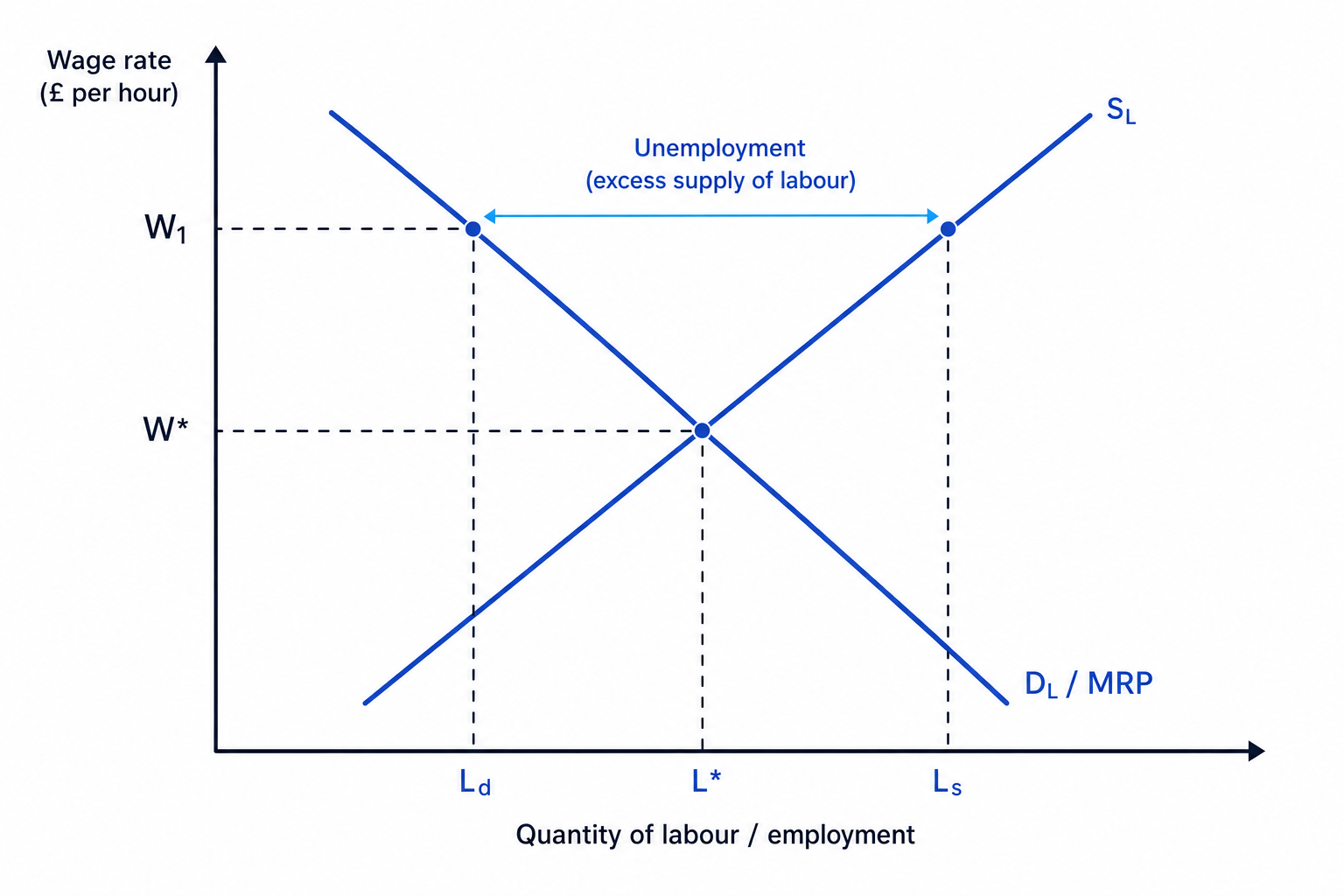
Real-wage unemployment can occur if the wage rate is held above the market-clearing level. The real wage is the wage adjusted for inflation. If wages are too high relative to productivity, firms may demand fewer workers than the number willing to work.
Labour demand is linked to marginal revenue product (MRP), the extra revenue a firm gains from employing one more worker. The diagram shows unemployment as excess labour supply when the wage is held above equilibrium.
Minimum wage nuance
Do not automatically claim a higher minimum wage increases unemployment. In a monopsony labour market, where one employer has wage-setting power, a higher wage floor can increase both wages and employment.
Consequences of unemployment
Unemployment has costs for individuals, firms, the government, and the wider economy.
For individuals, unemployment reduces income, living standards, confidence, and sometimes mental and physical health. Long-term unemployment can cause hysteresis, where people lose skills, work habits, and employability, making unemployment persist even after demand recovers.
For the government, unemployment lowers tax revenue from income tax, National Insurance, and VAT. It also raises welfare spending, worsening the budget position.
For the economy, unemployment means wasted resources and lower output. If unemployment is concentrated in particular regions, it can increase inequality and create local decline as spending leaves the area.
However, evaluation matters. Short-term frictional unemployment is much less damaging than long-term structural unemployment. Some unemployment may also reduce wage pressure and help control inflation, although this is a painful way to achieve price stability.
Duration matters
The longer unemployment lasts, the more serious the consequences become. Long-term unemployment damages human capital and can make future employment harder.
Effects of full employment
Full employment has major benefits. More people earning wages means higher household incomes, stronger consumption, lower poverty, and improved living standards. It also improves government finances because tax receipts rise and welfare spending falls.
Full employment can also support confidence. If workers feel secure, they may spend more. If firms see strong demand, they may invest more, creating a positive cycle of growth and jobs.
But there are trade-offs. If the economy is already close to potential output, extra demand may push up wages and prices rather than output. This links to the short-run Phillips curve idea: lower unemployment can be associated with higher inflationary pressure.
Full employment can also hide problems. A country may have low unemployment but high underemployment, where people have jobs but want more hours or are working below their skill level. Low unemployment may also coexist with weak productivity or insecure work.
Sustainable full employment
The best kind of full employment comes from higher productivity, skills, childcare access, transport links, and labour mobility — not just from boosting demand until inflation rises.
In the exam
- Define the labour market terms precisely: employment, unemployment, labour force, inactivity, and full employment are not interchangeable.
- For analysis, build a clear chain: cause → effect on labour demand or labour supply → unemployment rate → wider consequences.
- For evaluation, judge by type, duration, region, inflation risk, and whether jobs are productive, secure, and well matched to workers’ skills.
Check yourself
- Why can the Labour Force Survey and Claimant Count give different unemployment figures?
- Why does full employment not mean zero unemployment?
- Which is usually more damaging: frictional unemployment or long-term structural unemployment? Why?