

What you'll learn
- What economic growth means and why it is a major macroeconomic policy objective.
- How to distinguish nominal GDP, real GDP, growth rates, and GDP per capita.
- How the economy moves through the economic cycle.
- How to evaluate short-run and long-run causes and consequences of growth.
What is economic growth?
Economic growth
Economic growth is an increase in an economy’s output over time. In A-Level macroeconomics, it is usually measured by the percentage increase in real Gross Domestic Product (real GDP).
Gross Domestic Product (GDP) is the total monetary value of all final goods and services produced within an economy over a period of time, usually a quarter or a year.
The word final matters: GDP counts the value of finished output, not every intermediate input, because that would double count production.
There are two main ideas:
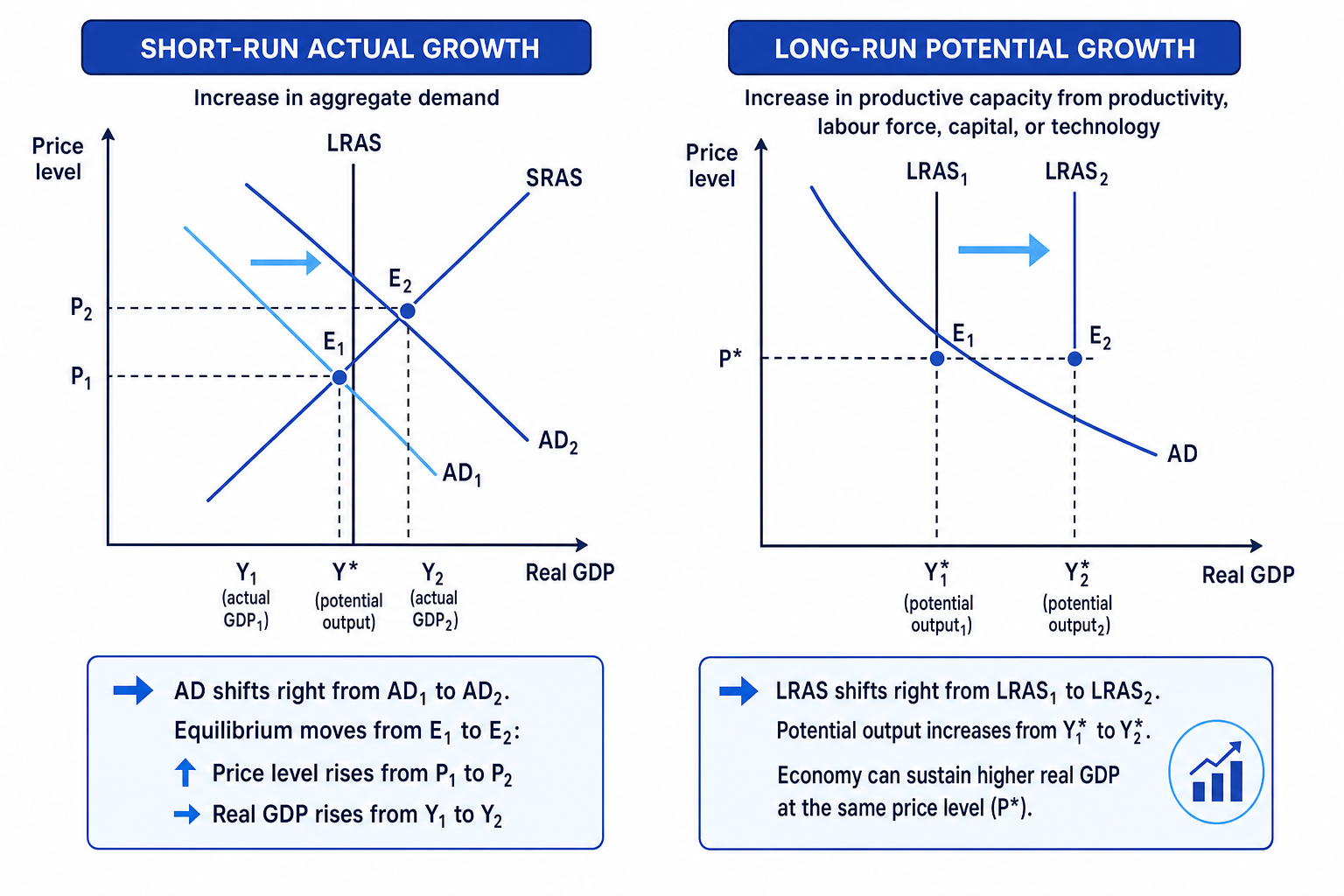
- Actual growth: real GDP increases in the short run, often because aggregate demand rises.
- Potential growth: the economy’s productive capacity increases in the long run, so it can produce more without inflationary pressure.
Nominal GDP and real GDP
Nominal and real GDP
Nominal GDP measures output using current prices. Real GDP adjusts nominal GDP for inflation, so it measures changes in the volume of output rather than just changes in prices.
If nominal GDP rises, the economy may not actually be producing more. Prices may simply have increased. That is why economists normally use real GDP when discussing economic growth.
Separating price rises from real growth
Suppose nominal GDP rises from £2,000 billion to £2,100 billion, while the GDP deflator rises from 100 to 107.
-
Nominal GDP has increased by £100 billion, so the nominal growth rate is 5%.
-
Convert year 2 nominal GDP into real GDP using the deflator:
Real GDP=Nominal GDPGDP deflator×100\text{Real GDP} = \frac{\text{Nominal GDP}}{\text{GDP deflator}} \times 100Real GDP=GDP deflatorNominal GDP×100 Real GDP=2100107×100≈1962.6\text{Real GDP} = \frac{2100}{107} \times 100 \approx 1962.6Real GDP=1072100×100≈1962.6 -
Real GDP is about £1,962.6 billion, which is lower than £2,000 billion. So although nominal GDP rose, real output fell by about 1.9%.
Nominal growth is not necessarily real growth
Do not say “GDP increased, therefore living standards improved” unless you know whether the figure is real GDP and whether it is adjusted for population size.
The policy objective of economic growth
Governments usually aim for sustained economic growth: steady increases in real GDP without causing high inflation, excessive environmental damage, or a large balance of payments problem.
Growth matters because it can:
- raise household incomes and living standards;
- reduce cyclical unemployment as firms need more workers;
- increase tax revenue without raising tax rates;
- make it easier to fund the NHS, education, infrastructure, and defence;
- reduce the burden of public debt as GDP rises relative to debt.
Growth is not automatically good
The best type of growth is usually sustainable, long-run, supply-side growth: it raises productive capacity and living standards without simply overheating the economy.
The economic cycle
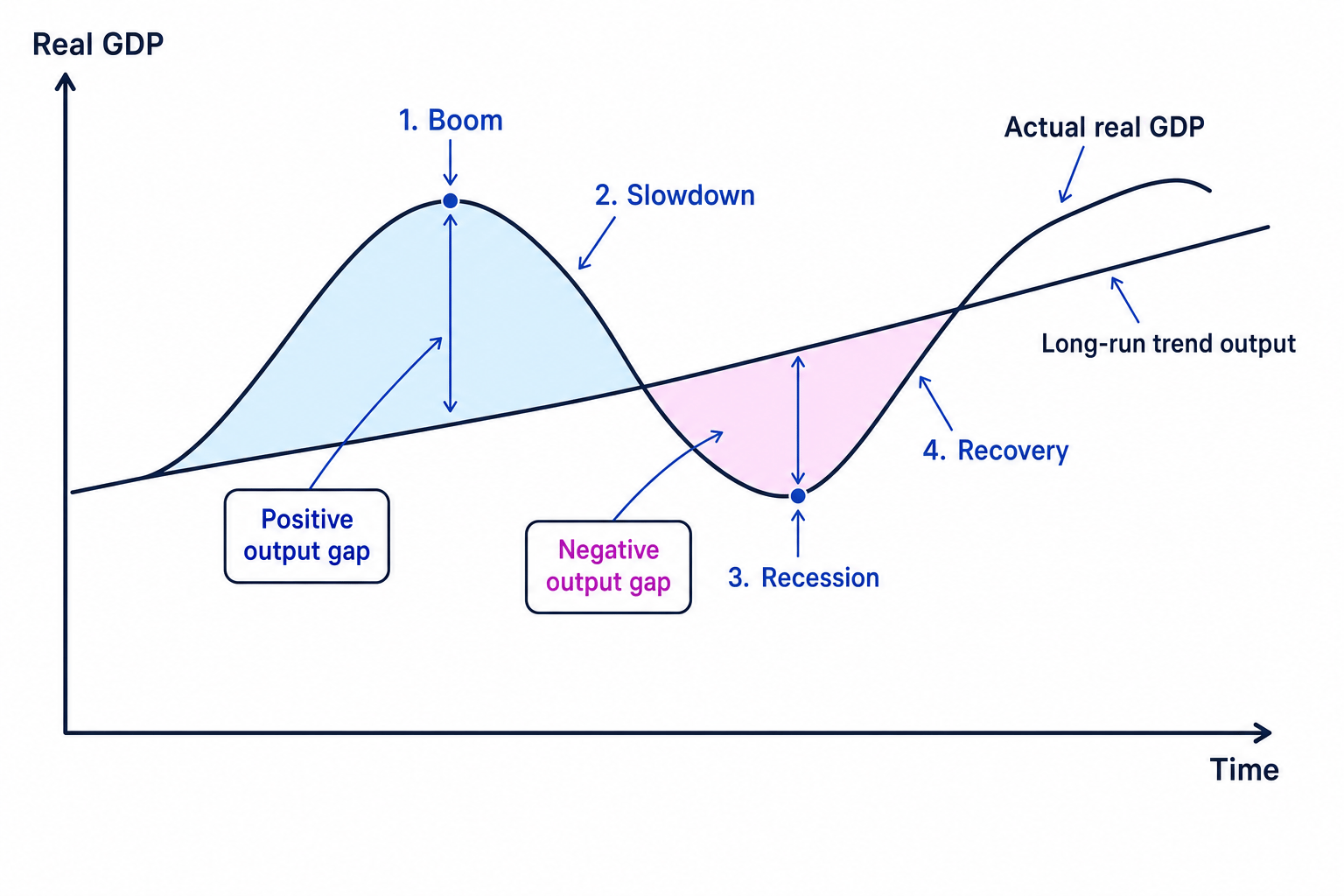
The economic cycle describes fluctuations in actual real GDP around the long-run trend level of output.
The main stages
A boom occurs when real GDP is rising strongly and output may be above the economy’s sustainable capacity. This can create a positive output gap, where actual output is above potential output.
A slowdown occurs when real GDP is still increasing, but at a slower rate. Growth is positive, but weakening.
A recession is commonly defined in the UK as two consecutive quarters of negative real GDP growth. Output falls, unemployment often rises, and business confidence weakens.
A recovery occurs when real GDP starts rising again after a downturn. Spare capacity is gradually used up.
Identifying the stage of the cycle
An economy’s annual real GDP growth falls from 3.0% to 1.0%, then to 0.3%, but GDP is still increasing.
- Compare the growth rates over time: growth is becoming weaker each period.
- Check whether output is actually falling: growth remains positive, so real GDP is still rising.
- Classify the stage: this is a slowdown, not a recession, because real GDP has not fallen.
Calculating economic growth rates
The economic growth rate measures the percentage change in real GDP over time.
Growth rate=Real GDPnew−Real GDPoldReal GDPold×100\text{Growth rate} = \frac{\text{Real GDP}_{\text{new}} - \text{Real GDP}_{\text{old}}}{\text{Real GDP}_{\text{old}}} \times 100Growth rate=Real GDPoldReal GDPnew−Real GDPold×100Use real GDP, not nominal GDP, unless the question specifically asks for nominal growth.
GDP per capita
GDP per capita
GDP per capita is GDP per person. It is calculated by dividing GDP by the population.
GDP per capita is often a better indicator of average living standards than total GDP. For example, if GDP rises by 2% but the population rises by 3%, GDP per capita falls.
Calculating growth and GDP per capita
Suppose real GDP rises from £2,280 billion to £2,337 billion. The population is 67 million.
-
Calculate the change in real GDP:
2337−2280=572337 - 2280 = 572337−2280=57Real GDP increased by £57 billion.
-
Calculate the growth rate:
572280×100=2.5\frac{57}{2280} \times 100 = 2.5228057×100=2.5The economy grew by 2.5%.
-
Calculate GDP per capita using the new GDP figure:
£2,337,000,000,00067,000,000≈£34,881\frac{£2{,}337{,}000{,}000{,}000}{67{,}000{,}000} \approx £34{,}88167,000,000£2,337,000,000,000≈£34,881GDP per capita is about £34,881 per person.
Short-run and long-run economic growth
Aggregate demand (AD) is total planned spending in the economy:
AD=C+I+G+(X−M)AD = C + I + G + (X - M)AD=C+I+G+(X−M)where C is consumption, I is investment, G is government spending, X is exports, and M is imports.
In the short run, growth often happens because AD increases. Firms respond by producing more, so real GDP rises. But if the economy is near full capacity, the price level may also rise.
In the long run, growth happens when productive capacity increases. This may come from better technology, a larger or more skilled labour force, more capital investment, improved infrastructure, or higher productivity.
Actual versus potential growth
Short-run growth is about producing more now. Long-run growth is about being able to produce more sustainably in the future.
Causes of economic growth
Short-run causes
Short-run growth is often demand-led. It may be caused by:
- higher consumer spending due to rising real wages or confidence;
- higher investment due to lower interest rates or stronger business expectations;
- higher government spending on infrastructure or public services;
- rising exports due to global growth or a weaker pound;
- falling import prices or energy prices, which can reduce firms’ costs.
For example, post-pandemic reopening boosted demand in many economies, while later Bank of England interest rate rises reduced borrowing and spending.
Long-run causes
Long-run growth depends on the quantity and quality of factors of production:
- Capital investment increases machinery, buildings, transport links, and digital infrastructure.
- Human capital improves through education, training, and health.
- Technology and innovation raise productivity.
- Labour force growth increases potential output, though it may also increase demand for housing and public services.
- Institutional quality matters: stable laws, competition, property rights, and efficient taxation support investment.
Brexit trade frictions, global supply-chain shocks, and the green transition can all affect long-run productive capacity in the UK.
Consequences of economic growth
Benefits
Growth can raise real incomes, reduce unemployment, increase profits, improve business confidence, and raise tax receipts. If growth is supply-side led, it can also reduce inflationary pressure by shifting LRAS to the right.
In developing economies, long-run growth can reduce absolute poverty and improve access to healthcare, education, and infrastructure.
Costs and risks
Demand-led growth may cause demand-pull inflation if AD rises faster than productive capacity. It may also worsen the current account if households buy more imports.
Growth can increase pollution, carbon emissions, congestion, and resource depletion if it relies on fossil fuels or high material consumption. It may also worsen inequality if gains mainly go to owners of capital or highly skilled workers.
Strong evaluation point
Always ask: what type of growth is it? Demand-led growth during a recession can reduce unemployment with limited inflation. Demand-led growth near full capacity is more likely to cause inflation.
Overall evaluation
Economic growth is usually desirable, but its value depends on its quality, sustainability, and distribution.
In the short run, growth is especially beneficial when there is spare capacity and high unemployment, because extra demand can increase output without much inflation. However, if the economy is already close to full capacity, growth may mainly raise prices.
In the long run, growth is most beneficial when it comes from productivity improvements, investment, innovation, and skills. This allows real GDP and GDP per capita to rise without creating the same inflationary pressure. The strongest judgement is therefore that governments should not simply maximise growth; they should aim for sustainable and inclusive growth.
In the exam
- Define growth carefully as an increase in real GDP, then distinguish actual and potential growth where relevant.
- Use diagrams precisely: AD shifting right shows short-run actual growth; LRAS shifting right shows long-run potential growth.
- Evaluate by considering the output gap, inflationary pressure, GDP per capita, inequality, environmental effects, and whether growth is demand-side or supply-side led.
Check yourself
- Why can nominal GDP rise even when real GDP falls?
- What is the difference between a slowdown and a recession?
- Why might long-run economic growth be less inflationary than short-run demand-led growth?
