

What you'll learn
- Why scarcity is the starting point for all economics.
- How scarcity forces choice and creates opportunity cost.
- The difference between economic goods and free goods.
- How individuals, governments and whole societies answer: what, how and for whom to produce.
The starting point: resources, wants and scarcity
Economics studies how people, firms and governments use limited resources to satisfy wants.
A want is something people would like to have. A need is something essential, such as basic food, shelter or healthcare. A good is a physical product, such as a phone or a loaf of bread. A service is an activity provided for someone, such as a haircut, a bus journey or a GP appointment.
Resources are the inputs used to produce goods and services. Economists often call these factors of production:
- Land: natural resources, such as oil, farmland, water and minerals.
- Labour: human effort, skills and time.
- Capital: man-made resources used to produce output, such as machinery, roads, computers and factories.
- Enterprise: the willingness to take risks and organise the other factors of production.
Scarcity
Scarcity exists when wants are unlimited but the resources available to satisfy them are finite. It is the reason economic decisions involve trade-offs.
Scarcity is not just about “not having much money”. The UK is a high-income economy, but it still cannot produce unlimited NHS treatment, housing, defence, public transport, university places and environmental protection all at once.
Scarcity is not the same as poverty
Scarcity affects every economy, including rich countries, because resources such as skilled workers, land, time and government budgets are always limited relative to people’s wants.
Choice: allocating scarce resources
Because resources are scarce, they have alternative uses. The same land could be used for housing, farming, offices or a park. The same £10 billion of public spending could support hospitals, schools, defence or tax cuts.
Choice means selecting between competing uses of scarce resources. Resource allocation means deciding where resources are used in the economy.
Choices happen at different levels:
- Individuals choose how to spend income and time.
- Firms choose what to produce and which production methods to use.
- Governments choose how to raise and spend tax revenue.
- Society as a whole chooses how resources are distributed between different goods, services and groups of people.
Applying scarcity to a household choice
A household has £90 left for the week during a cost-of-living squeeze and is deciding between extra heating, groceries and a train ticket to work.
- Identify the scarce resource: the household’s remaining income is limited to £90, so it cannot fully fund every want.
- Compare the competing uses: heating improves comfort, groceries meet food needs, and the train ticket helps the person get to work.
- Make the economic link: because the same £90 has alternative uses, choosing one option reduces what can be spent on the others.
Opportunity cost: the real cost of choosing
Whenever a choice is made, something else is given up. Economists call this the opportunity cost.
Opportunity cost
Opportunity cost is the value of the next best alternative foregone when a choice is made.
The key phrase is next best alternative. Opportunity cost is not every possible thing you could have done. It is the best option you sacrifice.
Calculating opportunity cost
A local authority has enough construction resources to build either 4 small schools or 12 health clinics. It chooses the schools.
- Identify the chosen option: the local authority builds 4 schools.
- Identify the next best alternative foregone: it gives up the chance to build 12 health clinics.
- Calculate the opportunity cost per school by dividing the clinics given up by the schools gained.
- Interpret the result: each extra school costs society the chance to build 3 clinics with those resources.
Adding up all rejected options
If you choose option A, the opportunity cost is the best rejected option, not the total value of options B, C and D added together.
Economic goods and free goods
Not everything that has a zero price is truly “free” in economics.
Economic goods and free goods
- An economic good is scarce: producing or consuming it uses resources with alternative uses, so it has an opportunity cost.
- A free good is available in such abundance at the point of use that consuming more of it has no opportunity cost.
Most goods and services are economic goods: houses, NHS appointments, train journeys, smartphones, clean water and electricity all use scarce resources.
A free good is rare. Sunlight on a bright day is often treated as a free good because one person enjoying it does not normally reduce the amount available to someone else. However, solar electricity is not a free good because solar panels, land and maintenance are scarce resources.
Classifying a zero-price good
A student receives a free school meal.
- Check whether scarce resources are used: the meal uses food, kitchen equipment, labour, energy and school space.
- Check whether those resources have alternative uses: the food, staff time and energy could have been used elsewhere.
- Decide the classification: even though the student pays £0 at the point of use, the meal is an economic good because it has an opportunity cost.
The three fundamental economic questions
Scarcity means every economy must answer three basic questions.
The basic economic problem
Scarcity forces choices about resource allocation: what is produced, how it is produced, and for whom it is produced.
What to produce?
This means deciding which goods and services are made, and in what quantities. For example, should more resources go into healthcare, defence, renewable energy, housing or education?
How to produce?
This means deciding the production method. A labour-intensive method uses relatively more workers. A capital-intensive method uses relatively more machinery, technology and equipment.
For example, a firm may choose between hiring more workers or investing in automated machinery.
For whom to produce?
This means deciding who receives the goods and services produced. In a market, this is often influenced by income and prices. In public services, it may be influenced by need, eligibility or government policy.
Applying the three economic questions
A government decides whether to use scarce land and public funds for new social housing.
- Apply “what to produce”: the government is choosing social housing rather than, for example, offices, roads or private luxury flats.
- Apply “how to produce”: it could use traditional construction, modular building methods, or greener materials, each with different costs and labour needs.
- Apply “for whom to produce”: social housing is likely to be allocated to lower-income households or people on waiting lists.
- Link to opportunity cost: the land, labour and materials cannot also be used for the next best alternative project.
Using a PPF to illustrate opportunity cost
A model is a simplified representation of reality used to explain economic behaviour. One useful model for this topic is the production possibility frontier.
Production possibility frontier (PPF)
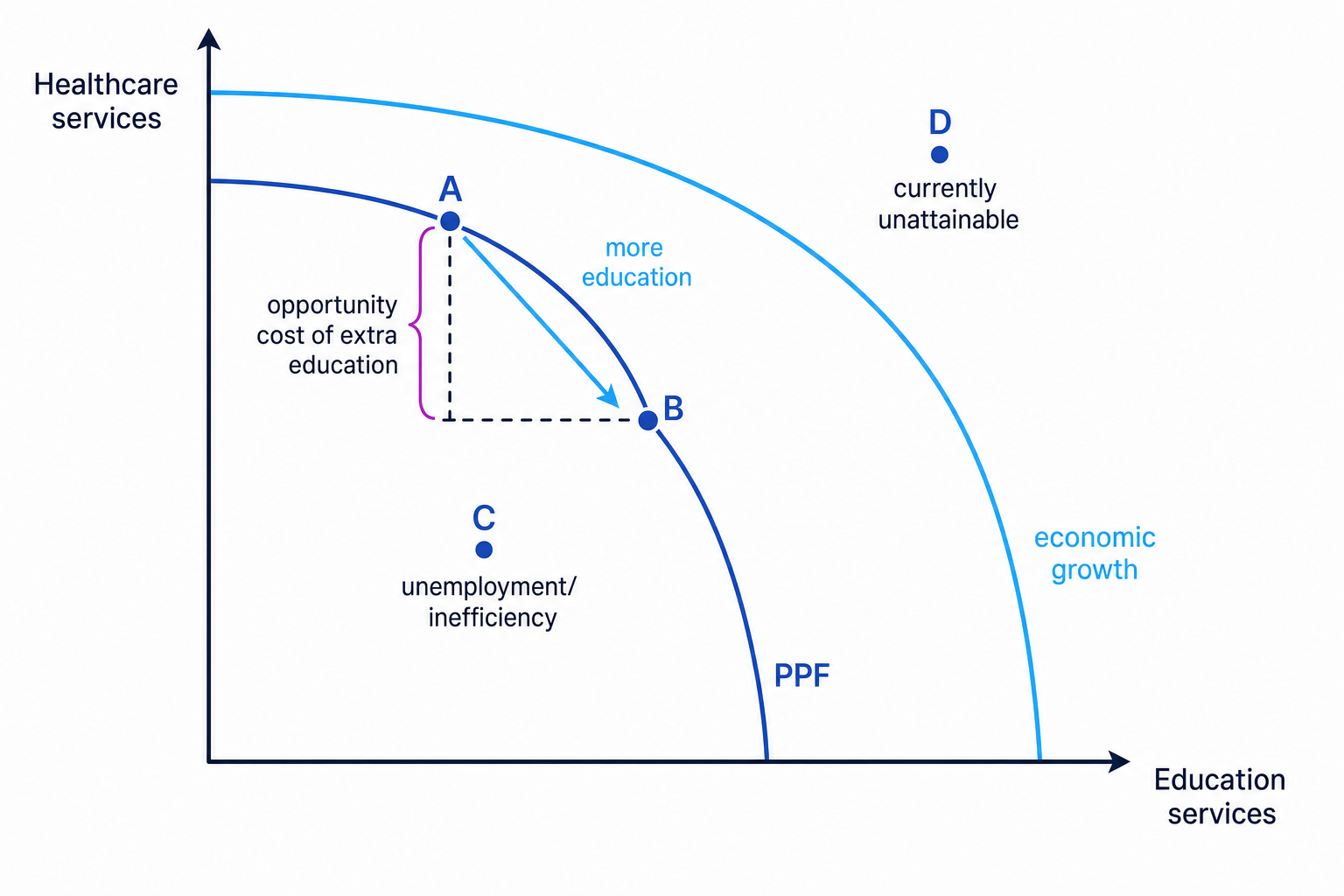
A production possibility frontier is a diagram showing the maximum combinations of two goods or services an economy can produce if resources are fully and efficiently used, given current technology.
The PPF below shows an economy choosing between healthcare services and education services.
How to read the PPF
Points on the PPF are productively efficient: the economy is using its resources fully, so producing more of one good requires producing less of the other.
A point inside the PPF shows unemployment or inefficiency. The economy could produce more without giving anything up if it used idle resources better.
A point outside the PPF is currently unattainable with existing resources and technology.
A movement along the PPF shows a choice and an opportunity cost. A shift outwards of the PPF shows economic growth, caused by factors such as better technology, more workers, improved skills or more capital equipment.
Reading a movement along a PPF
Imagine point A produces 90,000 GP appointments and 20,000 college places. Point B produces 60,000 GP appointments and 50,000 college places.
- Compare education output: moving from A to B increases college places by 30,000.
- Compare healthcare output: GP appointments fall by 30,000.
- Calculate the opportunity cost per extra college place.
- Interpret the movement: the economy has not grown; it has reallocated resources from healthcare to education.
Movement or shift?
A movement along a PPF means resources are being reallocated. A shift of the whole PPF means productive capacity has changed.
Turning definitions into analysis
Strong economics answers do not stop at definitions. Use a chain:
scarce resources → choice between alternatives → opportunity cost → effect on individuals, government or society.
For example, if the UK government spends more on defence, the analysis is not just “defence rises”. You should also explain what scarce resources are used, what the next best alternative might be, and who gains or loses from the decision.
In the exam
- Define the key term precisely: for opportunity cost, use “next best alternative foregone”.
- Apply the concept to the context: name the scarce resource, such as time, labour, land, tax revenue or capital.
- If calculating opportunity cost, show the alternative given up and carry the units through your answer.
- For PPF diagrams, label both axes and distinguish clearly between a movement along the frontier and a shift of the frontier.
- For evaluation, consider short-run versus long-run effects, stakeholder impacts and whether the next best alternative is easy to identify.
Check yourself
- Why can an NHS appointment be an economic good even if the patient pays £0 at the point of use?
- A council can build either 2 libraries or 10 playgrounds. What is the opportunity cost of 1 library?
- On a PPF diagram, what does a point inside the frontier show?
