

What you'll learn
- What free trade means, and why economists often support it.
- How to explain absolute advantage and comparative advantage numerically and with a PPF diagram.
- How to interpret the terms of trade.
- How free trade affects households, firms, government and the economy as a whole.
Starting point: what is free trade?
Free trade means goods and services can move between countries with few or no artificial barriers.
Free trade
Free trade is international trade without protectionist barriers such as tariffs, quotas or excessive regulations designed mainly to restrict imports.
A tariff is a tax on imports. A quota is a physical limit on the quantity of imports allowed. Protectionism means policies that restrict trade to protect domestic industries from foreign competition.
Free trade does not mean “no rules at all”. Countries still have laws on safety, standards, tax, labour rights and environmental protection. The key point is that trade is not being deliberately blocked to protect domestic producers.
The big idea
Free trade can raise total welfare because countries specialise in what they are relatively best at producing, then trade to consume more than they could in isolation.
Why countries trade: opportunity cost and specialisation
Before comparative advantage, you need two building blocks.
Opportunity cost is the value of the next best alternative given up when a choice is made. If a country uses land, labour and capital to produce cars, it cannot use the same resources to produce wheat.
Specialisation means focusing production on a narrower range of goods or services. This can raise productivity because workers, firms and countries get better at doing particular tasks.
Adam Smith argued that trade allows specialisation and wider markets. David Ricardo developed the deeper theory of comparative advantage, showing that trade can benefit countries even if one country is more efficient at producing everything.
Absolute advantage vs comparative advantage
Absolute advantage
A country has absolute advantage in producing a good if it can produce more of it using the same resources, or produce the same amount using fewer resources.
Comparative advantage
A country has comparative advantage in producing a good if it can produce it at a lower opportunity cost than another country.
Absolute advantage is about productivity. Comparative advantage is about relative sacrifice.
Suppose two countries can use the same amount of resources to produce either cloth or wine.
| Country | Maximum cloth | Maximum wine | Opportunity cost of 1 cloth | Opportunity cost of 1 wine |
|---|---|---|---|---|
| Country A | 40 | 20 | 0.5 wine | 2 cloth |
| Country B | 30 | 30 | 1 wine | 1 cloth |
A production possibility frontier (PPF) shows the maximum combinations of two goods an economy can produce if all resources are used efficiently.
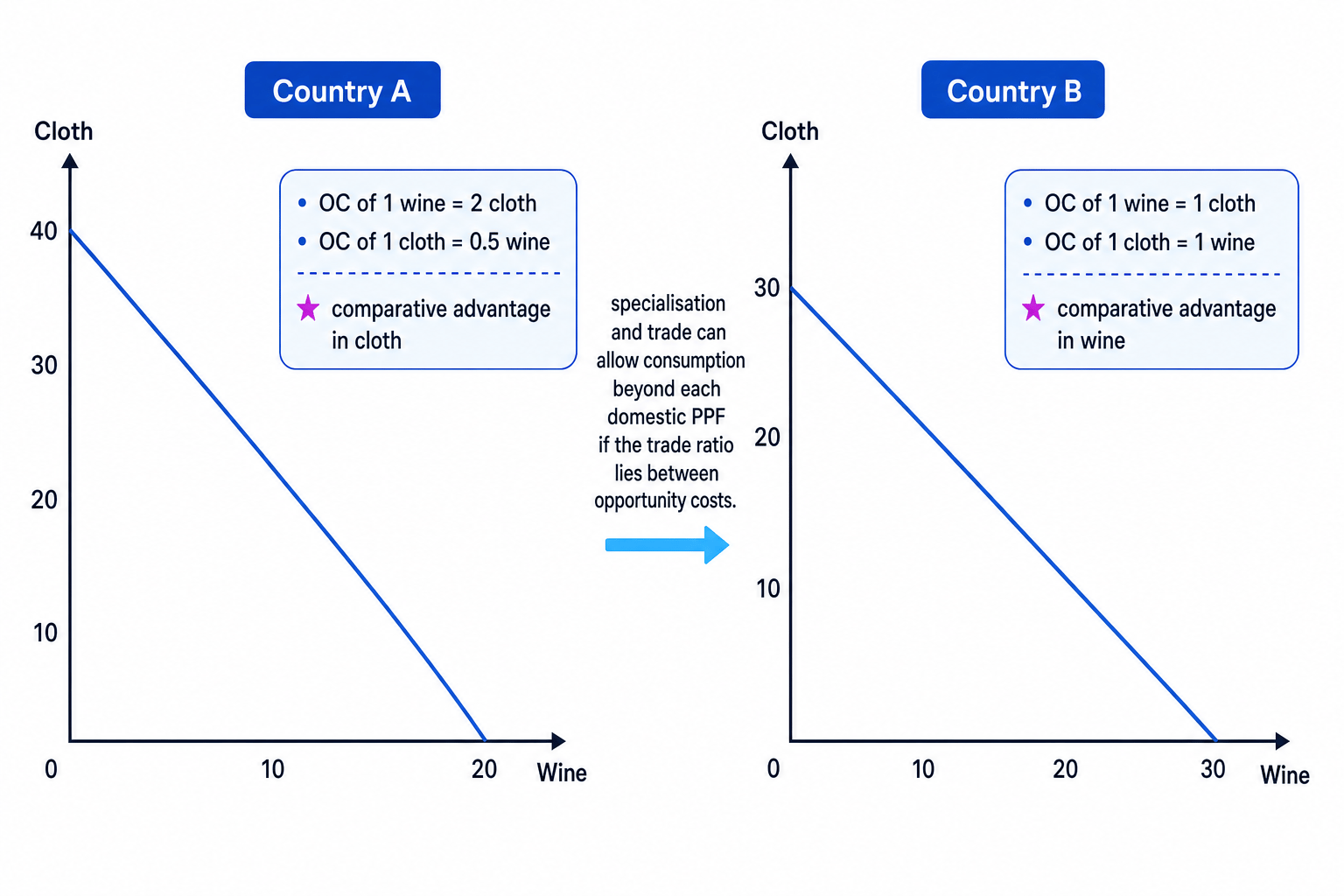
On these diagrams, the slope of the PPF shows opportunity cost. Country A’s PPF is steeper, meaning wine is relatively costly for it to produce. Country B’s PPF is flatter, meaning wine is relatively cheaper for it to produce.
Finding comparative advantage
-
Compare maximum outputs to find absolute advantage. Country A can produce more cloth, 40 compared with 30, so it has absolute advantage in cloth. Country B can produce more wine, 30 compared with 20, so it has absolute advantage in wine.
-
Calculate the opportunity cost of cloth. Country A gives up 20 wine to make 40 cloth, so 1 cloth costs 0.5 wine. Country B gives up 30 wine to make 30 cloth, so 1 cloth costs 1 wine. Country A has comparative advantage in cloth.
-
Calculate the opportunity cost of wine. Country A gives up 40 cloth to make 20 wine, so 1 wine costs 2 cloth. Country B gives up 30 cloth to make 30 wine, so 1 wine costs 1 cloth. Country B has comparative advantage in wine.
-
Apply the trade logic. Country A should specialise more in cloth, while Country B should specialise more in wine. Total output can rise, creating potential gains from trade.
Mixing up absolute and comparative advantage
Do not choose comparative advantage by looking only at who produces the most. Always compare opportunity costs.
Terms of trade
The terms of trade can be used in two related ways.
First, in comparative advantage, it means the rate at which one good exchanges for another. For trade to benefit both countries, the trade ratio must lie between their opportunity costs.
Checking a mutually beneficial trade ratio
-
Country A specialises in cloth. Producing 1 cloth costs Country A 0.5 wine, so it needs to receive more than 0.5 wine for each cloth exported.
-
Country B imports cloth. Producing 1 cloth itself would cost Country B 1 wine, so it is willing to pay less than 1 wine for each cloth imported.
-
A trade ratio of 1 cloth for 0.75 wine benefits both. Country A receives 0.25 wine more than its domestic opportunity cost, while Country B saves 0.25 wine compared with producing cloth itself.
Second, in macroeconomic data, the terms of trade are often shown as an index:
Terms of trade index=export price indeximport price index×100\text{Terms of trade index} = \frac{\text{export price index}}{\text{import price index}} \times 100Terms of trade index=import price indexexport price index×100If the index rises, export prices have risen relative to import prices. The country can buy more imports for a given amount of exports. If it falls, the terms of trade have deteriorated.
Calculating a terms of trade index
-
Suppose a country’s export price index is 115 and its import price index is 125, with the base year equal to 100.
-
Substitute into the formula:
- Interpret the result. A terms of trade index of 92 means export prices are 8% lower relative to import prices than in the base year, so the country must export more to buy the same volume of imports.
Terms of trade shortcut
A higher terms of trade index is usually good for purchasing power, but it may reduce export competitiveness if export prices rise too much.
Free trade in a market diagram
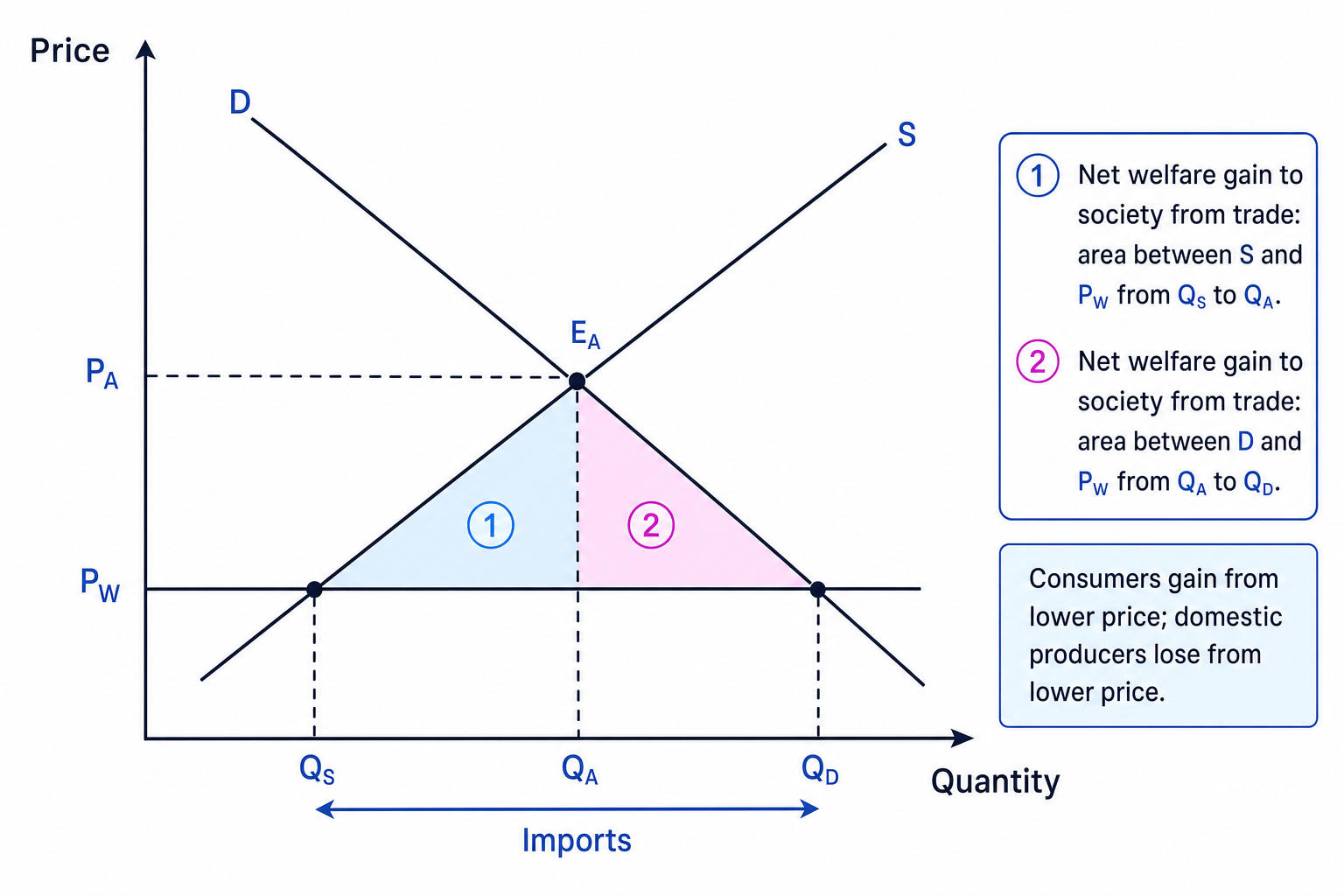
For a small importing country, the world price may be below the domestic price that would exist without trade. Consumers buy more at the lower price, domestic firms supply less, and the gap is filled by imports.
Consumer surplus is the extra benefit consumers receive when they pay less than the maximum they were willing to pay. Producer surplus is the extra benefit producers receive when they sell for more than the minimum they were willing to accept.
Analysing imports at a world price
-
Suppose the UK price of a pair of trainers would be £80 without trade, but the world price is £50. Since the world price is lower, the UK becomes an importer.
-
At £50, UK firms supply 1 million pairs and UK consumers demand 4 million pairs. Imports are therefore 3 million pairs.
-
Households gain from a lower price and greater choice. UK trainer producers lose sales and may reduce output or employment. Overall welfare can rise, but the gains and losses are unevenly distributed.
Advantages of free trade
For households
Households benefit from lower prices, especially for imported food, clothing, electronics and energy-intensive goods. This can raise real income, meaning income adjusted for inflation.
They also gain from more choice and potentially higher quality, because foreign competition gives firms an incentive to improve.
For firms
Firms can access larger export markets, helping them increase sales and benefit from economies of scale, where average costs fall as output rises.
They may also import cheaper raw materials, components or technology. For example, UK manufacturers often rely on global supply chains for parts and specialist inputs.
Competition from abroad can force firms to become more efficient, innovate and reduce costs.
For government and the whole economy
Free trade can improve allocative efficiency, meaning resources move towards goods and services that consumers value most highly. It may increase long-run economic growth through competition, investment and technology transfer.
It can also strengthen international relationships and reduce the risk of conflict by making economies more interdependent.
Disadvantages of free trade
For households
The main cost is that some workers lose out. If cheaper imports reduce demand for domestic output, workers in affected industries may face unemployment or lower wages.
This can create structural unemployment, where workers’ skills or locations do not match the jobs available. For example, import competition can hit particular regions or industries harder than the national average.
For firms
Domestic firms face stronger competition. Less efficient firms may shrink or close, even if they are important local employers.
New firms in developing economies may struggle against established multinational companies. This is the infant industry argument: young industries may need temporary protection until they become competitive.
Free trade can also expose firms to global shocks. COVID-19, shipping disruptions and energy-price spikes showed that relying heavily on global supply chains can be risky.
For government and the whole economy
Governments may lose tariff revenue if tariffs are removed. They may also face higher welfare spending or retraining costs if import competition causes unemployment.
Free trade may worsen a current account deficit if imports rise faster than exports. The current account records trade in goods and services, plus income flows and transfers.
There can also be environmental costs, such as emissions from long-distance transport or production shifting to countries with weaker environmental regulation.
For some developing economies, specialisation in primary commodities can be risky. Countries such as Zambia, which relies heavily on copper exports, can suffer when global commodity prices fall and their terms of trade deteriorate.
The theory depends on assumptions
Ricardo’s model assumes resources can move smoothly between industries, transport costs are low, and trade is fair. In reality, adjustment can be slow, painful and unequal.
Overall judgement
Free trade usually increases total economic welfare, but it does not guarantee that everyone gains. The strongest answers separate the size of the total gain from the distribution of that gain.
In the long run, households may benefit from cheaper goods and firms may become more productive. In the short run, however, workers in import-competing industries can lose jobs, and some communities may experience long-term decline.
A balanced policy might support free trade while using education, retraining, infrastructure investment and targeted regional support to help people move into expanding sectors.
In the exam
-
Define free trade clearly, then link it to specialisation, opportunity cost and comparative advantage.
-
Use a numerical example to prove comparative advantage; do not rely only on a written explanation.
-
Analyse stakeholders separately: households, firms, government and the economy as a whole may be affected differently.
-
Evaluate with time period, mobility of labour, stage of development, exchange rates and how evenly gains are shared.
Check yourself
-
What is the difference between absolute advantage and comparative advantage?
-
Why must the terms of trade lie between the two countries’ opportunity costs?
-
How can free trade raise total welfare while still making some workers worse off?
