The Supply Curve
Definition
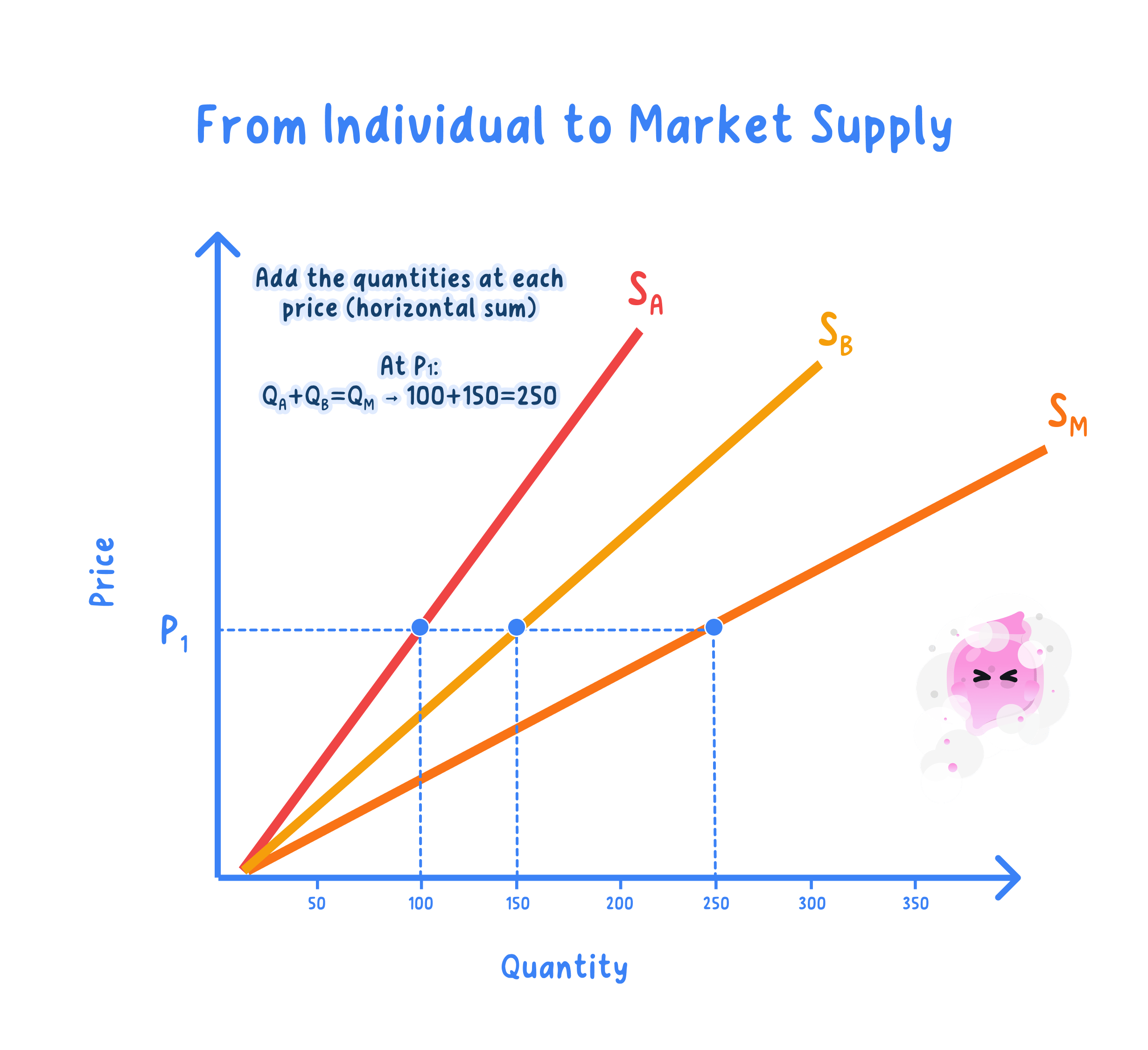
Supply: the quantity producers are willing and able to offer for sale at each price over a period, so it needs both willingness and the ability to produce.
Law of supply: ceteris paribus, a higher price raises quantity supplied, giving the supply curve its upward slope.
- On the diagram price is on the vertical axis and quantity supplied on the horizontal axis, and the curve slopes up from left to right.
- The main reason is that marginal cost rises as output expands, so firms need a higher price to justify producing more.
Example
- A bakery can bake extra loaves cheaply at first, but overtime pay and crowded ovens raise the cost of each further loaf.
- It will only produce these dearer loaves if the price is high enough, which is why the supply curve slopes up.
Movements and Shifts
Definition
Movement along the supply curve: a change in quantity supplied caused only by a change in the good's own price.
Shift of the supply curve: a change in supply at every price caused by a change in a condition of supply other than own price.
- Lower costs shift the curve right and higher costs shift it left; a rightward shift means more is supplied at every price, drawn as the whole curve moving to a new labelled position.
Example
- If the price of wheat rises and farmers offer more wheat, this is a movement along the supply curve.
- If a good harvest lets them offer more at every price, the whole curve shifts to the right.
Conditions of Supply
- Costs of production: higher wages, raw materials or energy costs shift supply left while lower costs shift it right, because each unit becomes dearer to make.
- The surge in gas prices in 2022 raised firms' energy costs and shifted supply left across many UK industries.
- Technology: better technology cuts unit costs and shifts supply right.
- Taxes and subsidies: an indirect tax raises costs at every price and shifts supply left, while a subsidy lowers them and shifts it right.
- Other conditions: the number of firms, the prices of other goods the firm could make, and external shocks such as the weather also shift supply.
- A more profitable alternative product draws resources away and shifts supply of this good left, while a good harvest shifts agricultural supply right.
Does supply always slope upwards?
- It holds in most markets because marginal cost rises as output expands, so firms supply more only at a higher price.
- But where the quantity is fixed, such as prime city-centre land or tickets to a fixed-capacity venue, supply is perfectly inelastic and drawn as a vertical line.
- But over a very short period firms cannot adjust output, so supply is highly inelastic until they can expand capacity.
- On balance, supply slopes upwards in most markets over a normal time horizon; it is vertical only where the quantity available is fixed or cannot yet respond.
Exam technique
- Diagnose the trigger: an own-price change is a movement along, any condition is a shift, and state the direction.
- Treat indirect taxes and subsidies as shifts of the curve, not movements.
- Justify the upward slope with rising marginal cost, not just a wish for more revenue.
Common Mistake
- Do not show an indirect tax as a movement along the supply curve; it raises costs at every price and shifts the whole curve left.
- Do not define supply as a mere willingness to sell, because it needs both willingness and the ability to produce.
Self review
- What causes a movement along the supply curve?
- What causes a shift of the supply curve?
- Name four conditions of supply and the direction each shifts the curve.
- How is an indirect tax shown on a supply diagram?
