Definition
Supply-side policies: measures designed to raise an economy's productive potential and the efficiency of markets, shifting long-run aggregate supply to the right.
Market-based policies: measures that reduce government intervention to sharpen incentives and let markets work more freely, such as tax cuts, deregulation and privatisation.
Interventionist policies: measures that use direct government action and spending to raise capacity where markets underprovide, such as education, training and infrastructure.
- Both approaches aim to shift long-run aggregate supply to the right, but they differ over whether the government should step back and free up markets or step in and spend to fix market failures.
Policy Methods
- To increase incentives, governments can cut marginal rates of income tax and reform benefits so that work pays more, raising participation and effort.
- To promote competition, they can use privatisation and deregulation to open markets to new firms, which lowers prices and encourages dynamic efficiency.
- To reform the labour market, they can reduce trade union power or make hiring and wages more flexible, which can lower structural unemployment.
- To improve skills and the quality of the labour force, they can spend on education, training and apprenticeships, which raises human capital and productivity over time.
- To improve infrastructure, they can invest in transport, energy and digital networks, which lowers firms' costs and attracts investment.
Example
- Building new roads and rail links lowers firms' transport costs and can attract investment; this is an interventionist measure.
- Apprenticeship funding raises workers' skills, which lifts productivity over time.
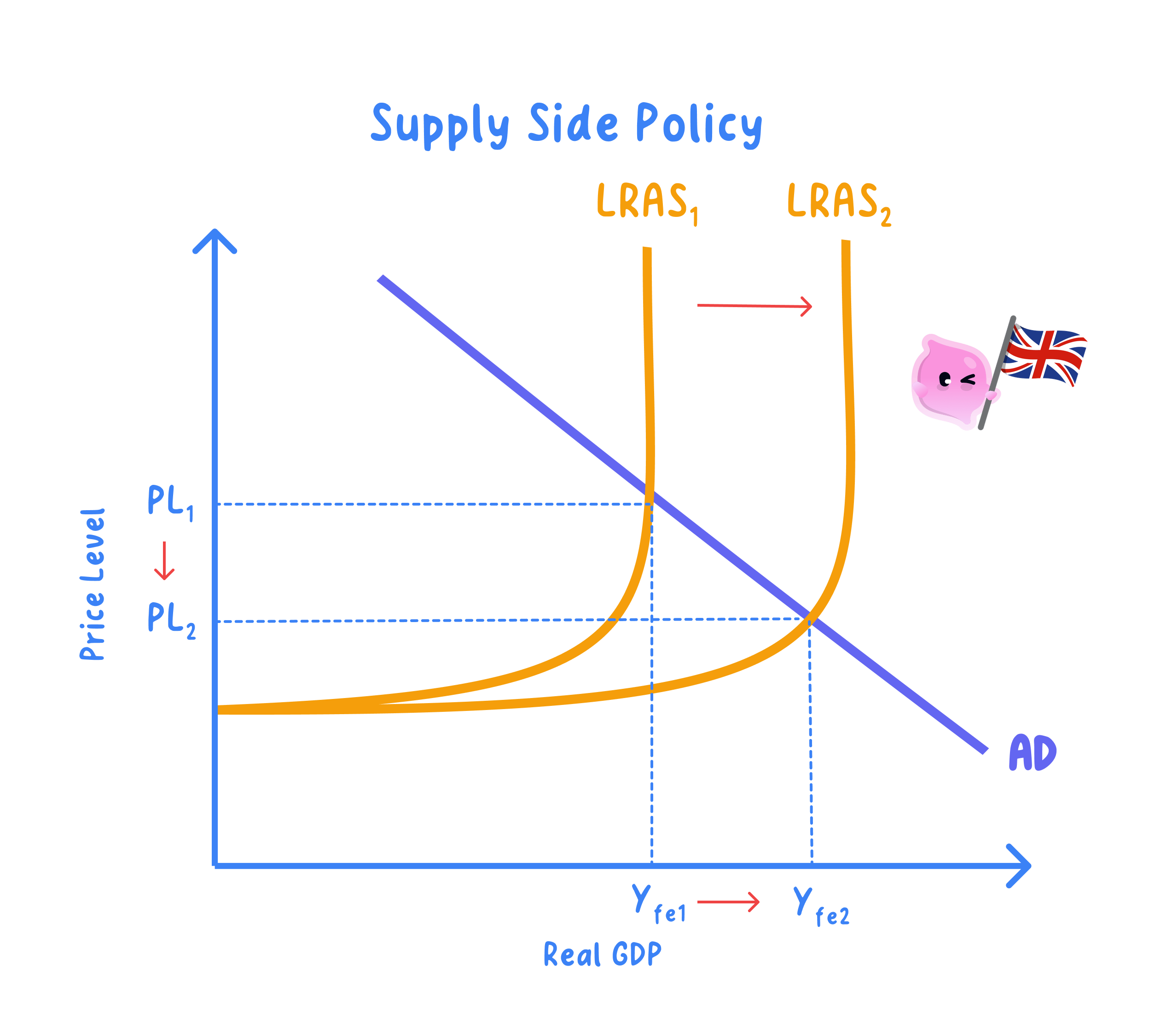
Supply-side Policy on AD/AS
Definition
Long-run aggregate supply (LRAS): the economy's productive potential, that is, the output it can produce when all resources are fully and efficiently employed.
- A successful supply-side policy shifts LRAS to the right, raising real output while easing pressure on the average price level.
- This allows faster growth without the inflation that a demand-side expansion alone would risk, so supply-side policy can improve growth, unemployment and inflation together.
Example
- Market-based reform in the UK includes the privatisation of utilities such as British Telecom in the 1980s and later deregulation, intended to sharpen competition and efficiency.
- Interventionist measures include the apprenticeship levy that funds training and large infrastructure projects such as HS2, both aimed at raising productivity and capacity.
Do supply-side policies always work?
- It holds because, if they succeed, they raise potential output and can hit several objectives at once, easing the trade-offs that demand-side policy cannot.
- But their effects come only after long time lags (education takes years), interventionist spending is costly and can worsen the deficit, and outcomes are uncertain, as a tax cut may not actually raise effort.
- They also do nothing for a shortfall in aggregate demand, so in a recession demand-side policy is still needed, and market-based measures such as deregulation can widen inequality.
- On balance it depends on the type of policy, how it is funded and the time horizon: supply-side reform is powerful in the long run but no quick fix in the short run.
Exam technique
- Classify each policy as market-based or interventionist, and link it to a rightward LRAS shift.
- Explain the mechanism by which a policy raises capacity rather than just listing policies.
Common Mistake
- Do not shift aggregate demand for a supply-side policy, because it shifts aggregate supply.
- Do not treat supply-side policy as a quick fix, as its effects are slow, costly and uncertain.
Self review
- Distinguish market-based from interventionist supply-side methods.
- Give one policy to increase incentives and one to promote competition.
- Name a policy to improve the skills of the labour force.
- On an AD/AS diagram, which curve shifts, and in which direction?
- Give one strength and one weakness of supply-side policies.
