2.6.2a Monetary and fiscal policy instruments
Monetary and Fiscal Policy
Monetary policy: the Bank of England's use of interest rates and the money supply to influence aggregate demand.
Fiscal policy: the government's use of spending and taxation to influence aggregate demand.
Aggregate demand (AD): total planned spending on an economy's output at a given price level.
- Both are demand-side policies that work by shifting aggregate demand to meet objectives such as growth and low inflation, but they use different instruments and different institutions.
- Monetary policy is run by the independent Bank of England, while fiscal policy is run by the government through the Treasury and HMRC.
- Think of Bank Rate as a thermostat for the economy: raising it cools spending and lowering it warms it up.
- The Bank of England's Monetary Policy Committee turns this dial to steer inflation towards target.
Monetary Policy Instruments
Bank Rate: the policy interest rate set by the Bank of England, which feeds through to borrowing and saving rates across the economy.
Quantitative easing (QE): the central bank creating new money to buy financial assets, mainly government bonds, to increase the money supply.
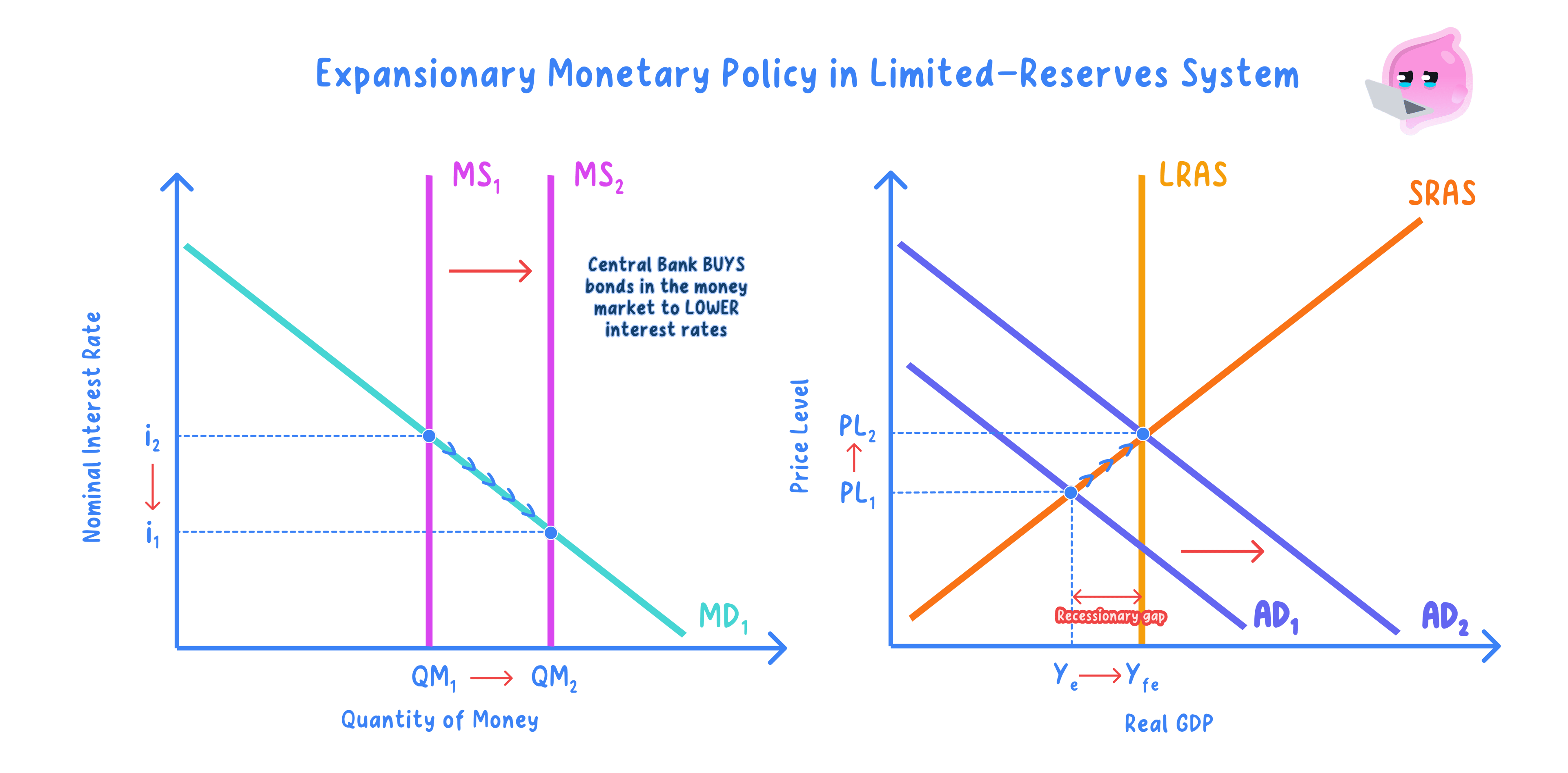
- A cut in Bank Rate lowers the cost of borrowing and the reward for saving, so households and firms borrow and spend more, raising consumption and investment and shifting AD to the right.
- QE is used when Bank Rate is already near the zero lower bound; by buying bonds the Bank lowers longer-term interest rates and raises asset prices, and the resulting wealth effect and cheaper credit support demand.
- After the 2008 crisis, and again in 2020, the Bank of England cut Bank Rate close to zero and used QE to support demand.
- This lowered longer-term borrowing costs when rate cuts alone were not enough.
Fiscal Policy Instruments
Government budget balance: the difference between government spending and tax revenue in a year.
Budget (fiscal) deficit: when spending exceeds revenue, so the government must borrow to fill the gap.
Budget (fiscal) surplus: when revenue exceeds spending, which allows debt to be repaid.
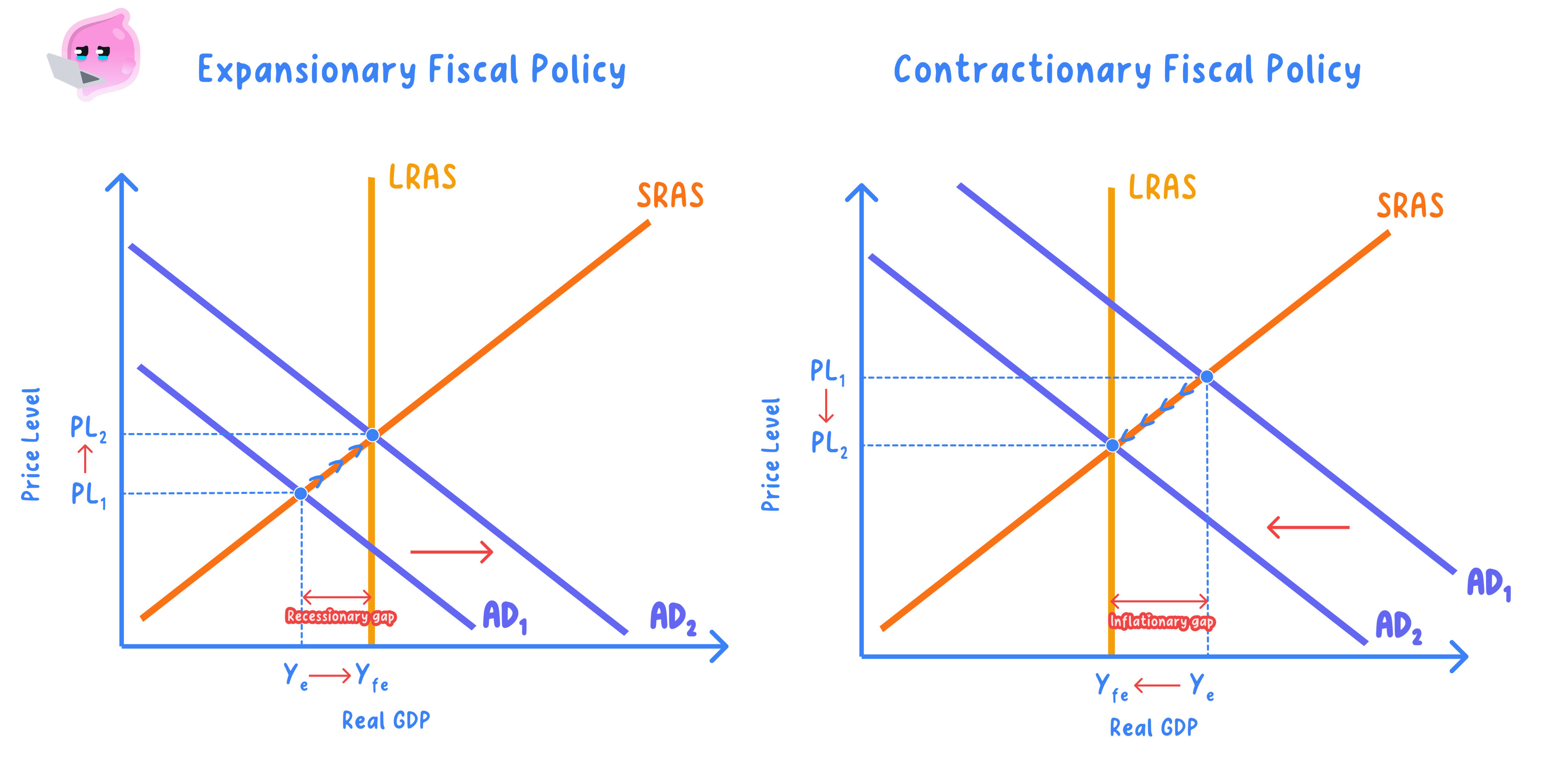
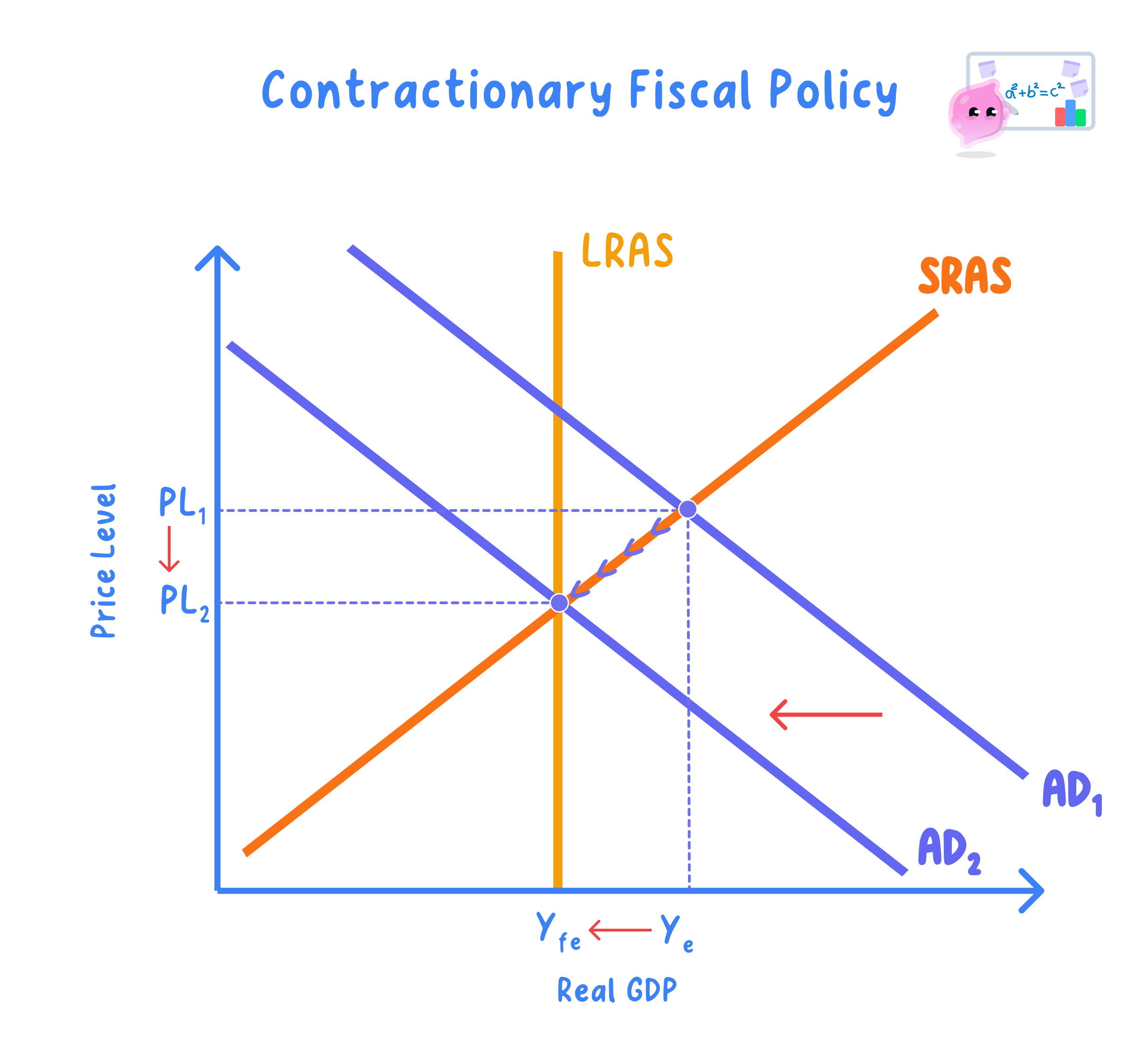
- Expansionary fiscal policy raises government spending or cuts taxes, injecting demand and shifting AD to the right, while contractionary fiscal policy cuts spending or raises taxes, shifting AD to the left.
- The deficit is a yearly flow of new borrowing, whereas the national debt is the accumulated stock of past deficits, so running surpluses over time is what allows the debt to be paid down.
- During the COVID-19 pandemic the UK government ran a large expansionary fiscal policy, including the furlough scheme, which supported demand but widened the deficit and added to the national debt.
- By contrast, the austerity programme after 2010 was contractionary, cutting spending to reduce the deficit that the Office for Budget Responsibility forecasts against the fiscal rules.
Direct and Indirect Taxes
Direct tax: a tax levied on income or wealth and paid straight to HMRC, such as income tax, National Insurance contributions and corporation tax.
Indirect tax: a tax levied on spending and collected by firms on the government's behalf, such as VAT and excise duties on fuel, alcohol and tobacco.
- The distinction matters for policy: changing direct taxes acts on disposable income and work incentives, while changing indirect taxes acts through the prices consumers pay.
Demand-side Policy on AD/AS
- On an AD/AS diagram the axes are the average price level (vertical) and real output (horizontal), not price and quantity.
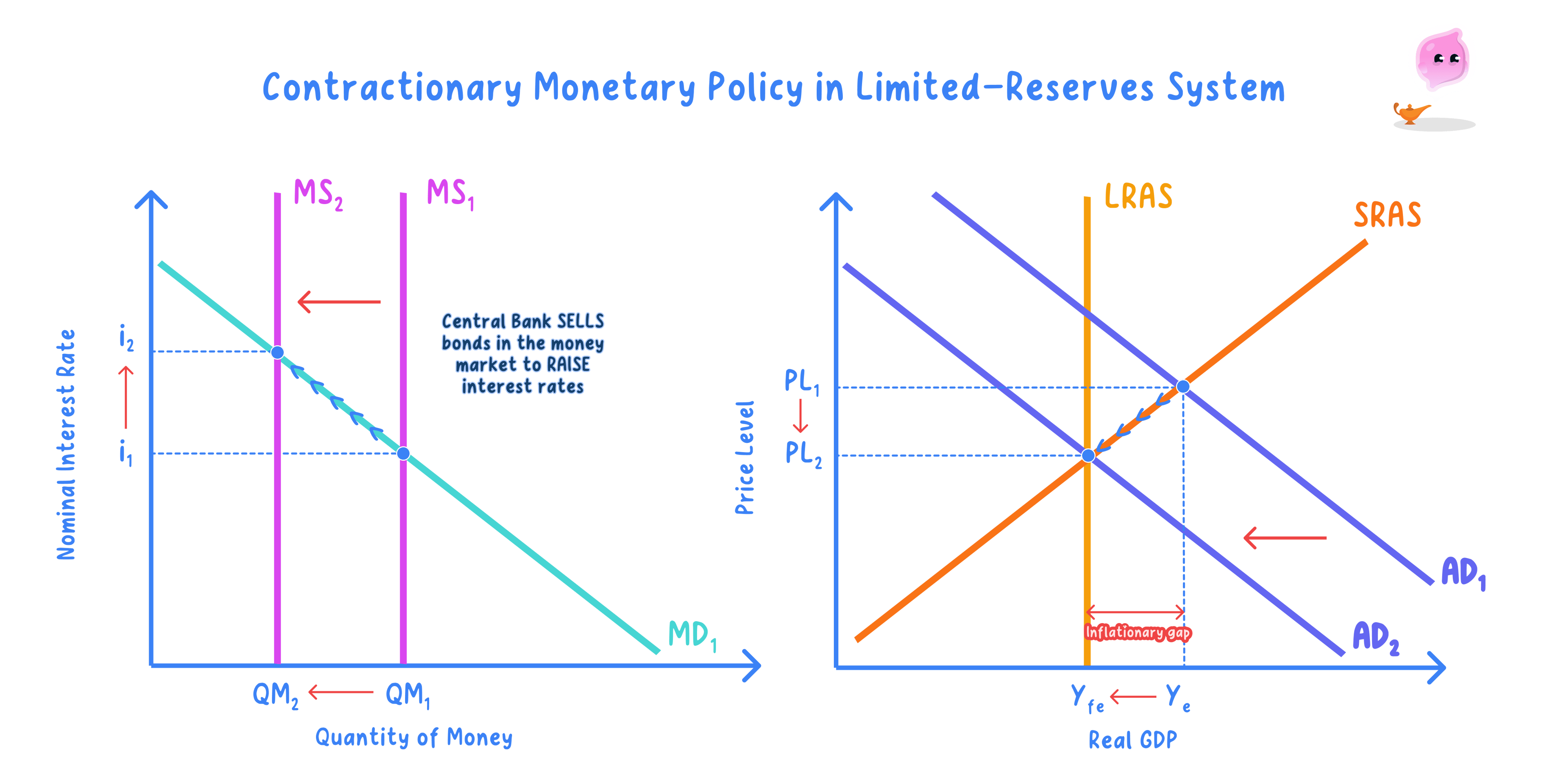
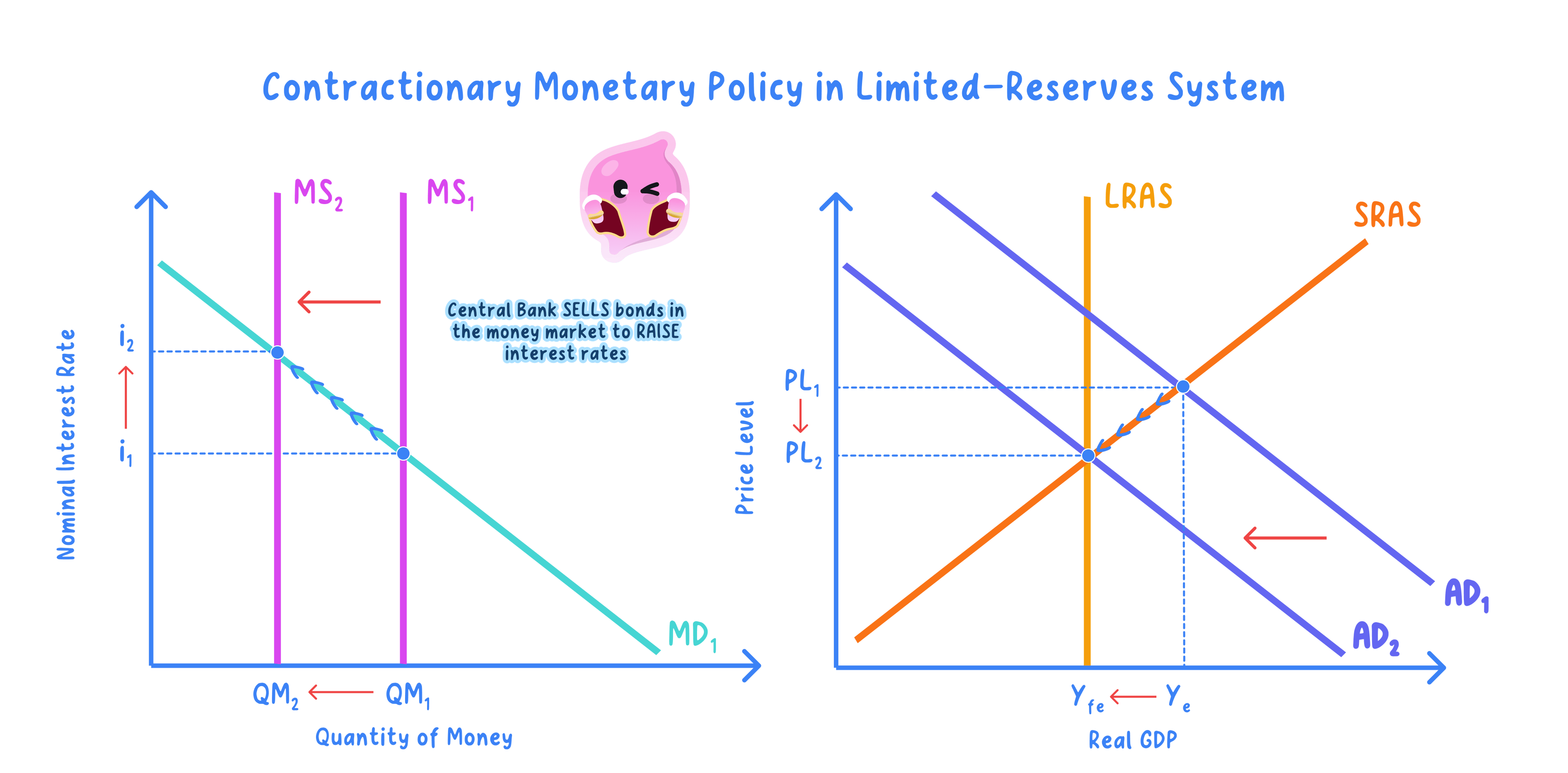
- Expansionary demand-side policy shifts AD to the right, raising real output and the price level, while contractionary policy shifts AD to the left, lowering output and easing inflation.
Is monetary or fiscal policy more effective?
- Monetary policy scores well because the independent MPC can adjust Bank Rate quickly and its credibility helps anchor inflation expectations, so it is well suited to fine-tuning demand.
- But monetary policy is blunt and loses traction at the zero lower bound, whereas fiscal policy can target specific groups and regions and still works when rates are near zero.
- However, fiscal policy is slower because it must pass through the political process, and a large fiscal stimulus can widen the deficit and add to the national debt.
- On balance it depends on the shock and the state of the economy: monetary policy suits normal times, but in a deep slump with rates near zero fiscal policy tends to be the more powerful tool, and the two are often used together.
- State clearly whether an instrument is monetary, such as interest rates or QE, or fiscal, such as spending or taxation.
- Label a macro diagram with the average price level and real output, and shift AD in the correct direction.
- Do not confuse the budget deficit (a yearly flow) with the national debt (the accumulated stock of past borrowing).
- Do not confuse direct taxes on income and wealth with indirect taxes on spending.
- What is the difference between monetary and fiscal policy?
- Name the two main instruments of monetary policy.
- What are the two fiscal policy instruments?
- Distinguish a budget deficit from a budget surplus.
- Give an example of a direct tax and an indirect tax.
2.6.2b Bank of England and policy evaluation
The Bank of England
Bank of England: the UK's independent central bank, which acts as banker to the government and to the commercial banks and as lender of last resort.
Monetary Policy Committee (MPC): the nine-member committee at the Bank that sets Bank Rate to meet the government's 2%2\%2% CPI inflation target.
- Before it raises, cuts or holds Bank Rate, the MPC weighs forecast inflation against growth, unemployment, the output gap and the exchange rate.
- It acts on forecast inflation rather than today's figure because a rate change affects the economy only after a long time lag, and its independence keeps policy free from short-term political pressure.
- The MPC has nine members and meets eight times a year to vote on Bank Rate, with the decision and minutes published.
- Because the Bank is independent, markets trust it to keep inflation near 2%2\%2% rather than boost the economy for political gain.
The Transmission Mechanism
Transmission mechanism: the chain through which a change in Bank Rate feeds through to aggregate demand and inflation, working via market interest rates, credit, asset prices, expectations and the exchange rate.
- A lower Bank Rate makes borrowing cheaper and saving less rewarding, so consumption and investment rise; it also tends to weaken the pound, making exports cheaper and imports dearer, which lifts net exports.
- Higher asset prices raise wealth and confidence, and together these channels shift aggregate demand to the right, raising output and, over time, inflation.
- Changing Bank Rate is like turning a large ship: the effect on inflation appears only after a long delay.
- This lag, often up to two years, is why the MPC targets forecast inflation rather than today's figure.
The Depression and 2008
- In the Great Depression of the 1930s, Keynesians argued that deficient aggregate demand needed active fiscal stimulus, while classical economists expected markets to self-correct and favoured leaving them alone.
- In the Global Financial Crisis of 2008, the Bank of England cut Bank Rate to 0.5%0.5\%0.5% and launched QE, while the US Federal Reserve cut rates close to zero and ran its own QE.
- Both governments also used fiscal stimulus at first, though interpretations differed over how far to intervene and how quickly to switch to austerity to control borrowing.
Strengths and Weaknesses
- Demand-side policies are flexible and can steer the economic cycle: monetary policy can be adjusted often, while fiscal policy can target specific groups and regions.
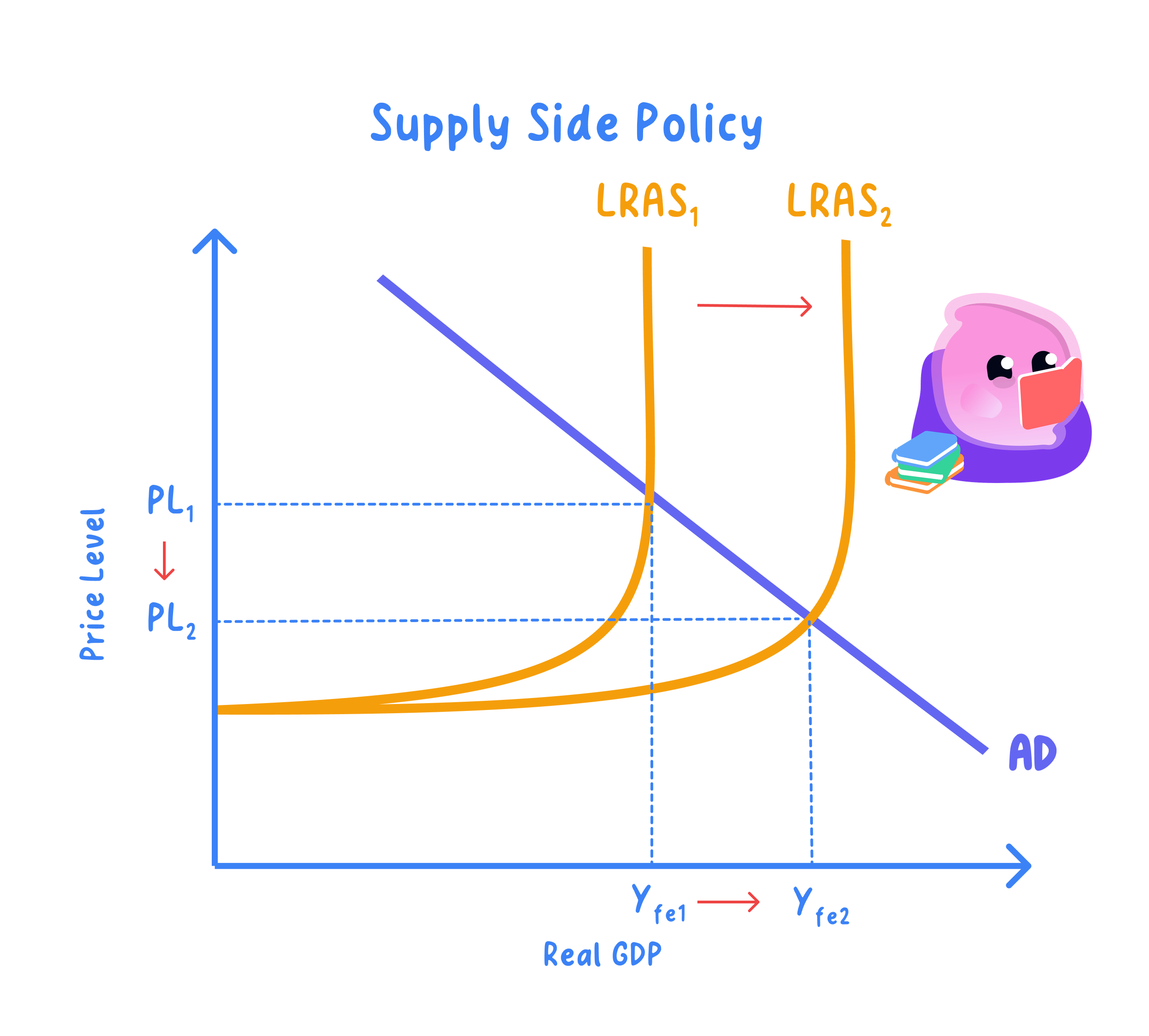
- Their weaknesses are time lags, weak effect when confidence is low, the zero lower bound, and uneven impact on borrowers, savers and firms; crucially they manage demand rather than raise long-run potential output.
- Quantitative easing from 2009 supported demand but pushed up asset prices, which tends to benefit wealthier holders most, showing the uneven impact of demand-side policy.
- When CPI rose well above the 2%2\%2% target in 2022-23, the MPC raised Bank Rate above 5%5\%5%, showing it can still act flexibly and credibly to bring inflation back down.
Are demand-side policies always effective?
- It holds because a rate cut or fiscal stimulus can quickly boost aggregate demand in a recession, and an independent MPC adds credibility that anchors inflation expectations.
- But long time lags mean policy can be mistimed, and at the zero lower bound rate cuts lose traction while QE mainly lifts asset prices, benefiting wealthier holders most.
- In a deep confidence crisis, households and firms may refuse to borrow however cheap credit is, so the transmission mechanism breaks down.
- On balance it depends on the size of the shock, the level of confidence and how close rates are to zero, so demand-side tools often need supply-side or fiscal support to work.
- State that the independent MPC, not the government, sets Bank Rate to hit the inflation target.
- Judge demand-side policy by the transmission mechanism, time lags and the state of confidence.
- Do not say the government sets UK interest rates, because the independent MPC does.
- Do not assume demand-side policy always works, as lags and the zero lower bound can weaken it.
- What does the MPC set, and what is its target?
- Name three channels of the monetary transmission mechanism.
- How did interpretations of the Great Depression differ?
- How did the UK and US respond to the 2008 financial crisis?
- Give one strength and one weakness of demand-side policy.
