2.6.4 Conflicts and tradeoffs between objectives and policies
Conflicts and Trade-offs
Definition
Trade-off: a situation where gaining more of one objective can be achieved only by giving up some of another.
- Most conflicts arise because the economy has finite productive capacity in the short run: near full capacity extra demand mainly raises prices, whereas with spare capacity several objectives can improve together for a time.
Conflicting Objectives
- Lower unemployment often conflicts with low inflation, because rising demand for labour bids up wages and prices.
- Faster growth can worsen the current account, as higher incomes pull in more imports, and can conflict with protecting the environment through more pollution and use of finite resources.
- Greater income equality can conflict with growth if high taxes and generous benefits weaken incentives to work and invest, while cutting a fiscal deficit through consolidation can slow growth and raise unemployment in the short run.
Example
- A UK boom that cuts unemployment can suck in imports and push CPI inflation above the 2%2\%2% target.
- The Bank of England may then raise Bank Rate, slowing growth to protect price stability.
The Short-run Phillips Curve
Definition
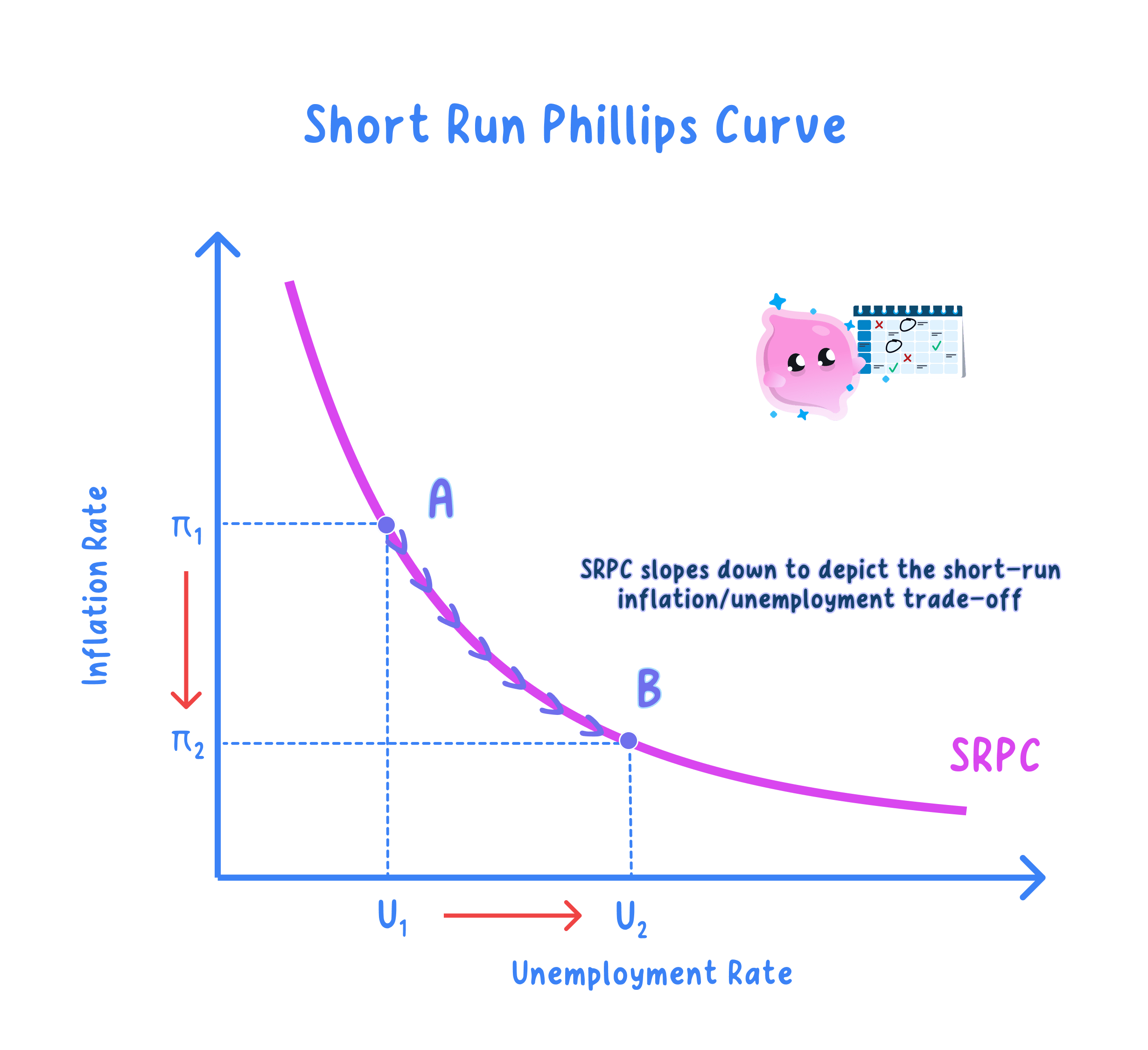
Short-run Phillips curve (SRPC): a downward-sloping curve showing the inverse trade-off between the rate of inflation and unemployment.
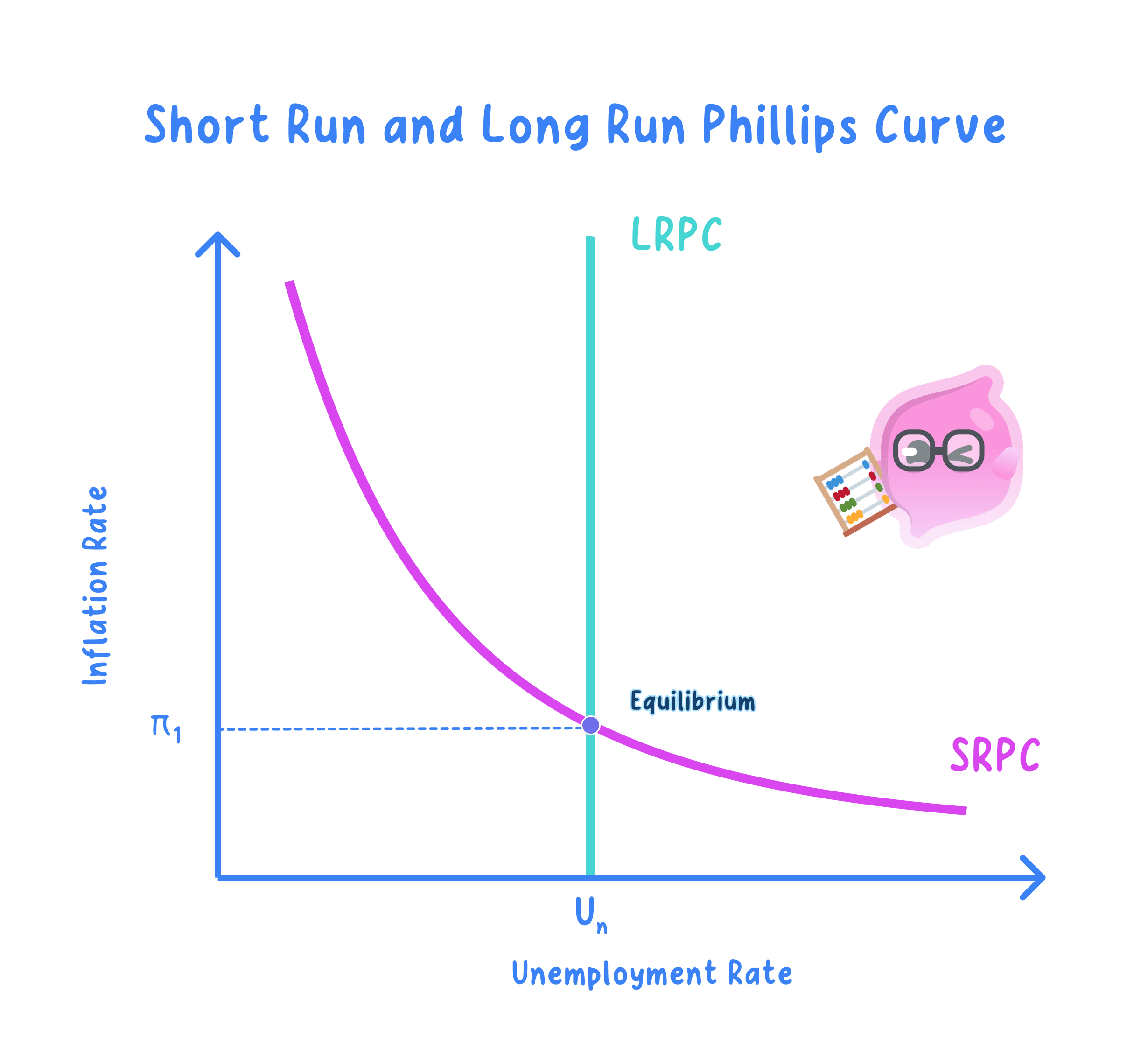
Long-run Phillips curve (LRPC): a vertical line at the natural rate of unemployment, showing no permanent trade-off once inflation expectations adjust.
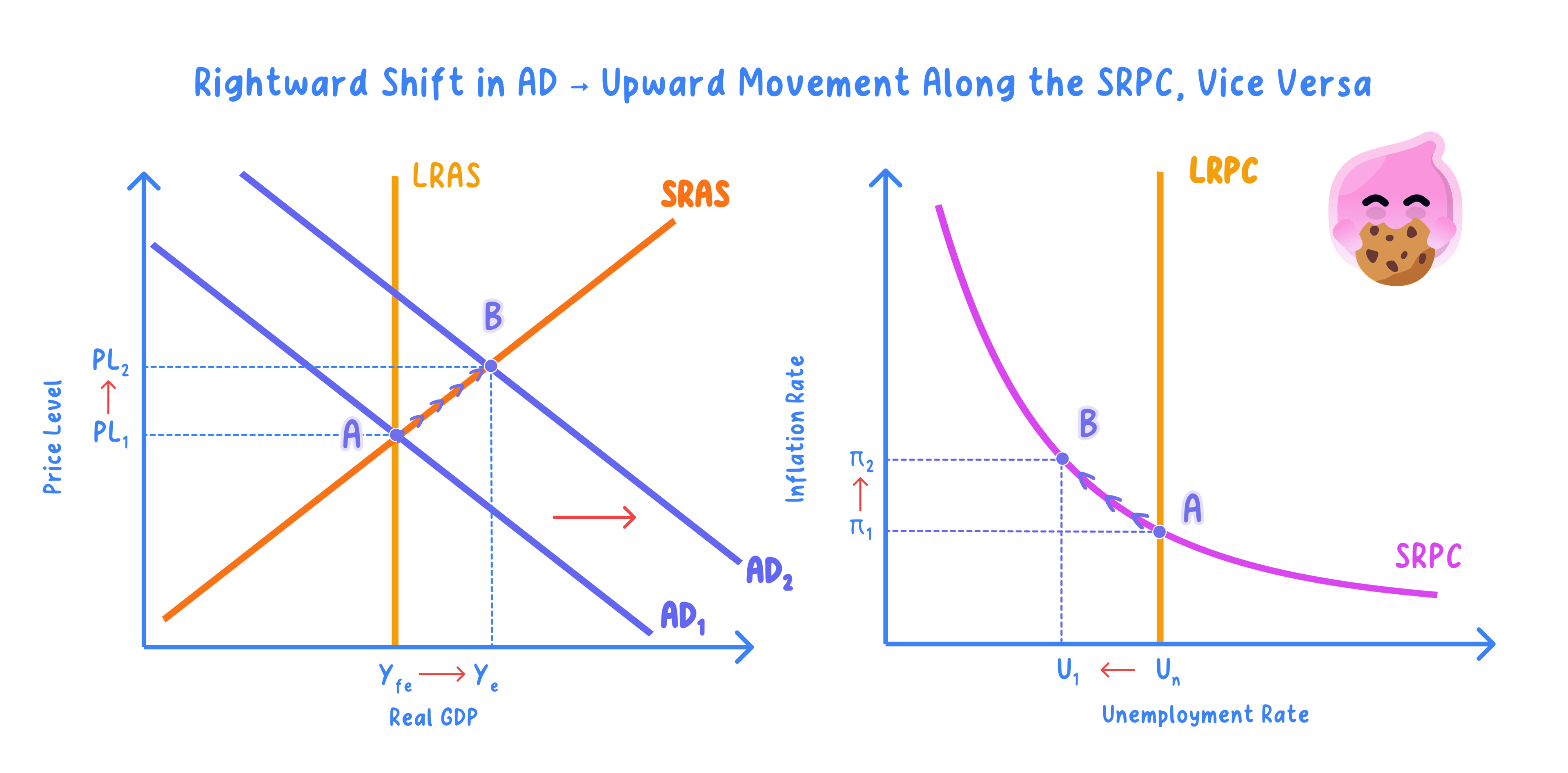
- On the diagram, unemployment is on the horizontal axis and inflation on the vertical axis, and a rise in aggregate demand moves the economy along the SRPC to lower unemployment but higher inflation.
- The trade-off holds only in the short run: once workers expect higher inflation and wages catch up, the SRPC shifts and unemployment returns to the natural rate, so the LRPC is vertical.
Example
- In the 1970s the UK suffered stagflation, with high inflation and high unemployment at the same time, which the simple Phillips-curve trade-off could not explain.
- This breakdown supported the view that the long-run Phillips curve is vertical, so there is no permanent trade-off once inflation expectations adjust.
Policy Conflicts
- Policies conflict because a policy aimed at one objective can move another the wrong way.
- Contractionary policy to cut inflation tends to raise unemployment and slow growth, while expansionary policy to cut unemployment can widen the current account deficit and add to inflation.
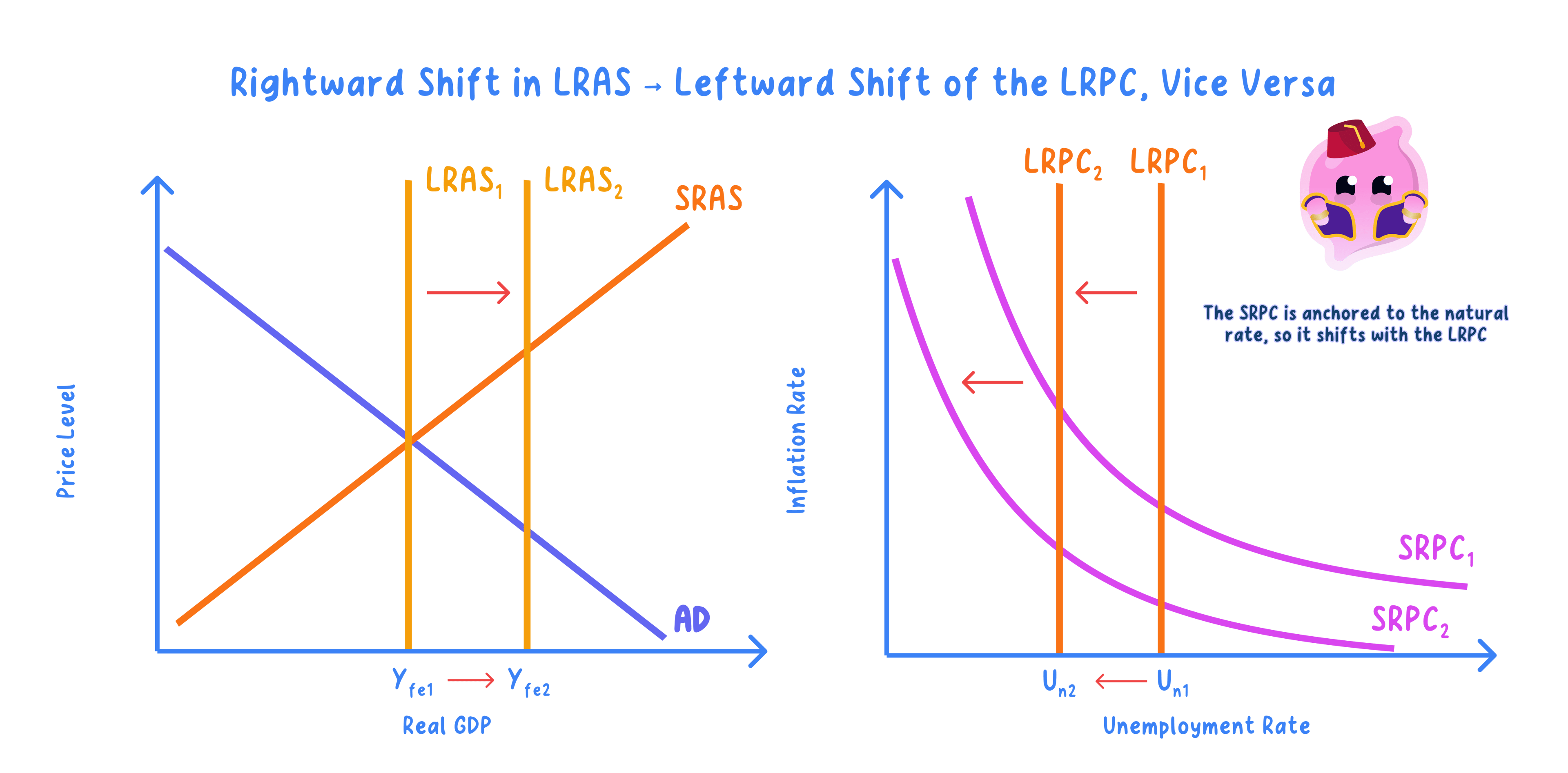
- Supply-side policy can ease some conflicts over time by raising capacity, though it works slowly and its outcome is uncertain.
Can all the objectives be met at once?
- It can hold with spare capacity, for example after a recession, when growth, jobs and low inflation improve together, and successful supply-side reform can shift the whole trade-off in a favourable direction.
- But near full capacity the short-run Phillips curve shows lower unemployment comes only with higher inflation, and faster growth tends to worsen the current account and the environment.
- Demand-side tools can only shift aggregate demand, so they cannot resolve a supply-constrained conflict on their own.
- On balance it depends on spare capacity, the time horizon and whether supply-side reform succeeds, so in the short run trade-offs are usually unavoidable.
Exam technique
- Name the two objectives in tension and explain the mechanism that links them.
- On a Phillips curve, put unemployment on the horizontal axis and inflation on the vertical, and show movement along the curve for a demand change.
Common Mistake
- Do not assume all objectives can be achieved at once, as finite capacity forces short-run trade-offs.
- Do not present the Phillips curve trade-off as permanent, because it disappears in the long run.
Self review
- What is a trade-off between objectives?
- Give three conflicts between macroeconomic objectives.
- What does the short-run Phillips curve show, and what are its axes?
- Why does the inflation-unemployment trade-off hold only in the short run?
- Give one example of a conflict between policies.
