Definition
Supply of labour: the total number of hours that workers are willing and able to offer to a particular occupation at each wage rate.
Market supply of labour: the sum of all individual workers' labour offered to an occupation across the whole market.
- A higher wage raises the reward per hour relative to leisure, so the substitution effect draws more people into the occupation and each worker tends to offer more hours; the market supply curve for labour therefore slopes upward.
- The wage rate is measured on the vertical axis and the quantity of labour, in hours or workers, on the horizontal axis, so a change in the wage is a movement along the curve while any other cause shifts the whole curve.
- For an individual worker a higher wage has two opposing effects: the substitution effect makes each hour of leisure more costly and encourages more work, while the income effect means that, once earnings are high enough, the worker can afford more leisure and offers fewer hours, which gives the individual labour supply curve its backward-bending shape even though market supply still slopes upward.
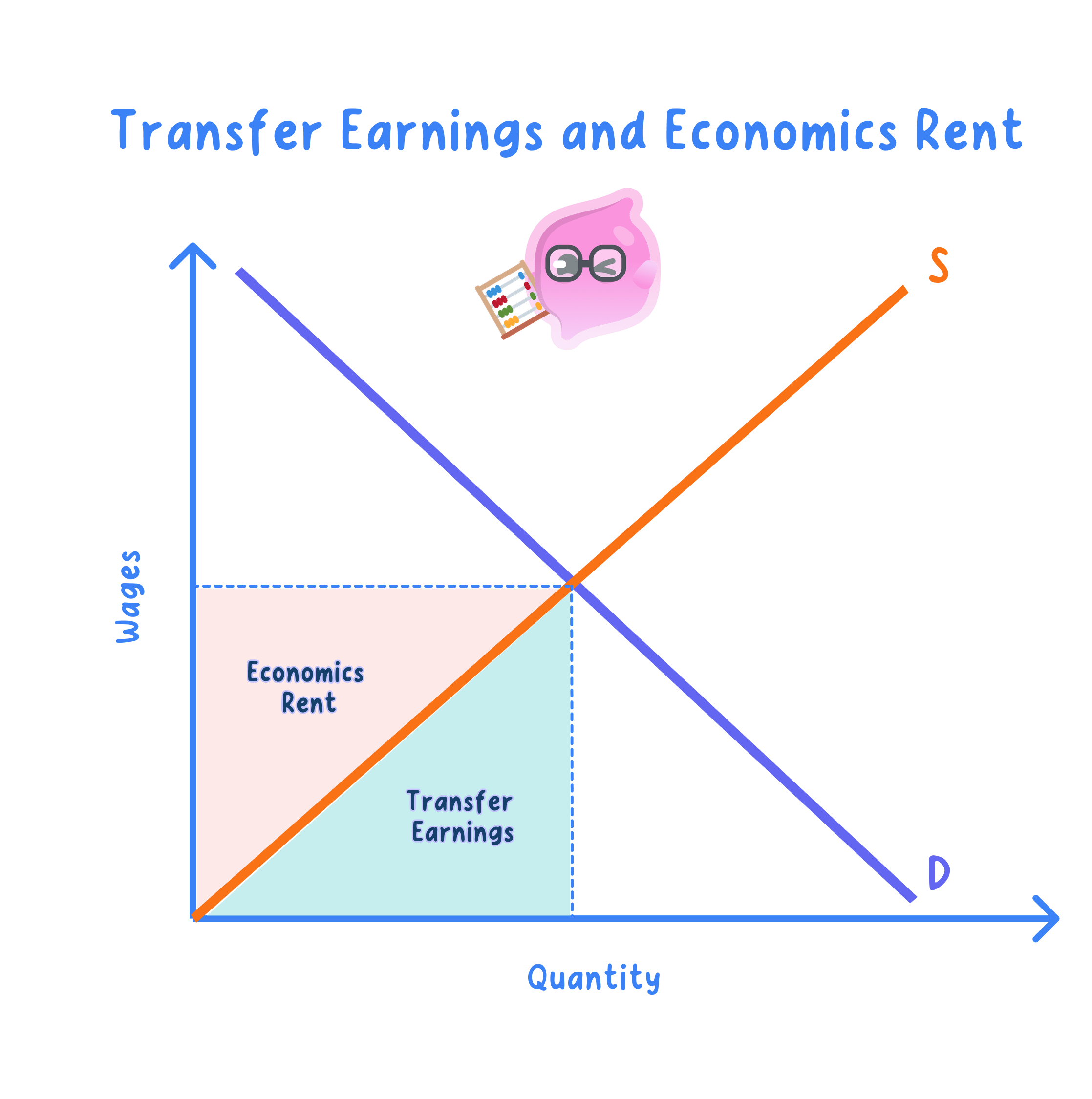
Factors Affecting Labour Supply
- Wages in substitute occupations: if a similar job starts to pay more, for example if warehouse work outpays care work, workers switch towards the better-paid role, shifting supply to the original occupation left.
- Barriers to entry: the years of qualification, training and professional licensing needed to practise medicine or law, policed by bodies such as the General Medical Council and the Solicitors Regulation Authority, restrict how many people can enter, holding supply low so the equilibrium wage stays high.
- Non-monetary factors: job satisfaction, status, danger, sociable hours and job security change how attractive a job is at any given wage, so pleasant conditions raise supply while unpleasant or risky work lowers it.
- Size of the working population: net migration, the birth rate, the participation rate and the state pension age set how many people are available; higher net migration of care workers, for instance, shifts supply right.
- Income tax and welfare benefits: these change the net reward from work, so a high marginal tax rate or generous out-of-work benefits can weaken the incentive to supply labour, while cutting tax raises take-home pay and can draw more workers in.
- Trade unions and professional bodies: by controlling entry through licensing or accreditation, professional bodies such as the British Medical Association can deliberately restrict the supply of labour to an occupation in order to raise members' wages, while industrial unions such as the RMT on the railways use collective bargaining to push the wage above the free-market rate.
Occupational and Geographical Mobility
Definition
Occupational mobility of labour: the ease with which workers can move between different types of job.
Geographical mobility of labour: the ease with which workers can move between different areas or regions to find work.
- Occupational mobility depends on transferable skills, qualifications and access to affordable retraining; an office administrator can move into other clerical roles far more easily than a deep-sea welder can.
- Geographical mobility depends on housing costs, family and social ties and information about jobs elsewhere, so high rents in London and the South East are a major brake on it.
Labour Immobility and Market Failure
Definition
Occupational immobility: when workers cannot switch between jobs because they lack the skills the new job requires.
Geographical immobility: when workers cannot move to where the jobs are, often because of housing costs, family ties or poor information.
- Occupational immobility is a major cause of structural unemployment, because a redundant coal miner or steelworker cannot instantly become a software developer, so their skills lie idle even while vacancies exist.
- Because immobile labour cannot flow to where it is most productive, vacancies and wages stay high in booming regions or sectors while unemployment persists in declining ones.
- This is a market failure because the free market misallocates labour, leaving the economy producing inside its production possibility frontier so output is permanently lost.
Does labour immobility always cause lasting market failure?
- It holds because immobility can be deep-rooted: retraining a 55-year-old ex-miner as a coder is slow and costly, and high house prices can lock workers out of high-employment regions for years.
- But markets can self-correct over time, as higher wages in shortage areas eventually pull in migrants and school leavers, and firms relocate to where labour is cheaper and more plentiful.
- Government policy can shrink the failure, since subsidised retraining, apprenticeships, better job information and help with relocation or housing all raise mobility.
- On balance it depends on the time period and the type of immobility: geographical immobility eases as people relocate, but occupational immobility among older, low-skilled workers tends to be the most persistent and damaging.
Exam technique
- Link each factor affecting labour supply back to a shift of the labour supply curve.
- Name a specific UK occupation, such as nursing or HGV driving, to earn application marks.
Common Mistake
- Do not confuse a movement along the supply curve, caused by a wage change, with a shift caused by any other factor.
- Occupational immobility is about lacking skills, while geographical immobility is about being unable to relocate.
Self review
- List three factors that affect the supply of labour to an occupation.
- Define the occupational immobility of labour.
- Define the geographical immobility of labour.
- Explain why labour immobility is a form of market failure.
