3.5.3a Labour market equilibrium and current issues
Labour Market Equilibrium
Equilibrium wage: the wage rate at which the demand for labour equals the supply of labour, so the market clears with no shortage or surplus.
Demand for labour: a derived demand, meaning firms hire workers not for their own sake but for the goods and services those workers produce.
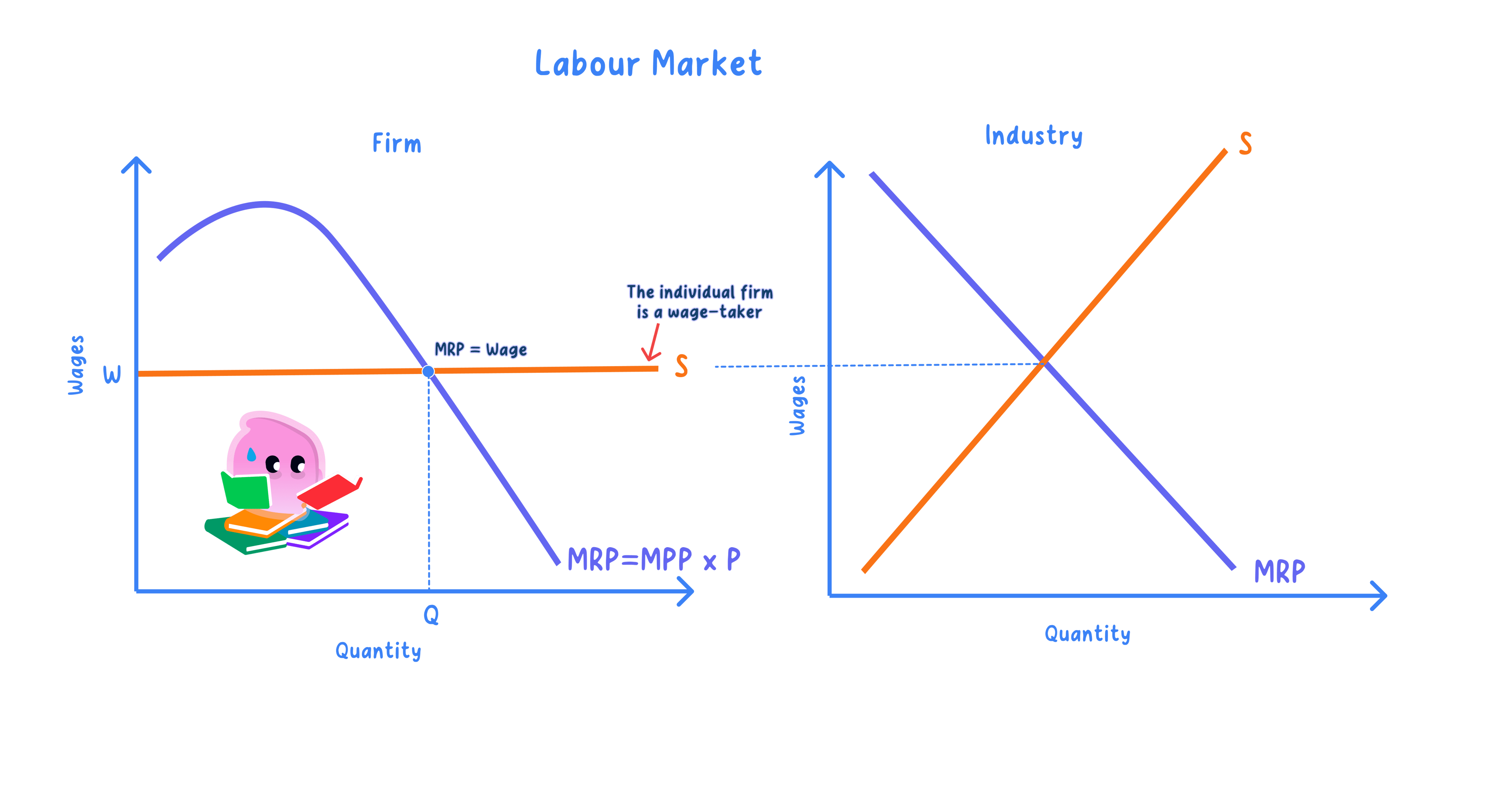
- In a competitive labour market the wage adjusts until the demand for labour equals the supply of labour, clearing the market at the equilibrium wage and level of employment.
- On the diagram the wage rate is on the vertical axis and the quantity of labour on the horizontal axis; the downward-sloping demand curve crosses the upward-sloping supply curve at the equilibrium point.
- If the wage is set above equilibrium, the supply of labour exceeds demand, so the resulting surplus of workers, that is unemployment, forces the wage back down towards equilibrium.
- If the wage is set below equilibrium, demand exceeds supply, so the resulting shortage of workers bids the wage back up.
- A rise in the demand for labour, from stronger product demand or higher productivity, shifts the demand curve right and raises both the wage and employment, which follows because labour demand is a derived demand.
- A rise in the supply of labour, for example from net migration, shifts the supply curve right, lowering the wage while raising employment.
Current Labour Market Issues
Wage differential: the gap in pay between different occupations or groups of workers.
Underemployment: when workers are in jobs below their skill level or want more hours than they can get, so labour is not fully used.
- Skills shortages leave vacancies unfilled in construction, healthcare and technology, as seen in the 2021 shortage of HGV drivers; because labour there is scarce, wages are bid up in those occupations.
- Migration raises the supply of labour in many sectors, easing shortages but tending to hold down wage growth where migrant and domestic workers compete.
- An ageing population shrinks the working-age labour force and raises the dependency ratio, tightening the supply of labour over the long run.
- The gig economy, zero-hours contracts and rising self-employment have made UK work more flexible for firms but less secure for many workers, though the 2021 Supreme Court ruling that Uber drivers count as workers entitled to the minimum wage shows the law adjusting to it.
- Automation and technology raise the demand for skilled workers while cutting demand for routine, low-skilled labour, widening wage differentials.
- Wage differentials between occupations persist because skills, qualifications and bargaining power vary widely, while underemployment sits alongside recorded unemployment as a further sign of slack.
- Rising economic inactivity, driven since the pandemic by long-term sickness and early retirement, has pulled many people out of the labour force altogether, so supply can stay tight even when the headline unemployment rate is low.
Does net migration hold down UK wages?
- It holds because a rightward shift in labour supply, other things equal, lowers the market-clearing wage, and this pressure is strongest in low-skill sectors where many migrants compete directly with domestic workers.
- But migrants also spend their wages, raising demand for goods and so the derived demand for labour, which shifts labour demand right and can offset the wage fall.
- Much depends on the skills mix, since migrants who fill genuine shortages such as NHS staff complement domestic workers and can raise their productivity and pay rather than undercut it.
- On balance the effect depends on the sector and time horizon, with any downward wage pressure typically small and concentrated among the lowest paid rather than economy-wide.
- Explain the equilibrium wage as the intersection of the labour demand and supply curves, then show shifts with arrows and new labels.
- Bring in a current UK issue, such as skills shortages or migration, to add application to a labour market answer.
- Remember the demand for labour is a derived demand, so it depends on demand for the good the workers produce.
- Do not treat every wage difference as unfair, as much of it reflects differences in skills and productivity.
- Explain how the equilibrium wage is determined in a competitive labour market.
- State what happens if the wage is set above the equilibrium level.
- Give two current issues affecting the UK labour market.
- Explain how net migration affects labour market equilibrium.
3.5.3b Intervention and elasticity in labour markets
Minimum and Maximum Wages
Minimum wage: a legal wage floor, such as the UK National Living Wage, that firms cannot legally pay below.
Maximum wage: a legal wage ceiling set below equilibrium, sometimes proposed to limit very high pay.
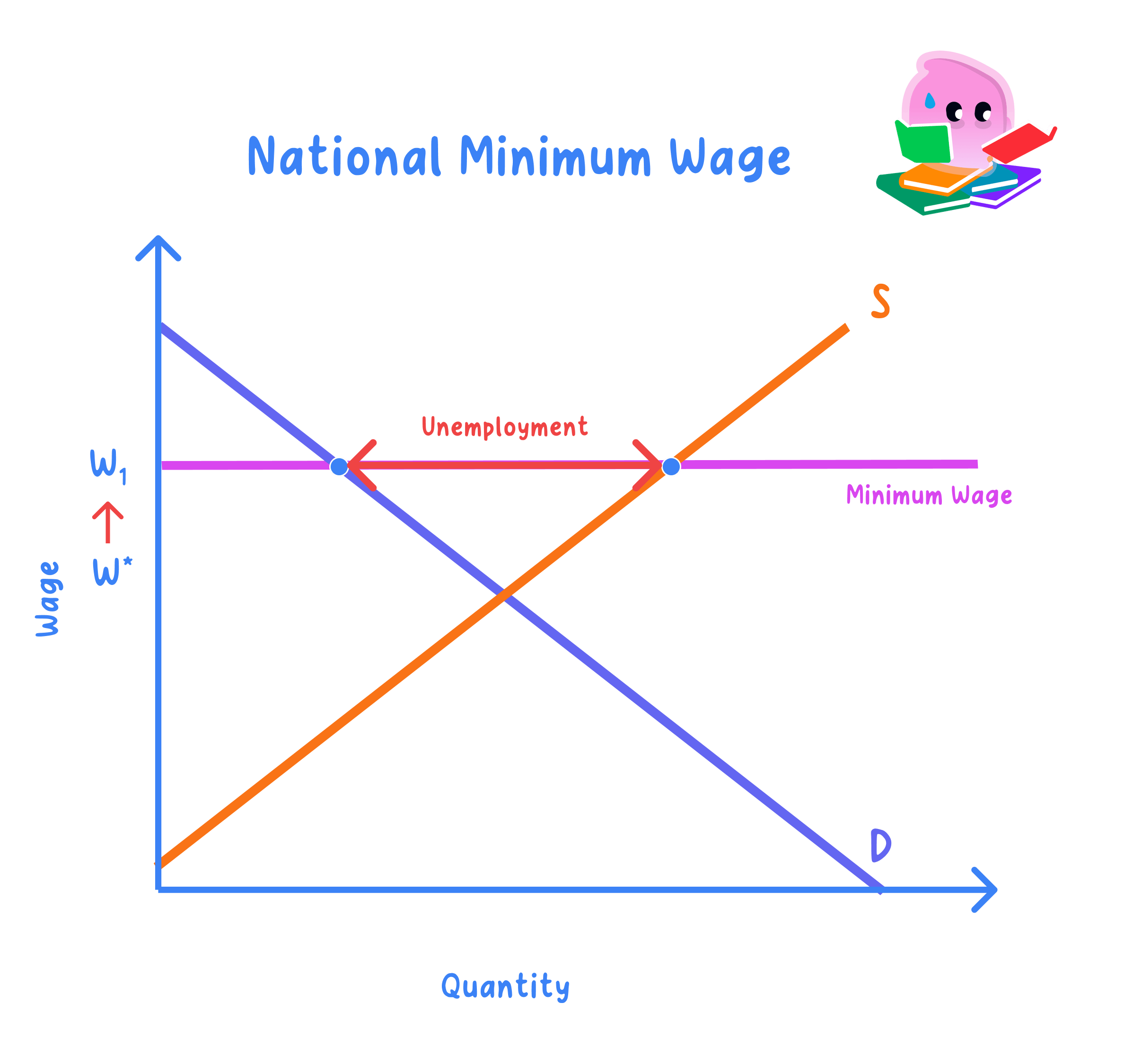
- On a labour market diagram a minimum wage set above equilibrium means the quantity of labour supplied exceeds the quantity demanded, opening a gap of excess supply.
- It raises pay and can reduce in-work poverty, but that excess supply, workers who want the job at the higher wage yet cannot find it, shows up as unemployment.
- A maximum wage set below equilibrium holds pay down, but the quantity of labour demanded then exceeds supply, causing shortages and weaker incentives to work in that occupation.
Public Sector Wage Setting
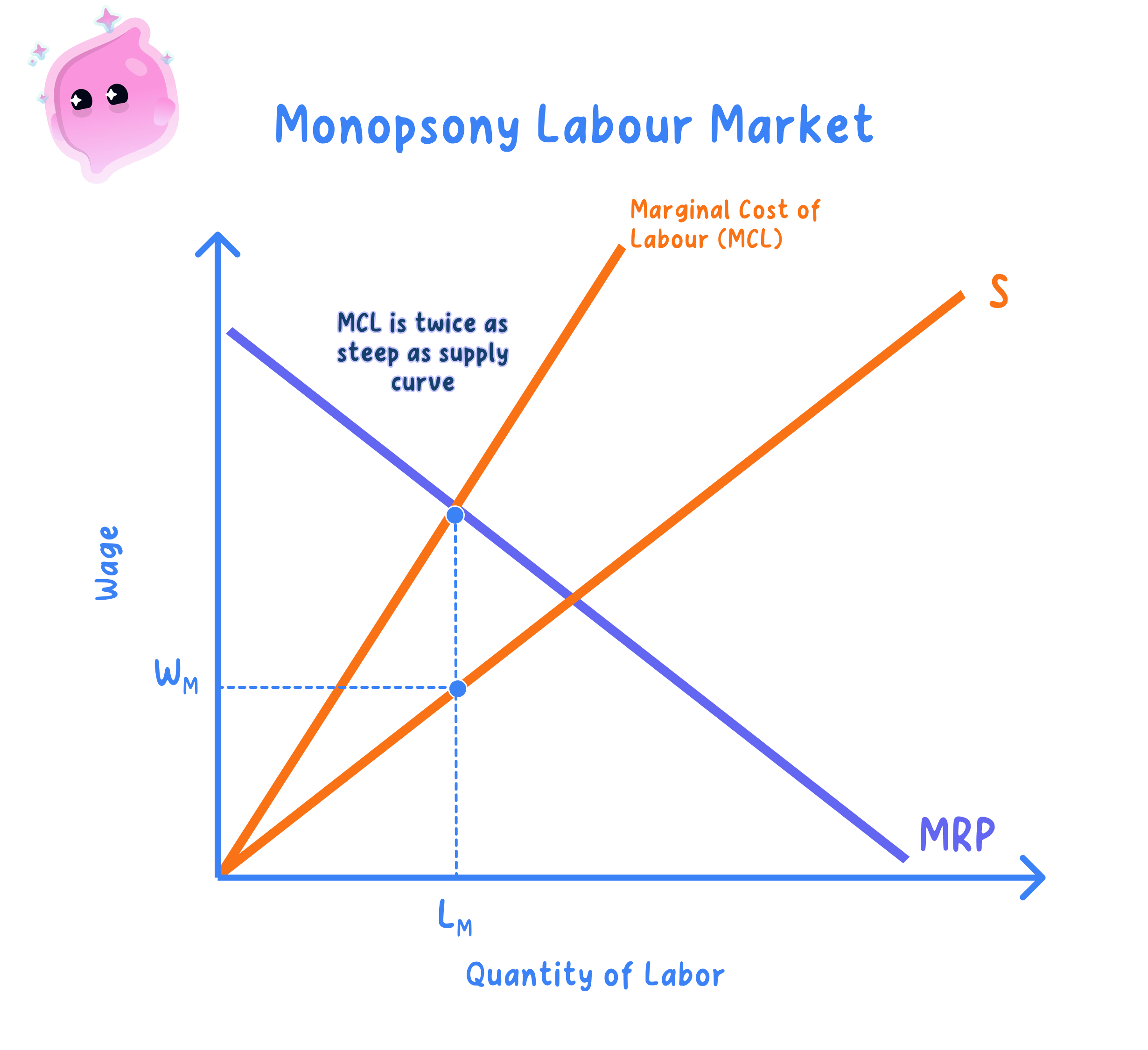
Monopsony: a market with a single, dominant buyer, so the buyer has wage-setting power rather than taking the market wage.
- As a monopsony the government is the dominant buyer of labour for NHS staff, teachers and other public sector workers, so it can set pay rather than accept a market wage.
- It often uses independent pay review bodies or pay caps to control the public sector wage bill and limit the pressure on the budget deficit.
- Because a monopsonist faces the whole upward-sloping labour supply curve, taking on one more worker raises the wage that must be paid to all workers, so it restricts employment and sets pay below both the competitive wage and workers' marginal revenue product.
- But setting pay too low relative to the private sector causes recruitment and retention problems and shortages, as seen in nursing and teaching vacancies and in the 2022-23 pay disputes involving the Royal College of Nursing and the RMT.
Tackling Labour Immobility
Occupational immobility: when workers cannot switch between jobs because they lack the required skills.
Geographical immobility: when workers cannot move to where the jobs are, often because of housing costs or family ties.
- To cut occupational immobility, governments fund education, training and apprenticeships so redundant workers gain transferable skills and can move into growing sectors.
- To cut geographical immobility, governments can subsidise or build affordable housing, improve transport links and provide better information about jobs in other regions.
- Reforming benefits to remove the unemployment trap can also strengthen the incentive to move and take work, since workers then keep more of any extra earnings.
Elasticity in Labour Markets
Elasticity of demand for labour: how responsive the quantity of labour demanded is to a change in the wage rate.
Elasticity of supply of labour: how responsive the quantity of labour supplied is to a change in the wage rate.
- The demand for labour is more elastic when labour is a large share of total costs, when capital can easily replace workers, when demand for the product is elastic, and over a longer period when firms can restructure.
- The supply of labour is more inelastic when jobs need long training or rare qualifications, such as surgeons, and more elastic when the work is low-skilled and over a longer period.
- Elasticity matters for policy, because the more elastic the demand for labour, the greater the job losses from a minimum wage, since firms shed more workers for a given wage rise.
- When the supply of labour is inelastic, a shortage pushes wages up sharply because few extra workers respond, for example among specialist doctors.
Suppose a 10% rise in the wage rate reduces the quantity of labour demanded by 4%:
EDL=−4%+10%=−0.4 E_{D_L} = \dfrac{-4\%}{+10\%} = -0.4 EDL=+10%−4%=−0.4The magnitude is below 1, so labour demand is wage-inelastic and a minimum wage here costs relatively few jobs. If instead a 5% wage rise drew a 15% rise in the quantity of labour supplied:
ESL=+15%+5%=+3 E_{S_L} = \dfrac{+15\%}{+5\%} = +3 ESL=+5%+15%=+3supply is wage-elastic, as expected for low-skilled work where extra workers respond readily to higher pay.
Does a minimum wage always cost jobs?
- It holds because in a competitive labour market a wage floor above equilibrium raises the quantity supplied and cuts the quantity demanded, so firms with elastic labour demand let their least productive workers go.
- But under monopsony the employer already pays below the competitive wage and hires fewer workers, so a minimum wage can raise both pay and employment up to the competitive point.
- If labour demand is wage-inelastic, for example where labour is a small share of costs, the job losses from a given rise are small and firms may absorb it through lower profits or higher prices.
- On balance it depends on market structure and elasticity: modest National Living Wage rises overseen by the Low Pay Commission have lifted pay with little measured job loss, but a very high floor in a competitive, labour-intensive sector would cost more jobs.
- Judge a minimum wage by the elasticity of labour demand, as inelastic demand means small job losses.
- Anchor answers in UK policy such as the National Living Wage or public sector pay caps.
- A minimum wage only bites when it is set above the market equilibrium wage.
- Do not assume a minimum wage always raises unemployment, as a monopsony employer may absorb it with little job loss.
- Explain how a minimum wage set above equilibrium can cause unemployment.
- Give one policy to reduce occupational immobility of labour.
- State two determinants of the elasticity of demand for labour.
- Explain why the elasticity of demand for labour affects the employment impact of a minimum wage.
