Labour as a derived demand
Definition
Demand for labour: the number of workers firms wish to employ at each wage rate.
Derived demand: demand for a factor that comes not from the factor itself but from demand for the good it helps to produce.
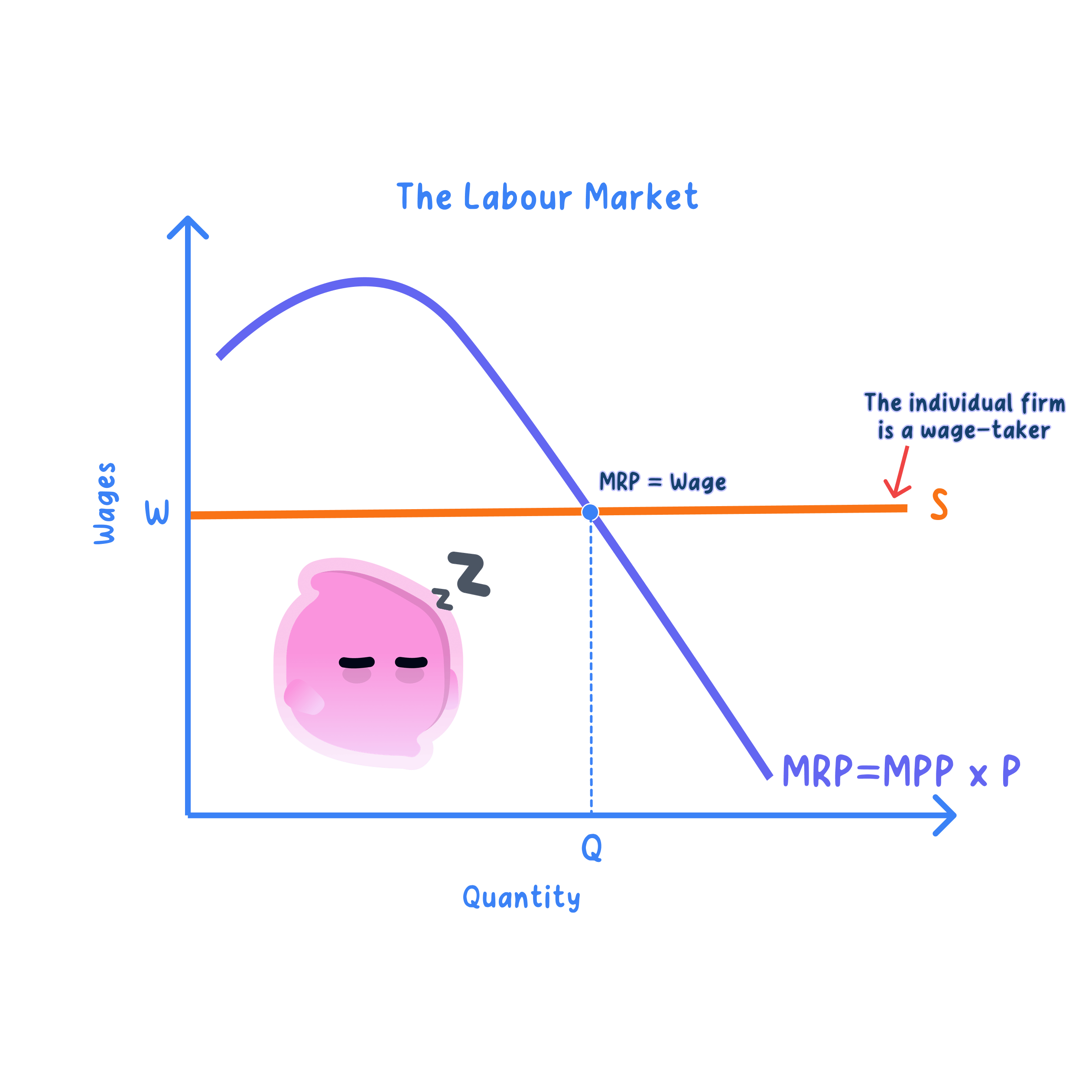
Marginal revenue product (MRP): the extra revenue from employing one more worker, equal to that worker's marginal physical product times the marginal revenue (or price) of the output.
- Firms hire workers not for their own sake but for what they produce, so if no one wants the product, no one is hired to make it.
- Labour demand therefore rises and falls with demand for the final good: a boom in housebuilding lifts demand for bricklayers, and a slump cuts it.
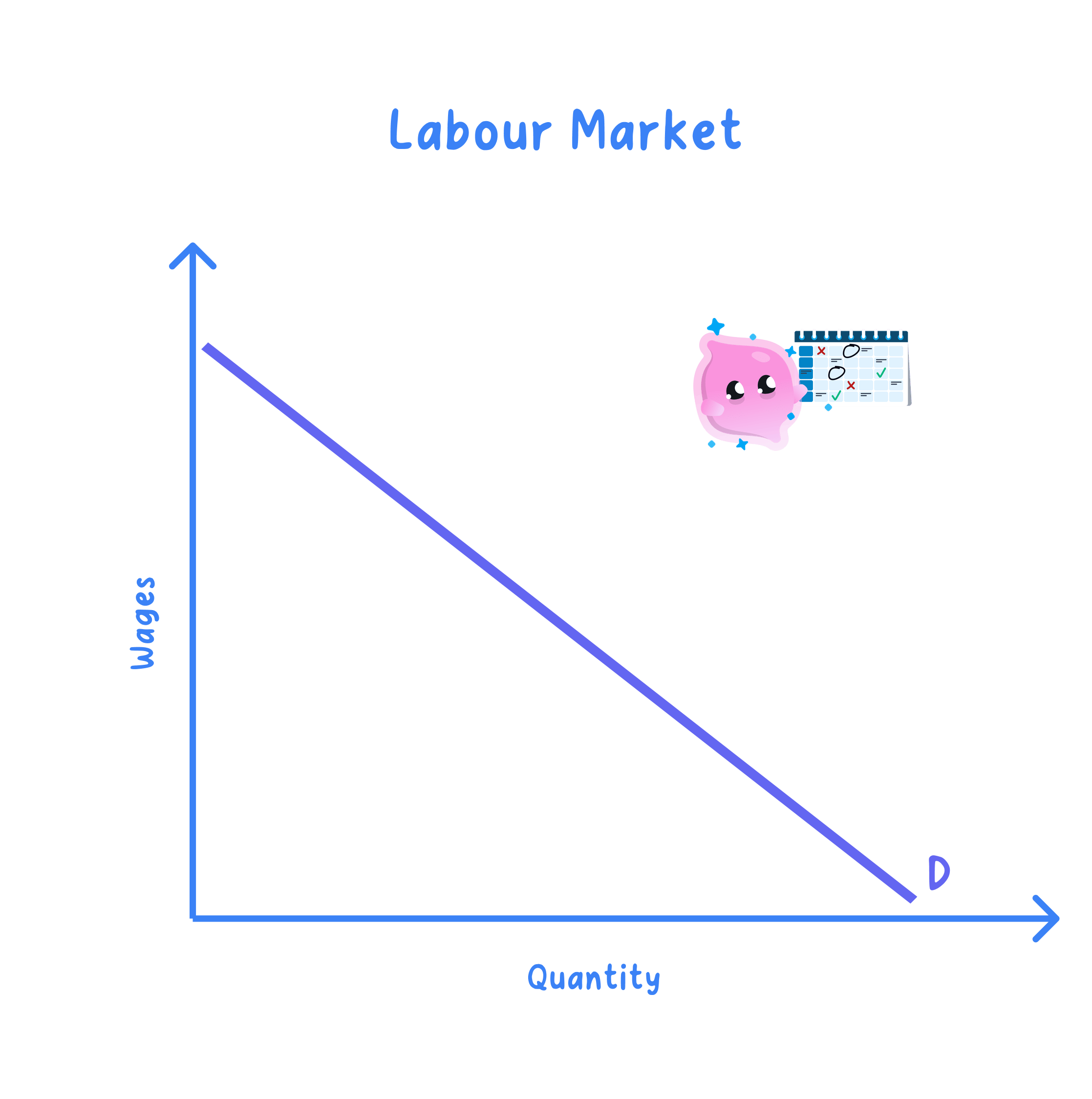
- Under marginal productivity theory a firm keeps hiring while each extra worker adds more to revenue (MRP) than to cost (the wage), so the MRP curve is the labour demand curve; it slopes down because marginal physical product falls as more workers share fixed capital (diminishing returns).
Example
A worker adds 20 units of output a day (MPP = 20) and each unit sells for £5 (MR = £5), so the marginal revenue product per day is:
MRP=MPP×MR=20×5=100 MRP = MPP \times MR = 20 \times 5 = 100 MRP=MPP×MR=20×5=100That is £100 a day, so the firm will employ this worker while the daily wage is below £100 and stops hiring once the wage rises to meet MRP.
What determines labour demand
- Demand for the product drives labour demand, since it is derived; a stronger product market shifts labour demand to the right.
- Labour productivity raises each worker's MRP, so higher output per worker increases demand for labour at any wage.
- The price of the product matters, because a higher price raises the marginal revenue of each worker's output and so lifts MRP.
- The price of substitutes such as capital matters: cheaper, more capable machines lead firms to replace workers, shifting labour demand to the left.
- The price of complementary factors and the number of firms in the industry also shift labour demand.
Shifts and movements
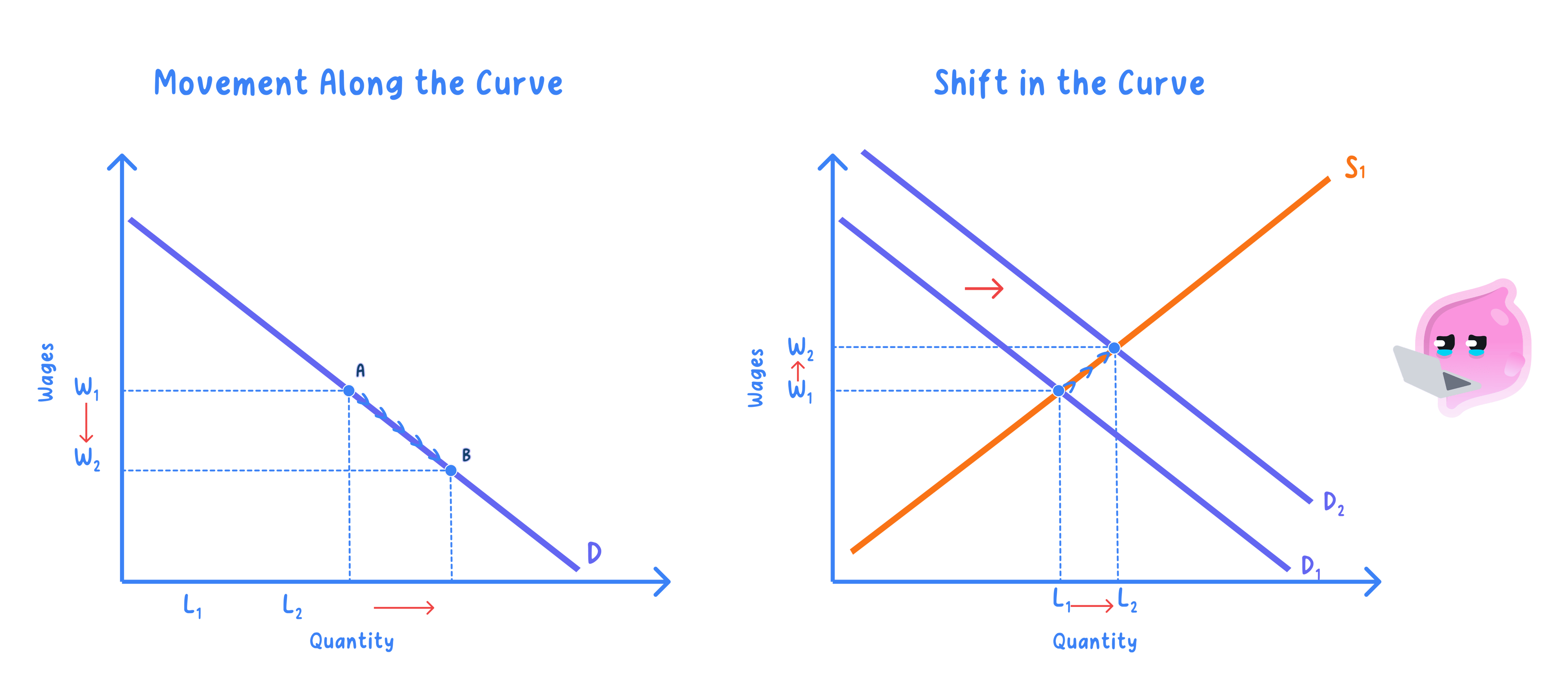
- A change in the wage is a movement along the labour demand curve, not a shift; a higher wage raises the cost of each worker, so firms wish to employ fewer.
- A change in any other determinant shifts the whole curve left or right.
- Keeping the two apart is essential for correct diagrams; for example, a slump in a product market shifts labour demand left and feeds straight through to jobs.
Does MRP theory fully explain the demand for labour?
- It holds well where output is measurable and pay tracks value added, so firms clearly hire up to the point where MRP equals the wage, as in piece-rate or commission sales roles.
- It also usefully explains why skilled, productive workers in high-price industries earn more, since their MRP is higher.
- But it is hard to apply where output per worker cannot be measured (teachers, nurses), where team production blurs each person's contribution, and where imperfections such as trade unions, the minimum wage or monopsony break the link between wage and MRP.
- On balance MRP is a strong guide to the demand for labour but not a complete account, because real labour markets are shaped by institutions, bargaining and imperfect information as well as productivity.
Exam technique
- Define derived demand and tie labour demand to product demand, MRP and the price of capital.
- Label the axes wage rate and quantity of labour.
- State which determinant has changed and shift the curve, keeping a wage change as a movement along it.
Common Mistake
- Do not treat labour demand like ordinary product demand, since it is derived from demand for the final product.
- Do not confuse a shift of the curve with a movement along it.
- Only a wage change moves along the curve, while determinants shift it.
Self review
- What is a derived demand?
- Why do firms demand labour?
- Name three factors that shift labour demand.
- How does higher productivity affect labour demand?
- What causes a movement along the curve?