Revenue Concepts
Total, Average and Marginal Revenue
Definition
Total revenue (TR): the total income a firm receives from selling its output, found by multiplying price by quantity.
Average revenue (AR): revenue per unit sold, which equals the price and so traces the firm's demand curve.
Marginal revenue (MR): the change in total revenue from selling one more unit.
Example
- A firm sells 10 units at a price of £5, and the 11th unit lifts total revenue to £53.
- Total revenue is £50, average revenue (the price) is £5, and the 11th unit brings marginal revenue of £3.

The Revenue Relationships
- Total revenue rises while marginal revenue is positive, because each extra unit still adds to revenue.
- Total revenue peaks when marginal revenue is zero, then falls once marginal revenue turns negative.
- The average revenue curve is the firm's demand curve, since average revenue is the price at each quantity.
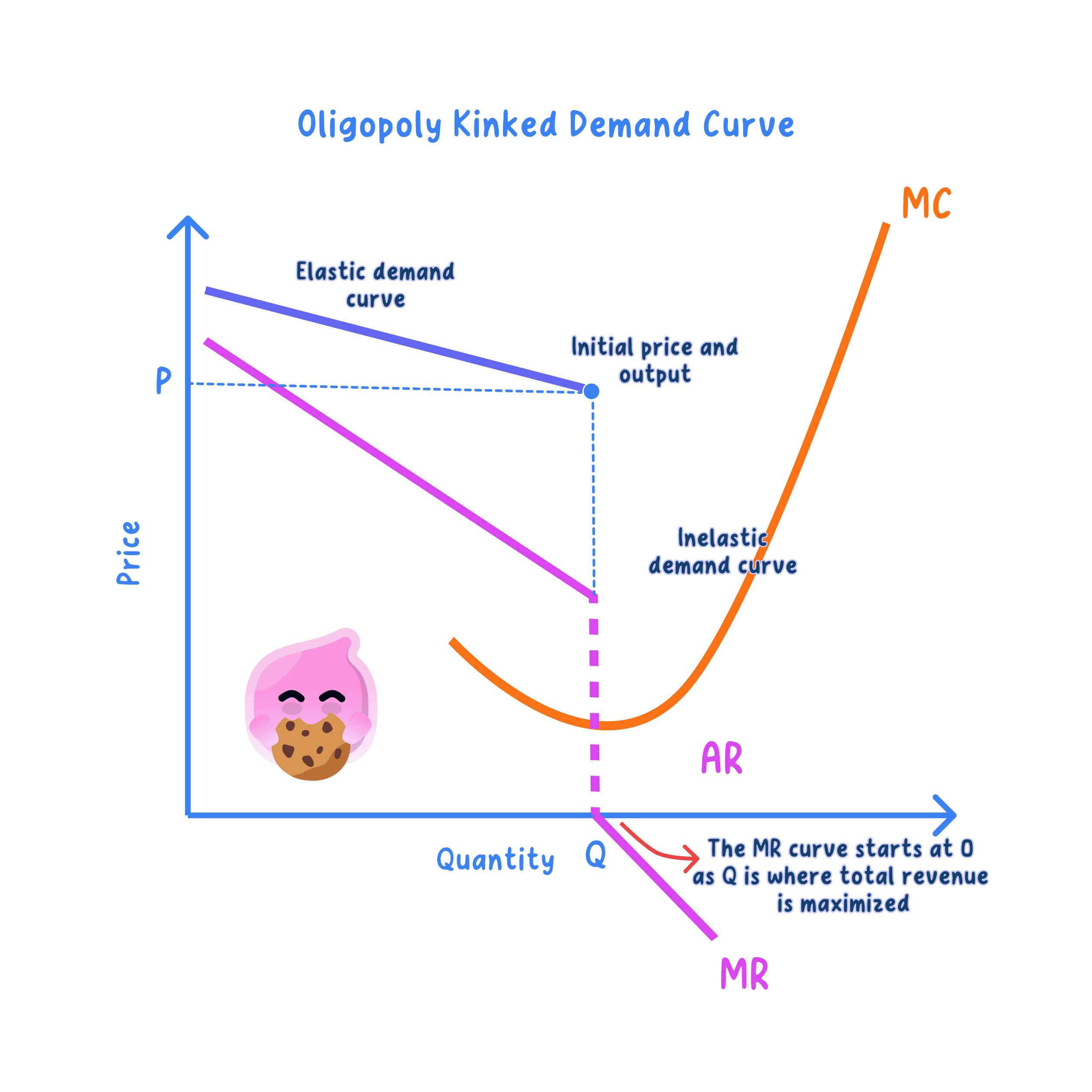
- For a price-taker average revenue equals marginal revenue equals price, while for a price-maker marginal revenue lies below average revenue.
Elasticity and Revenue
Definition
Price elasticity of demand: the responsiveness of quantity demanded to a change in price.
- When demand is elastic, a price cut raises total revenue and a price rise lowers it.
- When demand is inelastic, a price rise raises total revenue and a price cut lowers it.
- Total revenue is maximised where price elasticity of demand equals one, the same output at which marginal revenue is zero.
- On a straight-line demand curve the upper half is elastic with positive marginal revenue, and the lower half is inelastic with negative marginal revenue.
- A budget airline such as easyJet cutting a £10 fare to £8 that lifts seats sold from 100 to 150 raises total revenue from £1,000 to £1,200, confirming elastic demand.
- A streaming platform such as Netflix raising its subscription when demand is inelastic increases total revenue, because the proportionate loss of subscribers is smaller than the proportionate price rise.
Example
- Take the easyJet fare above: price falls from £10 to £8 and seats sold rise from 100 to 150.
- PED is 2.5 in magnitude, so demand is elastic (greater than one); because demand is elastic the price cut raises total revenue, here from £1,000 to £1,200.
Exam technique
- Use total revenue as price times quantity, and marginal revenue as the change in total revenue, to work through the numbers.
- Establish whether demand is elastic or inelastic before predicting revenue.
Common Mistake
- Do not assume marginal revenue always equals price, as that holds only for a price-taker.
- Do not assume raising price always raises revenue, since it lowers revenue when demand is elastic.
Self review
- State the formulae for total, average and marginal revenue.
- Why is the average revenue curve the firm's demand curve?
- What is marginal revenue when total revenue is at its peak?
- When does a price cut raise total revenue?
- Where on a straight-line demand curve is revenue maximised?