Objectives Beyond Profit
- Firms are traditionally assumed to profit maximise, but many pursue other aims in practice.
- The divorce of ownership from control makes alternatives more likely, as managers may chase growth, status or an easier life.
- The objective a firm chooses shapes the price it sets and the output it produces.
- At a listed plc such as BP, salaried directors act as agents for dispersed shareholders (the principals), and this principal-agent split can push them towards growth or revenue targets tied to their pay rather than maximum profit.
Profit Maximisation
Definition
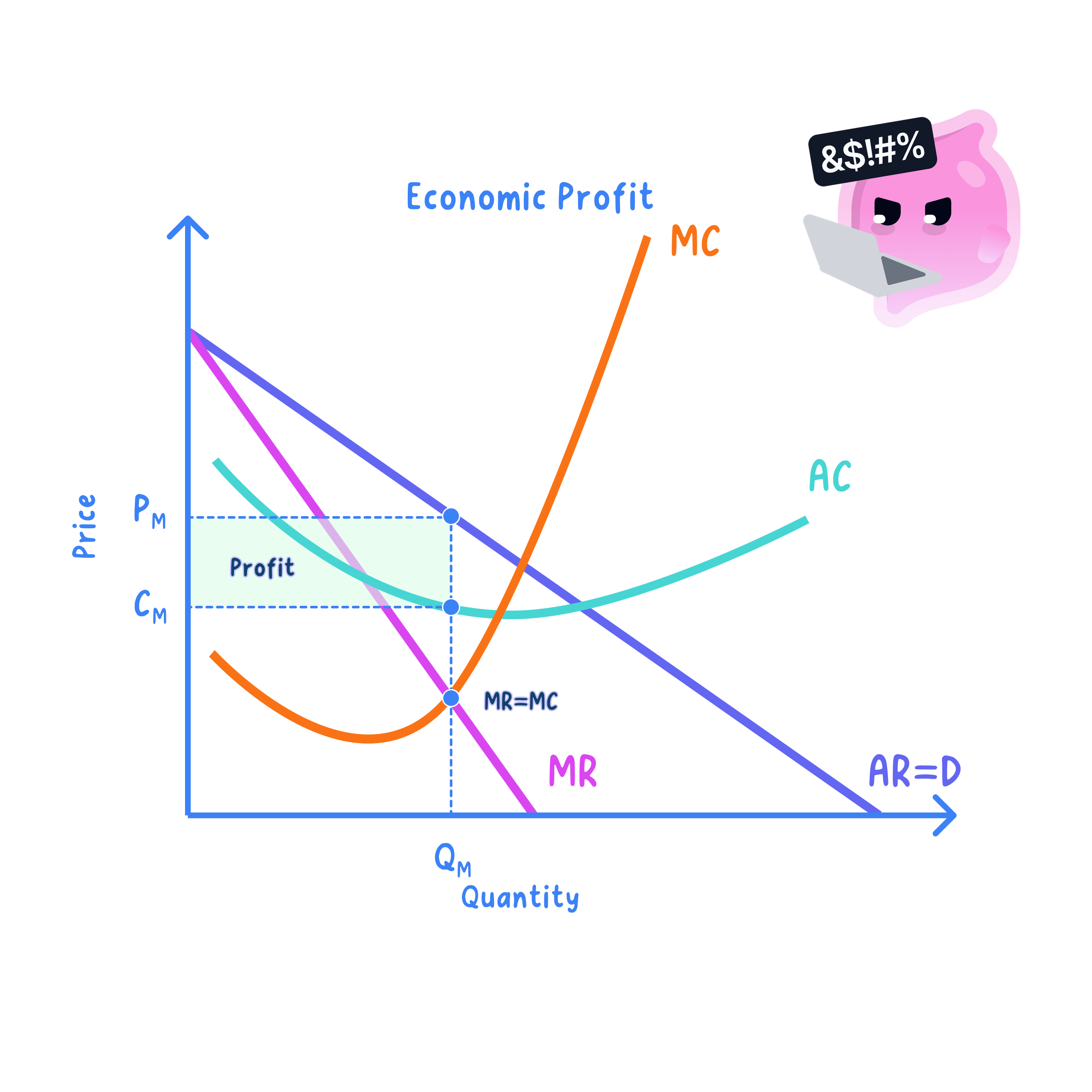
Profit maximisation: producing the output where marginal cost equals marginal revenue, giving the largest gap between total revenue and total cost.
- Below this output an extra unit adds more to revenue than to cost, so producing it raises profit.
- Beyond this output marginal cost exceeds marginal revenue, so the last unit reduces profit, which is why profit peaks where the two are equal.
- On a cost and revenue diagram it sits at the output where the MC curve cuts the MR curve from below.
- A profit-maximising producer such as a patent-holding pharmaceutical firm restricts output to the point where MC = MR, since any further unit would add more to cost than to revenue.
Revenue Maximisation
Definition
Revenue maximisation: producing the output where marginal revenue is zero, so total revenue is at its peak.
- Total revenue peaks here because up to this output marginal revenue is positive, and beyond it marginal revenue turns negative.
- It gives a higher output and lower price than profit maximisation, since the firm pushes past the profit-maximising point.
- Managers may target revenue where their bonuses or status are tied to sales revenue rather than to profit.
Sales Maximisation
Definition
Sales maximisation: producing the largest output the firm can sell while still earning at least normal profit, where average revenue equals average cost.
- It sits further right than revenue maximisation, at the output where the AR curve meets the AC curve so only normal profit is earned.
- A firm may maximise sales to build market share or deter new entrants, accepting lower profit to do so.
Satisficing
Definition
Satisficing: aiming for a satisfactory rather than maximum level of profit, enough to keep the main stakeholders content.
- It reflects the idea that managers balance competing stakeholder groups rather than optimise a single aim.
- Even a satisficing firm must earn enough profit to survive and fund investment in the long run.
Do firms maximise profit in practice?
- Many do, because shareholders demand returns and competitive pressure punishes firms that let costs drift.
- But the divorce of ownership from control lets managers pursue revenue, sales or a quiet life instead of maximum profit.
- Firms also lack the perfect cost and revenue data needed to pinpoint the profit-maximising output, so they often satisfice instead.
- On balance it depends on who controls the firm and how contestable its market is, though some profit is still needed for long-run survival.
Exam technique
- State each objective's condition: marginal cost equals marginal revenue, marginal revenue equals zero, or average revenue equals average cost.
- Link the likely objective to whether owners or managers control the firm.
Common Mistake
- Do not confuse revenue maximisation, where marginal revenue is zero, with sales maximisation, where average revenue equals average cost.
- Do not claim firms abandon profit entirely, since profit is still needed for survival and investment.
Self review
- Where on the diagram does a profit maximiser produce?
- State the condition for revenue maximisation.
- What condition defines sales maximisation?
- What is profit satisficing?
- Why does the divorce of ownership from control encourage alternative objectives?