Cost Concepts
Fixed, Variable and Total Costs
Total fixed cost (TFC): costs that do not vary with output in the short run, such as rent and insurance.
Total variable cost (TVC): costs that rise and fall with output, such as raw materials and the wages of extra staff.
Total cost (TC): the sum of total fixed cost and total variable cost.
- Whether a cost is fixed or variable depends on the time period, and in the long run all costs are variable.
- In the short run at least one factor is fixed, so even at zero output total cost equals total fixed cost rather than zero.
Average and Marginal Cost
Average total cost (ATC), also written AC: total cost per unit of output.
Average fixed cost (AFC): total fixed cost per unit of output.
Average variable cost (AVC): total variable cost per unit of output.
Marginal cost (MC): the addition to total cost from producing one more unit.
- A firm has fixed costs of £100 and variable costs of £50 at 10 units, and an 11th unit raises total cost to £158.
- Total cost is £150, average cost is £15 per unit, and the 11th unit adds marginal cost of £8.
- Average total cost is the sum of average fixed cost and average variable cost, so it always exceeds average variable cost by the average fixed cost.
- Marginal cost captures only the change in variable cost, since total fixed cost does not change when output rises.
Diminishing Marginal Returns
Variable factor: an input, such as labour, whose quantity can be changed in the short run.
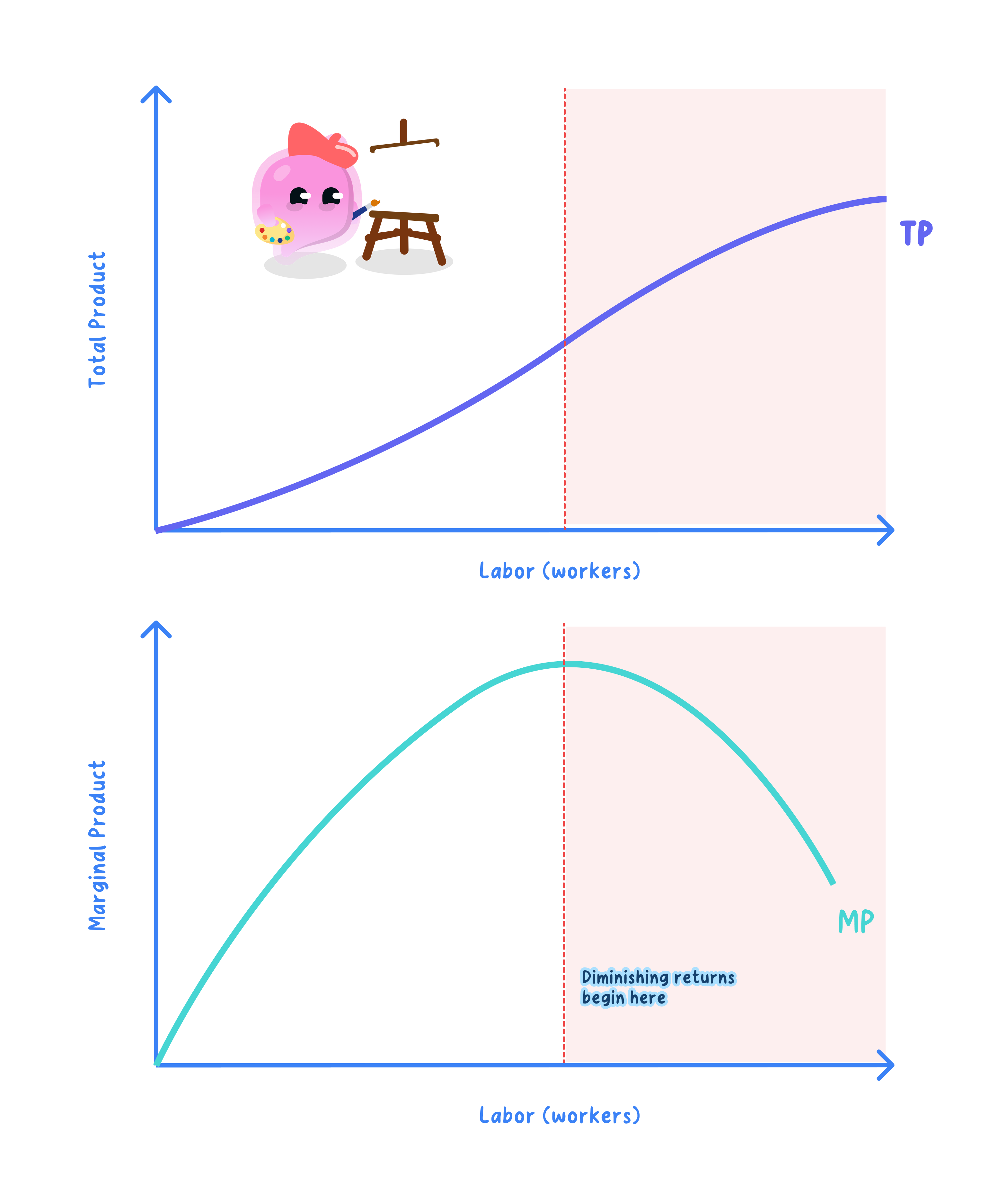
Marginal product: the extra output produced by adding one more unit of a variable factor.
Law of diminishing marginal returns: as more of a variable factor is added to a fixed factor, the marginal product of the variable factor eventually falls.
- In the short run at least one factor, usually capital, is fixed, which is what makes diminishing returns possible.
- Adding successive units of the variable factor to the fixed factor eventually lowers its marginal product.
- A kitchen with one oven gains a lot from the second and third cook, but the tenth cook adds little while queuing for the same oven.
Short-Run Cost Curves
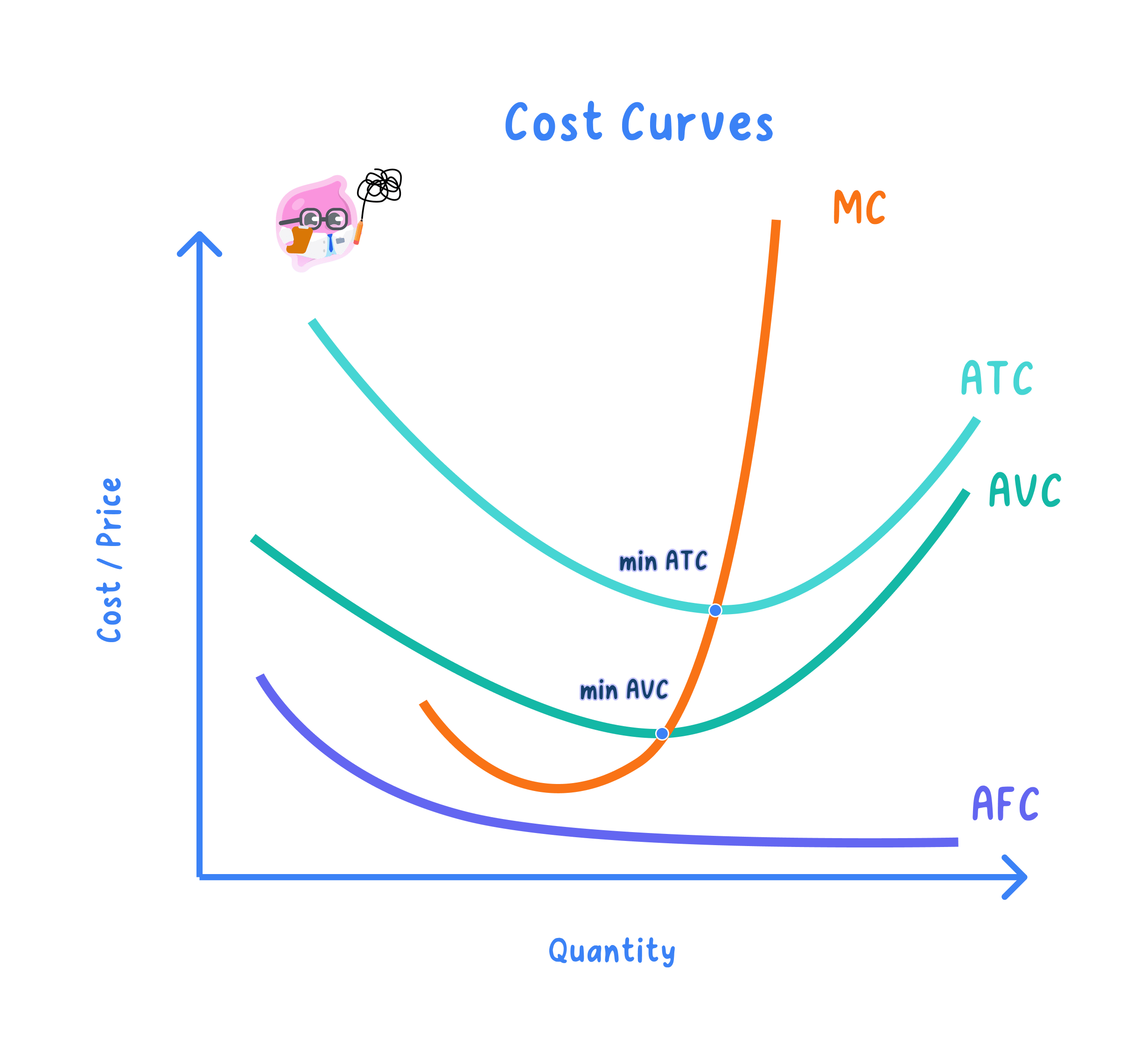
- Falling marginal product means each extra unit of output needs more of the variable factor, so marginal cost rises.
- This drives up short-run average variable and average total cost, giving them a U shape.
- Average fixed cost falls continuously as output spreads it more thinly, widening the gap between average total cost and average variable cost.
- Marginal cost cuts average variable and average total cost at their lowest points, because while it is below the average it drags the average down and while above it pulls the average up.
Short-Run and Long-Run Average Cost
Long-run average cost (LRAC): the lowest average cost achievable at each level of output when all factors are variable.
- In the long run all factors are variable, and each short-run average cost curve fits one scale of plant.
- The long-run average cost curve is the envelope of the short-run curves, tangent to each one and tracing the lowest cost achievable at each output as the firm changes scale.
- A falling LRAC section reflects economies of scale, while a flat or rising section reflects constant or diseconomies of scale.
- A large supermarket such as Tesco spreads bulk-buying, distribution and marketing costs over huge volumes, so its long-run average cost sits well below that of a small independent grocer, illustrating economies of scale.
- Build total cost first, then divide by output for average cost.
- Describe marginal cost cutting average variable and average total cost at their minimum points.
- Treat the LRAC as the tangent envelope of the short-run curves, not a join of their lowest points.
- Do not confuse total cost with average cost, which is total cost divided by the number of units.
- Do not confuse diminishing returns, a short-run effect with a fixed factor, with diseconomies of scale, a long-run effect.
- State the formulae linking total, average and marginal cost.
- Why does diminishing marginal productivity make short-run marginal cost rise?
- Where does marginal cost cross average variable and average total cost?
- Why is the LRAC curve the envelope of the short-run curves?
- What does a falling section of the LRAC curve show?
