Functions of prices
Price mechanism: the system by which the interaction of demand and supply sets prices that coordinate the decisions of buyers and sellers with no central authority directing them.
Rationing: when a good becomes scarce a rising price restricts it to those willing and able to pay.
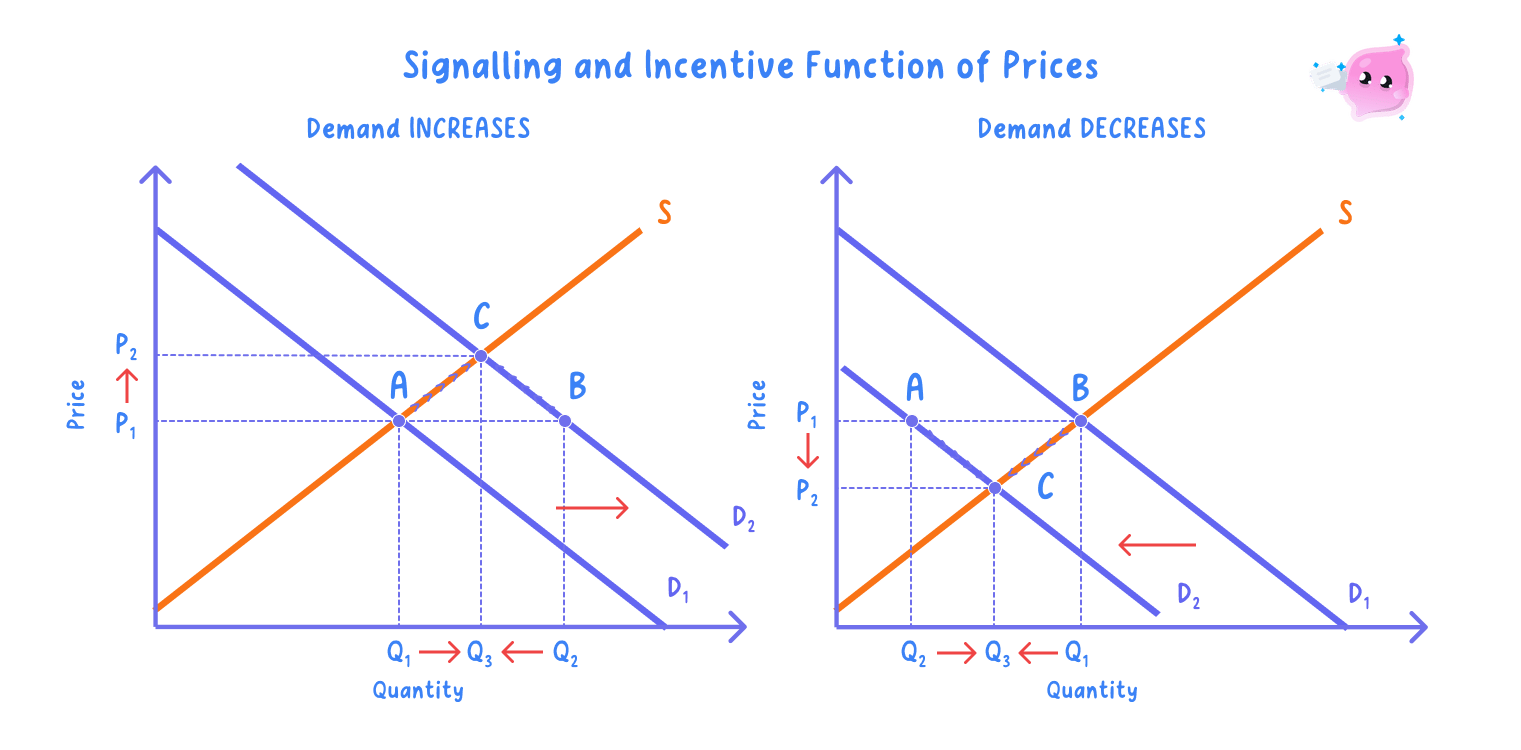
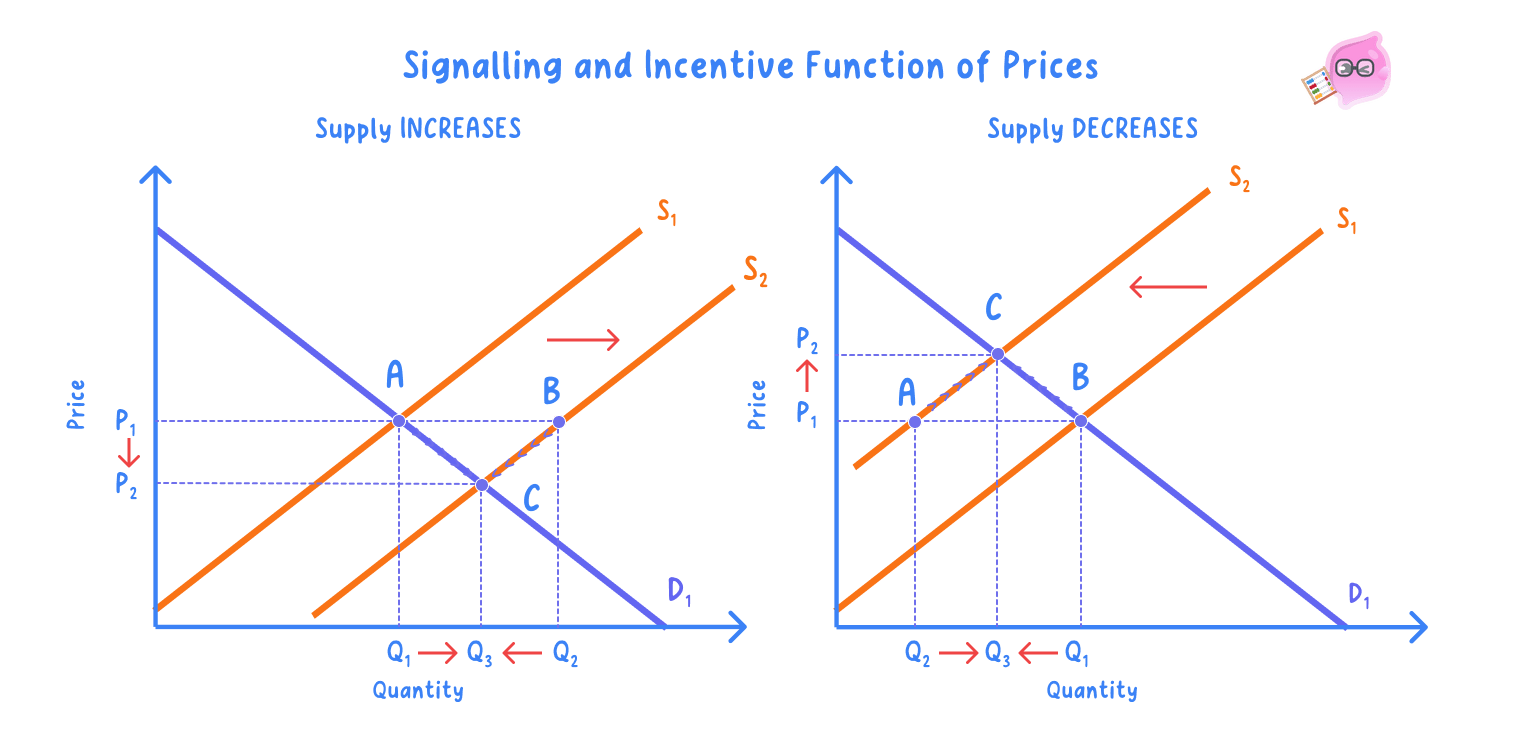
Incentive: a higher price, and the profit it brings, rewards producers for supplying more while leading consumers to economise.
Signalling: price changes indicate where resources should flow, drawing them into rising markets and out of falling ones.
- Coordination without a planner: the mechanism answers what, how and for whom to produce because self-interested buyers and sellers respond only to price, yet their separate choices dovetail into an allocation.
- The three functions act together: a single price rise simultaneously rations, signals and incentivises, which is why one number can reallocate resources so quickly.
- A rise in demand for lithium, used in electric-vehicle batteries, pushes up its price.
- The higher price rations the lithium, signals scarcity and gives firms an incentive to mine and supply more.
- Supply expands until the market clears at a new equilibrium.
Local to global markets
Local market: buyers and sellers trade within a small area, such as parking spaces in one town.
National market: trade spans a whole country under one broad price, such as UK electricity.
Global market: a single world price links buyers and sellers across countries, such as crude oil.
- The wider the market, the further signals travel: in a local market price rations a fixed supply among nearby buyers only.
- In a national market price can draw supply from across the country, so a shortage in one region is smoothed more than it could be locally.
- In a global market a single world price transmits scarcity across borders, so a shock in one country reallocates resources internationally.
- The global crude oil market has one world price, so a supply cut by producers raises prices everywhere at once.
- UK motorists then face higher petrol prices, and some switch to public transport, rationing the scarcer fuel.
Does the price mechanism always allocate resources well?
- It holds because the mechanism is efficient and self-correcting, coordinating vast numbers of decisions automatically and moving resources to where they are valued most without costly central planning.
- But it fails where there are public goods (national defence is non-rival and non-excludable, so no market price forms), externalities or missing markets, so prices omit external costs and benefits and resources are misallocated.
- But it rations by ability to pay, which can be efficient yet leave essentials such as housing out of reach for the poorest, raising concerns about equity as well as efficiency.
- On balance, how well the price mechanism allocates depends on the market: it works well for ordinary private goods such as groceries, but for merit goods, public goods and markets with large externalities it needs government intervention to correct the outcome.
- Name rationing, incentive and signalling explicitly rather than only one or two.
- Trace a demand or supply change through all three functions to the new equilibrium.
- Apply the functions to a named local, national or global market.
- Do not list fewer than three functions; examiners expect rationing, incentive and signalling.
- Do not assume the mechanism always allocates fairly, since it rations by ability to pay.
- Do not forget the mechanism can fail with public goods, externalities and missing markets.
- Name the three functions of prices.
- How does a rising price ration a scarce good?
- How does a price signal where resources should flow?
- Give an example of the price mechanism working in a global market.
- Why might allocation by ability to pay be a problem?
