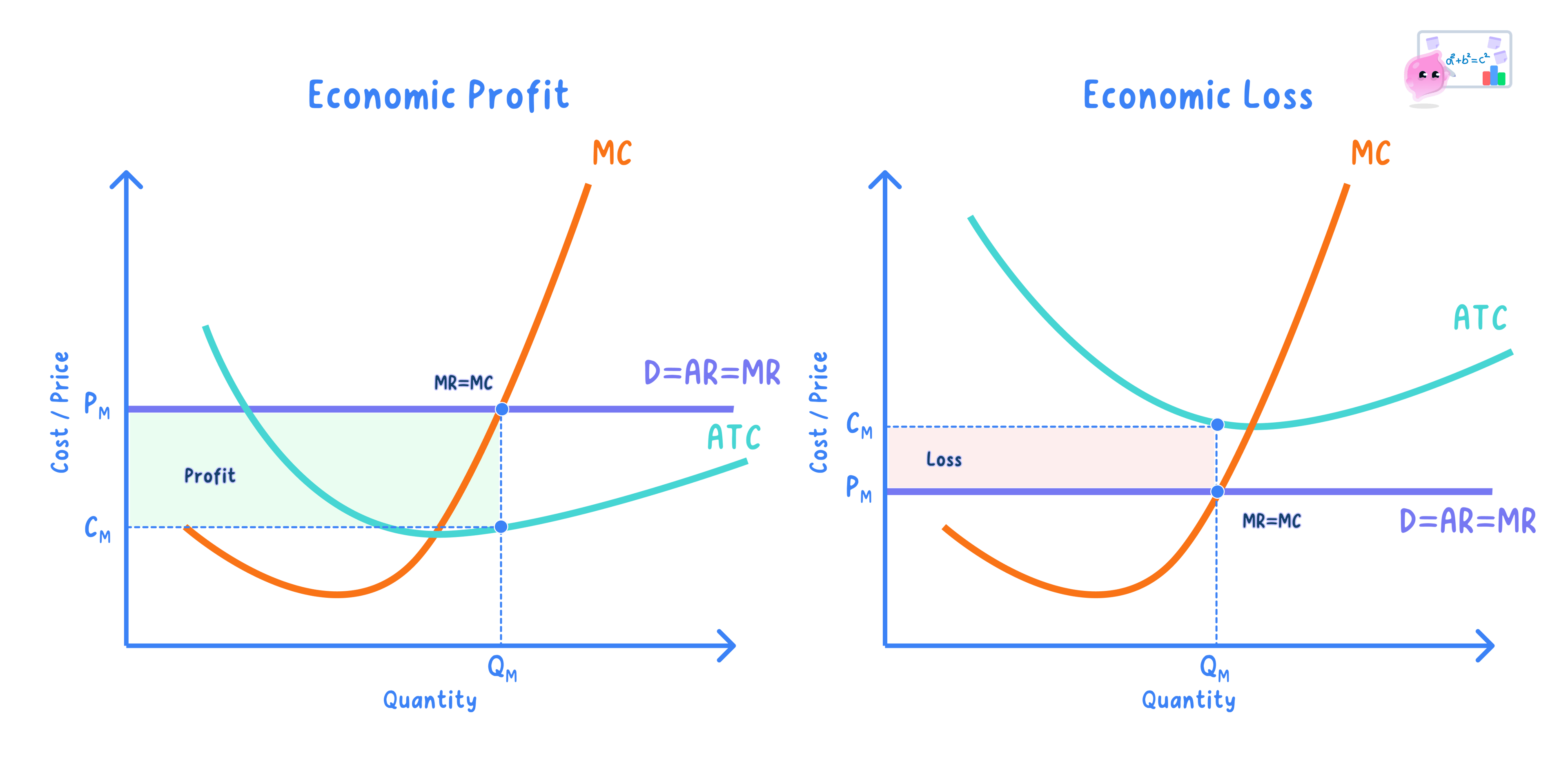
Types of Profit
Profit: the difference between total revenue and total cost.
Normal profit: the minimum reward needed to keep the entrepreneur in the industry, counted as a cost.
Supernormal profit: any profit earned above normal profit (also called abnormal profit).
Loss: the result when total cost exceeds total revenue.
- Normal profit equals what the entrepreneur could earn in the next best use of their resources, so it is an opportunity cost and is included within costs.
- A firm earning only normal profit is therefore doing exactly as well as its next best alternative, which is why it stays put rather than leaving.
- Supernormal profit is whatever total revenue leaves once every cost, including normal profit, has been covered.
Measuring profit on the diagram
Profit=TR−TC Profit = TR - TC Profit=TR−TC Profit=(AR−AC)×Q Profit = (AR - AC) \times Q Profit=(AR−AC)×Q AR=AC AR = AC AR=AC- The break-even condition is AR = AC: here supernormal profit is zero and the firm earns exactly normal profit.
- On a cost and revenue diagram, output is on the horizontal axis and costs and revenue per unit on the vertical axis.
- At the profit-maximising output, compare average revenue (AR) with average cost (AC) to read off profit or loss.
- Where AR > AC the firm earns supernormal profit, shown by the rectangle between the AR and AC curves whose height is (AR − AC) and whose width is the output.
- Where AR = AC the firm earns only normal profit and breaks even.
- Where AR < AC the firm makes a loss, shown by the rectangle between the AC and AR curves multiplied by output.
Suppose a firm produces 500 units, sells each at a price (AR) of £12 and has an average cost (AC) of £9. Its supernormal profit is:
Profit=(AR−AC)×Q=(12−9)×500=1500 Profit = (AR - AC) \times Q = (12 - 9) \times 500 = 1500 Profit=(AR−AC)×Q=(12−9)×500=1500So the firm earns £1,500 of supernormal profit. If AC instead rose to £12, then AR = AC, supernormal profit would be zero and the firm would earn only normal profit, breaking even.
Profit maximisation
Profit maximisation: the assumption in the traditional theory of the firm that a firm chooses the output that makes total profit as large as possible.
- Below the MC = MR output an extra unit adds more to revenue than to cost (MR > MC), so producing it raises profit and the firm should expand.
- Above it the last unit costs more than it earns (MC > MR), so producing it lowers profit and the firm should cut back.
- Profit is therefore greatest only where the two are equal, with MC rising through MR at that output.
- On the diagram, find the output where MC cuts MR from below, then read the price up to the AR curve.
Shut-down points
Short-run shut-down point: the price below which the firm stops producing in the short run, where price falls short of average variable cost (AVC).
Long-run shut-down point: the price below which the firm leaves the industry in the long run, where price falls short of average total cost (ATC).
- In the short run some costs are fixed and must be paid whether or not the firm produces, so only the variable costs are avoidable by shutting.
- So while price ≥ AVC the firm keeps producing, because the revenue covers all variable cost and makes some contribution to fixed cost, leaving a smaller loss than shutting down.
- A seaside hotel often stays open through a quiet winter while room takings still cover the variable costs of heating, cleaning and staffing, accepting a small loss rather than the larger loss of paying its fixed costs for nothing.
- Once price < AVC every unit deepens the loss, so the firm shuts down in the short run.
- In the long run all costs are variable, so the firm must cover ATC; if price < ATC it cannot even earn normal profit and exits.
- It breaks even where AR = ATC, earning normal profit, and between AVC and ATC it makes a loss yet stays open in the short run.
Profit as a signal
- Supernormal profit signals that a market is attractive, drawing new firms in where entry is possible.
- Losses signal that resources are better used elsewhere, driving firms out and releasing those resources.
- Normal profit signals equilibrium, being just enough to keep a firm where it is.
Should we worry about supernormal profit?
- It can be harmful: in an uncompetitive market persistent supernormal profit tends to come from a price above marginal cost and restricted output, so consumers pay more.
- But it can be beneficial, because it funds investment and innovation (dynamic efficiency) and rewards the risk the entrepreneur took.
- It is also the market's own correction: it attracts entrants who compete the profit away over time, improving choice and price for consumers.
- On balance it depends on barriers to entry: with low barriers profit erodes and spurs efficiency, but with high barriers it can persist and may justify regulation.
- State the profit-maximising rule as MC = MR, with marginal cost rising through marginal revenue.
- Treat normal profit as part of costs, not as a separate reward.
- Measure supernormal profit or loss as (AR − AC) × output, and shade the matching rectangle.
- Test the short-run decision against average variable cost and the long-run decision against average total cost.
- Do not treat normal profit as zero profit, because it is the opportunity-cost return already included in costs.
- Do not confuse the profit-maximising point (MC = MR) with the break-even point (AR = AC).
- Do not confuse the shut-down point (price below average variable cost) with the break-even point (AR = average total cost).
- What is normal profit and why is it counted as a cost?
- When does a firm earn supernormal profit in terms of AR and AC?
- State the condition for profit maximisation.
- Where is the short-run shut-down point?
- Where is the long-run shut-down point?