Types of Efficiency
Definition
Static efficiency: how well resources are used at a single point in time, covering allocative and productive efficiency.
Dynamic efficiency: how well resources are used over time, as costs fall and products improve.
- Economists judge how well resources are used through four ideas: allocative efficiency, productive efficiency, dynamic efficiency and x-inefficiency.
- Allocative and productive efficiency are static snapshots, so a market can score well on them today yet still fail to improve over time, which is what dynamic efficiency captures.
Allocative efficiency
Definition
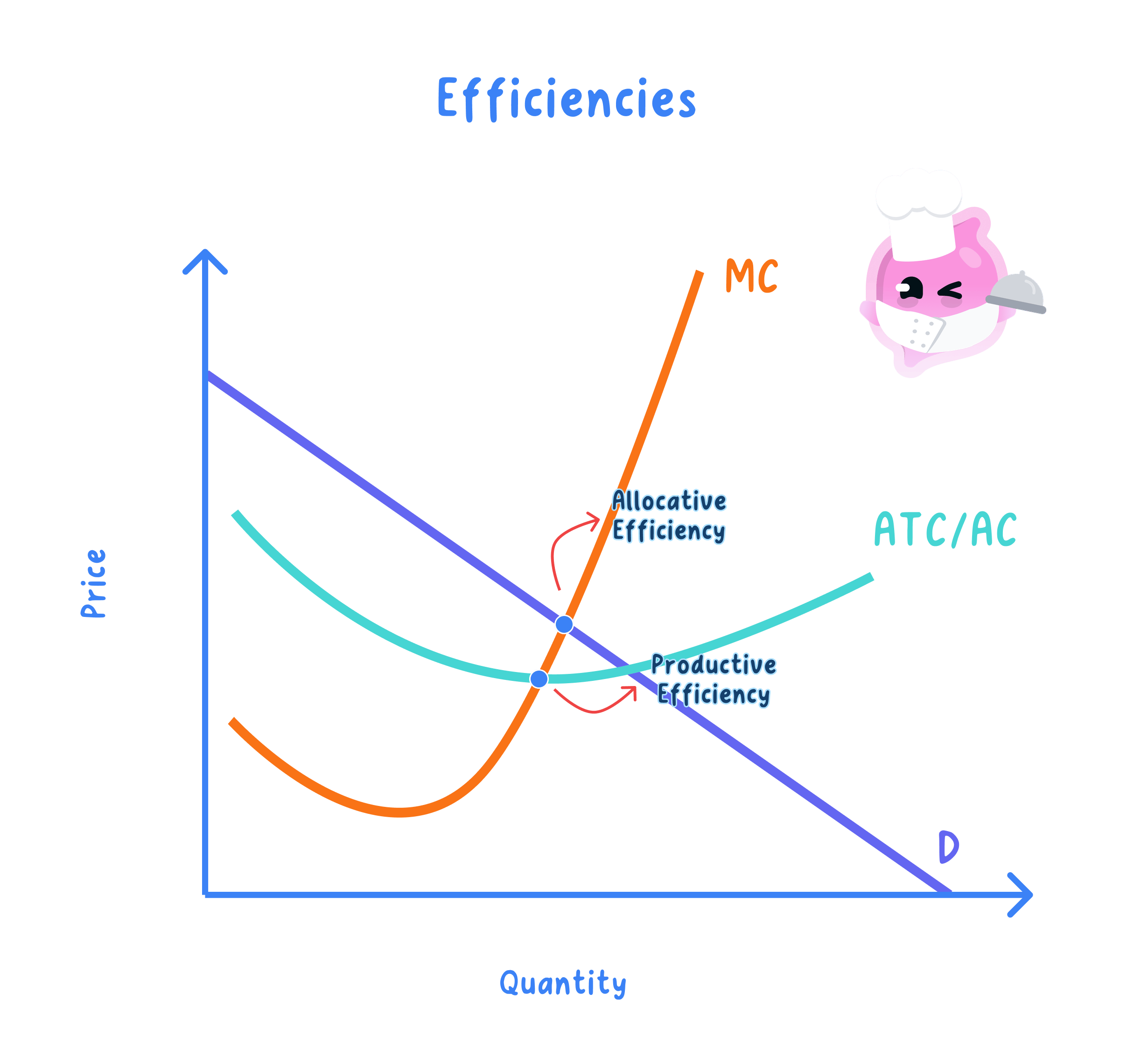
Allocative efficiency: producing the mix of goods and services that consumers most want, reached where price equals marginal cost.
- At P = MC the value consumers place on the last unit (its price) exactly equals the cost of the resources used to make it, so society cannot be made better off by producing more or less.
- On a diagram with output on the horizontal axis and price on the vertical axis, it is the output where the demand curve crosses the marginal cost curve.
- If price is set above marginal cost, consumers value extra units by more than they cost to make, so too little is produced and there is a welfare loss.
Example
- If a good's price is £5 and its marginal cost is £5, that market is allocatively efficient.
- If the price were £8 while marginal cost stayed at £5, output would be restricted and a welfare loss would appear.
Productive efficiency
Definition
Productive efficiency: producing at the lowest possible average total cost, which occurs where marginal cost equals average cost.
- MC cuts AC at its lowest point because while MC < AC it drags the average down and while MC > AC it pulls the average up, so the two are equal exactly at the minimum of AC.
- On a cost diagram with output on the horizontal axis and cost per unit on the vertical axis, the U-shaped AC curve is at its minimum where the rising MC curve cuts it from below.
- For a whole economy, productive efficiency means producing on the production possibility frontier, wasting no resources.
Dynamic efficiency
Definition
Dynamic efficiency: improvements in efficiency over the long run through investment, research and development and innovation.
- By reinvesting profit in R&D, new technology and human and physical capital, a firm lowers its costs and improves the quality and variety of its products over time.
- Supernormal profit, though a static welfare loss, can provide the very funds that finance these dynamic gains, which is why the two measures can conflict.
Example
- A pharmaceutical firm reinvests profit to develop better drugs.
- A supermarket invests in checkout and logistics technology that cuts its costs over time.
X-inefficiency
Definition
X-inefficiency: producing above the lowest-cost curve, so average cost is higher than it needs to be.
- It arises when weak competition removes the pressure to control costs, allowing organisational slack such as overstaffing or wasteful spending.
- It is therefore most likely in monopolies and other firms that face little competitive threat, because there is no rival forcing costs down.
Efficiency across market structures
- Perfect competition delivers both allocative and productive efficiency in the long run, because free entry competes price down to P = MC at the lowest point of AC.
- Monopoly is statically inefficient, setting price above marginal cost and producing below the productively efficient output, and it risks x-inefficiency from weak competition.
- However, a monopoly's supernormal profit may fund investment, so it can be dynamically efficient even while it is statically inefficient.
- Oligopoly sits between the two, depending on whether firms compete hard or settle into a quiet life.
- No single structure wins on every measure, so static and dynamic efficiency must be weighed against each other rather than judged in isolation.
Exam technique
- State the condition, not just the word: write P = MC for allocative efficiency and MC = AC for productive efficiency.
- Judge each market structure on static and dynamic efficiency separately, then reach a verdict that depends on the type of market.
Common Mistake
- Do not confuse allocative efficiency, the right mix of output, with productive efficiency, least-cost production.
- Do not assume perfect competition is efficient in every sense, as it may lack the profit needed for dynamic efficiency.
Self review
- At what price is allocative efficiency achieved?
- Where on the cost curve is productive efficiency, and what equals what at that point?
- What is the source of dynamic efficiency?
- What is x-inefficiency and when is it most likely?
- Which market structure is statically efficient in the long run, and which may instead be dynamically efficient?
