Definition
Long-run aggregate supply (LRAS): the economy's potential output, set by the quantity and quality of its factors of production and independent of the price level.
- LRAS reflects the economy's productive capacity, not short-run costs, so it is determined by the supply side rather than by demand.
- Because it is independent of the price level, a change in the price level alone cannot move long-run output; only a change in capacity can.
Classical and Keynesian LRAS
Definition
Classical LRAS: a vertical line at the full-employment level of output.
Keynesian LRAS: horizontal at low levels of output, then upward-sloping, and finally vertical at full capacity, giving a reverse-L shape.
- On the classical view output in the long run is fixed by supply-side factors, so a rise in AD raises only the price level, not real output.
- On the Keynesian view, when there is spare capacity output can rise without raising the price level, but once resources are fully used only the price level can rise.
Analogy
- The Keynesian curve is like a factory with idle machines: output can rise cheaply until full capacity is reached, after which only prices can rise.
Supply-side factors
Definition
Productivity: output per worker or per unit of input; higher productivity means more output from the same resources.
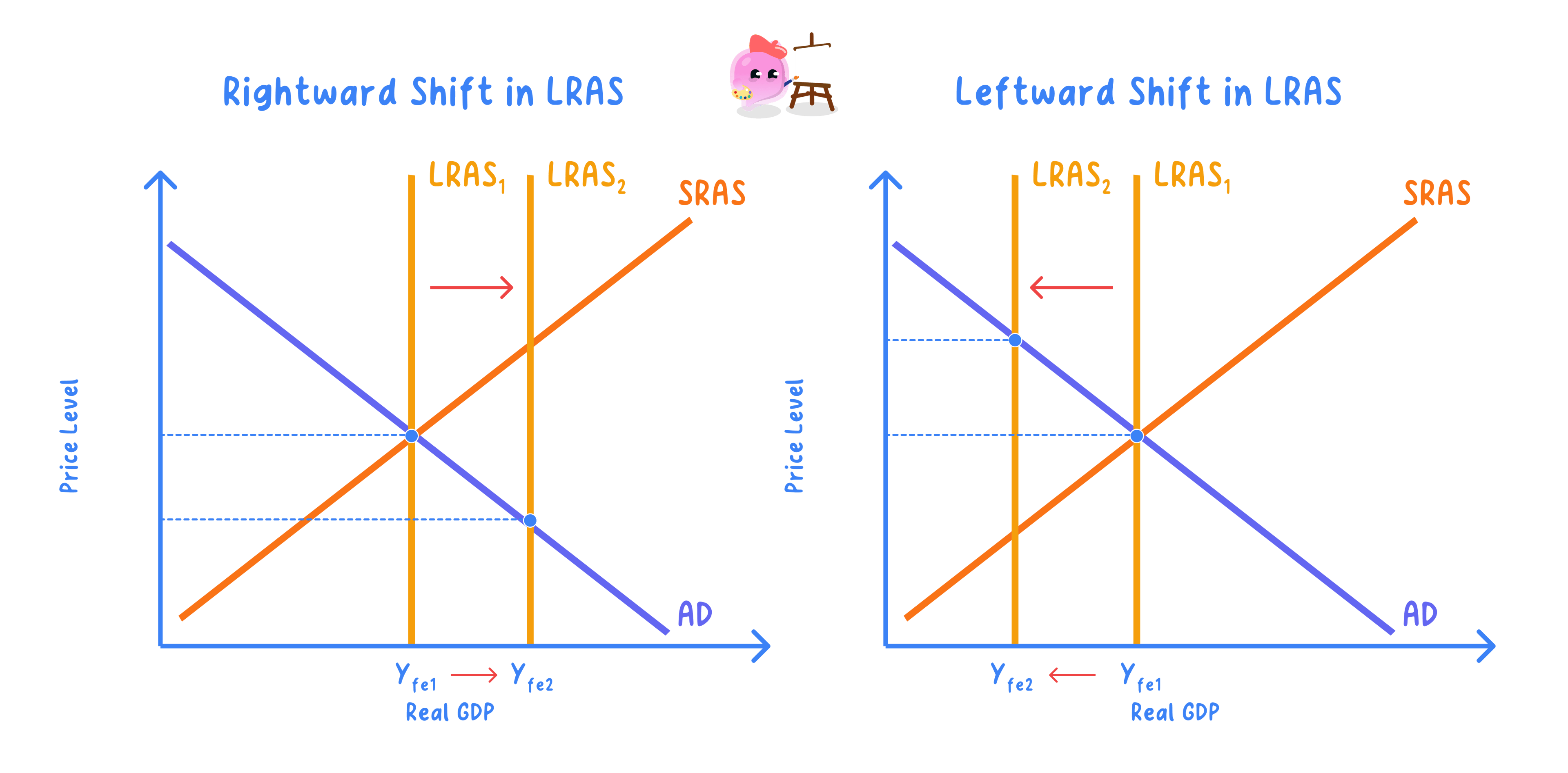
- Technological advances raise potential output and shift LRAS right, because new methods produce more from the same resources.
- Higher relative productivity raises output per worker, shifting LRAS right and cutting unit costs over time; conversely the UK's weak productivity growth since the 2008-09 financial crisis has held back LRAS gains.
- Better education and skills raise the quality of labour, shifting LRAS right by making workers more productive.
Example
- Investment in AI and automation can raise output per worker, shifting LRAS to the right.
- Apprenticeships that improve workforce skills also expand potential output.
Policy and demographics
- Changes in government regulation can raise capacity if deregulation cuts business costs, or reduce it if regulation becomes excessive.
- Demographic changes and migration shift LRAS by changing the size of the workforce, so net inward migration of workers raises potential output, as high net migration to the UK in the 2000s and 2010s expanded the labour force.
- Competition policy can raise efficiency and productivity by pushing firms to cut costs and innovate, shifting LRAS right.
Is the LRAS really vertical?
- It holds on the classical view because in the long run wages and prices adjust so the economy returns to full employment, making output independent of the price level and the curve vertical.
- But Keynesians argue that when there is large spare capacity, as in a deep recession, output can expand with little effect on prices, so the curve is horizontal or upward-sloping over that range.
- On balance it depends on how much spare capacity there is: near full employment the vertical classical shape fits, but with mass unemployment the Keynesian shape better describes the economy.
Exam technique
- State which model you are using, as a demand-side boost has no long-run output effect on a classical LRAS but can raise output where the Keynesian curve is horizontal.
- Link each supply-side factor to a rightward LRAS shift and higher potential output.
Common Mistake
- Long-run AS shifts come from the quantity and quality of resources, not from short-run cost changes.
- The classical curve is vertical, so do not draw it upward sloping like short-run AS.
Self review
- What determines the position of long-run AS?
- How does the classical LRAS shape differ from the Keynesian one?
- Give three supply-side factors that shift LRAS to the right.
- How can migration affect long-run AS?
