The Circular Flow
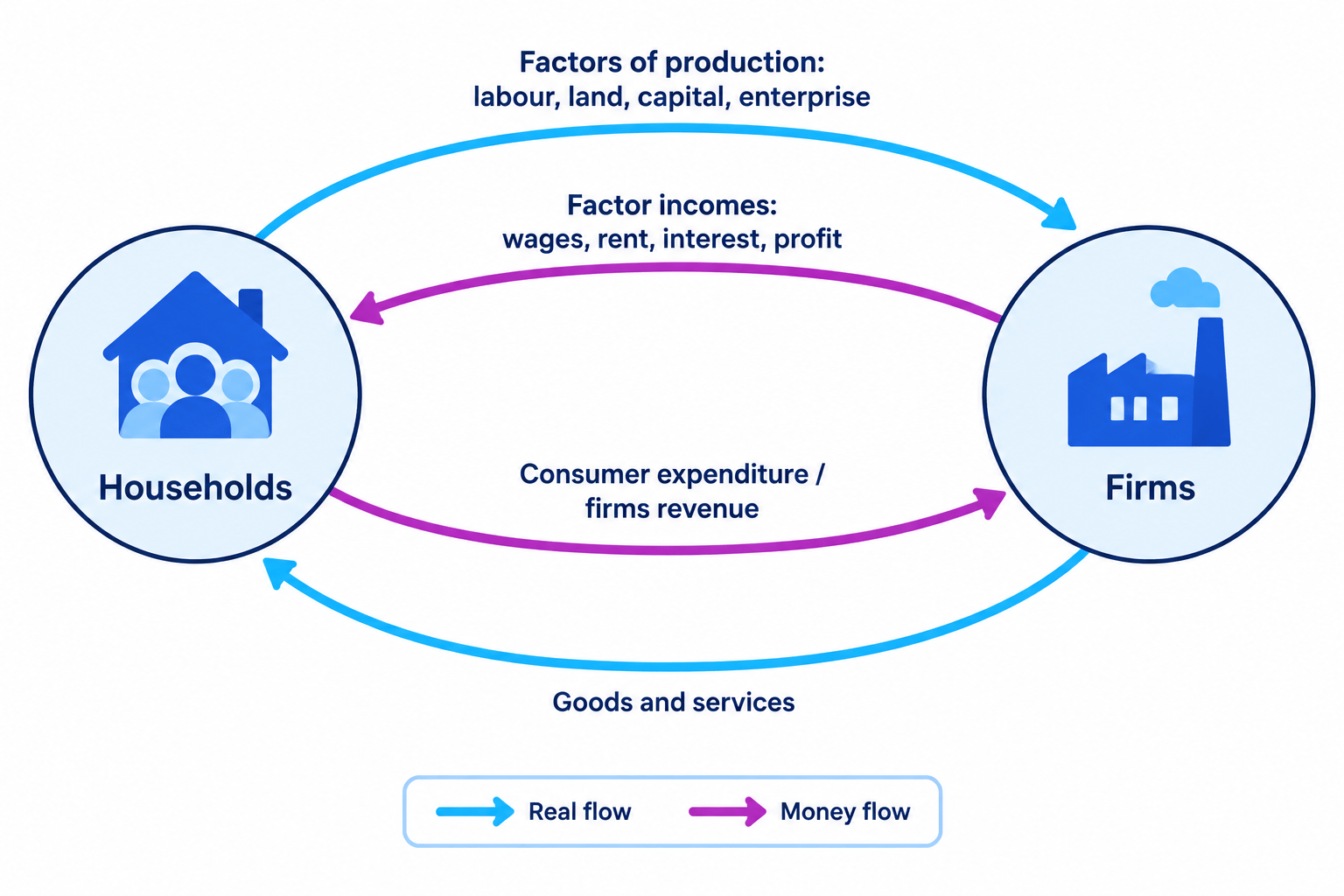
Circular flow of income: a model showing how money, factors of production and output move continuously between households and firms.
Factor incomes: the payments households receive for supplying factors of production, namely wages, rent, interest and profit.
- Households supply factors of production to firms, and firms pay factor incomes in return.
- Households spend those incomes on the goods and services firms produce, returning the money to firms as revenue.
- That revenue funds the next round of factor payments, so the loop keeps turning.
- A real flow of factors and finished goods runs one way, while a matching money flow of incomes and spending runs the opposite way.
- Picture the economy as a loop where goods flow one way and money flows back the other.
- Each lap of spending funds the next lap of incomes, keeping the loop turning.
Sectors of the Model
Two-sector model: the simplest circular flow, containing only households and firms, with no government or foreign trade.
Four-sector model: the full open economy, adding the government and the foreign sector to households and firms.
- The two-sector version strips the model down to its core loop so the basic mechanism is clear.
- Adding the government and the foreign sector introduces the injections and withdrawals covered in 2.4.2, matching a real open economy.
Measuring National Income
Output: the value of the goods and services firms produce in a given period.
Income: the total factor incomes households earn from producing that output.
Expenditure: the total spending on that output.
- National income can be measured three ways: the output method adds the value added by all firms, the income method adds all factor incomes, and the expenditure method adds total spending on final output.
- Every unit of output generates an equal amount of income and is bought by an equal amount of expenditure, so the three totals are equal by definition.
- This identity means national income can be measured by adding up output, income or expenditure, and each route should give the same figure.
- In the UK, the Office for National Statistics estimates GDP using all three approaches and publishes a single reconciled figure.
- Because measurement is imperfect, a small statistical discrepancy is reconciled, but in principle the output, income and expenditure totals are identical.
Income Versus Wealth
Income: a flow of money received over a period, from wages, interest, rent, profit and transfer payments.
Wealth: a stock of assets held at a point in time, such as property, shares and pension savings.
- Wealth can generate income, for example rent from property or dividends from shares, and income that is saved can build wealth, so the two reinforce each other over time.
- Wealth is usually distributed far more unequally than income, because assets accumulate and can be inherited.
- Describe the circular flow as two opposite flows, a real flow one way and a money flow the other.
- Label income as a flow and wealth as a stock whenever a question mixes the two.
- Do not treat the three measures of national income as different totals; income, output and expenditure are equal by definition.
- Do not use income and wealth interchangeably, as one is a flow and the other a stock.
- What are the two directions of flow in the circular flow of income?
- State the identity linking income, output and expenditure.
- Which two sectors make up the simplest circular flow?
- Define income and explain why it is a flow.
- Define wealth and explain why it is a stock.