Indirect taxes
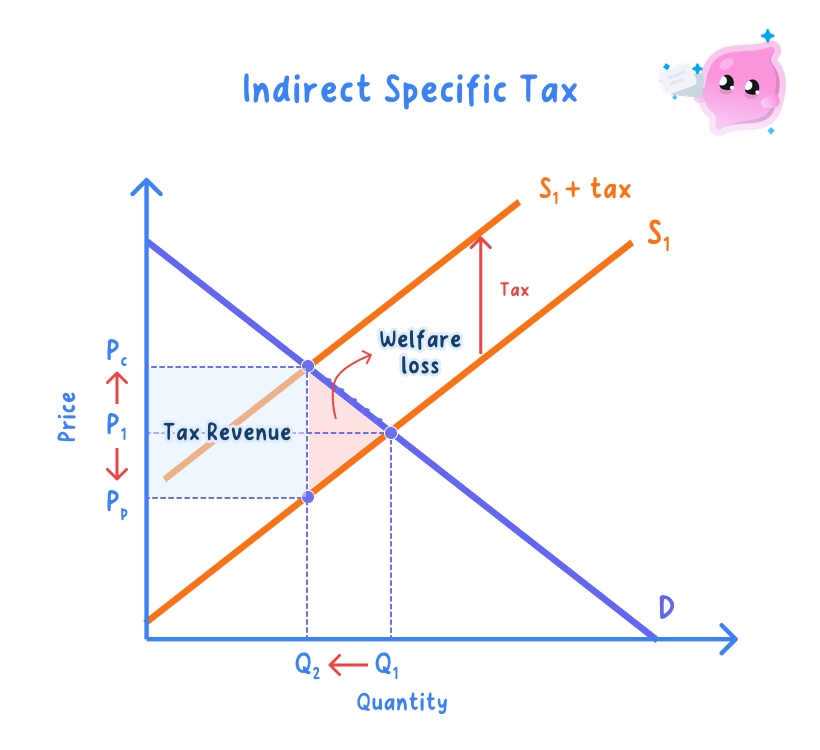
Indirect tax: a tax on spending that shifts the supply curve up vertically by the amount of the tax.
Specific tax: a set amount per unit, so supply shifts up by a constant vertical distance.
Ad valorem tax: a percentage of the price, such as VAT, so the vertical gap widens as price rises and the supply curve pivots.
- A wedge between two prices: the tax raises the price paid by consumers, lowers the price kept by producers and reduces the quantity traded, because sellers must now cover the tax as well as their costs.
- Government revenue equals the tax per unit × the quantity sold, shown as the rectangle between the two prices up to the new quantity.
- The UK sugar levy raises the price of sugary drinks to cut consumption; suppose the specific rate is £0.24 a litre and 500 million litres are still sold.
- The Treasury collects about £120 million, the tax rectangle; and because tobacco demand is inelastic, most tobacco duty is likewise passed on to smokers as a higher price.
Tax incidence
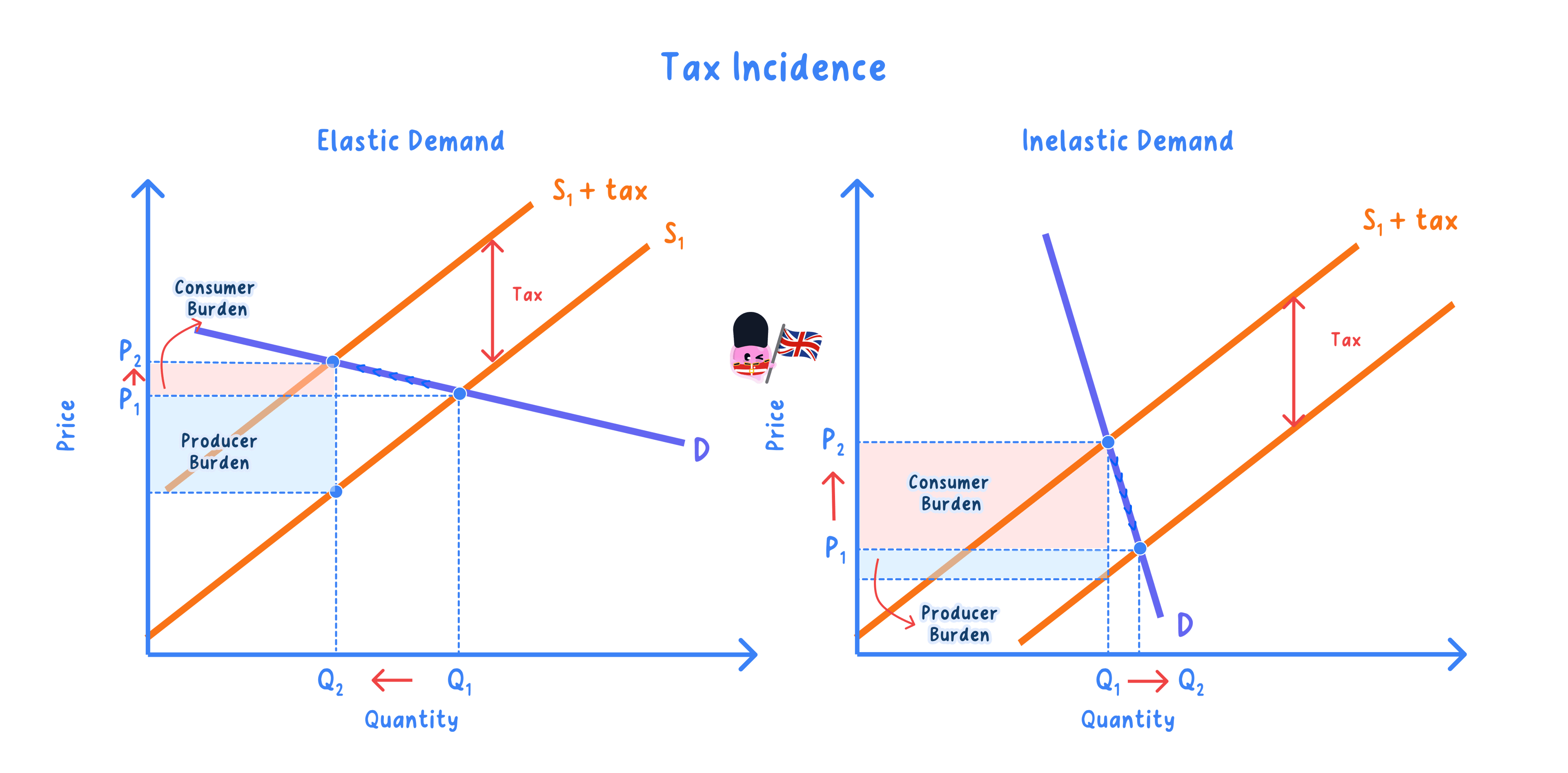
Incidence: how the burden of an indirect tax is split between consumers and producers.
- The inelastic side pays more: whichever side of the market is more price inelastic cannot escape the tax by changing quantity much, so it bears the larger share.
- With inelastic demand, such as tobacco, consumers pay most of the duty, whereas with inelastic supply producers pay most.
- On the diagram the consumer burden is the area between the old and new price, and the producer burden is the rest of the tax rectangle below the old price.
- Tax incidence is like splitting a bill, where whoever is least willing to walk away ends up paying more.
- If smokers will buy cigarettes almost whatever the price, they shoulder most of the duty.
Subsidies
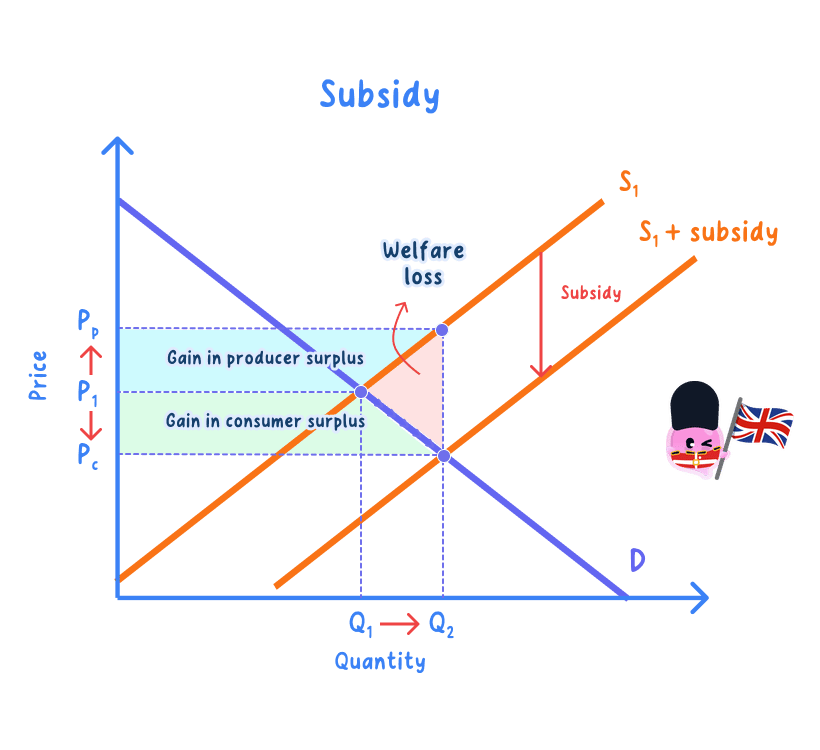
Subsidy: a payment to producers that shifts the supply curve down vertically by the amount of the subsidy.
- A subsidy mirrors a tax: it lowers the price consumers pay, raises the price producers receive and increases the quantity traded.
- Government cost equals the subsidy per unit × the new quantity, so a large take-up makes the policy expensive.
- A subsidy on bus travel lowers fares and raises passenger numbers, encouraging a good with positive externalities; suppose the subsidy is £0.50 a journey and 200 million journeys are now made.
- The government pays about £100 million, the subsidy on every extra journey, so a large take-up raises the cost to taxpayers.
Subsidy areas
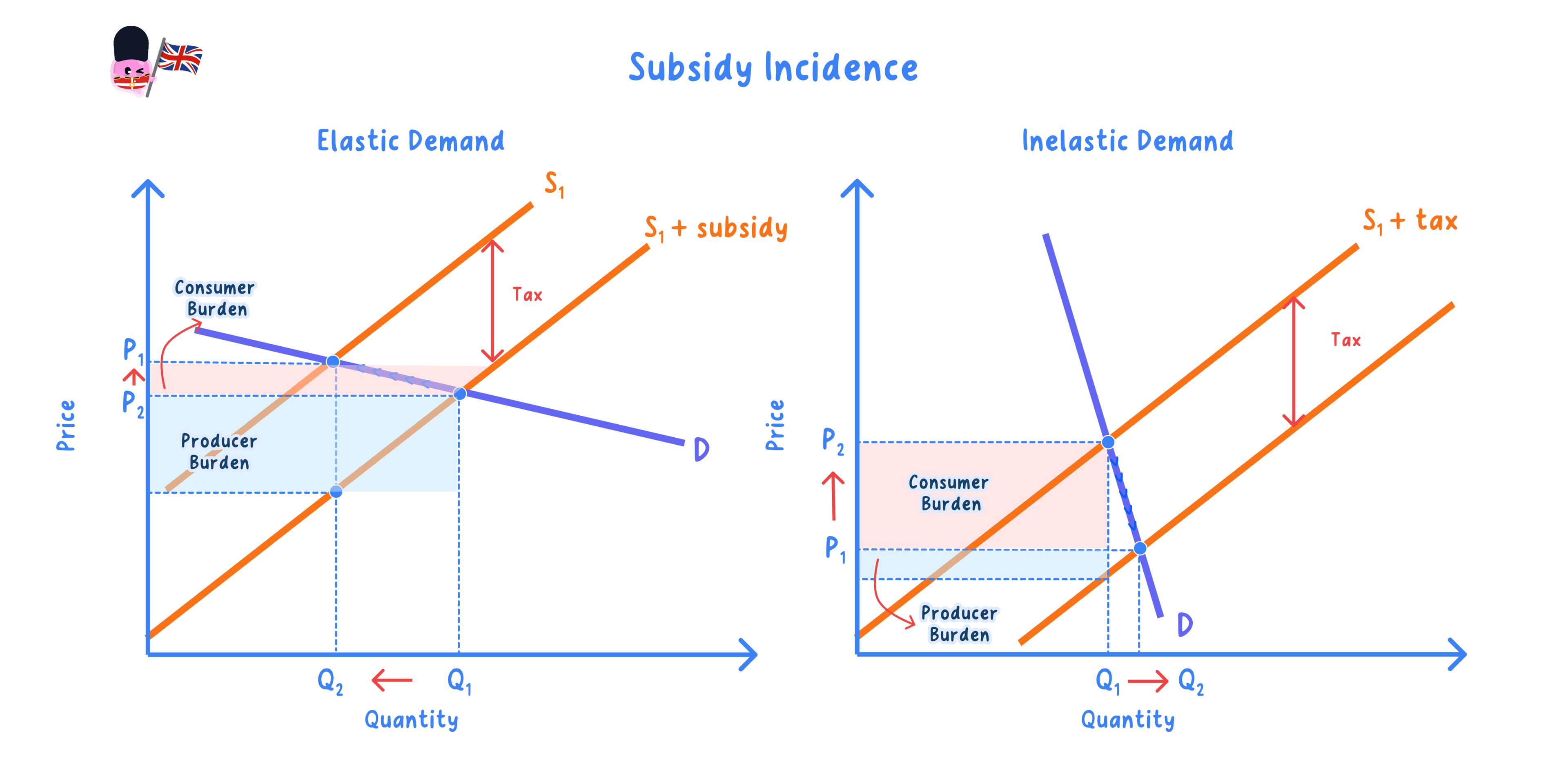
Consumer subsidy: the share of the subsidy consumers enjoy as a lower price, the area between the old and new consumer price up to the new quantity.
Producer subsidy: the share producers keep as a higher price received, the area between the old price and the higher price producers now get.
- The two areas make up the whole subsidy: together they form the total subsidy rectangle, and the more inelastic side keeps the larger share, mirroring tax incidence.
Do indirect taxes always achieve their aim?
- It holds because on goods with inelastic demand, such as tobacco and fuel, a tax raises substantial revenue and internalises external costs, nudging consumption towards the socially optimal level.
- But if demand is very inelastic the tax barely cuts quantity, so it works far better as a revenue-raiser than as a way to change behaviour.
- But indirect taxes are regressive and can push activity into black markets or cross-border shopping, undermining both fairness and the intended fall in consumption.
- On balance, whether an indirect tax works depends on the elasticity of demand and the aim: strong for revenue on inelastic goods, weaker for cutting consumption, and often needing complements such as information campaigns or regulation where the externality is large.
- Draw the tax as an upward supply shift and the subsidy as a downward shift, each by the vertical distance of the tax or subsidy.
- Mark government revenue or government cost as the rectangle at the new quantity.
- Assign the larger share of a tax or subsidy to the more inelastic side of the market.
- Do not split the incidence the wrong way: the more price inelastic side bears more of a tax and keeps more of a subsidy.
- Do not assume one side receives the whole subsidy, since it is shared between consumers and producers.
- Do not forget the government effect: a tax raises revenue while a subsidy is a cost to the taxpayer.
- How does an indirect tax shift the supply curve?
- What is government revenue from an indirect tax equal to?
- What determines the incidence of an indirect tax?
- Which areas show the consumer subsidy and the producer subsidy?
- Give one drawback of using a subsidy.
