Contestable Markets
Characteristics of contestability
Definition
Contestable market: a market disciplined by the threat of new entry rather than by the number of firms currently in it.
Sunk costs: costs already incurred that cannot be recovered if a firm leaves the market.
- Even a single firm may behave competitively if entry and exit are easy, because the incumbent fears that a high price would simply attract a rival.
- Perfect contestability requires freedom of entry and exit and, above all, no sunk costs, so a new firm risks nothing it cannot get back.
- Contestability is a spectrum, from perfectly contestable to completely blocked, and real markets sit somewhere in between.
How firms behave
Definition
Hit-and-run entry: a firm enters a market to capture short-run supernormal profit, then leaves before the incumbent can retaliate.
- The threat of entry disciplines incumbents: to avoid attracting rivals they keep prices and supernormal profit low, so it is the threat, not actual entry, that does the work.
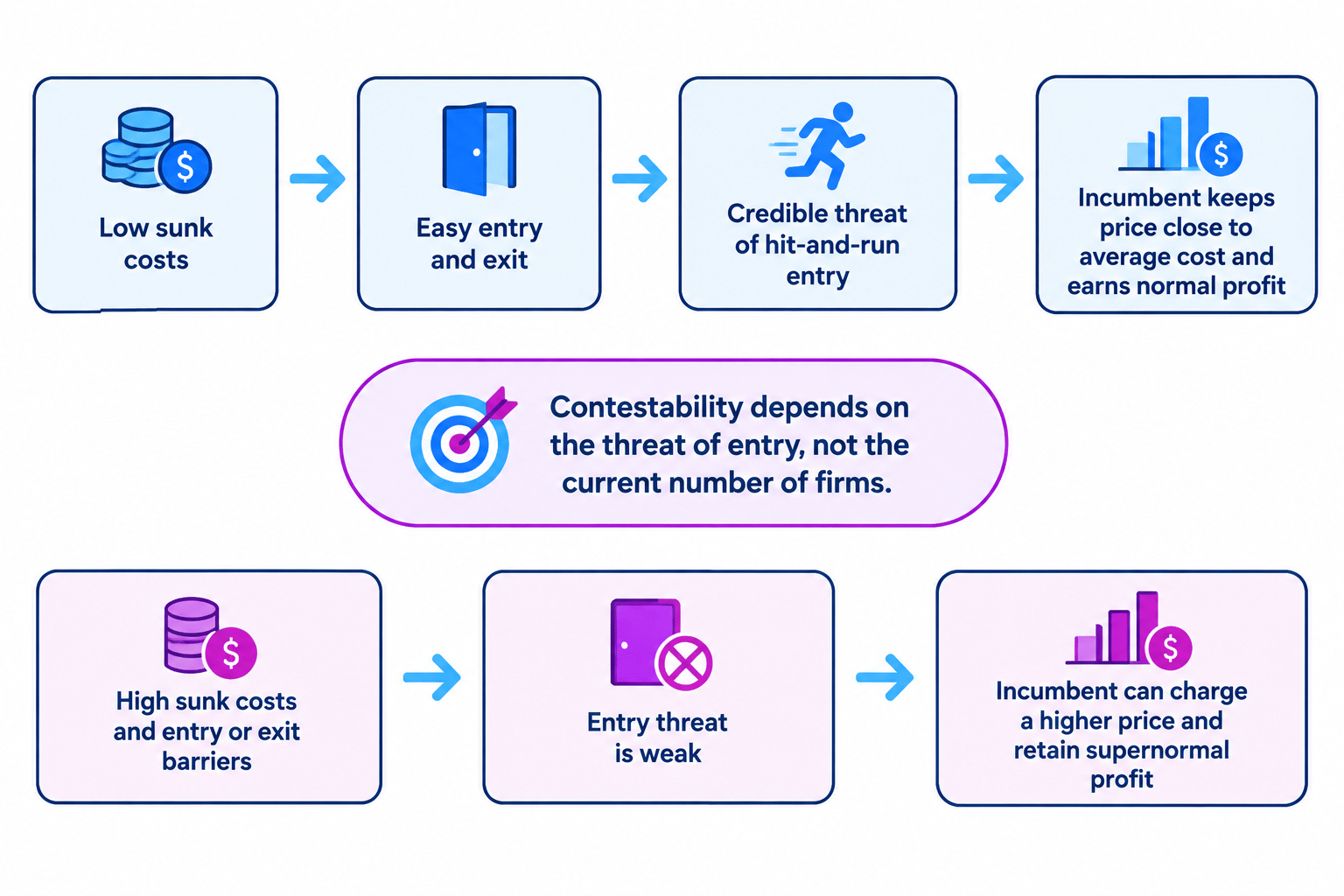
- That threat is credible only where a new firm could enter, profit and exit cheaply; where it is, the mere possibility pushes incumbents towards normal profit and lower prices.
- So a highly contestable market can be allocatively and productively efficient even with only one or a few firms, weakening the usual link between market structure and performance.
- Food delivery apps show this clearly: it is a low-sunk-cost market, since a new platform needs little more than software and a network of self-employed couriers to enter, and can withdraw cheaply if profit fades, so the mere threat of a rival app keeps established platforms from charging restaurants too much.
Barriers to entry and exit
Definition
Barriers to entry: obstacles that raise the cost or difficulty of joining a market.
Barriers to exit: obstacles, such as sunk costs and contractual or redundancy commitments, that make leaving a market costly.
- Entry can be blocked by legal barriers such as patents and licences, and by economies of scale that give large incumbents a cost advantage a small entrant cannot match.
- Strong brand loyalty, heavy advertising and control of key resources also deter entrants.
- Incumbents may deliberately use limit pricing or predatory pricing to make entry look unprofitable before a rival even tries.
- Barriers to exit deter entry too, because a firm that cannot leave cheaply will hesitate to enter in the first place.
Sunk costs and the degree of contestability
- Low sunk costs make hit-and-run entry credible, because a firm can recover almost all its outlay on leaving, so the market is highly contestable.
- High sunk costs weaken the threat of entry, since a would-be entrant risks losing money it cannot recoup, letting incumbents raise prices safely.
- So sunk costs, far more than the number of firms, are the key determinant of the degree of contestability.
Does contestability discipline incumbents?
- It holds where sunk costs are low: the credible threat of hit-and-run entry keeps prices near cost and profit near normal, even with only a few firms.
- It is reinforced in some digital markets, where a rival platform can scale fast and quick entry keeps dominant firms cautious about raising prices.
- But where sunk costs and other barriers are high the threat is not credible, so incumbents can charge more and keep supernormal profit; perfect contestability is an extreme rarely met in practice.
- On balance contestability disciplines firms only as far as sunk costs and barriers allow, which is why the CMA focuses on removing entry barriers rather than simply counting firms.
Exam technique
- Explain contestability through the threat of entry and the level of sunk costs, not firm numbers.
- Link low sunk costs to a credible threat, and that threat to normal profit and lower prices.
- Note that perfect contestability is an extreme rarely met in practice.
Common Mistake
- Do not equate contestability with the number of firms; it depends on the threat of entry and sunk costs.
- Do not assume the threat of entry always disciplines a firm, as high sunk costs and barriers can blunt it.
- Keep barriers to entry distinct from barriers to exit, though both reduce contestability.
Self review
- What disciplines firms in a contestable market?
- What is hit-and-run entry?
- Name three barriers to entry.
- Why do sunk costs matter so much?
- Why is perfect contestability rare?