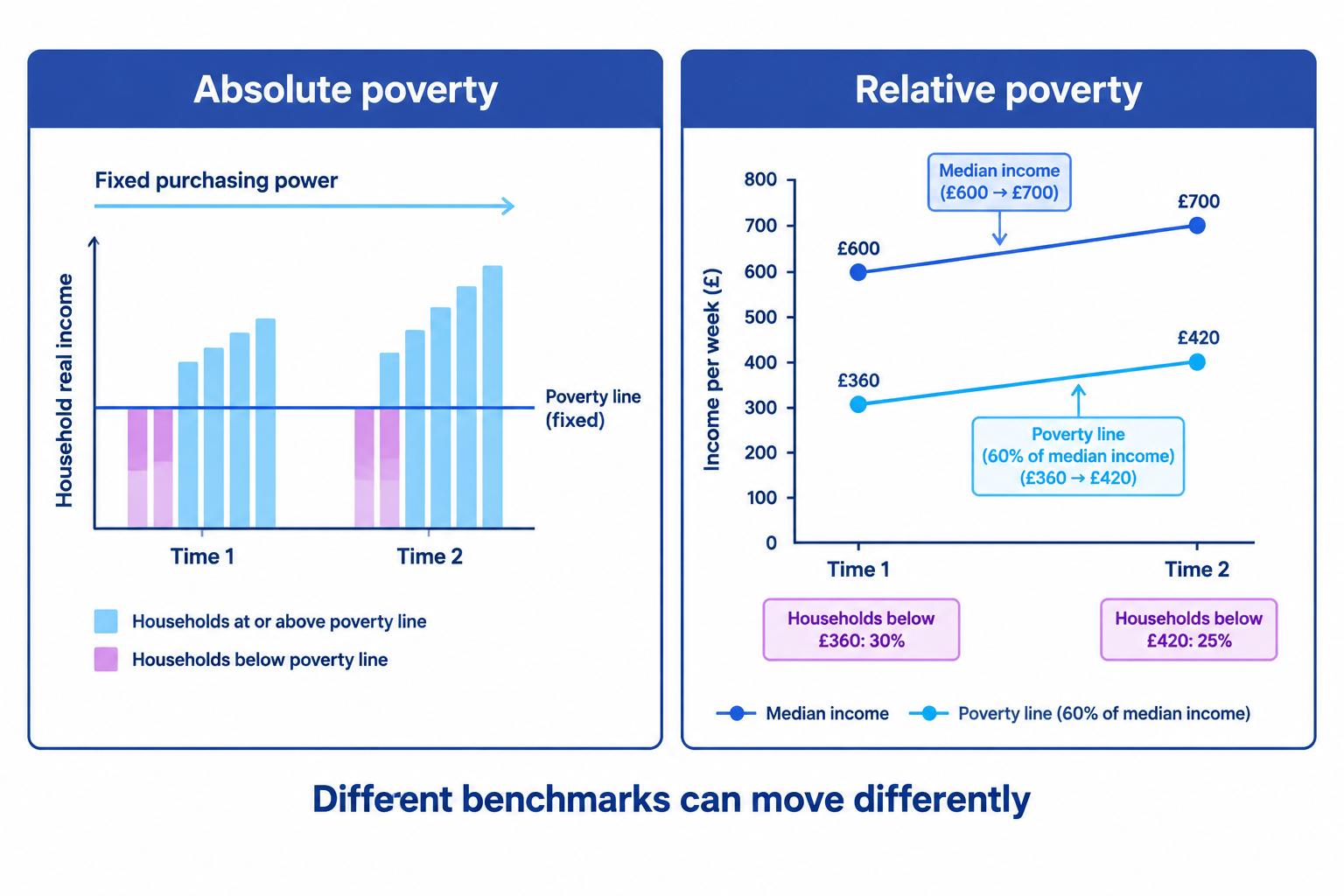
Measuring Poverty
Absolute poverty: being unable to afford the basic necessities needed to sustain life, such as food, clean water, shelter and warmth.
Relative poverty: having an income below a given proportion of the median, judged against the standard of living that is normal in a particular society.
- The two are judged against different benchmarks and can move in opposite directions, so it matters which one a figure refers to.
- Absolute poverty uses a fixed real line, so it falls as real incomes rise; relative poverty is tied to the median, so it can persist even in a rich economy.
Absolute Poverty
Fixed real poverty line: a poverty threshold set at a constant real purchasing power, so it does not shift as average incomes change.
World Bank international poverty line: the global benchmark for extreme poverty, currently living on less than US$2.15 a day at internationally comparable (PPP) prices.
- Because the line holds its real value, progress against absolute poverty reflects genuine gains in real income rather than shifting social standards.
- The World Bank line lets absolute poverty be compared across countries.
- Extreme poverty has fallen sharply in East Asia, above all China, but remains high across much of sub-Saharan Africa, in economies such as the Democratic Republic of the Congo.
Relative Poverty
Relative poverty line: a threshold set as a proportion of a society's median income, commonly 60% of the median in the UK, so it rises as the society grows richer.
- Formally, a household is in relative poverty when its income falls below the line: Relative poverty line=0.6×median income\text{Relative poverty line} = 0.6 \times \text{median income}Relative poverty line=0.6×median income
- Because it is tied to the median, relative poverty reflects the gap with the middle of society rather than bare survival.
- It can be measured before or after housing costs, and official statistics often report it both ways.
Suppose median household income in a country is 600 pounds a week. The 60% relative poverty line is:
Relative poverty line=0.6×600=360 \text{Relative poverty line} = 0.6 \times 600 = 360 Relative poverty line=0.6×600=360Any household with a weekly income below 360 pounds is counted as being in relative poverty. If the economy grows and the median rises to 700 pounds, the line rises to 420 pounds, so relative poverty can persist even as everyone becomes better off.
Causes of Changes in Poverty
- Changes in absolute poverty are driven mainly by economic growth and development.
- As real incomes rise across an economy, more people can afford basic necessities and cross the fixed poverty line.
- Changes in relative poverty depend mainly on how income is spread across society.
- Unemployment and low wage levels pull household incomes below the relative threshold.
- The tax and benefits system redistributes income and can raise or lower relative poverty.
- Changes in the age structure of the population, such as a growing share of pensioners, can change the number in relative poverty.
- Improved education and skills raise earning potential and can reduce relative poverty over time.
- A shift in the distribution of income alters how many households fall below the threshold, since relative poverty is set against the median.
Is relative or absolute poverty the better measure?
- Absolute poverty is better for tracking whether basic needs are met and for comparing across countries, so it shows real progress against deprivation.
- But it can appear near-eliminated in a rich economy while many are still shut out of a normal standard of living, which relative poverty captures.
- Relative poverty, however, is really a measure of inequality: it can stay high even as everyone grows richer, and can even fall in a recession when median income itself drops.
- On balance, the two measures answer different questions, so development analysis usually needs both rather than either alone.
- Always state whether you mean absolute or relative poverty, and quote the relevant measure, such as the World Bank line or 60 per cent of median income.
- When explaining causes, trace the chain from the cause to the change in income rather than just listing factors.
- Economic growth reduces absolute poverty, but relative poverty can persist even as living standards rise, because it is defined relative to the median.
- Do not confuse the two: absolute poverty is a fixed survival line, whereas relative poverty moves with median income.
- What is the difference between absolute and relative poverty?
- How does the World Bank measure absolute poverty?
- At what percentage of median income is relative poverty commonly set in the UK?
- Why can economic growth reduce absolute poverty but leave relative poverty unchanged?
- Name two causes of a change in relative poverty.