1.5.2a Profit maximisation and the MC=MR rule
Firms Maximise Profit Where Marginal Cost Equals Marginal Revenue
Definition
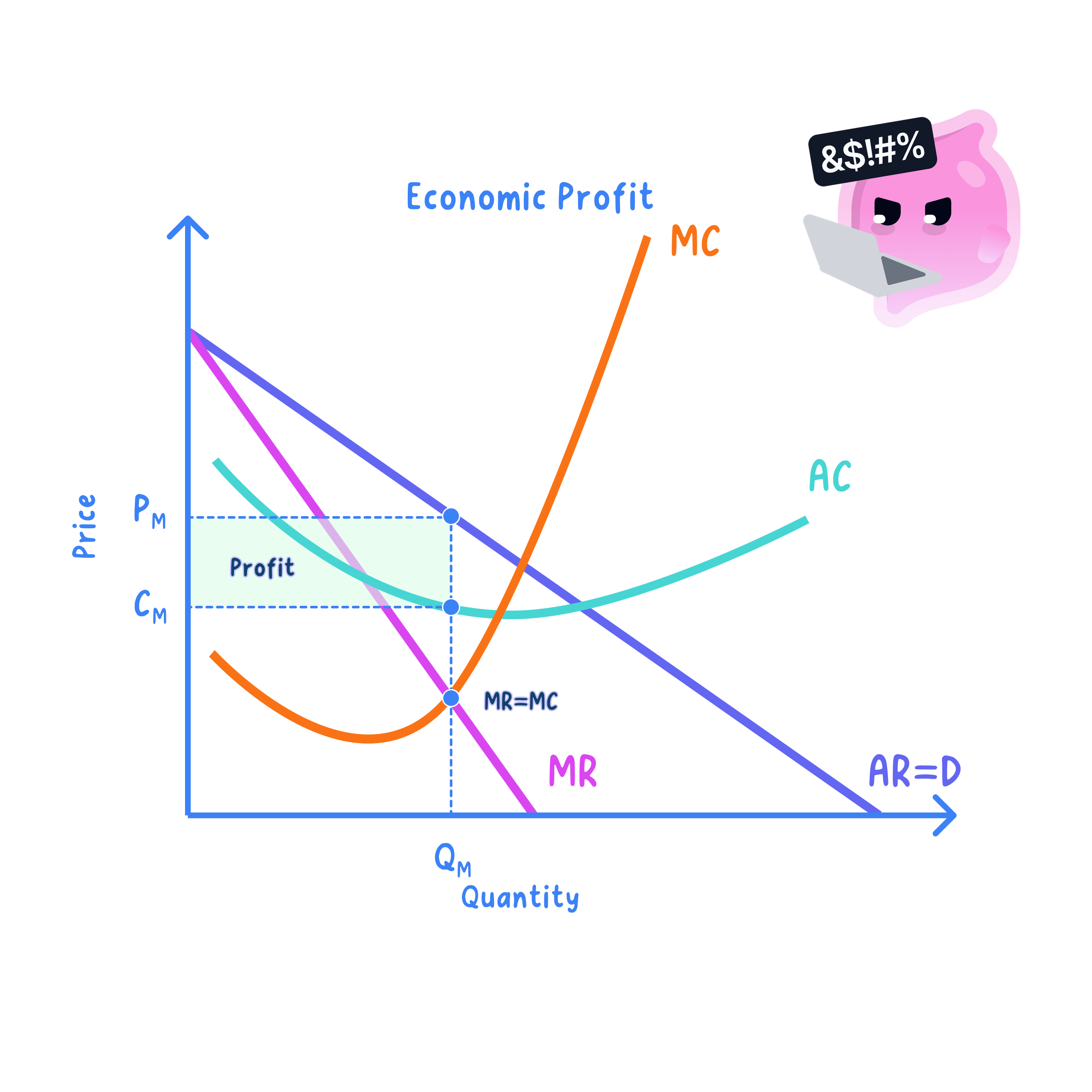
Profit maximisation: producing at the level of output where marginal cost equals marginal revenue (MC=MR\text{MC} = \text{MR}MC=MR), which gives the firm the greatest possible total profit.
- The traditional theory of the firm assumes firms maximise profit.
- Profit is greatest where marginal cost equals marginal revenue.
- Marginal cost must be rising through marginal revenue at that point.
Note
- Below MC=MR\text{MC} = \text{MR}MC=MR, one more unit adds more to revenue than to cost, so produce it.
- Above MC=MR\text{MC} = \text{MR}MC=MR, the last unit costs more than it earns, so cut back.
Find the Output Where Rising MC Cuts MR, Then Read Price off the AR Curve
- Find the output where MC cuts MR from below.
- Read the price up to the demand (AR) curve at that output.
- Check that marginal cost is rising, not falling, at the crossing.
Example
- Suppose marginal revenue for units 1 to 5 is £11\pounds 11£11, £9\pounds 9£9, £7\pounds 7£7, £5\pounds 5£5, £3\pounds 3£3 and marginal cost is £8\pounds 8£8, £6\pounds 6£6, £5\pounds 5£5, £5\pounds 5£5, £7\pounds 7£7.
- Each of the first four units adds more to revenue than to cost (MR>MC\text{MR} > \text{MC}MR>MC), so producing them raises profit.
- At the 4th unit MR=MC\text{MR} = \text{MC}MR=MC at £5\pounds 5£5; a 5th unit would cost £7\pounds 7£7 to earn only £3\pounds 3£3, cutting profit, so profit is maximised at 4 units.
- Marginal cost is rising through marginal revenue there (£5\pounds 5£5 then £7\pounds 7£7), which confirms this is the profit-maximising output and not a loss-maximising one.
In the Short Run a Loss-Making Firm Produces Only If Price Covers Average Variable Cost
- Even at MC=MR\text{MC} = \text{MR}MC=MR, a firm may be making a loss.
- In the short run it keeps producing only if price covers average variable cost.
- If price falls below average variable cost, it shuts down.
State MC Equals MR and Confirm Marginal Cost Is Rising Through MR
Exam technique
- State MC=MR\text{MC} = \text{MR}MC=MR and that marginal cost must be rising through MR.
- Do not confuse the profit-maximising rule with break-even.
Common Mistake
- Do not state MC=MR\text{MC} = \text{MR}MC=MR without checking that marginal cost is rising.
- MC=MR\text{MC} = \text{MR}MC=MR is the profit-maximising rule, not the break-even point.
Self review
- State the profit-maximising rule.
- Why must marginal cost be rising through MR?
- How do you find the price on the diagram?
- When does a firm shut down in the short run?
- If MR\text{MR}MR is 12,10,8,6,412, 10, 8, 6, 412,10,8,6,4 and MC\text{MC}MC is 7,6,6,8,107, 6, 6, 8, 107,6,6,8,10 for units 1 to 5, find the profit-maximising output.
1.5.2b Divorce of ownership and alternative objectives
As Firms Grow, Ownership Becomes Divorced from Control
Definition
Divorce of ownership and control: the separation in many large firms of the owners (shareholders) from the managers who control day-to-day decisions, which can lead to conflicting objectives.
- Some firms stay small while others grow through organic or external growth.
- In large firms, ownership is often divorced from control.
- Owners (principals) rely on managers (agents) to run the firm.
Note
- The principal-agent problem arises when managers pursue their own aims.
- It rests on asymmetric information, since managers know more than owners.
The Principal-Agent Problem Lets Managers Pursue Their Own Aims
- Owners want maximum profit and returns.
- Managers may prefer growth, status or an easier life.
- Because owners cannot fully monitor managers, these aims can diverge.
Example
- Shareholders want dividends, but managers may chase empire-building takeovers.
- Owners cannot see every decision, so managers have room to pursue their own goals.
The Divorce of Ownership Opens the Door to Non-Profit Objectives
- The divorce of ownership from control opens the door to non-profit aims.
- Managers may target sales, growth or their own utility instead.
- This is the root of the alternative objectives firms pursue.
Tie the Principal-Agent Problem to Asymmetric Information
Exam technique
- Tie the principal-agent problem to asymmetric information.
- Show how conflicting objectives follow from owners being unable to monitor managers.
Common Mistake
- Do not describe the principal-agent problem without asymmetric information.
- The gap between owners and managers depends on conflicting objectives and imperfect monitoring.
Firms May Pursue Objectives Other than Maximum Profit
- Firms may pursue objectives other than maximum profit.
- These include profit satisficing, revenue maximisation and sales maximisation.
- Others include growth, market share, managerial utility and social goals.
Note
- Revenue maximisation is where marginal revenue equals zero.
- Sales-volume maximisation is the largest output that still earns at least normal profit.
Satisficing, Revenue and Sales Maximisation Are the Main Alternatives
- Satisficing: Managers aim for good-enough profit to satisfy a range of stakeholders (Simon).
- Revenue and sales maximisation: Revenue maximisation sets MR=0\text{MR} = 0MR=0, while sales maximisation pushes output to the break-even limit.
- Growth and social goals: Firms may chase market share, size or ethical and environmental aims.
Example
- A supermarket may cut prices to maximise sales volume and market share, accepting thinner margins now to squeeze out rivals.
- A fast-growing tech firm may run at low or no profit for years, prioritising growth in users over immediate returns.
- A firm may satisfice, keeping shareholders content without squeezing every last pound, which can also protect its reputation with workers and customers and so serve owners in the long run.
Each Objective Sits at a Different Output on the Diagram
- Profit maximisation sits at MC=MR\text{MC} = \text{MR}MC=MR.
- Revenue maximisation sits further right, where MR=0\text{MR} = 0MR=0.
- Sales-volume maximisation sits further right still, where AR=AC\text{AR} = \text{AC}AR=AC.
Do Firms Really Abandon Profit Maximisation?
- The divorce of ownership from control does give managers room to pursue growth, sales or an easier life rather than maximum profit for owners.
- But incentives such as performance-related pay and share options can realign managers with shareholders, pulling behaviour back towards profit.
- The threat of takeover also disciplines managers, since a firm making low profit becomes a cheap target for a more profit-focused buyer.
- Many apparently non-profit objectives serve profit in the long run anyway, since satisficing protects reputation while sales or growth build future market power.
- So whether a firm truly departs from profit maximisation depends on how tightly owners can monitor and incentivise managers, and on the time horizon over which profit is judged.
Separate Revenue Maximisation from Sales-Volume Maximisation
Exam technique
- Place revenue maximisation at MR=0\text{MR} = 0MR=0.
- Place sales-volume maximisation at the output where the firm just earns normal profit.
Common Mistake
- Do not confuse revenue maximisation with sales-volume maximisation.
- Revenue maximisation is MR=0\text{MR} = 0MR=0, while sales-volume maximisation is the largest output earning at least normal profit.
Self review
- What is the divorce of ownership from control, and why does it arise?
- Who are the principal and the agent, and why does asymmetric information matter?
- Name four objectives firms may pursue instead of maximum profit.
- What is profit satisficing?
- Where do revenue and sales-volume maximisation sit on the diagram?
