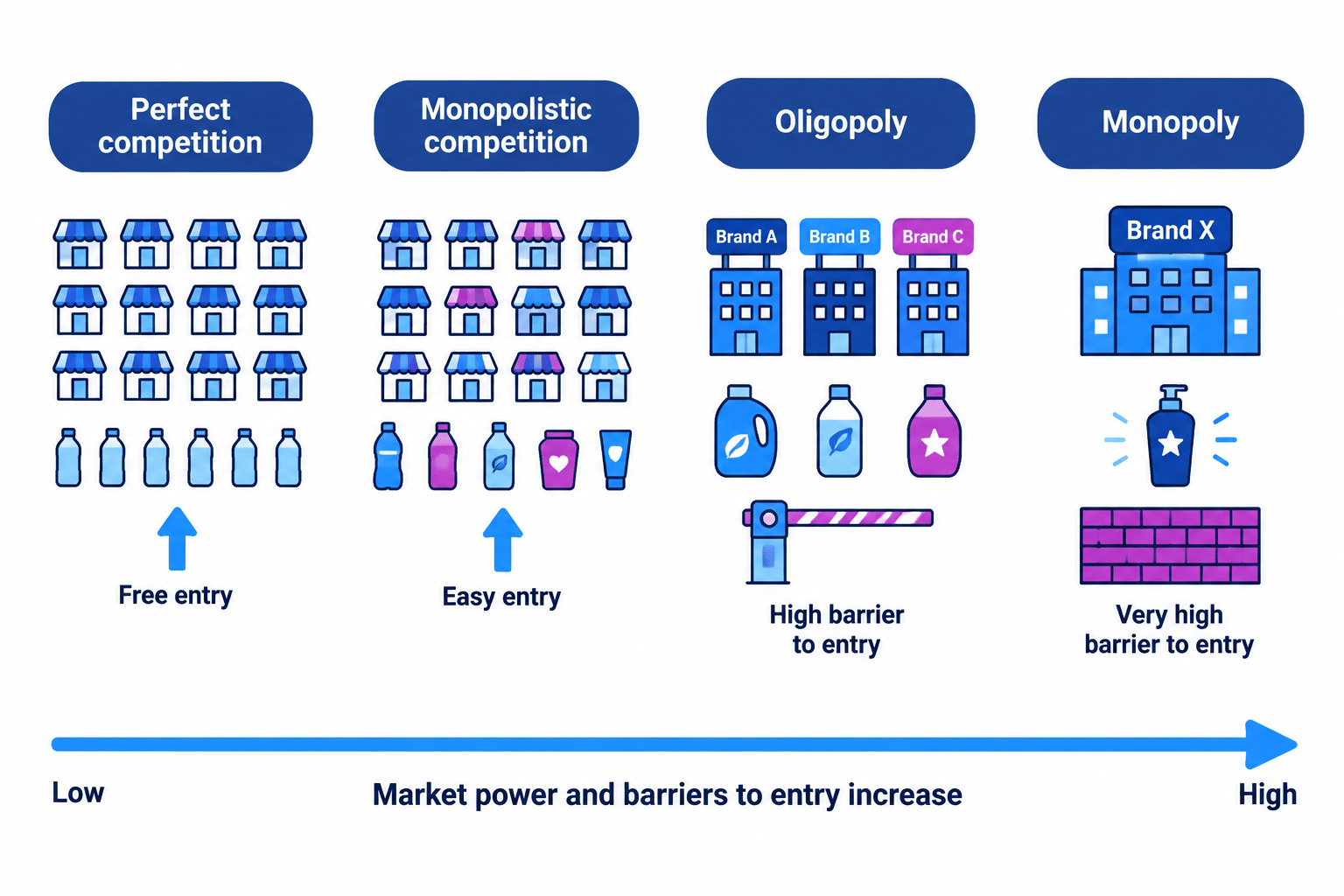
Competition Runs on a Spectrum from Perfect Competition to Pure Monopoly
Definition
Market structure: the characteristics of a market, such as the number of firms, the degree of product differentiation and the ease of entry, that shape the behaviour and performance of firms within it.
- Market structures run from perfect competition to pure monopoly.
- Monopolistic competition and oligopoly sit in between.
- Structure shapes how firms behave and how efficient the outcome is.
Note
- Structure is set by more than just the number of firms.
- Product differentiation, barriers to entry and information all matter too.
Number of Firms, Product Differentiation and Ease of Entry Distinguish Structures
- The number and size of firms in the market.
- The degree of product differentiation.
- The ease of entry and exit, and the availability of information.
The Four Structures Compared
- Perfect competition
- Very many small firms selling identical products, with free entry and exit; each firm is a price-taker.
- Monopolistic competition
- Many firms selling slightly differentiated products with easy entry, giving each a little price-setting power.
- Oligopoly
- A few large interdependent firms behind high barriers to entry, selling branded or similar products.
- Monopoly
- One dominant firm with a unique product and very high barriers to entry; it is a price-maker.
Example
- Farming sits near perfect competition, with many small firms selling near-identical produce.
- Independent restaurants are monopolistically competitive, and UK supermarkets are a classic oligopoly of a few large chains.
- Rail travel on a single route can be close to monopoly, with one operator and no substitute.
A Market's Place on the Spectrum Predicts How Firms Behave
- Where firms are many and products identical, price-taking follows.
- Where entry is hard, firms gain power to set prices.
- So placing a market on the spectrum predicts firm conduct.
Judge Structure on Several Criteria, Not Firm Numbers Alone
Exam technique
- Judge structure on firms, differentiation, entry and information.
- Place the market on the spectrum before predicting behaviour.
Common Mistake
- Do not treat the number of firms as the only criterion.
- Barriers to entry and product differentiation matter just as much.
Self review
- Name the four main market structures.
- What distinguishes one structure from another?
- Why is the number of firms not enough on its own?
- How does structure link to firm behaviour?