1.8.2a Meaning and types of market failure
Market Failure Is a Misallocation of Resources by the Free Market
Definition
Market failure: a situation in which the free market, left to itself, leads to a misallocation of resources, so that too much or too little of a good is produced relative to the socially optimal level.
- Market failure is when the free market misallocates resources.
- Too much or too little of a good is produced and consumed.
- The outcome differs from the socially optimal level.
- It can be complete or partial.
Note
- Market failure is a misallocation of resources by the free market.
- It means over-provision or under-provision relative to the social optimum.
- It can be complete or partial.
Market Failure Can Be Complete or Partial
- Complete market failure means a market is missing entirely.
- No market exists to provide the good.
- Partial market failure means a market exists but allocates badly.
- Resources are still misallocated in both cases.
Example
- A pure public good may have no market at all.
- That is complete market failure.
- A polluting factory shows partial failure, since the market exists but over-produces.
Several Distinct Sources Cause Market Failure
- Externalities and public goods are key sources.
- Merit and demerit goods and information failure are others.
- Monopoly power and factor immobility also cause failure.
- Inequality in the distribution of income and wealth is sometimes included as well.
Example
- Pollution is an externality that markets ignore.
- Street lighting is a public good markets underprovide.
- So each source leads to its own misallocation.
Reading the Market Failure Diagram
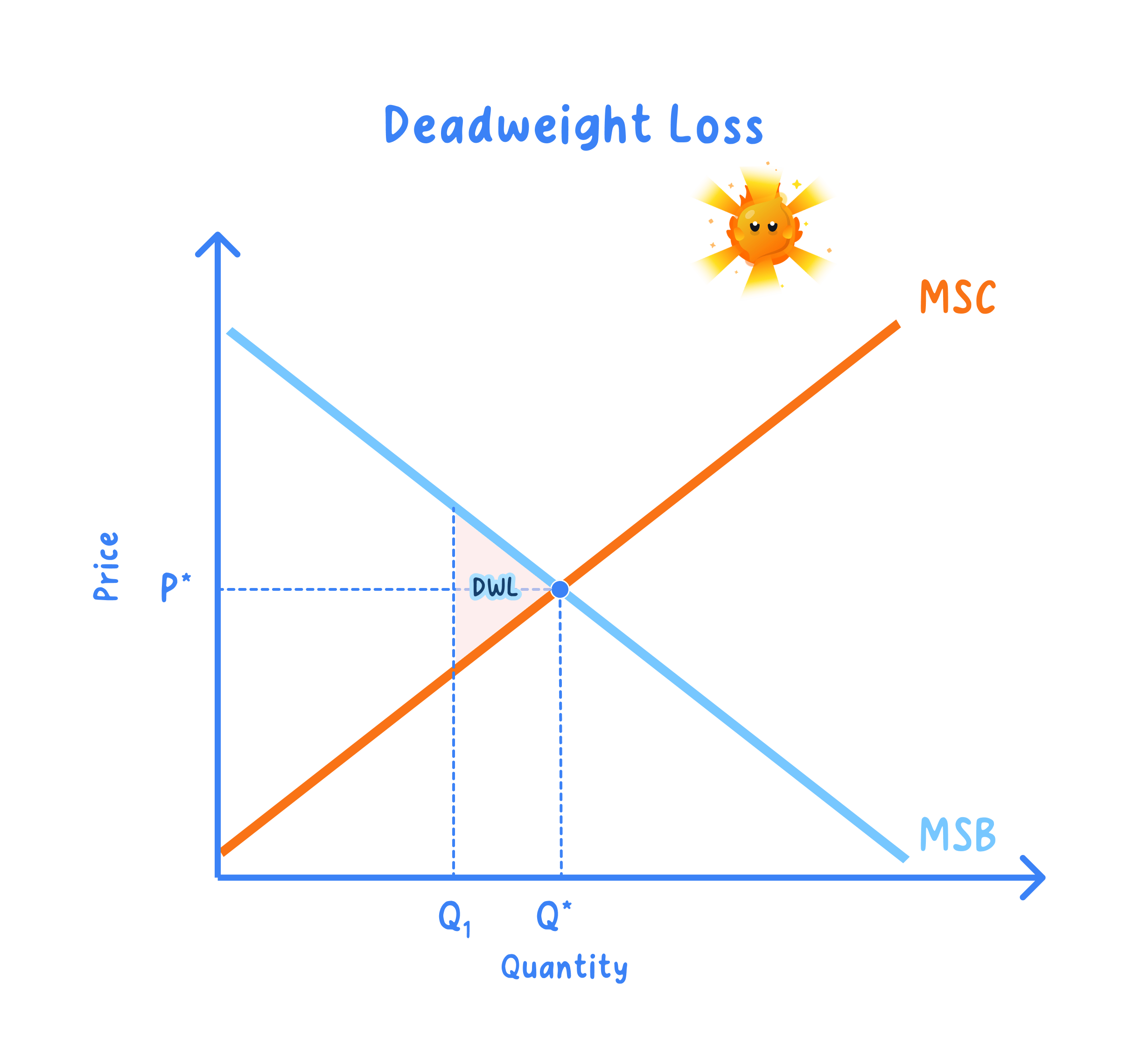
- The vertical axis shows price, and the horizontal axis shows the quantity of the good.
- Marginal social cost (MSC) is the upward-sloping curve, showing the rising cost to society of producing each extra unit.
- Marginal social benefit (MSB) is the downward-sloping curve, showing the falling benefit to society from each extra unit consumed.
- The social optimum is where MSC = MSB, at quantity Q∗Q^*Q∗ and price P∗P^*P∗, because every unit whose social benefit is at least its social cost is produced and no more.
- Here the market produces only Q1Q_1Q1, which lies to the left of Q∗Q^*Q∗, so the good is under-produced relative to the social optimum.
- The shaded triangle between the MSB and MSC curves over the range Q1Q_1Q1 to Q∗Q^*Q∗ is the deadweight welfare loss (DWL), the net benefit society loses because output stops short of the optimum, since on those units MSB is greater than MSC.
Example
- Suppose the social optimum is Q∗Q^*Q∗ but the market produces Q1Q_1Q1, which is 10,00010{,}00010,000 units below it.
- At Q1Q_1Q1 the marginal social benefit exceeds the marginal social cost by £4\pounds 4£4 per unit.
- Using the area of a triangle, the deadweight welfare loss is about 0.5×£4×10,000 units=£20,0000.5 \times \pounds 4 \times 10{,}000 \text{ units} = \pounds 20{,}0000.5×£4×10,000 units=£20,000.
- This £20,000\pounds 20{,}000£20,000 is the value of the net benefit society loses by under-producing the good.
UK Application: Under-Provision of Vaccination
- Vaccination creates a positive externality, since one person being immunised also lowers the risk of infection for everyone around them.
- Because individuals ignore this wider social benefit, the marginal social benefit lies above their private benefit, so a free market would under-provide vaccination at Q1Q_1Q1.
- This is partial market failure, since a market for vaccines exists but produces less than the socially optimal quantity Q∗Q^*Q∗, which is why the NHS provides many vaccines free.
Market Failure Means Genuine Inefficiency, Not Any Disliked Outcome
- Market failure means genuine inefficiency.
- It is not just any outcome a person dislikes.
- It provides the case for possible government action.
- So the term must be used precisely.
Define Market Failure, Then Distinguish Complete From Partial
Exam technique
- Define market failure as a misallocation of resources.
- Distinguish complete from partial failure.
- List the main sources before studying each.
Common Mistake
- Do not call any outcome you dislike a market failure.
- Reserve the term for genuine inefficiency.
Self review
- What is market failure?
- What is complete market failure?
- What is partial market failure?
- Name four sources of market failure.
- Why must the term be used precisely?
- On the market failure diagram, where does the deadweight welfare loss triangle sit, and what does it represent?
1.8.2b Causes of market failure
Inequality: When the Market Distributes by Ownership
Definition
Market failure: a situation in which the free market, left to itself, leads to a misallocation of resources, so that too much or too little of a good is produced relative to the socially optimal level.
- The unregulated market shares income by the ownership of factors.
- This can give a very unequal, arguably inequitable outcome.
- It is often treated as a market failure, since the ability to consume depends on income, not need.
- This section focuses on inequality in the distribution of income and wealth; the other causes of market failure, namely public goods, externalities, merit and demerit goods, and monopoly and other market imperfections, are covered in sections 1.8.3 to 1.8.6.
Note
- Equality means a similar distribution, while equity means a fair one.
- Judging what is fair involves a value judgement.
Inequality Sends Resources Toward Ability to Pay, Not Need
- Scarce goods flow to those who can pay, not to those who need them most.
- That can misallocate resources away from basic needs.
- It builds the case for redistribution through tax and benefits.
Example
- Essential care may be under-consumed by low-income households.
- Luxury goods are produced while some basic needs go unmet.
Worked Example: Ability to Pay Versus Need
- Suppose a course of private medical treatment costs £10,000\pounds 10{,}000£10,000.
- For a household earning £15,000\pounds 15{,}000£15,000 a year, this represents about 67%67\%67% of their annual income, an amount most could not afford without government support.
- For a household earning £150,000\pounds 150{,}000£150,000 a year, the same treatment is only about 7%7\%7% of income, easily affordable.
Example
- Both households may have an identical medical need, but a pure free market would allocate the treatment to the household that can pay, not the one that needs it most.
- This is one reason healthcare in the UK is largely provided by the NHS free at the point of use, rather than left purely to market forces.
UK Application: Evidence of Resources Not Reaching Need
- The Trussell Trust, a UK food bank charity, distributes several million emergency food parcels a year, evidence that some households cannot afford basic necessities even while food is plentiful and available in the market.
- The UK's income Gini coefficient of around 0.350.350.35 shows a persistent gap between the top and bottom of the income distribution, reinforcing the case that the market alone does not allocate all goods according to need.
Whether Inequality Is a Failure Depends on a View of Fairness
- Whether inequality is a failure rests partly on a view of fairness.
- Some inequality can reward effort and encourage enterprise.
- On balance, extreme inequality is widely seen as a failure worth addressing.
Separate Equality From Equity and Flag Value Judgements
Exam technique
- Define equality and equity separately, then say which you mean.
- Flag clearly where a value judgement is involved.
Common Mistake
- Do not treat inequality and inequity as identical.
- Equality is about the spread, while equity is about fairness.
Self review
- Why is inequality treated as a market failure?
- Distinguish equality from equity.
- Why does judging fairness involve value judgements?
- Give an example of inequality misallocating resources.
- Using the £10,000\pounds 10{,}000£10,000 treatment example, explain why the market allocates by ability to pay rather than need.
