The Price Mechanism Allocates Resources With No Central Planner
Definition
Price mechanism: the system by which changes in relative prices perform the rationing, incentive and signalling functions that allocate scarce resources in a market economy.
- In a market economy, the price mechanism allocates scarce resources with no central planner.
- It works through three functions of prices: rationing, incentive and signalling.
- Together these coordinate the decisions of millions of buyers and sellers.
Note
- Prices carry information and motivation at the same time.
- Through three functions they help answer what, how and for whom to produce.
Prices Perform Three Functions: Rationing, Incentive and Signalling
- Rationing
- When a good is scarce, a higher price rations it to those willing and able to pay.
- Incentive
- A higher price encourages producers to supply more and consumers to economise.
- Signalling
- Price changes signal where resources should flow, into rising markets and out of falling ones.
Note
- Profit is central: firms move resources towards goods where prices and profits are high.
- For example, when demand for electric cars rises, the higher price signals and rewards firms to expand output.
- The mechanism works at local, national and global levels at once.
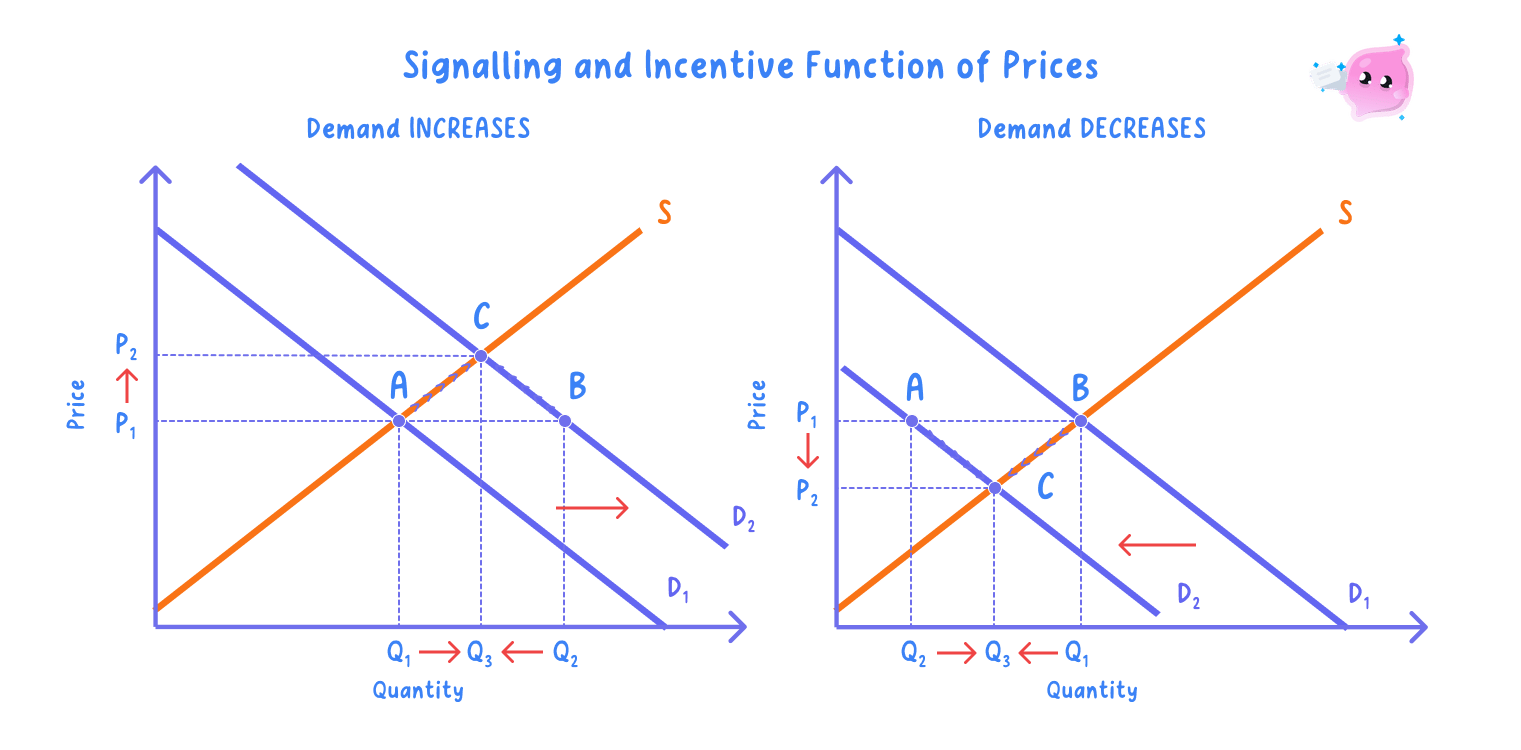
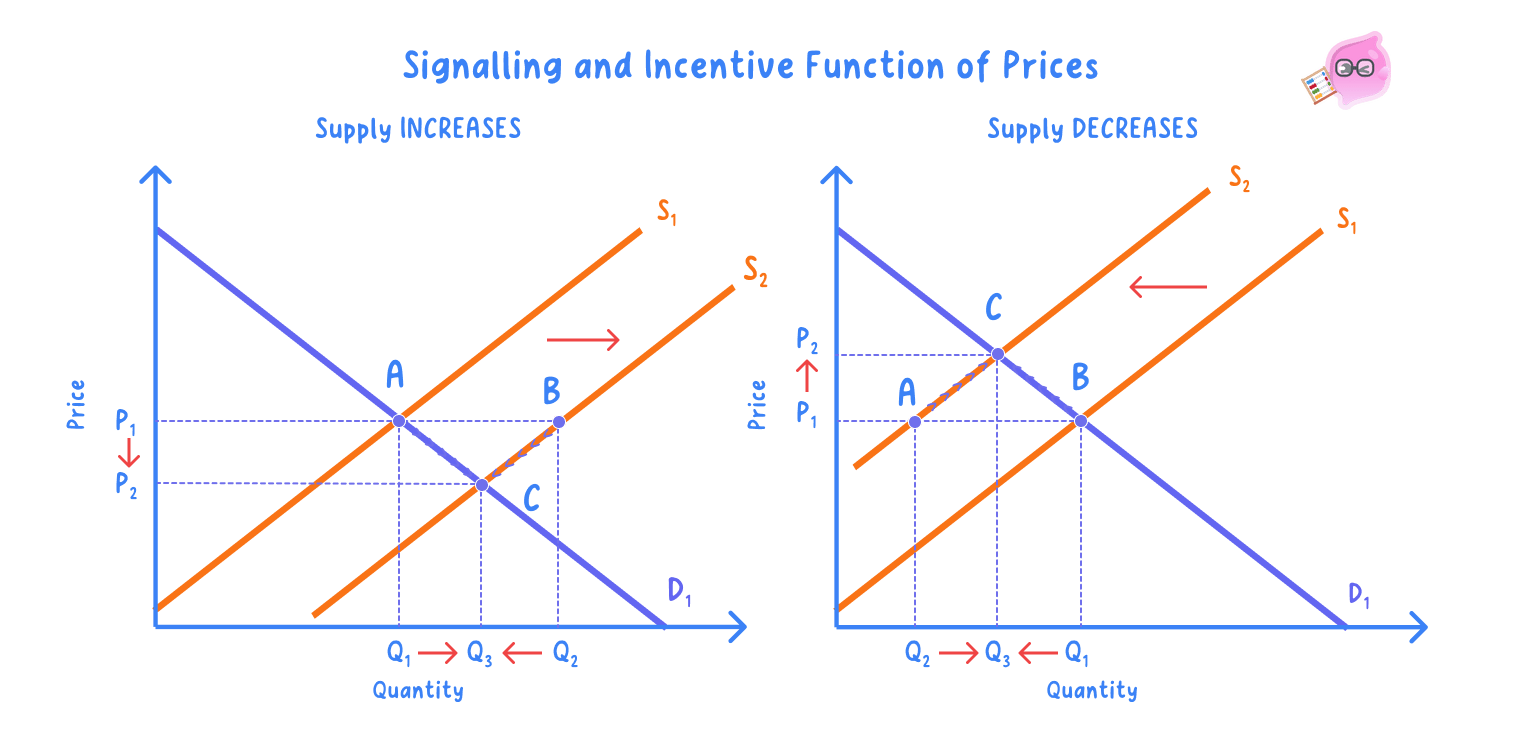
The Three Functions Work Together to Clear a Market
- A rise in demand pushes up the price, which rations the good and signals a shortage.
- The higher price and profit give producers an incentive to supply more.
- Resources are drawn in until the market clears, all without anyone directing it.
Worked Example: Prices Rationing a Shortage
- Global demand for computer chips rises unexpectedly.
- At the original price of £10\pounds 10£10 per unit, quantity demanded is 120120120 million units but quantity supplied is only 100100100 million, a shortage of 202020 million units.
- The price rises to £15\pounds 15£15 per unit.
- At this higher price, quantity demanded falls to 105105105 million as some buyers are rationed out, while quantity supplied rises to 105105105 million as producers respond to the incentive of higher profit.
- The market clears at the new equilibrium of £15\pounds 15£15 and 105105105 million units.
Example
- The price rise from £10\pounds 10£10 to £15\pounds 15£15 has simultaneously rationed demand (fewer buyers can afford chips), incentivised supply (producers earn more profit per unit) and signalled to other producers that this market is profitable to enter.
- This single worked example shows all three functions of price operating together to clear the shortage.
The Price Mechanism Is Efficient but Not Always Equitable
- It is efficient and responsive, coordinating vast numbers of decisions automatically.
- But it can fail, for example with public goods, externalities or missing markets.
- It allocates by ability to pay, which may be efficient but not equitable.
- So the price mechanism is powerful but not flawless, which is why some state role usually remains.
Extending Pricing to New Areas Can Ration Scarce Resources but Raises Equity and Valuation Problems
- The price mechanism can be extended into new areas, such as charging for road space through congestion charging, pricing carbon emissions, or attaching prices to provision that was previously free.
- The advantage is that a price rations a scarce resource, signals its true value and gives users an incentive to cut wasteful overuse, so resources flow to their most valued uses.
- The disadvantages are that charging raises equity concerns, since a flat charge hits poorer users hardest, and that placing an accurate value on things like clean air or road space is difficult.
- Pricing can also fail where public-good characteristics or strong externalities are present, so prices alone may not capture the full social costs and benefits.
Note
- For example, a congestion charge prices scarce road space and cuts overuse, but critics argue it can be regressive for lower-income drivers.
- Extending pricing therefore involves a trade-off between the efficiency gains from rationing and the equity and valuation problems it creates.
UK Application: Pricing Road Space and Carbon
- London's Congestion Charge is currently £15\pounds 15£15 a day for driving within the zone during charging hours, rationing scarce road space and cutting traffic volumes.
- The UK Emissions Trading Scheme puts a price on each tonne of carbon dioxide emitted by covered industries, giving firms a financial incentive to cut emissions or invest in cleaner technology.
- Both schemes illustrate extending the price mechanism into areas that were previously unpriced or provided free at the point of use.
Case study
- A delivery driver who pays the Congestion Charge daily has a strong incentive to switch to an electric van, since zero-emission vehicles can qualify for a discount.
- A factory facing the carbon price has an incentive to cut emissions if doing so costs less than paying for each tonne emitted.
Always Name and Apply All Three Functions
Exam technique
- Always identify rationing, incentive and signalling by name.
- Trace a demand or supply change through all three functions to the new equilibrium.
- Evaluate with the limits of the mechanism, such as market failure and equity.
Common Mistake
- Do not list only one or two functions of prices.
- The three are rationing, incentive and signalling, and examiners expect all three.
- Do not assume the price mechanism always allocates fairly.
- It allocates by ability to pay, which can leave essentials out of reach for the poorest.
Self review
- Name the three functions of prices.
- Explain the rationing function.
- Explain the signalling function.
- What role does profit play in the price mechanism?
- Give one limitation of the price mechanism.
- Give one advantage and one disadvantage of extending the price mechanism into a new area of activity.
- Using the computer chip example, explain how a single price rise can ration, incentivise and signal at the same time.
