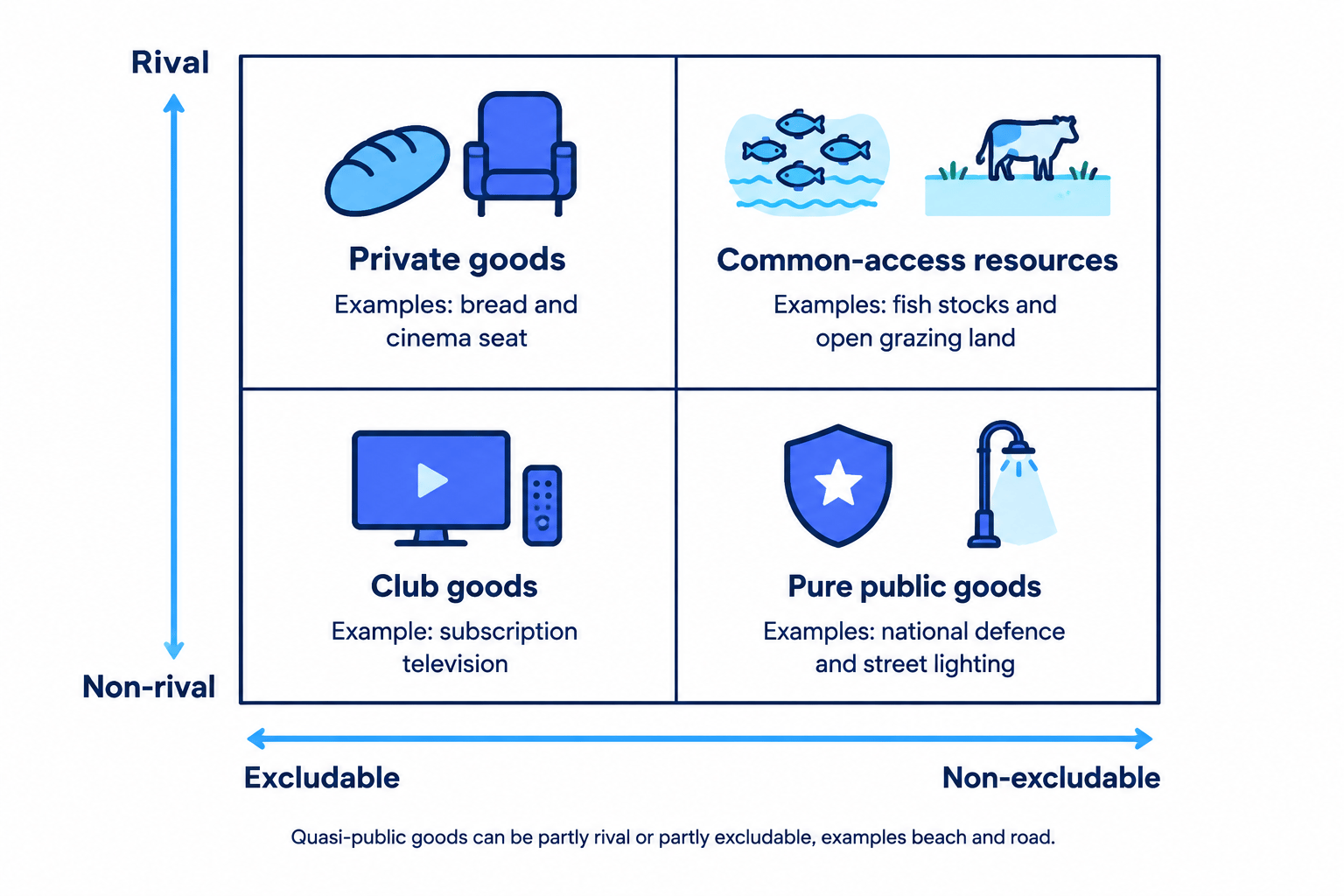
1.8.3a Public goods and quasi-public goods
Public Goods Are Non-Rival and Non-Excludable, so the Market Fails to Provide Them
Definition
Public good: a good that is both non-rival and non-excludable in consumption, so the free market fails to provide it and it must usually be provided by the state.
- A public good has two features: non-rivalry and non-excludability.
- Non-rivalry means one person's use does not reduce what is left for others.
- Non-excludability means people cannot be stopped from consuming it.
Note
- Because non-payers cannot be excluded, they can free-ride.
- Profit-seeking firms will not supply the good, so the market is missing.
Public Goods Range From Pure to Quasi-Public
- Pure public goods
- Fully non-rival and non-excludable, such as national defence.
- Quasi-public goods
- Only partly non-rival or excludable, such as roads or beaches.
- A private good, by contrast, is both rival and excludable.
Example
- Street lighting benefits everyone and cannot be switched off for non-payers.
- A beach is a quasi-public good, since it can get crowded and access can be limited.
Technological Change Can Turn a Public Good Excludable
- New technology can make it easier to exclude non-payers, for example through metering or digital access.
- This can turn a good the state once provided into one markets can supply.
- Television broadcasting, for example, is now excludable through encryption and subscription.
- The public good nature of a good is therefore not fixed.
Example
- Toll technology lets firms charge for roads that were once free to all.
- Digital paywalls make excludable what open broadcasts once were not.
Pure Public Goods Need State Provision; Quasi-Public Goods May Not
- The free-rider problem does block private provision of pure public goods.
- But technology can make some goods excludable, shrinking the problem.
- On balance, pure public goods need state provision, while quasi-public goods may not.
The Missing Market Prevents Any Price From Forming
- Because non-payers cannot be excluded, no one has an incentive to reveal how much they would truly pay for the good.
- Without a genuine willingness-to-pay signal, firms cannot estimate demand or set a viable price.
- The result is not simply under-provision but a missing market, since profit-seeking firms supply none of the good at all.
- Governments therefore use methods such as cost-benefit analysis to estimate the value of provision and fund it from general taxation.
Example
- Flood defences protect a whole floodplain at once; a household that declined to pay could not be excluded from the protection, so schemes are funded by government and local levies rather than sold in a market.
- This is why UK street lighting and flood defence are financed through local taxation and government spending rather than by private firms charging individual users.
Test Every Good Against Non-Rivalry and Non-Excludability
Exam technique
- Test a good against non-rivalry and non-excludability before labelling it.
- Link non-excludability directly to the free-rider problem.
Common Mistake
- Do not call any government-provided good a public good.
- The label depends on the technical features, not on who supplies it.
Self review
- Name the two characteristics of a public good.
- What is the free-rider problem?
- Distinguish a pure from a quasi-public good.
- Why will the market fail to provide a pure public good?
1.8.3b The free-rider problem and the commons
The Free-Rider Problem Stops Markets Providing Public Goods
Definition
Free-rider problem: the situation where people can consume a good without paying for it because it is non-excludable, so private firms have no incentive to provide it and the market fails.
- The free-rider problem arises when people can enjoy a good without paying for it.
- Because non-payers cannot be excluded, each person has an incentive to let others pay.
- Profit-seeking firms cannot then cover their costs, so the good is under-provided or missing.
Missing Property Rights Cause the Tragedy of the Commons
- Externalities often arise because property rights are absent or poorly defined.
- When no one owns a resource, no one bears the full cost of using it.
- The result is over-use, known as the tragedy of the commons.
Note
- Missing property rights mean the cost of over-use falls on everyone, not the user.
- Assigning or extending property rights is one way to internalise the problem.
Shared Costs and Private Gains Drive Over-Use of the Commons
- Each user gains the full private benefit of taking a little more.
- The cost is shared across everyone, so each user ignores most of it.
- Everyone follows the same logic, and the resource is depleted.
Example
- Over-fishing drains shared fish stocks because no boat owns the sea.
- The atmosphere is treated as a free dump for emissions for the same reason.
Property Rights Help but Rarely Solve the Global Commons
- Assigning property rights can make users bear the true cost of their actions.
- But rights are hard to define for the air, the oceans or global fisheries.
- Enforcement across borders is often weak or absent.
- On balance, clearer property rights help, but they rarely solve the global commons on their own.
A Numerical Example Shows Why Shared Costs Cause Over-Use
- Suppose ten trawlers share an open-access fishing ground with no ownership rights.
- Catching one more tonne of fish earns a trawler the full private benefit, say £2,000\pounds 2{,}000£2,000.
- That extra tonne also depletes breeding stock, cutting future total catches by £1,000\pounds 1{,}000£1,000 in value, a cost shared equally across all ten trawlers.
- Each trawler bears only 110\dfrac{1}{10}101 of that cost, around £100\pounds 100£100, so catching the extra tonne still looks worthwhile privately even though the true cost is spread across everyone.
- Because every trawler reasons the same way, the fishing ground is over-exploited until stocks collapse, which is the tragedy of the commons expressed in numbers.
Example
- This is why the UK manages fishing through quotas, such as individual transferable quotas (ITQs), which cap the total catch and assign tradeable rights to a share of it.
- A quota effectively creates a limited property right, so a boat that holds back today keeps its claim on future catches instead of losing that share to a rival.
Explain the Missing Property Right, Then the Over-Use It Causes
Exam technique
- Explain the missing property right first, then the over-use it causes.
- Name a real shared resource such as fish stocks or the atmosphere.
Common Mistake
- Do not treat the commons problem as separate from externalities.
- It is a cause of them, arising when property rights are missing.
Self review
- What is the free-rider problem?
- Why do missing property rights cause externalities?
- Explain the tragedy of the commons.
- Give an example of a common-access resource.
- How can property rights help, and why are they not a full fix?