A Union Can Raise Wages Through Collective Bargaining
Definition
Trade union: an organised association of workers that bargains collectively with employers to raise wages and improve working conditions.
- A trade union acts as a monopoly seller of labour.
- Through collective bargaining it can raise wages above the competitive level.
- In a competitive market, a higher union wage tends to cut employment.
Note
- In a competitive market, a wage rise moves up the demand curve, cutting jobs.
- Against a monopsonist, a union can raise the wage and employment together.
Union Effects Differ in Competitive and Monopsony Markets
- In a competitive market, a union wage above equilibrium reduces jobs.
- Against a monopsony, a union can offset the employer's power.
- There a union can push both the wage and employment towards the competitive level.
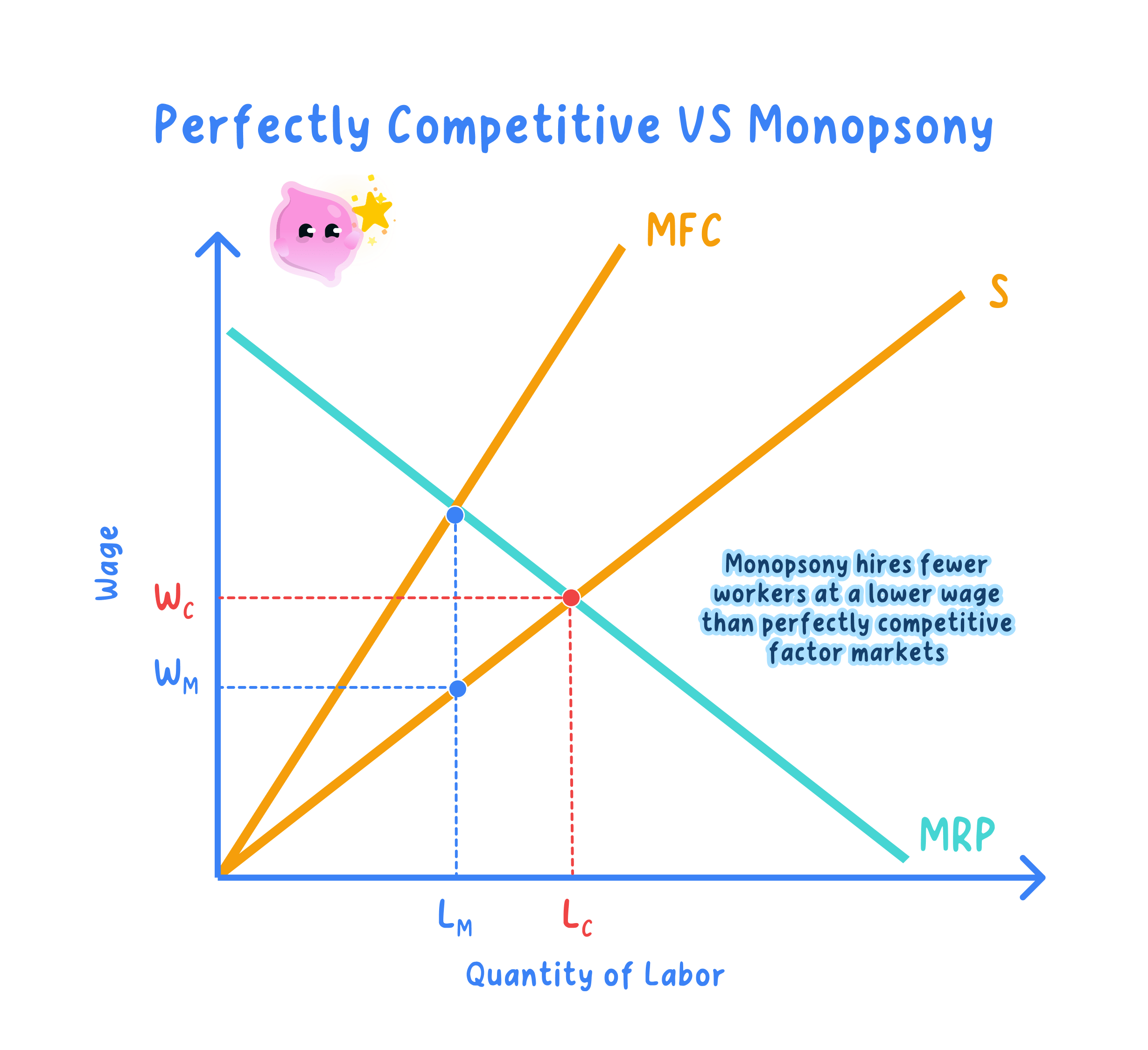
Example
- A union in a competitive trade may raise pay but cost some jobs.
- A union facing one dominant employer can lift pay without cutting jobs.
Density, the Law and Elasticity Decide Union Power
- Membership density and the legal framework shape bargaining power.
- The more inelastic labour demand, the smaller the job loss from a wage rise.
- A firm's profitability also affects how much it can concede.
Always Show Both Cases
Exam technique
- Give the competitive case and the monopsony case with diagrams.
- Link the job effect to the elasticity of labour demand.
Common Mistake
- Do not assume unions always cut employment.
- Against a monopsony, a union can raise the wage and employment together.
Worked Example: A Union in a Competitive Labour Market
- Retail assistants in a competitive local labour market earn the market-clearing wage of £11\pounds 11£11/hour, with 2,0002{,}0002,000 employed.
- A union negotiates a wage floor of £13\pounds 13£13/hour, an 18%18\%18% rise.
- At £13\pounds 13£13/hour, employers move up their labour demand curve and only wish to employ 1,7001{,}7001,700 assistants, a fall of 300300300 jobs (15%15\%15%).
- At the same wage, 2,2002{,}2002,200 workers move along the supply curve and now want a job, creating an excess supply (a queue of unemployed applicants) of 500500500 workers.
Worked Example: A Union Against a Monopsony Employer
- A regional logistics firm is the only major employer of delivery drivers in its area, a monopsonist paying £10\pounds 10£10/hour and employing 300300300 drivers.
- The competitive wage and employment level, where supply would meet demand, is £12\pounds 12£12/hour and 340340340 drivers.
- A drivers' union negotiates a wage floor of £12\pounds 12£12/hour, matching the competitive wage.
- The firm must now pay £12\pounds 12£12/hour to hire any driver, removing its incentive to restrict hiring to hold down the wage bill, so employment rises to 340340340: both the wage (£10→£12\pounds 10 \rightarrow \pounds 12£10→£12) and employment (300→340300 \rightarrow 340300→340) increase together.
Example
- This is the key exam evaluation point: raising the union wage up to the competitive level removes monopsony exploitation without costing jobs.
- If the union instead pushed for £14\pounds 14£14/hour, above the £12\pounds 12£12 competitive rate, the firm would move up its MRP (demand) curve and cut employment back below 340340340, just as in a competitive market.
- So the beneficial win-win outcome only holds up to the competitive wage; beyond that, further rises trade off pay against jobs even against a monopsonist.
Describing the Two Union Diagrams
- Competitive case: draw D and S crossing at the equilibrium wage, then add a horizontal line at the higher union wage; where this line crosses D gives the lower quantity demanded, and where it crosses S gives the higher quantity supplied, with the horizontal gap between the two showing the excess supply of labour (unemployment or a queue of applicants).
- Monopsony case: draw S, the steeper MCL curve above it, and the downward-sloping D (= MRP) curve; without a union, employment is where MCL meets MRP and the wage is read down to S, below the competitive level.
- Adding a union wage floor at the competitive wage makes the effective supply and MCL curves horizontal at that wage up to where the floor meets the original S curve, after which the original upward-sloping S and MCL resume; employment then rises to where this floor meets MRP, at the competitive level.
Case study
- UK trade union membership has fallen from around half of employees in 1980 to roughly a fifth today, reducing bargaining power in most private-sector labour markets.
- Unions remain strong in sectors with large, near-monopsony employers, such as rail (RMT, ASLEF negotiating with train operators) and the NHS, where the Agenda for Change pay talks and national pay review bodies function much like collective bargaining against a dominant employer.
Self review
- How does a union act in the labour market?
- Why can a union wage cut jobs in a competitive market?
- How can a union raise employment against a monopsony?
- Name two factors that affect union bargaining power.
- In the retail worked example, recalculate the excess supply of labour if the union wage instead pushed employment down to 1,6001{,}6001,600 while 2,1002{,}1002,100 workers wanted jobs.
- Using the delivery driver example, explain why a union wage of £12\pounds 12£12 raises both pay and jobs, but a union wage of £14\pounds 14£14 would not.
- Describe, in words, how a union wage floor changes the effective supply and MCL curves facing a monopsonist.
