A Monopsonist Pays Below the Competitive Wage
Definition
Monopsony: a labour market with a single dominant buyer of labour, giving the employer the market power to pay a lower wage rate and employ fewer workers than would occur in a perfectly competitive labour market.
- A monopsony is a labour market with a single, or dominant, buyer of labour.
- It faces an upward-sloping labour supply curve.
- So its marginal cost of labour lies above the supply curve.
Note
- To hire one more worker, the monopsonist must raise the wage for all.
- So the marginal cost of labour exceeds the wage on the supply curve.
The Monopsonist Employs Where MCL Equals MRP
- The monopsonist employs where the marginal cost of labour equals MRP.
- It then pays the lower wage read off the supply curve.
- So both the wage and employment are below the competitive level.
Example
- A single large employer in a town can hold the wage below the competitive rate.
- With few rival employers, workers have little choice but to accept it.
Read the Wage Down to the Supply Curve
- Draw the supply, marginal cost of labour and MRP curves.
- Set employment where marginal cost of labour meets MRP.
- Read the wage down to the supply curve, below the competitive wage.
Imperfect Information Is a Further Source of Labour Market Imperfection
- When workers lack full information about pay and job vacancies, or employers lack full information about worker productivity, labour is misallocated and wages can settle above or below the competitive rate.
- Imperfect information reduces the mobility of labour, because workers cannot easily find or move to the jobs that would pay them the most.
- This weakens the operation of market forces, so wages no longer reliably reflect the marginal revenue product of labour.
Note
- For example, a worker unaware of a better-paid vacancy nearby may stay in a lower-paid job, holding their wage below its competitive level.
- Together with monopsony power and trade unions, imperfect information is one of the reasons real labour markets depart from the competitive model.
Read the Wage off the Supply Curve
Exam technique
- Set employment where marginal cost of labour equals MRP.
- Read the wage down to the supply curve, not at the MRP intersection.
Common Mistake
- Do not set the wage where marginal cost of labour meets MRP.
- The wage is read off the supply curve, below that point.
Common Mistake
- Do not confuse monopsony with monopoly: monopsony is buyer power in a factor market (one dominant employer buying labour), while monopoly is seller power in a product market (one dominant firm selling output).
- A firm can be a monopsonist in the labour market while facing plenty of competition when it sells its product, and vice versa.
Worked Example: Monopsony Wage and Employment
- A remote quarry is the only significant employer of manual labour in its town, so it is a monopsonist.
- Its labour supply schedule shows 100100100 workers willing to work for £8\pounds 8£8/hour, 120120120 workers for £9\pounds 9£9/hour, and 140140140 workers for £10\pounds 10£10/hour.
- The total wage bill (wage ×\times× workers) is £800\pounds 800£800 at 100100100 workers, £1,080\pounds 1{,}080£1,080 at 120120120 workers, and £1,400\pounds 1{,}400£1,400 at 140140140 workers.
- The marginal cost of labour (MCL) for the extra 202020 workers === change in wage bill ÷\div÷ change in workers: (£1,080−£800)÷20=(\pounds 1{,}080 - \pounds 800) \div 20 =(£1,080−£800)÷20= £14\pounds 14£14 to move from 100100100 to 120120120 workers, and (£1,400−£1,080)÷20=(\pounds 1{,}400 - \pounds 1{,}080) \div 20 =(£1,400−£1,080)÷20= £16\pounds 16£16 to move from 120120120 to 140140140 workers.
- Because MCL (£14\pounds 14£14, £16\pounds 16£16) always exceeds the wage needed to attract those workers (£9\pounds 9£9, £10\pounds 10£10), the MCL curve lies above the supply curve, exactly as the monopsony model predicts.
Example
- Suppose the quarry's MRP of labour equals £14\pounds 14£14 at 120120120 workers: it maximises profit by hiring 120120120 workers, where MCL=MRP\text{MCL} = \text{MRP}MCL=MRP, and pays only £9\pounds 9£9/hour, the wage read off the supply curve, even though the 120th worker is worth £14\pounds 14£14 to the firm.
- If this had instead been a competitive market with many quarries bidding for workers, competition would have pushed the wage up towards £10\pounds 10£10/hour and employment up towards 140140140 workers, the point where supply meets demand.
- So the monopsonist pays a lower wage (£9\pounds 9£9 vs £10\pounds 10£10) and employs fewer workers (120120120 vs 140140140) than a competitive market would produce.
Describing the Monopsony Diagram
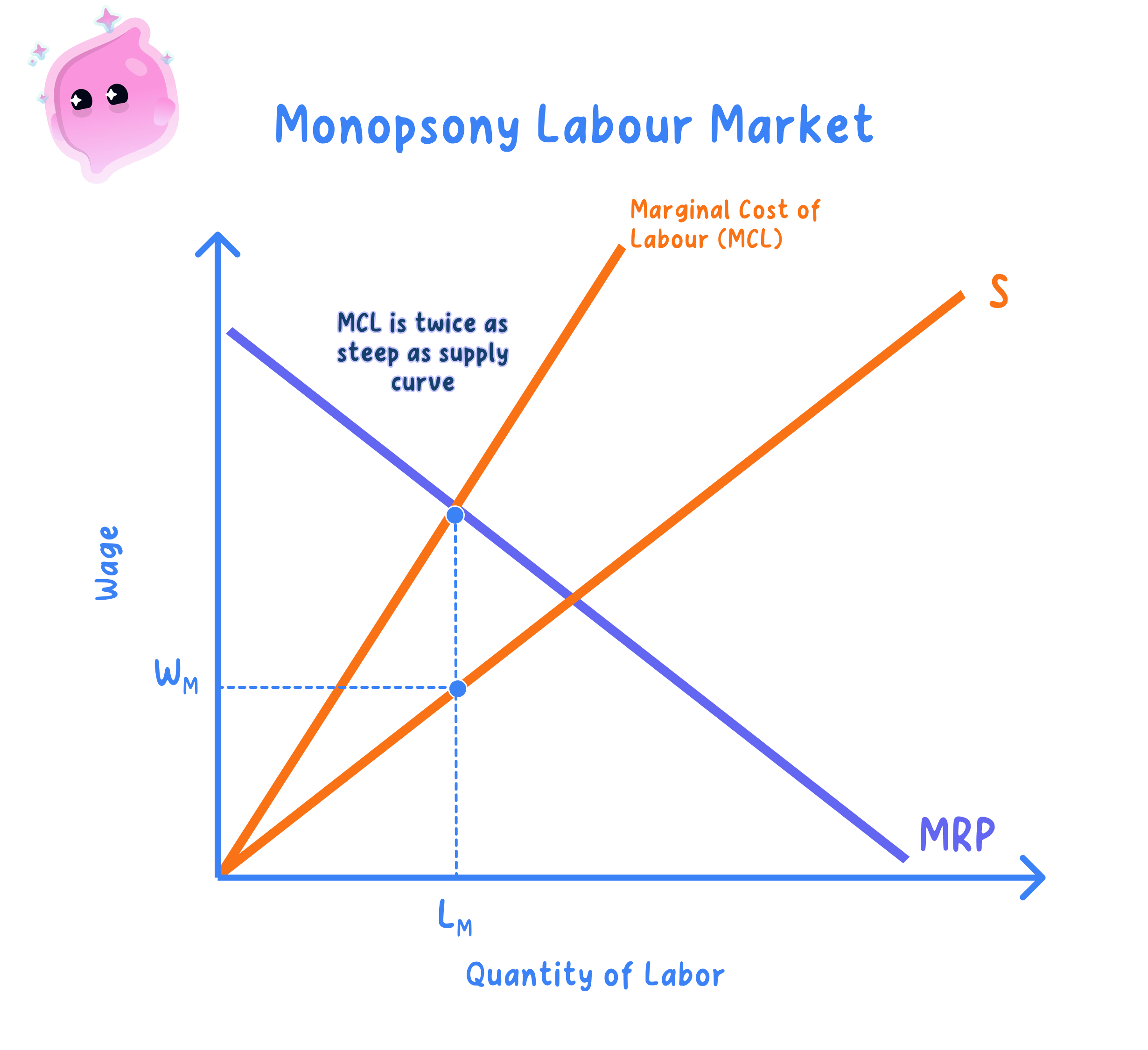
- The vertical axis measures the wage rate (W) and the horizontal axis measures the quantity of labour (QL).
- Draw the upward-sloping supply curve (S) and, above it, the steeper marginal cost of labour curve (MCL), since hiring one more worker forces the firm to raise pay for every existing worker too.
- Add the downward-sloping demand curve (D = MRP); the monopsony employment level Qm is where MCL crosses MRP, above and to the left of the competitive employment level Qc, where S would cross D.
- From Qm, draw a vertical line down to the supply curve (not to the MCL or MRP curves) to read off the monopsony wage Wm, which sits below the competitive wage Wc.
- The rectangle between Wm and the MRP curve up to Qm can be shaded to show the monopsonist's gain from paying workers less than the value of what they produce.
Trade Unions Are Another Source of Labour Market Imperfection
- A trade union that bargains a single wage on behalf of its members can turn the labour supply facing an employer effectively horizontal at that negotiated wage, much like a minimum wage.
- This gives workers collective bargaining power they would lack individually, allowing the union to push the wage above what an unorganised competitive market would set.
- The effect on employment depends on the market: in a competitive market a union wage above equilibrium creates unemployment, but against a monopsonist a union wage can raise both the wage and employment together, up to the point where the negotiated wage equals MRP.
Case study
- Historically, single-employer colliery or mill towns in the UK matched the monopsony model closely, since workers had few alternative local employers.
- Modern examples include the NHS as the dominant employer of nurses in many local labour markets, and a single large factory or warehouse as the main employer in a small town, where trade union recognition can help offset employer wage-setting power.
Self review
- Define a monopsony.
- Why does the marginal cost of labour exceed the wage?
- Where does the monopsonist set employment?
- How is the monopsony wage read from the diagram, and why is it below the competitive wage?
- How does imperfect information contribute to imperfections in a labour market?
- In the quarry worked example, if MRP at 100100100 workers was £14\pounds 14£14 instead, would the profit-maximising employment level be higher or lower than 120120120, and why?
- Explain why a trade union can raise both the wage and employment when bargaining against a monopsonist, but not in a competitive labour market.
- Explain the difference between monopsony and monopoly.
